
15 Hidden Golf Slice Correction Mistakes You Must Avoid
Golf Slice Correction Mistakes That Destroy Consistency
Introduction
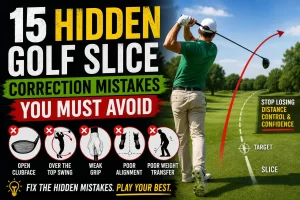
If you’ve been battling a slice for months—or even years—you’re not alone. The golf slice is one of the most common problems golfers face, and it’s also one of the most frustrating. Many players spend countless hours on the driving range searching for the perfect golf slice correction method, only to watch shot after shot curve dramatically off target. The result is often lower confidence, higher scores, and the feeling that no matter how much you practice, the slice keeps coming back.
One reason golfers struggle with slices for so long is that they are constantly exposed to conflicting advice. A quick search online will reveal thousands of articles and videos promising to help you fix a golf slice overnight. Some instructors recommend strengthening your grip, while others focus on swing path, ball position, or weight transfer. While many of these tips can be helpful, they often address only a small part of the problem rather than the underlying cause. This is why many golfers experience temporary improvements but never achieve lasting results.
Another major issue is that golfers frequently focus on symptoms instead of root causes. For example, if the ball curves sharply to the right for a right-handed golfer, the obvious symptom is the curve itself. However, the real problem may be poor clubface control, an improper golf swing path, faulty setup fundamentals, or an over the top swing. Without identifying what actually creates the slice, golfers often waste years practicing the wrong drills and making ineffective swing changes.
Understanding the true causes of a slice starts with learning basic ball flight laws. Modern golf instruction has shown that the relationship between the clubface and swing path at impact largely determines the direction and curvature of the golf ball. Effective golf slice correction focuses on improving these impact conditions rather than chasing random swing tips. When you understand how the clubface and swing path work together, you can begin making meaningful improvements that produce straighter and more consistent shots.
In this guide, we’ll uncover 15 hidden golf slice correction mistakes that many golfers never realize they’re making. These include common golf slice correction mistakes to avoid such as ignoring clubface control, practicing the wrong drills, swinging over the top, misunderstanding ball position, and failing to address the true root cause of the problem. By recognizing these hidden golf slice correction mistakes, you’ll gain a clearer understanding of how to fix a golf slice correctly and build a swing based on sound golf swing fundamentals.
Let’s begin by looking at what actually causes a golf slice in the first place.
11 Ultimate Fixes: The Easiest Way to Stop Slicing the Golf Ball
What Causes a Golf Slice in the First Place?
If you’re searching for an effective golf slice correction strategy, the first step is understanding exactly what causes a slice. Many golfers assume a slice is simply the result of a bad swing, but the reality is much more specific. Modern golf instruction and ball flight laws have revealed that slices are created by a combination of clubface position, swing path, and impact conditions. Once you understand these factors, it becomes much easier to identify the real cause of your miss and learn how to fix a golf slice correctly.
Understanding Ball Flight Laws
One of the biggest breakthroughs in modern golf instruction is the understanding of ball flight laws. These laws explain how the clubface and swing path work together to determine the direction and curvature of the golf ball.
The clubface has the greatest influence on where the ball initially starts. In simple terms, the ball tends to begin its flight in the direction the clubface is pointing at impact. If the face is open relative to the target, the ball will often start right of the intended line.
The second factor is the relationship between the clubface and the golf swing path. When the swing path travels left of the clubface at impact for a right-handed golfer, the ball curves further to the right. This combination creates the classic slice that so many golfers struggle with.
Many golfers also misunderstand the concept of side spin. Modern launch monitor data has shown that the ball doesn’t simply spin sideways. Instead, the tilt of the spin axis created by the face-to-path relationship causes the ball to curve. This is why effective golf slice correction focuses on improving impact conditions rather than trying to manipulate the ball in flight.
The Three Main Causes of a Slice
While there are many swing flaws that can contribute to a slice, most golf slice mistakes can be traced back to three primary causes.
Open Clubface
An open clubface is one of the most common reasons golfers slice the ball. When the clubface points right of the target at impact, the ball starts right and often continues curving farther right. Improving clubface control is often the fastest way to reduce excessive curvature.
Outside-to-Inside Swing Path
An outside-to-inside swing path, often called an over the top swing, occurs when the club approaches the ball from outside the target line and cuts across it. This path creates the conditions that produce slice spin and weak ball flights.
Poor Impact Conditions
Even golfers with a decent swing can slice the ball if they deliver the club poorly at impact. Improper weight transfer, poor body sequencing, and inconsistent contact can all contribute to the problem.
Why Quick Fixes Usually Fail
Many golfers spend years chasing quick fixes that promise immediate results. Unfortunately, most of these solutions only create temporary improvements because they fail to address the true root cause of the slice.
For example, strengthening the grip may help one golfer but do very little for another whose primary issue is an over the top swing. Similarly, changing ball position might reduce a slice temporarily while leaving the underlying swing mechanics unchanged.
This is one of the biggest golf slice correction mistakes to avoid. Lasting improvement requires understanding why the slice occurs rather than simply masking the symptoms. Successful golfers focus on long-term golf swing fundamentals, including proper setup, efficient body movement, sound clubface control, and a consistent inside out swing path.
As you’ll see throughout this guide, many of the hidden golf slice correction mistakes golfers make stem from treating symptoms rather than causes. The key to learning how to fix a golf slice correctly is identifying the specific factors creating your slice and building a solution around those fundamentals.
Mistake #1 – Ignoring Clubface Control
One of the most common yet overlooked golf slice correction mistakes to avoid is ignoring clubface control. Many golfers spend countless hours trying to change their swing mechanics without realizing that the position of the clubface at impact plays a major role in determining where the ball goes. In fact, many players who struggle to fix a golf slice are fighting an open clubface more than any other swing flaw.
Why an Open Clubface Creates a Slice
According to modern ball flight laws, the clubface has the greatest influence on the ball’s starting direction. When the clubface is open relative to the target at impact, the ball typically starts to the right for a right-handed golfer. If the clubface is also open relative to the swing path, the ball will curve even farther right, producing the familiar slice.
Many golfers mistakenly believe their slice is caused entirely by their golf swing path, but an open clubface is often the biggest contributor. You could improve your swing path dramatically, but if the clubface remains open at impact, the slice may still persist. This is why effective golf slice correction requires attention to both face and path.
Common Signs of Poor Clubface Control
Several indicators suggest that poor clubface control may be causing your slice:
- Shots consistently start right of the target.
- The ball curves farther right during flight.
- Weak, glancing contact with reduced distance.
- Difficulty squaring the clubface with longer clubs.
- Frequent misses with the driver.
These are some of the most common golf slice mistakes recreational players make. Many golfers attempt to compensate by aiming left, but this only masks the problem instead of fixing it.
How to Improve Clubface Awareness
The first step toward better clubface control is becoming aware of what the clubface is doing during the swing. Many golfers have no idea whether the face is open, closed, or square at impact.
A few simple ways to improve awareness include:
- Practicing slow-motion swings while monitoring face position.
- Using alignment sticks to verify target alignment.
- Recording your swing on video.
- Working on grip fundamentals to encourage a square clubface.
- Hitting short shots while focusing on face control rather than distance.
Developing better clubface awareness is often one of the fastest ways to improve golf slice correction results. Before changing your entire swing, make sure you understand what the clubface is doing at impact.
Mistake #2 – Focusing Only on Swing Path
Another one of the most common hidden golf slice correction mistakes is focusing exclusively on swing path. While swing path certainly matters, many golfers become obsessed with creating an inside out swing path and overlook other critical factors that influence ball flight.
Why Swing Path Isn’t the Entire Problem
Golf instructors frequently teach players to stop coming over the top swing and start swinging more from the inside. While this can be helpful, swing path alone does not determine whether a ball slices.
For example, a golfer may develop a perfectly neutral swing path yet still hit slices if the clubface remains open. Likewise, some golfers with slightly outside-to-inside paths hit relatively straight shots because their clubface is properly aligned.
This is why focusing only on path can lead to frustration. Golfers often make major swing changes but see little improvement because the real issue lies elsewhere.
Face-to-Path Relationship Explained
The key concept many golfers miss is the face-to-path relationship. This relationship describes how the clubface and swing path interact at impact.
A slice occurs when:
- The clubface is open relative to the swing path.
- The swing path travels left of where the face is pointing.
- The resulting spin axis tilts to the right.
Even if you develop a better inside out swing path, the ball can still curve right if the face remains open. Conversely, a square clubface paired with a slightly outside path may produce only a small fade.
Understanding this relationship is one of the most important aspects of how to fix a golf slice correctly.
Better Golf Slice Correction Strategies
The best golf slice correction strategies focus on both clubface control and swing path rather than treating them as separate issues.
Effective approaches include:
- Improving grip fundamentals.
- Monitoring clubface position throughout the swing.
- Creating a more neutral or slightly inside-out path.
- Improving body rotation and sequencing.
- Using video feedback to verify changes.
- Practicing drills that promote both face and path improvements.
Many golfers waste years chasing swing path fixes alone. By addressing the complete face-to-path relationship, you’ll avoid one of the biggest golf slice correction mistakes to avoid and dramatically increase your chances of hitting straighter, more consistent shots.
Best Golf Training Program For Beginners: Why Most Golfers Never Improve
Mistake #3 – Swinging Harder to Fix a Slice
One of the most frustrating golf slice mistakes golfers make is trying to swing harder in an effort to straighten the ball flight. It seems logical at first. Many players believe that if they simply generate more power, they can overpower the slice or force the ball to fly straighter. Unfortunately, the opposite is usually true. Swinging harder often exaggerates the very flaws that create a slice in the first place, making effective golf slice correction even more difficult.
Why More Speed Often Makes Things Worse
When golfers try to increase swing speed without improving their mechanics, they typically lose control of the clubface and swing path. The harder they swing, the more difficult it becomes to square the clubface at impact.
Many slicers already struggle with an open clubface and an over the top swing. Adding more speed often causes the upper body to dominate the downswing, making the club approach the ball from outside the target line. This creates an even steeper outside-to-inside path and increases the likelihood of producing slice spin.
Another problem is that excessive effort creates tension throughout the body. Tight muscles reduce flexibility and make it harder to execute a smooth, repeatable motion. Instead of improving clubface control, golfers often find themselves hitting weaker shots that curve even farther offline.
Loss of Balance and Timing
A powerful golf swing depends on proper sequencing, not brute force. When golfers swing too hard, balance and timing frequently break down.
Common signs include:
- Falling backward or forward after impact.
- Rushing the transition from backswing to downswing.
- Pulling the club down with the shoulders.
- Inconsistent contact quality.
- Difficulty repeating the same swing.
These issues often lead to poor impact conditions and make golf slice correction mistakes to avoid even more difficult to identify. Golfers become focused on speed rather than understanding why the ball is curving.
Poor timing can also disrupt the relationship between the clubface and the golf swing path. Even a small timing error can leave the face open at impact, producing a slice despite good intentions.
How Controlled Tempo Improves Accuracy
Many of the best ball strikers in golf are known for their rhythm and tempo rather than maximum effort. A controlled swing allows the body, arms, and club to work together more efficiently.
Improving tempo can help:
- Increase clubface control.
- Improve consistency of contact.
- Promote better balance.
- Create a more efficient inside out swing path.
- Reduce tension throughout the swing.
One of the best ways to improve tempo is to swing at approximately 75–85% effort during practice sessions. Focus on making solid contact and maintaining balance through the finish. As your mechanics improve, speed will naturally increase without sacrificing accuracy.
If you’re serious about how to fix a golf slice correctly, remember that better sequencing and tempo almost always outperform raw effort.
Mistake #4 – Using a Weak Golf Grip
Among all the hidden golf slice correction mistakes, a weak golf grip is one of the most common. Many golfers unknowingly place their hands on the club in a position that makes it extremely difficult to square the clubface at impact. Even with a good swing path, a weak grip can leave the face open and cause the ball to curve dramatically to the right.
How Grip Influences Clubface Position
Your grip is the only connection you have with the golf club, so it plays a critical role in controlling the clubface.
A weak grip generally means the hands are rotated too far toward the target side. For a right-handed golfer, this often results in seeing very few knuckles on the lead hand when looking down at address.
This grip position tends to encourage an open clubface during the downswing and at impact. As a result, golfers often struggle with:
- Consistent clubface control.
- Weak fades and slices.
- Reduced distance.
- Poor compression at impact.
Many golfers attempt complicated swing changes when a simple grip adjustment could significantly improve their golf slice correction efforts.
Signs Your Grip May Be Too Weak
Several common indicators suggest your grip may be contributing to your slice:
- Shots consistently start right of the target.
- The ball curves excessively to the right.
- Difficulty releasing the club through impact.
- Weak ball flights with limited distance.
- Frequent slices with the driver.
These symptoms are often mistaken for swing path issues, but in many cases the grip is the primary culprit.
Because grip influences the clubface throughout the swing, it is one of the first areas that should be evaluated when trying to fix a golf slice.
Simple Grip Adjustments That Help
Fortunately, grip adjustments are usually easy to implement.
To strengthen your grip slightly:
- Rotate both hands slightly away from the target.
- Allow two to three knuckles of the lead hand to be visible at address.
- Position the trail hand more underneath the grip.
- Maintain light grip pressure throughout the swing.
It’s important not to overdo these changes. An excessively strong grip can create new ball flight problems, including hooks and pulls.
The goal is to create a grip that allows the clubface to return to square more naturally at impact. Combined with proper golf swing fundamentals, improved grip positioning can dramatically reduce slices and help golfers develop a more reliable inside out swing path.
For many players, correcting a weak grip is one of the fastest and most effective steps toward lasting golf slice correction success.
Many golfers spend years working on the wrong parts of their swing because they never identify the hidden mistakes causing their slice. If you’ve tried countless tips and still struggle with golf slice correction, there’s a good chance you’re focusing on symptoms instead of the real problem. Discover the simple system that helps golfers uncover the true cause of their slice inside 👉 The Golf Swing Lab Training System https://ultimategolfmasterypro.com/the-golf-swing-lab-2/
Mistake #5 – Practicing the Wrong Drills
Many golfers spend hours on the driving range working hard to improve their game, yet their slice never seems to disappear. One reason is that they’re practicing the wrong drills. This is one of the most overlooked hidden golf slice correction mistakes because golfers often assume that any drill designed to help a slice will work for everyone. In reality, effective golf slice correction depends on identifying the specific cause of your slice and choosing drills that address that problem.
Why Generic YouTube Tips Can Backfire
The internet is filled with golf instruction videos promising to help golfers fix a golf slice in minutes. While some of these tips can be valuable, many are designed for a general audience and may not address your individual swing flaws.
For example, one golfer may slice because of poor clubface control, while another may struggle with an over the top swing. If both golfers use the same drill, one might improve while the other sees little or no progress.
Another issue is information overload. Golfers often jump from one video to another, trying multiple swing thoughts during the same practice session. This creates confusion and prevents consistent improvement. Instead of building reliable golf swing fundamentals, they constantly chase quick fixes that rarely produce long-term results.
Matching Drills to Your Specific Problem
Before selecting a drill, it’s important to determine what is actually causing your slice.
Ask yourself:
- Is the clubface open at impact?
- Is my golf swing path moving outside-to-inside?
- Am I losing balance during the swing?
- Is my grip contributing to poor clubface control?
- Do I struggle with weight transfer or body rotation?
Answering these questions allows you to choose drills that target the root cause rather than the symptom.
This approach is essential for golfers who want to learn how to fix a golf slice correctly. Practicing a drill that doesn’t address your specific flaw is like trying to repair the wrong part of a machine. You may spend hours working without making meaningful progress.
Effective Golf Slice Correction Drills
Several proven drills can help improve common slice-causing issues:
Headcover Path Drill
Place a headcover just outside the target line behind the golf ball. This encourages the club to approach from the inside rather than cutting across the ball.
Half-Swing Clubface Drill
Hit short shots while focusing solely on squaring the clubface at impact. This develops better clubface control and awareness.
Alignment Stick Drill
Use alignment sticks to verify setup and swing direction. Many golfers discover their path is significantly different than they believed.
Slow Motion Transition Drill
Practice making slow swings while emphasizing proper sequencing and balance. This helps reduce the tendency to swing over the top.
The key is selecting drills that match your swing flaws and practicing them consistently over time.
Mistake #6 – Coming Over the Top
One of the most common golf slice correction mistakes to avoid is swinging over the top. This move is responsible for countless slices and is often the primary reason golfers struggle to hit straight, powerful shots. Even golfers with solid athletic ability can fight persistent slices if this swing fault remains uncorrected.
What an Over the Top Swing Looks Like
An over the top swing occurs when the club moves outside the ideal swing plane during the transition from backswing to downswing. Instead of approaching the ball from the inside, the club travels over the intended path and cuts across the ball.
Common characteristics include:
- The shoulders initiate the downswing aggressively.
- The club approaches from outside the target line.
- The swing path moves left of the target for right-handed golfers.
- Contact often feels glancing rather than solid.
Many golfers don’t realize they are coming over the top until they see their swing on video. What feels like a normal swing can often be dramatically outside the ideal plane.
Why It Creates a Slice
The reason an over-the-top move produces slices comes down to ball flight laws.
When the club cuts across the golf ball from outside to inside, the golf swing path moves left of the target. If the clubface remains open relative to that path, the ball develops a spin axis tilt that causes it to curve sharply to the right.
This combination of an outside-to-inside path and open clubface is one of the most common causes of slicing.
Golfers who come over the top often experience:
- Weak ball flights.
- Loss of distance.
- Excessive curvature.
- Inconsistent contact.
- Difficulty controlling direction.
These are classic golf slice mistakes that prevent players from reaching their potential.
How to Develop an Inside Out Swing Path
Developing an inside out swing path is one of the most effective ways to improve golf slice correction.
Start by focusing on proper sequencing during the transition. Rather than pulling the club down with your shoulders, allow the lower body to initiate the downswing.
Helpful strategies include:
- Practicing slow-motion swings.
- Using the headcover drill to encourage an inside approach.
- Improving body rotation through impact.
- Maintaining posture throughout the swing.
- Recording your swing to monitor progress.
As you develop a more efficient path and improve clubface control, you’ll begin producing straighter shots with more power and consistency.
For many golfers, eliminating the over the top swing is one of the biggest breakthroughs in learning how to fix a golf slice correctly. Combined with solid fundamentals and proper practice habits, it can dramatically improve both accuracy and confidence on the golf course.
Mistake #7 – Poor Alignment at Address
Many golfers spend hours working on their swing mechanics while completely overlooking one of the most important aspects of golf slice correction: alignment. Even a fundamentally sound swing can produce poor results if you’re not properly aligned at address. In fact, poor alignment is one of the most common golf slice correction mistakes to avoid because it often creates compensations that lead directly to slices.
How Misalignment Affects Swing Direction
Alignment influences everything that happens during the swing. If your body is aimed incorrectly at address, your brain will naturally try to guide the club toward the target during the downswing. This often causes golfers to make compensations that negatively affect their golf swing path.
For example, many slicers unknowingly aim their feet, hips, and shoulders left of the target. When this happens, the body encourages an outside-to-inside swing path, which is one of the leading causes of a slice. Even if the golfer feels like they’re swinging straight, the club is often cutting across the ball.
Poor alignment can also make clubface control more difficult. Golfers may manipulate the clubface in an attempt to compensate for their setup, creating inconsistent ball flights and making it harder to fix a golf slice permanently.
Common Setup Mistakes
Several setup errors frequently contribute to slices:
- Aiming shoulders left of the target.
- Positioning feet open at address.
- Aligning hips incorrectly.
- Standing too close or too far from the ball.
- Failing to pick a precise target.
Many golfers are surprised when they use alignment sticks and discover they have been aiming significantly left or right of their intended target for years.
These setup flaws are among the most overlooked hidden golf slice correction mistakes because they occur before the swing even begins.
Alignment Checkpoints Every Golfer Needs
Improving alignment doesn’t require a major swing overhaul. In fact, a few simple checkpoints can make a significant difference.
Before every shot:
- Select a specific target.
- Pick an intermediate target a few feet in front of the ball.
- Align the clubface first.
- Position feet parallel to the target line.
- Check that hips and shoulders are also parallel.
Using alignment sticks during practice is one of the easiest ways to verify your setup. Many golfers see immediate improvements in ball flight simply by correcting alignment issues.
Because proper alignment supports better golf swing fundamentals, it should always be part of any successful golf slice correction plan.
Mistake #8 – Neglecting Lower Body Movement
When golfers think about slicing the ball, they usually focus on the hands, arms, or clubface. However, one of the most important factors in effective golf slice correction is often overlooked: lower body movement. The lower body plays a critical role in creating power, balance, and proper sequencing throughout the swing.
Ignoring this area is one of the most common golf slice mistakes golfers make.
Why the Lower Body Matters
The golf swing is a full-body motion, not just an upper-body movement. The lower body helps initiate the downswing, transfer energy into the ball, and support proper rotation through impact.
When the lower body functions correctly, it allows the club to approach the ball on a more efficient path. This can help golfers develop an inside out swing path, improve consistency, and reduce the likelihood of slicing.
Strong lower-body movement also helps maintain balance and posture throughout the swing. Without it, golfers often compensate by relying too heavily on their arms and shoulders, which frequently leads to an over the top swing.
Common Lower Body Errors
Several lower-body mistakes commonly contribute to slices:
- Minimal weight transfer during the downswing.
- Excessive sliding instead of rotating.
- Locked or restricted hips.
- Poor balance throughout the swing.
- Starting the downswing with the upper body.
These errors often disrupt sequencing and force the club onto an outside-to-inside path.
For example, when the shoulders dominate the downswing before the lower body has a chance to move properly, the club is more likely to come over the top. This creates poor impact conditions and makes how to fix a golf slice correctly much more difficult.
Building Better Sequencing
One of the best ways to improve golf slice correction is by developing proper sequencing between the lower body and upper body.
Good sequencing generally follows this pattern:
- Complete the backswing.
- Initiate the downswing with the lower body.
- Allow the torso to rotate naturally.
- Deliver the club into impact from a more efficient path.
- Finish in balance.
A simple drill involves making slow-motion swings while focusing on shifting pressure into the lead side before the arms begin moving down. This helps train the proper sequence and encourages a more natural swing path.
Improving lower-body movement won’t eliminate every slice on its own, but it can dramatically improve the quality of your motion. Combined with better clubface control, alignment, and swing fundamentals, proper sequencing is a key part of lasting golf slice correction and one of the most effective ways to stop repeating the same mistakes year after year.
Mistake #9 – Trying Too Many Swing Changes at Once
One of the biggest obstacles to successful golf slice correction is trying to fix everything at the same time. Golfers who struggle with a slice are often eager to improve, which is understandable. However, many end up making multiple swing changes simultaneously, creating confusion and slowing their progress. This is one of the most common hidden golf slice correction mistakes because it feels productive even when it isn’t.
Information Overload in Modern Golf
Today’s golfers have access to more instruction than ever before. Between YouTube videos, social media tips, launch monitor data, golf forums, and online coaching programs, there is no shortage of information available.
The problem is that much of this advice is designed for different golfers with different swing flaws. One instructor may tell you to strengthen your grip, while another recommends changing your stance, swing path, or wrist angles. When golfers attempt to apply all of these tips at once, they often become overwhelmed.
This information overload frequently leads to inconsistent swings, poor clubface control, and an inability to identify what is actually helping or hurting performance. Instead of improving their golf swing fundamentals, golfers bounce from one swing thought to another.
Why Simplicity Produces Faster Results
The best golfers and coaches understand that meaningful improvement usually comes from focusing on one priority at a time.
For example, if your slice is primarily caused by an open clubface, improving clubface control should be your main focus before worrying about several other swing adjustments. Likewise, if you’re fighting an over the top swing, developing a better path may produce greater results than changing multiple setup variables simultaneously.
Simplicity helps golfers:
- Build confidence.
- Develop consistent movement patterns.
- Track progress more effectively.
- Avoid frustration.
- Learn how to fix a golf slice correctly.
Small improvements made consistently often outperform large changes made inconsistently.
Creating a Structured Improvement Plan
A structured plan is one of the most effective ways to improve golf slice correction.
Start by identifying the biggest contributor to your slice. This may involve:
- Recording your swing.
- Using launch monitor data.
- Working with a qualified instructor.
- Evaluating your setup and grip.
Once you’ve identified the primary issue, dedicate several practice sessions to that specific area before moving on to something new.
For example:
Week 1–2: Improve clubface control.
Week 3–4: Work on creating a more neutral swing path.
Week 5–6: Improve sequencing and balance.
This method allows you to make measurable progress while avoiding one of the most common golf slice mistakes—trying to fix everything at once.
Mistake #10 – Misunderstanding Ball Position
Ball position may seem like a small detail, but it can have a major influence on your ability to make solid contact and execute effective golf slice correction. Many golfers underestimate its importance and unknowingly place the ball in positions that encourage poor impact conditions.
Ball Position and Club Delivery
Ball position affects where the club meets the ball during the swing arc. If the ball is positioned incorrectly, it can change the relationship between the clubface and the golf swing path, leading to inconsistent ball flights.
For example, a ball positioned too far forward can encourage the clubface to remain open at impact. Conversely, a ball positioned too far back may cause other compensations that affect accuracy and consistency.
Proper ball position helps golfers:
- Improve clubface control.
- Deliver the club more efficiently.
- Strike the ball more solidly.
- Develop a more consistent swing path.
- Produce better overall ball flight.
This is why setup fundamentals are such an important part of long-term golf slice correction.
Common Driver Ball Position Errors
The driver is often the club most associated with slicing, and ball position frequently contributes to the problem.
Some common errors include:
- Positioning the ball excessively forward.
- Positioning the ball too far back.
- Changing ball position from swing to swing.
- Setting up differently on every shot.
When the ball is too far forward, golfers often struggle to square the clubface before impact. This can exaggerate slices and make it difficult to fix a golf slice effectively.
When the ball is too far back, golfers may become steep and create an outside-to-inside path, another common slice-producing pattern.
Setup Adjustments That Reduce Slices
For most golfers, the driver ball position should be near the inside of the lead heel. This allows the club to approach the ball on a more efficient path while promoting solid contact.
Additional setup adjustments that may help include:
- Maintaining proper posture.
- Aligning shoulders parallel to the target line.
- Distributing weight evenly at address.
- Checking alignment regularly.
- Keeping ball position consistent during practice.
These simple changes often improve impact conditions without requiring major swing modifications.
While ball position alone won’t solve every slice, it is one of the most important setup fundamentals. When combined with proper clubface control, improved sequencing, and a better inside out swing path, correct ball position can significantly improve your golf slice correction efforts and help you avoid one of the most common golf slice correction mistakes to avoid.
Mistake #11 – Poor Weight Transfer
Many golfers focus heavily on their hands, arms, and club position when working on golf slice correction, but overlook one of the most important elements of an efficient swing: weight transfer. Proper weight shift helps create power, consistency, and solid contact. When weight transfer breaks down, golfers often compensate with their upper body, leading to slices, weak shots, and inconsistent ball striking.
Among the many golf slice correction mistakes to avoid, poor weight transfer is one that quietly affects nearly every part of the swing.
How Weight Shift Influences Impact
A good golf swing involves shifting pressure and weight from the trail side during the backswing to the lead side during the downswing and impact.
When this movement occurs correctly, it helps:
- Promote better clubface control.
- Improve sequencing.
- Increase power without extra effort.
- Encourage a more efficient golf swing path.
- Produce more consistent impact conditions.
Proper weight transfer allows the lower body to lead the downswing while the upper body follows naturally. This sequence helps the club approach the ball from a better angle and reduces the tendency to come over the top swing.
When golfers fail to transfer weight properly, they often get stuck on their trail side, forcing the arms and shoulders to take over. This frequently results in an outside-to-inside swing path and a slice.
Signs of Improper Weight Transfer
Many golfers don’t realize they have a weight transfer problem because it can feel normal during the swing.
Common signs include:
- Falling backward after impact.
- Finishing with weight on the trail foot.
- Weak, glancing contact.
- Loss of distance.
- Frequent slices and pushes.
- Difficulty compressing the golf ball.
These symptoms often appear alongside other golf slice mistakes, making it difficult to identify the true cause without careful observation.
A golfer may spend months working on grip or swing path while the real issue is poor lower-body movement and weight shift.
Drills to Improve Movement
Improving weight transfer doesn’t require complicated swing thoughts.
One effective drill is the Step-Through Drill:
- Set up normally.
- Begin the backswing.
- As the downswing starts, step toward the target with the trail foot.
- Swing through and finish in balance.
This drill promotes proper movement toward the target and encourages the body to sequence correctly.
Another useful exercise is making slow-motion practice swings while focusing on moving pressure into the lead foot before the arms begin moving down.
Over time, these drills can improve balance, sequencing, and overall golf slice correction results.
If you’re tired of watching good rounds disappear because of one frustrating slice, now is the time to stop guessing and start following a proven improvement system. Better consistency, more confidence, and straighter ball flights all begin with understanding the true causes of your swing flaws. Take the next step toward lasting improvement with 👉 Join The Golf Swing Lab Today https://ultimategolfmasterypro.com/the-golf-swing-lab-2/
Mistake #12 – Failing to Record Your Swing
One of the most valuable tools available to modern golfers is video analysis, yet many players never use it. Instead, they rely entirely on feel and assumptions about what their swing looks like. This is one of the most costly hidden golf slice correction mistakes because what golfers feel during the swing is often very different from reality.
Why Feel Isn’t Real
A common phrase among golf instructors is, “Feel isn’t real.”
Golfers frequently believe they are making major swing changes when video shows only minor differences. For example, a player may feel as though they’re swinging dramatically from the inside when they are still producing an obvious over the top swing.
Similarly, golfers often think they’re squaring the clubface when video reveals persistent clubface control issues.
Without visual feedback, it’s easy to spend weeks or months practicing incorrect movements while believing you’re making progress.
This is one reason many golfers struggle to fix a golf slice despite putting in significant practice time.
What Video Analysis Reveals
Recording your swing provides objective feedback that can quickly identify the true causes of a slice.
Video analysis can reveal:
- An open clubface at impact.
- Poor alignment.
- Outside-to-inside swing paths.
- Faulty posture.
- Improper weight transfer.
- Sequencing issues.
- Inconsistent setup positions.
Many of the most common golf slice correction mistakes to avoid become immediately obvious when viewed on video.
Even a simple smartphone recording from down-the-line and face-on angles can provide valuable information.
Golfers are often surprised to discover that the issue they believed was causing their slice isn’t actually the primary problem.
Using Technology for Better Golf Slice Correction
Modern technology has made swing analysis easier and more affordable than ever.
Golfers can use:
- Smartphone video recordings.
- Slow-motion playback.
- Launch monitors.
- Swing analysis apps.
- Online coaching platforms.
These tools help connect swing mechanics with actual ball flight results, making it easier to understand ball flight laws and identify the specific adjustments needed for improvement.
Video analysis also helps track progress over time. Instead of relying on memory or feel, golfers can compare swings from different practice sessions and see measurable improvements.
If you’re serious about how to fix a golf slice correctly, recording your swing should become a regular part of your practice routine. The ability to see what is actually happening during the swing often accelerates improvement far more than simply hitting bucket after bucket of golf balls.
By combining video feedback with solid golf swing fundamentals, better clubface control, and a more efficient inside out swing path, you’ll be far more likely to achieve lasting golf slice correction success.
Mistake #13 – Chasing Equipment Solutions
When golfers struggle with a slice, it’s tempting to believe that a new driver, upgraded shaft, or the latest technology will solve the problem. Equipment manufacturers often promote clubs designed to reduce slices, and while these products can help in certain situations, many golfers make the mistake of relying on equipment instead of addressing the real cause of their ball flight issues.
Among all the hidden golf slice correction mistakes, chasing equipment solutions without improving swing mechanics is one of the most common.
Can Equipment Help?
The short answer is yes—equipment can help to a certain extent.
Modern drivers often include features designed to reduce slice tendencies, such as:
- Draw-biased weighting.
- Adjustable hosels.
- Higher levels of forgiveness.
- Larger sweet spots.
- Improved launch characteristics.
For golfers who already have reasonably sound mechanics, these features can provide a small advantage and help keep more shots in play.
Proper club fitting can also improve performance by matching shaft flex, club length, and clubhead characteristics to the golfer’s swing.
However, while equipment can influence ball flight, it rarely addresses the root cause of a slice.
What Equipment Can and Cannot Fix
Understanding the limitations of equipment is crucial for effective golf slice correction.
Equipment can help:
- Reduce the severity of a slice.
- Improve forgiveness on mishits.
- Increase confidence at address.
- Optimize launch and spin characteristics.
Equipment cannot fix:
- Poor clubface control.
- An over the top swing.
- Improper weight transfer.
- Faulty alignment.
- A poor golf swing path.
- Weak golf fundamentals.
Many golfers purchase multiple drivers hoping to fix a golf slice, only to discover that the same ball flight follows them from club to club. This happens because the underlying mechanics remain unchanged.
Why Technique Still Matters Most
The best long-term solution for any slice is improving technique.
Modern ball flight laws clearly show that slices are primarily caused by the relationship between the clubface and swing path at impact. No club can completely overcome poor impact conditions.
Golfers who focus on:
- Better clubface control,
- Improved sequencing,
- Proper setup fundamentals,
- A more efficient inside out swing path,
typically see far greater improvement than those who simply replace equipment.
This doesn’t mean equipment is unimportant. A properly fitted club can complement a good swing. But if you’re serious about how to fix a golf slice correctly, technique must remain the priority.
The golfers who achieve lasting golf slice correction success understand that equipment can support improvement, but fundamentals create it.
Mistake #14 – Ignoring Practice Structure
Many golfers genuinely want to improve, but their practice habits work against them. They hit bucket after bucket of balls with no clear objective, hoping repetition alone will solve their slice. Unfortunately, random practice rarely produces lasting improvement.
Ignoring practice structure is one of the most damaging golf slice correction mistakes to avoid because it slows progress and makes it difficult to identify what is actually working.
Random Practice vs Purposeful Practice
Random practice typically looks like this:
- Hitting balls without a specific goal.
- Changing swing thoughts every few shots.
- Switching clubs constantly.
- Focusing only on results rather than technique.
- Practicing without feedback.
While this may feel productive, it often reinforces the same mistakes that created the slice in the first place.
Purposeful practice, on the other hand, focuses on a specific skill or improvement area.
For example:
- Improving clubface control.
- Developing an inside out swing path.
- Working on alignment.
- Improving weight transfer.
- Building better tempo.
Purposeful practice helps golfers identify cause-and-effect relationships and accelerate their golf slice correction progress.
Building a Consistent Routine
One of the best ways to improve is to create a repeatable practice routine.
A simple structure might include:
Warm-Up (10 Minutes)
- Stretching.
- Short wedge shots.
- Tempo-focused swings.
Skill Development (20–30 Minutes)
- Focus on one specific area.
- Use drills designed to address your primary slice cause.
Transfer Training (15 Minutes)
- Alternate clubs.
- Simulate on-course situations.
- Practice target-focused shots.
Review and Reflection (5 Minutes)
- Evaluate what improved.
- Identify areas needing additional work.
This type of routine allows golfers to build strong golf swing fundamentals while avoiding common golf slice mistakes.
Tracking Progress Effectively
Many golfers struggle because they have no system for measuring improvement.
Instead of judging success solely by whether a shot curves or not, track factors such as:
- Fairways hit.
- Starting direction.
- Quality of contact.
- Clubface consistency.
- Swing path improvements.
- Practice session notes.
Keeping a simple practice journal can reveal patterns that might otherwise go unnoticed.
Video recordings, launch monitor data, and periodic swing reviews can also help measure progress objectively.
One of the biggest benefits of tracking improvement is that it keeps golfers focused on the process rather than immediate results. This mindset encourages steady development and helps prevent frustration when progress isn’t instant.
Ultimately, successful golf slice correction comes from consistent, purposeful work. Golfers who follow a structured plan and monitor their progress are far more likely to eliminate their slice and build a reliable golf swing than those who simply hit balls without a clear objective.
Mistake #15 – Not Addressing the Root Cause
After years of struggling with a slice, many golfers eventually realize that the problem isn’t a lack of effort—it’s a lack of understanding. They spend countless hours practicing, watching instructional videos, buying new equipment, and experimenting with different swing tips, yet the slice remains. This happens because they never identify the true cause of the problem.
Among all the hidden golf slice correction mistakes, failing to address the root cause is by far the most damaging. It is also the reason many golfers stay stuck for years despite their best efforts.
Symptoms vs Causes
One of the biggest mistakes golfers make is treating symptoms instead of causes.
A slice itself is a symptom. The ball curving dramatically to the right is simply the result of something happening at impact. The real cause is usually one or more of the following:
- Poor clubface control.
- An outside-to-inside golf swing path.
- An over the top swing.
- Improper weight transfer.
- Poor alignment.
- Faulty grip fundamentals.
- Inefficient sequencing.
Many golfers see the ball curve right and immediately search for a quick fix. They may adjust their aim, change their grip, or alter their stance without understanding why the slice occurs.
Effective golf slice correction starts with identifying the actual cause rather than reacting to the result.
Why Golfers Stay Stuck for Years
Most golfers don’t struggle because they lack dedication. They struggle because they repeatedly focus on the wrong things.
Common reasons golfers stay stuck include:
- Constantly changing swing techniques.
- Following generic advice that doesn’t match their swing.
- Ignoring video feedback.
- Chasing equipment solutions.
- Practicing without structure.
- Failing to understand ball flight laws.
These habits create a cycle where golfers continue repeating the same golf slice mistakes while expecting different results.
For example, a golfer may spend months trying to develop an inside out swing path when the primary issue is actually an open clubface. Another golfer may focus on grip changes when poor sequencing is causing the problem.
Without identifying the root cause, improvement becomes slow and inconsistent.
How to Fix a Golf Slice Correctly
If you truly want to learn how to fix a golf slice correctly, the goal should not be to eliminate the curve itself. The goal should be to improve the impact conditions that create the curve.
A successful golf slice correction plan should focus on:
- Understanding ball flight laws.
- Improving clubface control.
- Developing a more efficient swing path.
- Improving alignment and setup.
- Building better sequencing and weight transfer.
- Practicing with purpose.
- Tracking progress through video and feedback.
When golfers focus on fundamentals rather than quick fixes, they often experience faster and more lasting improvement.
The slice isn’t the problem—it’s the result of a problem. Once you identify and fix the root cause, the slice usually begins to disappear naturally.
Proven Golf Slice Correction Checklist
Before every practice session, use this checklist to evaluate the key fundamentals that influence ball flight.
Clubface Control Checklist
✔ Is my grip positioned correctly?
✔ Can I consistently return the clubface square at impact?
✔ Do my shots start close to the target line?
✔ Am I monitoring clubface position during practice?
✔ Have I used video to verify face control?
Swing Path Checklist
✔ Am I avoiding an over the top swing?
✔ Is the club approaching from a neutral or slightly inside out swing path?
✔ Am I maintaining proper posture throughout the swing?
✔ Is my transition smooth and balanced?
✔ Have I verified my path using video or alignment aids?
Setup and Alignment Checklist
✔ Is the clubface aligned to the target first?
✔ Are my feet, hips, and shoulders parallel to the target line?
✔ Is my ball position appropriate for the club I’m using?
✔ Am I maintaining athletic posture at address?
✔ Have I selected a precise target before every shot?
Practice Checklist
✔ Do I have one specific focus for today’s practice session?
✔ Am I working on the root cause rather than symptoms?
✔ Am I using drills that match my swing flaw?
✔ Have I recorded swings for feedback?
✔ Am I tracking progress over time?
By consistently reviewing these fundamentals, you’ll avoid the most common golf slice correction mistakes to avoid and create a clear roadmap for improvement. Most importantly, you’ll stop chasing temporary solutions and begin building the kind of repeatable, reliable golf swing that produces straighter shots and lower scores.
Slices – How to Stop Slicing Golf Balls Right https://www.golfdistillery.com/shot-errors/how-to-fix-slice/
Final Thoughts on Golf Slice Correction
Fixing a slice can feel like one of the most challenging tasks in golf, especially if you’ve been battling it for years. However, as you’ve seen throughout this guide, successful golf slice correction isn’t about finding a magical swing tip or purchasing the latest piece of equipment. It’s about understanding what causes the slice, identifying the mistakes that are holding you back, and focusing on the fundamentals that create solid, repeatable ball striking.
The good news is that every golfer can improve. Whether you’re a beginner who recently started playing or an experienced golfer who has struggled with a slice for decades, the path to straighter shots begins with understanding the root causes of your ball flight.
The Biggest Takeaways
The most important lesson from these 15 hidden golf slice correction mistakes is that slices are usually the result of multiple factors working together. Rarely is there a single flaw responsible for every miss.
Some of the biggest takeaways include:
- An open clubface is often a major contributor to slices.
- The relationship between the clubface and golf swing path determines ball curvature.
- Poor alignment can create swing compensations.
- An over the top swing frequently produces an outside-to-inside path.
- Proper weight transfer and sequencing are critical for consistent impact.
- Random practice often slows improvement.
- Understanding ball flight laws makes improvement easier.
Most importantly, lasting improvement comes from addressing causes rather than symptoms. Many golfers spend years fighting the curve of the ball instead of fixing the underlying issue that creates it.
Focus on Fundamentals First
If there’s one piece of advice that applies to every golfer, it’s this: focus on fundamentals before chasing advanced swing concepts.
Strong golf swing fundamentals provide the foundation for effective golf slice correction. Before worrying about complicated swing positions, make sure you have:
- A functional grip.
- Proper alignment.
- Consistent ball position.
- Good posture.
- Reliable clubface control.
- Balanced movement throughout the swing.
These fundamentals may not seem exciting, but they are often the difference between golfers who struggle with slices and golfers who hit consistent shots.
Many of the most common golf slice mistakes occur because golfers skip these basics and immediately search for advanced solutions.
Building a Repeatable Golf Swing
The ultimate goal of how to fix a golf slice correctly isn’t simply eliminating one bad shot pattern. The goal is building a repeatable golf swing that produces consistent results under pressure.
A repeatable swing is built through:
- Consistent setup routines.
- Purposeful practice sessions.
- Ongoing feedback and video analysis.
- Incremental improvement rather than drastic changes.
- Patience and commitment to the process.
As you continue working on your game, remember that improvement doesn’t happen overnight. Golf is a skill that develops over time, and even small gains in clubface control, swing path, and impact quality can produce significant results on the course.
By avoiding the golf slice correction mistakes to avoid outlined in this guide and focusing on proven fundamentals, you’ll put yourself in a much stronger position to hit straighter shots, lower your scores, and enjoy the game more.
The next time you step onto the practice range, don’t focus solely on the slice itself. Focus on the factors that create it. That’s where real improvement begins, and that’s the key to achieving lasting golf slice correction success.