
9 Powerful Golf Swing Accuracy Drills Every Golfer Should Master
9 Golf Swing Accuracy Drills That Actually Work
Introduction
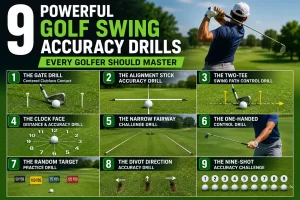
When most golfers think about improving their game, they immediately focus on hitting the ball farther. While distance can certainly be an advantage, accuracy is often the real difference between shooting lower scores and constantly battling trouble on the golf course. A 250-yard drive that finds the fairway is usually far more valuable than a 300-yard drive that ends up in the trees, rough, or a hazard. That’s why incorporating effective golf swing accuracy drills into your practice routine can have a dramatic impact on your overall performance.
Accuracy influences nearly every aspect of golf. It helps you hit more fairways, reach more greens in regulation, avoid costly penalty strokes, and create easier scoring opportunities. Even professional golfers understand that controlling ball flight and consistently finding their target is often more important than simply maximizing distance. If your goal is to lower your handicap and become a more reliable golfer, learning how to improve golf swing accuracy should be a top priority.
Unfortunately, many golfers struggle with accuracy due to several common issues. Poor target line alignment, inconsistent clubface control, faulty swing path control, and a lack of understanding of basic golf swing mechanics can all cause shots to miss their intended target. Many players also fail to make centered clubface contact, leading to weak shots, slices, hooks, and inconsistent ball flight patterns. Understanding these problems is the first step toward correcting them.
This is where golf accuracy drills become incredibly valuable. Well-designed drills create repetition, improve muscle memory, and provide instant feedback about what your swing is doing. Over time, these exercises help train your body to produce a more consistent motion, resulting in straighter and more predictable shots. Whether you’re trying to learn how to improve golf swing accuracy with drills or searching for golf swing accuracy drills that actually work, the right practice methods can accelerate your progress significantly.
In this guide, you’ll discover nine powerful golf swing accuracy drills designed to improve your alignment, ball striking, clubface awareness, swing path, and overall consistency. These drills can be practiced at the driving range, on the course, or even at home with minimal equipment. You’ll also learn why each drill works and how to incorporate it into an effective practice routine.
The best part is that these exercises benefit golfers of all skill levels. Beginners can use these as some of the best golf swing accuracy drills for beginners because they focus on building strong fundamentals. More experienced golfers can use them to refine ball control, tighten shot dispersion, and maintain consistency under pressure. No matter where your game currently stands, these drills can help you hit more accurate shots, gain confidence, and ultimately lower your scores.
11 Secret Techniques to Improve Golf Swing Accuracy Like a Pro
Why Golf Swing Accuracy Drills Are Essential for Better Golf
Every golfer wants to hit longer drives and make more birdies, but the truth is that accuracy is often the fastest path to lower scores. The ability to consistently hit your target can dramatically improve your performance on the course, regardless of your current skill level. That’s why incorporating effective golf swing accuracy drills into your practice routine is one of the smartest investments you can make in your game. These drills help golfers develop better control, consistency, and confidence while reducing costly mistakes that lead to higher scores.
The Relationship Between Accuracy and Scoring
Many golfers underestimate how much accuracy affects scoring. While distance can provide an advantage, accuracy determines how often you place yourself in position to succeed.
One of the biggest benefits of improved accuracy is hitting more fairways. When your tee shots consistently find the short grass, your approach shots become easier and more predictable. Instead of punching out from trees or fighting through thick rough, you can focus on attacking the green.
Accuracy also plays a major role in increasing greens in regulation. Golfers who control their ball flight and direction effectively are more likely to hit greens with their approach shots, creating more birdie opportunities and reducing pressure on their short game.
Perhaps most importantly, accurate golfers avoid penalty strokes. Slices into water hazards, hooks out of bounds, and errant shots into trouble areas can quickly destroy a scorecard. Learning how to improve golf swing accuracy can help eliminate these costly mistakes and save several strokes per round.
Common Swing Errors That Hurt Accuracy
Many golfers struggle with accuracy because of a few recurring swing flaws. One of the most common issues is poor clubface control. An open clubface often produces slices, while a closed clubface can create hooks. Even slight clubface errors can send the ball significantly offline.
Another major factor is poor swing path control. When the club moves excessively outside-to-in or inside-to-out, ball direction becomes inconsistent. Understanding basic ball flight laws can help golfers recognize how swing path influences shot shape.
Alignment mistakes are equally damaging. Many golfers unknowingly aim left or right of their target, making it nearly impossible to hit accurate shots. Proper target line alignment should be part of every practice session.
Finally, inconsistent contact remains a major challenge. Failing to achieve centered clubface contact reduces both distance and directional control, making accuracy difficult to maintain.
How Drills Build Consistent Ball Flight
The reason golf accuracy drills are so effective is that they create structured repetition. Through consistent practice, golfers develop muscle memory that allows the correct movement patterns to become automatic.
Repeated practice also helps reinforce proper golf swing mechanics, making it easier to produce the same swing under pressure. Over time, these movements become more natural and require less conscious effort.
The best golfers in the world rely on drills because they understand that consistency comes from repetition. Whether you’re searching for the best golf swing accuracy drills for beginners, wondering how to improve golf swing accuracy with drills, or looking for golf swing accuracy drills that actually work, the key is focused practice that trains your body to deliver the club consistently to the ball.
The following nine drills are designed to help you build that consistency, improve ball striking, and hit more accurate shots every time you step onto the course.
1. The Gate Drill for Centered Clubface Contact
One of the most effective golf swing accuracy drills for improving ball striking is the Gate Drill. This simple yet powerful exercise helps golfers develop the ability to consistently strike the center of the clubface, which is essential for producing straighter and more predictable shots. Many golfers struggle with accuracy not because of poor swing speed or lack of power, but because they fail to make solid contact. Even a small miss toward the heel or toe can dramatically affect ball flight, distance, and direction.
The Gate Drill provides immediate feedback and helps golfers develop better awareness of where the clubface is traveling through impact. It’s one of the golf swing accuracy drills that actually work because it addresses one of the most fundamental aspects of the golf swing: consistent contact.
How to Set Up the Gate Drill
Setting up the Gate Drill is simple and requires only two tees.
Start by placing two tees in the ground slightly wider than the width of your clubhead. The tees should create a narrow “gate” that the clubhead must pass through without touching either tee. Position the tees just ahead of the golf ball so they encourage a proper strike through the impact zone.
Next, position the ball in its normal location based on the club you’re using. For irons, the ball should typically be near the center of your stance, while longer clubs may require a slightly forward ball position.
Finally, select a target downrange and align yourself properly. Good target line alignment is critical because it helps ensure you’re training both contact and directional control at the same time. Before swinging, double-check that your feet, hips, and shoulders are aimed parallel to your intended target line.
What This Drill Improves
The primary goal of this drill is to improve centered clubface contact. When the clubhead passes cleanly through the gate without touching either tee, it indicates that you’re delivering the club consistently into the ball.
The drill also enhances clubface control and awareness. Many golfers have no idea where the clubface is during the downswing. The gate forces you to pay attention to the movement of the club through impact, helping you develop a better feel for square contact.
In addition, this exercise improves overall contact consistency. Repeated practice trains the body to return the clubhead to the same position repeatedly, strengthening the muscle memory required for accurate ball striking. This is one reason many instructors consider it one of the best golf swing accuracy drills for beginners.
As your contact improves, you’ll notice tighter shot dispersion, improved distance control, and a more predictable ball flight pattern.
Common Mistakes to Avoid
One common mistake is setting the tees too far apart. If the gate is overly wide, the drill loses much of its effectiveness because it doesn’t challenge your precision.
Another mistake is swinging too hard. Many golfers focus on power instead of accuracy, causing them to lose control of their golf swing mechanics. Start with smooth, controlled swings and gradually increase speed as consistency improves.
Poor alignment is another issue. If your body isn’t properly aligned, you may hit the ball solidly while still sending it off target. Always pay attention to your setup and target line alignment before beginning the drill.
For golfers wondering how to improve golf swing accuracy with drills, the Gate Drill is an excellent starting point. By improving centered strikes, increasing clubface awareness, and building consistent contact, this drill lays the foundation for more accurate and reliable golf shots.
2. The Alignment Stick Accuracy Drill
If there is one training aid that every golfer should own, it’s an alignment stick. Despite its simplicity, an alignment stick can dramatically improve accuracy by helping golfers develop proper setup fundamentals. Many golfers spend hours working on their swing but overlook one of the most important elements of consistent ball striking—alignment. The Alignment Stick Accuracy Drill is one of the most effective golf swing accuracy drills because it teaches golfers how to consistently aim at their target and swing along the correct path.
Even a technically sound golf swing can produce poor results if you’re not aligned correctly. This drill helps eliminate guesswork and creates a foundation for more accurate shots.
Proper Alignment Stick Setup
To perform this drill, place one alignment stick on the ground pointing directly at your target. This stick represents your target line and serves as a visual reference throughout the practice session.
Next, place a second alignment stick parallel to the first one along your toes. This helps ensure your feet, hips, and shoulders are properly aligned with the target. Many golfers are surprised to discover they have been aiming several yards left or right without realizing it.
Once the sticks are in place, address the golf ball normally and verify that your body is positioned parallel to the target line. As you practice, use the sticks as a constant reminder of proper setup and positioning.
Benefits for Target Line Alignment
One of the biggest advantages of this drill is improved target line alignment. Many missed shots occur before the club even moves because the golfer is aimed incorrectly.
Practicing with alignment sticks develops awareness of body positioning and helps create a more consistent setup routine. Over time, you’ll begin to recognize what proper alignment feels like, making it easier to replicate on the golf course.
This drill also supports better clubface control and more reliable golf swing mechanics. When the body is properly aligned, it becomes easier to swing along the intended path and deliver the clubface squarely at impact.
Golfers searching for how to improve golf swing accuracy with drills often overlook alignment, but fixing this fundamental issue can produce immediate results.
How Often to Practice This Drill
The Alignment Stick Accuracy Drill should be incorporated into nearly every practice session. Spending just five to ten minutes with alignment sticks before hitting balls can prevent bad habits from developing.
Beginners can benefit from using alignment sticks during every range session, while experienced golfers may use them periodically to ensure their setup remains consistent.
Because alignment influences every shot you hit, many instructors consider this one of the best golf swing accuracy drills for beginners and advanced players alike. Consistent use can help produce straighter shots, tighter dispersion patterns, and greater confidence over the ball.
Best Golf Training Program For Beginners: Why Most Golfers Never Improve
3. The Two-Tee Swing Path Control Drill
Your swing path plays a major role in determining where the golf ball starts and how it curves through the air. Even golfers with solid contact can struggle with accuracy if their swing path is inconsistent. The Two-Tee Swing Path Control Drill is one of the most effective golf accuracy drills for improving path awareness and creating a more repeatable swing.
This drill provides immediate feedback and helps golfers better understand the relationship between swing path, clubface position, and ball flight.
Why Swing Path Influences Accuracy
According to modern ball flight laws, swing path and clubface angle work together to determine shot direction and curvature.
An outside-to-in swing path often produces pulls and slices, while an excessively inside-to-out path can create pushes and hooks. When swing path varies from shot to shot, accuracy becomes unpredictable.
Developing better swing path control helps golfers produce more consistent ball flights and tighter shot patterns. A repeatable path also improves centered clubface contact, which contributes to both distance and directional control.
For golfers looking to improve golf swing accuracy, understanding swing path is an essential step toward more consistent performance.
Setting Up the Drill Correctly
Begin by placing a golf ball on the ground. Then insert two tees several inches in front of and behind the ball along your intended swing path.
The tees should create a narrow channel that encourages the clubhead to travel on the proper path through impact. The goal is to swing through the gate without striking either tee.
Start with slow practice swings before progressing to full shots. Focus on allowing the clubhead to move naturally through the channel while maintaining balance and rhythm.
This setup helps train both clubface control and path awareness while reinforcing efficient golf swing mechanics.
Signs You’re Improving
One of the first signs of progress is a noticeable reduction in slices, hooks, and other directional misses. As your swing path becomes more consistent, your ball flight will begin to stabilize.
You’ll also notice improved contact quality. Better path control often leads to more frequent centered clubface contact, resulting in straighter shots and improved distance consistency.
Another positive sign is tighter shot dispersion. Instead of seeing shots scattered across the range, you’ll begin grouping them much closer together around your intended target.
For golfers seeking golf swing accuracy drills that actually work, the Two-Tee Swing Path Control Drill is a proven method for developing a more repeatable swing. With regular practice, it can help transform inconsistent ball striking into reliable shot-making and significantly improve overall accuracy on the course.
4. The Clock Face Distance and Accuracy Drill
One of the biggest challenges golfers face is controlling both distance and direction at the same time. Many players make full swings for every shot, which often leads to inconsistent contact, poor tempo, and unpredictable ball flights. The Clock Face Distance and Accuracy Drill is one of the most effective golf swing accuracy drills because it teaches golfers how to control swing length while maintaining accuracy and consistency.
This drill uses a simple clock-face concept to help golfers develop better feel, improve distance control, and produce more reliable ball striking. It’s particularly useful for wedge play and approach shots where precision matters more than power.
Understanding Swing Length Control
Imagine your lead arm as the hand of a clock. During your backswing, different positions represent different swing lengths. For example, a backswing that reaches the 9 o’clock position is shorter than one that reaches 10 o’clock or 11 o’clock.
By learning to stop the club at specific positions, golfers gain greater control over both distance and accuracy. Instead of relying solely on feel, they develop measurable swing lengths that can be repeated consistently.
This type of practice also helps improve golf swing mechanics by encouraging balance and body control throughout the swing. As golfers become more comfortable with various swing lengths, they gain confidence in their ability to hit specific yardages while maintaining direction.
For players wondering how to improve golf swing accuracy with drills, mastering swing length control is an excellent place to start.
Improving Consistency Through Tempo
Tempo is often overlooked when discussing accuracy. Many golfers rush the transition from backswing to downswing, causing poor contact and inconsistent shot patterns.
The Clock Face Drill encourages a smooth and repeatable tempo by focusing on controlled movements rather than maximum speed. When golfers maintain a consistent rhythm, they improve clubface control, centered clubface contact, and overall shot consistency.
A smooth tempo also supports better swing path control, helping the club travel more predictably through impact. This results in tighter dispersion patterns and more reliable ball flights.
Best Practice Routine
Begin with a wedge and hit five balls using a 9 o’clock backswing. Focus on making solid contact and observing the distance each shot travels.
Next, repeat the process using a 10 o’clock backswing, then an 11 o’clock backswing. Record the average distance for each swing length.
As your consistency improves, challenge yourself by selecting random distances and matching them with the appropriate clock position. This creates a more realistic practice environment and strengthens your ability to control both distance and direction.
Among the many golf swing accuracy drills that actually work, the Clock Face Drill stands out because it improves both precision and distance control simultaneously. It’s also one of the best golf swing accuracy drills for beginners because it develops feel, rhythm, and consistency without requiring complicated swing changes.
Newbie Golfer Constantly Struggled With His Golf Swing Accuracy Came Within 3 Seconds Of Giving Up Then Discovered This
5. The Narrow Fairway Challenge Drill
Practice ranges often provide wide-open targets with little pressure, which can create a false sense of confidence. On the golf course, however, fairways are much narrower and mistakes carry real consequences. The Narrow Fairway Challenge Drill is one of the most practical golf accuracy drills because it simulates real playing conditions and forces golfers to focus on hitting specific targets.
This drill helps bridge the gap between range practice and on-course performance by training both accuracy and mental discipline.
Creating a Simulated Fairway
To set up the drill, choose a target on the driving range and create an imaginary fairway around it. You can use alignment sticks, range markers, or visible landmarks to define the boundaries.
Ideally, the fairway should be approximately 25 to 35 yards wide, similar to what you would encounter on many golf courses. Your objective is to hit shots that finish within these boundaries.
Before each shot, go through your normal pre-shot routine and select a specific target. Pay close attention to target line alignment, as proper setup is critical for success.
This simple setup immediately adds purpose and accountability to your practice session.
Training Pressure and Focus
One reason many golfers struggle on the course is that they rarely practice under pressure. The Narrow Fairway Challenge introduces consequences and encourages golfers to focus on execution.
Rather than mindlessly hitting ball after ball, each shot has a defined goal. This helps improve concentration and reinforces quality practice habits.
The drill also encourages better clubface control and swing path control because golfers become more aware of where the ball is starting and finishing. Over time, this heightened awareness improves overall shot dispersion and consistency.
Golfers looking to improve golf swing accuracy often discover that focused practice like this produces faster results than simply hitting large buckets of balls.
Tracking Your Results
To maximize the effectiveness of this drill, keep score. Hit ten drives and record how many finish inside your simulated fairway.
For example:
- 6 out of 10 fairways hit = 60%
- 8 out of 10 fairways hit = 80%
- 9 out of 10 fairways hit = Excellent accuracy
Tracking your performance creates measurable goals and allows you to monitor improvement over time.
You can also increase the challenge by narrowing the fairway width as your accuracy improves. This forces continued growth and prevents practice sessions from becoming too easy.
For golfers searching for golf swing accuracy drills that actually work, the Narrow Fairway Challenge provides realistic feedback while developing the focus and precision needed to perform under pressure. By combining technical skill with mental discipline, this drill helps golfers hit more fairways, avoid penalty strokes, and lower their scores.
6. The One-Handed Control Drill
Many golfers focus on body rotation, swing speed, and power, but overlook one of the most important factors in accuracy: hand control. Your hands are the final connection between your body and the golf club, and they play a critical role in controlling the clubface through impact. The One-Handed Control Drill is one of the most effective golf swing accuracy drills for developing better feel, improving clubface awareness, and creating more consistent ball striking.
Although this drill may feel challenging at first, it provides valuable feedback that can quickly expose weaknesses in your swing and help build better fundamentals.
Why Hand Control Matters
The position of the clubface at impact largely determines where the ball starts and how it curves. Even small errors in hand positioning can cause the clubface to be open or closed, leading to slices, hooks, and inconsistent shots.
Many golfers rely too heavily on their arms and body while neglecting the role their hands play in controlling the clubface. As a result, they struggle with inconsistent ball flights and poor directional control.
The One-Handed Control Drill helps golfers develop a stronger connection to the club and improves awareness of how the hands influence the swing. This awareness is especially important for improving clubface control, one of the key elements of accurate ball striking.
Golfers who learn to control the clubface more effectively often see immediate improvements in both accuracy and consistency.
Developing Better Clubface Control
To perform the drill, begin with short shots using a wedge or short iron. Hit several shots using only your lead hand while making smooth, controlled swings.
The goal is not distance but solid contact and directional control. Focus on maintaining balance and allowing the clubface to return squarely to the ball at impact.
After practicing with your lead hand, switch to your trail hand and repeat the exercise. Although it may feel awkward, this variation helps develop additional awareness and coordination.
This drill encourages better centered clubface contact, improves feel through impact, and reinforces proper golf swing mechanics. It also helps golfers better understand how the clubface influences ball flight laws, making it easier to diagnose and correct directional misses.
For golfers seeking how to improve golf swing accuracy with drills, few exercises provide as much feedback as this simple one-handed practice routine.
Beginner-Friendly Modifications
Beginners may find full swings difficult when using one hand. If that’s the case, start with small chip shots or half swings.
Another option is to choke down on the grip, which provides additional control and makes the club easier to manage. As confidence grows, gradually increase swing length while maintaining balance and solid contact.
Because it develops feel and awareness without requiring complex swing thoughts, this is often considered one of the best golf swing accuracy drills for beginners. Consistent practice can lead to improved control, better contact quality, and greater confidence on the course.
7. The Random Target Practice Drill
Many golfers spend hours at the driving range hitting one club repeatedly toward the same target. While this approach can feel productive, it often produces limited results on the golf course. The Random Target Practice Drill is one of the most effective golf accuracy drills because it closely mimics the decision-making process golfers face during an actual round.
Instead of repeating the same shot over and over, this drill challenges golfers to adapt, focus, and execute different shots just as they would on the course.
Why Most Range Sessions Fail
Traditional range sessions often involve hitting dozens of balls with the same club to the same target. While repetition has value, this type of practice rarely prepares golfers for real playing conditions.
On the golf course, no two shots are exactly alike. Every shot requires a new target, different club selection, varying distances, and changing conditions.
When golfers practice only one shot repeatedly, they become comfortable with that specific motion but fail to develop the adaptability required for on-course success.
The Random Target Practice Drill solves this problem by creating variety and forcing golfers to reset mentally before every shot.
Simulating Real On-Course Conditions
To perform this drill, select a different target before each shot and change clubs frequently. For example, hit a driver toward one target, a 7-iron toward another, and a wedge toward a third.
Go through your complete pre-shot routine before every swing. Visualize the shot, pick a target, align yourself properly, and execute with commitment.
This process improves target line alignment, strengthens focus, and develops more reliable golf swing mechanics under realistic conditions.
The drill also helps golfers better understand ball flight laws because they begin observing how different swings and clubface positions affect ball direction and curvature.
For players searching for golf swing accuracy drills that actually work, this realistic practice method often produces significant improvements in on-course performance.
Building Shot-Making Skills
One of the greatest benefits of this drill is improved shot-making ability. By constantly changing targets and clubs, golfers learn to adapt and execute different shots with confidence.
The drill develops better swing path control, enhances clubface control, and promotes more consistent decision-making. It also helps golfers improve their ability to focus on a single shot rather than becoming trapped in repetitive practice patterns.
As your skills improve, challenge yourself by aiming at smaller targets or visualizing specific shot shapes such as fades and draws.
For golfers who want to improve golf swing accuracy, this drill provides one of the closest practice experiences to actual golf. It teaches adaptability, concentration, and precision while helping golfers transfer their range performance directly onto the course. Over time, these benefits can lead to more fairways hit, more greens in regulation, and lower scores overall.
8. The Divot Direction Accuracy Drill
Many golfers focus entirely on where the golf ball goes and ignore one of the most valuable sources of swing feedback available—the divot. Every divot tells a story about what the club was doing through impact. The Divot Direction Accuracy Drill is one of the most effective golf swing accuracy drills because it helps golfers understand swing path, clubface delivery, and impact conditions without relying on expensive technology.
Learning how to read your divots can provide immediate insight into why shots are flying off target and help you make faster adjustments. For golfers who want to improve golf swing accuracy, this drill offers a simple yet powerful way to diagnose and correct common swing issues.
Understanding Ball Flight Laws
Modern ball flight laws explain how the clubface and swing path work together to determine ball direction and curvature.
The clubface primarily influences where the ball starts, while the swing path affects how the ball curves after launch. If your swing path consistently moves too far left or right of the target line, accuracy becomes difficult to maintain.
Your divot often reveals this information. A divot that points significantly left of the target may indicate an outside-to-in swing path, which commonly produces pulls and slices. Conversely, a divot pointing right of the target may indicate an inside-to-out swing path that can lead to pushes and hooks.
Understanding these relationships helps golfers better identify the true cause of their misses instead of simply guessing.
Reading Your Divots Correctly
To perform this drill, hit a series of iron shots from natural turf and carefully examine the direction of each divot.
Ideally, the divot should point close to your intended target line. Minor variations are normal, but large deviations often indicate problems with swing path control or alignment.
Also pay attention to the shape and depth of the divot. Consistent, shallow divots typically indicate solid golf swing mechanics, while excessively deep or uneven divots may signal issues with weight transfer or low-point control.
This drill also helps improve centered clubface contact because golfers become more aware of how the club is interacting with the turf. When paired with proper target line alignment, divot analysis can dramatically improve accuracy and consistency.
Using Feedback for Faster Improvement
One reason this drill is considered one of the golf swing accuracy drills that actually work is the immediate feedback it provides.
After each shot, compare the divot direction to the ball’s flight. Over time, you’ll begin to see clear patterns that reveal your tendencies. For example, if your divots consistently point left and your shots slice, you’ll know your swing path needs attention.
Use this information to make small adjustments rather than major swing changes. Consistent monitoring helps build awareness and accelerates improvement.
For golfers searching for how to improve golf swing accuracy with drills, the Divot Direction Accuracy Drill offers one of the simplest and most effective methods for understanding what the club is doing through impact. The more accurately you interpret your feedback, the faster you’ll develop a more reliable and repeatable swing.
How Golf Students Are Mastering Their Golf Swing Without Spending Thousands Of Dollars On Golf Lessons https://ultimategolfmasterypro.com/the-golf-swing-lab-2/
9. The Nine-Shot Accuracy Challenge
The final drill on this list combines everything you’ve learned into one comprehensive practice exercise. The Nine-Shot Accuracy Challenge is designed to test your ability to control direction, trajectory, and shot shape while maintaining consistency. It is one of the most advanced golf accuracy drills, yet it can be adapted for players of all skill levels.
This challenge develops the versatility and precision needed to perform under real playing conditions while helping golfers identify areas that still need improvement.
How the Challenge Works
The concept is simple. Using the same club, attempt to hit nine different shots:
- Straight shot
- Fade
- Draw
- High straight shot
- High fade
- High draw
- Low straight shot
- Low fade
- Low draw
Before each shot, choose a target and visualize the desired ball flight. Then execute the shot while maintaining proper setup and alignment.
The goal isn’t perfection. Instead, the objective is to develop awareness and improve your ability to intentionally influence ball flight.
This challenge forces golfers to apply concepts such as clubface control, swing path control, and ball flight laws in a practical setting.
Combining Accuracy and Ball Control
Many golfers can hit a straight shot when conditions are ideal, but true accuracy involves controlling the golf ball under a variety of situations.
The Nine-Shot Challenge helps golfers learn how different swing adjustments influence trajectory and curvature. It also strengthens understanding of golf swing mechanics and improves adaptability on the course.
As you work through the challenge, you’ll develop greater confidence in your ability to shape shots around obstacles, adjust for wind conditions, and attack different pin positions.
This is one reason many instructors consider it among the best golf swing accuracy drills for beginners who are progressing beyond basic fundamentals and for experienced players seeking greater precision.
Measuring Long-Term Improvement
The Nine-Shot Accuracy Challenge also serves as an excellent performance benchmark.
Keep track of how many of the nine shots you successfully complete during each practice session. Record your results in a notebook or training app and monitor your progress over time.
For example:
- 3–4 successful shots = Developing control
- 5–6 successful shots = Solid accuracy skills
- 7–9 successful shots = Advanced ball-flight control
By tracking performance, you’ll gain a clearer understanding of your strengths and weaknesses while staying motivated to improve.
For golfers looking for golf swing accuracy drills that actually work, the Nine-Shot Accuracy Challenge provides a complete test of ball control, shot-making ability, and precision. Combined with the previous drills in this guide, it can help you build a more reliable swing, hit more targets, and ultimately lower your scores on the golf course.
How to Practice Golf Swing Accuracy Drills for Maximum Results
Learning effective golf swing accuracy drills is only part of the equation. To see real improvement on the golf course, you must practice those drills consistently and with purpose. Many golfers spend hours on the range but fail to make significant progress because their practice sessions lack structure. By following a proven practice strategy, you can maximize the benefits of every drill and accelerate your improvement.
Whether you’re trying to improve golf swing accuracy, develop better clubface control, or create more consistent ball striking, the quality of your practice matters just as much as the drills themselves.
Create a Weekly Practice Schedule
One of the biggest mistakes golfers make is practicing randomly. Instead of showing up at the range without a plan, create a weekly schedule that focuses on specific skills.
For example:
- Monday: Alignment Stick Accuracy Drill
- Wednesday: Two-Tee Swing Path Control Drill
- Friday: Gate Drill and Divot Direction Drill
- Weekend: Nine-Shot Accuracy Challenge
This structured approach prevents practice from becoming repetitive while ensuring that all aspects of accuracy receive attention.
Golfers searching for how to improve golf swing accuracy with drills often discover that consistency in practice produces far better results than occasional marathon range sessions.
Focus on Quality Repetitions
Many golfers believe improvement comes from hitting hundreds of balls. In reality, quality repetitions are far more valuable than quantity.
Instead of rushing through a large bucket, treat each shot as if you’re playing an actual hole. Go through your full pre-shot routine, select a target, and focus on executing one quality swing.
This type of deliberate practice reinforces proper golf swing mechanics, strengthens target line alignment, and improves overall consistency.
The goal isn’t simply to hit more balls—it’s to make every swing count.
Track Progress Over Time
One of the best ways to stay motivated is to track your performance.
Record simple metrics such as:
- Fairways hit during practice challenges
- Successful gate drill repetitions
- Nine-Shot Challenge scores
- Percentage of shots finishing near your target
Tracking results allows you to identify strengths and weaknesses while measuring improvement over time.
Many of the most successful golfers keep detailed practice notes because objective feedback makes it easier to evaluate progress and make adjustments.
Combine Multiple Drills Together
Although each drill can be practiced individually, combining drills often creates the most realistic training environment.
For example, start with the Alignment Stick Drill to establish proper setup, then move into the Gate Drill to improve centered clubface contact, and finish with the Narrow Fairway Challenge to test your accuracy under pressure.
Combining drills helps golfers develop multiple skills simultaneously while creating practice sessions that more closely resemble real golf.
When used consistently, these golf swing accuracy drills that actually work can help golfers build confidence, improve ball striking, and produce more reliable results on the course.
Common Mistakes Golfers Make When Practicing Accuracy
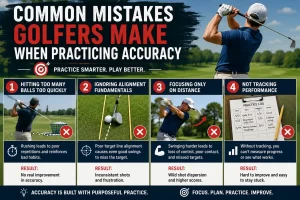
Even golfers who spend considerable time practicing often struggle to improve because they unknowingly develop ineffective habits. Avoiding these common mistakes can dramatically increase the effectiveness of your golf accuracy drills and lead to faster improvement.
Hitting Too Many Balls Too Quickly
One of the most common errors is rapid-fire practice. Many golfers hit ball after ball without stopping to evaluate results or make adjustments.
This approach often reinforces poor habits rather than correcting them.
Instead, slow down and treat every shot as an individual challenge. Focus on setup, target selection, and execution before hitting the next ball.
Deliberate practice improves retention and helps develop more reliable movement patterns.
Ignoring Alignment Fundamentals
Many golfers spend countless hours working on their swing while completely overlooking alignment.
Poor target line alignment can make even a technically sound swing appear inaccurate. If you’re consistently aimed left or right of your target, you’ll struggle to develop confidence and consistency.
Using alignment sticks regularly can help eliminate this issue and ensure you’re practicing with correct fundamentals.
For golfers looking to improve golf swing accuracy, alignment should be one of the first areas evaluated.
Focusing Only on Distance
Distance is exciting, but it should never come at the expense of accuracy.
Many golfers swing harder than necessary, causing breakdowns in clubface control, swing path control, and overall balance. The result is often wild dispersion patterns and inconsistent ball striking.
Remember that a shot in the fairway is almost always more valuable than a longer shot in trouble.
The most effective golf swing accuracy drills prioritize control first and distance second.
Not Tracking Performance
Another major mistake is failing to measure progress.
Without tracking results, it’s difficult to know whether your practice is producing meaningful improvement. Golfers who keep records of their drills, fairway percentages, and accuracy challenges gain valuable insights into their development.
Tracking performance also helps identify patterns and provides motivation when progress feels slow.
If you’re searching for the best golf swing accuracy drills for beginners or advanced players, remember that even the best drills require accountability. By avoiding these common mistakes and practicing with intention, you’ll build stronger fundamentals, develop more consistent ball striking, and ultimately lower your scores through improved accuracy.
The Best Golf Swing Accuracy Drills for Beginners
If you’re new to golf, improving accuracy should be one of your top priorities. While many beginners focus on hitting the ball farther, learning to hit the ball straighter and more consistently will have a much bigger impact on your scores. The good news is that you don’t need a complicated swing or expensive training equipment to see improvement. Some of the most effective golf swing accuracy drills are also the simplest.
By focusing on fundamental skills such as alignment, contact quality, and clubface control, beginners can build a strong foundation that supports long-term success.
Drills That Build Fundamentals First
When starting out, it’s important to focus on drills that reinforce the basics. The Alignment Stick Accuracy Drill is one of the best places to begin because it teaches proper target line alignment and helps golfers develop a consistent setup routine.
The Gate Drill is another excellent choice because it improves centered clubface contact, which is essential for producing straighter shots and more predictable ball flights. Many beginners struggle simply because they don’t strike the center of the clubface consistently.
The One-Handed Control Drill is also valuable because it develops feel and improves clubface control without requiring major swing changes. Learning how the hands influence the clubface helps beginners better understand why shots curve left or right.
These are widely considered some of the best golf swing accuracy drills for beginners because they focus on building strong fundamentals before introducing more advanced concepts.
Simple Practice Plans for Faster Progress
One of the most effective ways to improve golf swing accuracy is to follow a simple and repeatable practice plan.
For example:
Practice Session 1
- 10 minutes of Alignment Stick Drill
- 15 minutes of Gate Drill
- 10 minutes of One-Handed Control Drill
Practice Session 2
- 10 minutes of Two-Tee Swing Path Control Drill
- 15 minutes of Narrow Fairway Challenge
- 10 minutes of Random Target Practice
This type of structured approach allows beginners to develop multiple skills without becoming overwhelmed.
Remember that consistency is more important than duration. Three focused practice sessions per week will usually produce better results than one long session every few weeks.
How Beginners Can Avoid Information Overload
One of the biggest challenges facing beginner golfers is trying to fix too many things at once.
Golf instruction videos, articles, and social media tips can provide valuable information, but constantly changing swing thoughts often creates confusion. Instead of attempting to master every aspect of the game immediately, focus on one skill at a time.
Choose two or three golf swing accuracy drills that actually work and practice them consistently for several weeks. Allow your body time to develop muscle memory and confidence before introducing additional changes.
By simplifying your practice routine, you’ll improve faster and enjoy the learning process much more.
Golf Drills for Every Part of your Golf Swing https://www.golfdistillery.com/golf-tips/swing-drills/
Final Thoughts on Golf Swing Accuracy Drills
Developing accuracy is one of the most effective ways to lower your scores and become a more confident golfer. Throughout this guide, we’ve covered nine powerful golf swing accuracy drills that can help golfers of all skill levels improve consistency, ball striking, and overall performance.
Let’s quickly recap the drills:
- The Gate Drill for Centered Clubface Contact
- The Alignment Stick Accuracy Drill
- The Two-Tee Swing Path Control Drill
- The Clock Face Distance and Accuracy Drill
- The Narrow Fairway Challenge Drill
- The One-Handed Control Drill
- The Random Target Practice Drill
- The Divot Direction Accuracy Drill
- The Nine-Shot Accuracy Challenge
Each drill targets a specific area of performance, whether it’s clubface control, swing path control, target line alignment, centered clubface contact, or understanding ball flight laws. Together, they create a complete system for improving both accuracy and consistency.
The key to success is repetition. Even the most effective golf accuracy drills won’t produce results unless they’re practiced regularly. Consistent, focused practice builds muscle memory, strengthens proper golf swing mechanics, and helps golfers perform more confidently under pressure.
If you’re wondering how to improve golf swing accuracy with drills, remember that progress doesn’t happen overnight. Small improvements made consistently over weeks and months often lead to dramatic long-term results.
The benefits extend far beyond the driving range. Improved accuracy means more fairways hit, more greens in regulation, fewer penalty strokes, and ultimately lower scores. You’ll spend less time recovering from mistakes and more time creating birdie opportunities.
Most importantly, you’ll enjoy the game more. Few things are as satisfying as standing over a shot with confidence, knowing you have the skills to hit your target.
Start with one or two drills from this list, commit to practicing them consistently, and track your progress. Over time, you’ll discover why these are some of the most effective golf swing accuracy drills that actually work. Stay patient, trust the process, and keep improving one swing at a time. Your most accurate golf is still ahead of you. 🏌️♂️⛳
1. What are the best golf swing accuracy drills for beginners?
The best golf swing accuracy drills for beginners are the Alignment Stick Drill, Gate Drill, and One-Handed Control Drill. These drills focus on building strong fundamentals such as target line alignment, clubface control, and centered clubface contact. Beginners often struggle with consistency because they lack proper setup and swing awareness. By practicing these golf accuracy drills regularly, new golfers can improve ball striking, develop better golf swing mechanics, and build confidence while learning how to hit straighter shots.
2. How do golf swing accuracy drills help improve golf swing accuracy?
Golf swing accuracy drills help improve golf swing accuracy by developing consistent movement patterns through repetition. Effective drills train golfers to deliver the clubface more consistently at impact while improving swing path control and alignment. Over time, these drills create muscle memory that helps golfers produce more predictable ball flights. Whether you’re working on contact quality, alignment, or ball striking, the right golf accuracy drills can significantly reduce slices, hooks, and other common directional misses.
3. How often should I practice golf swing accuracy drills?
For most golfers, practicing golf swing accuracy drills two to four times per week produces excellent results. Consistent practice is more important than the length of each session. Even 20 to 30 minutes focused on clubface control, target line alignment, and centered clubface contact can lead to noticeable improvement. Golfers looking for how to improve golf swing accuracy with drills should prioritize quality repetitions rather than simply hitting large numbers of golf balls at the range.
4. What golf swing accuracy drills actually work for fixing slices and hooks?
Some of the most effective golf swing accuracy drills that actually work for correcting slices and hooks include the Two-Tee Swing Path Control Drill, Divot Direction Drill, and Alignment Stick Drill. These drills help golfers better understand ball flight laws and how the relationship between clubface angle and swing path affects shot shape. Improving swing path control and clubface control can dramatically reduce unwanted curvature and help golfers produce straighter, more reliable golf shots.
5. Can golf swing accuracy drills help lower my scores?
Yes, practicing golf swing accuracy drills can directly contribute to lower scores. Greater accuracy leads to more fairways hit, more greens in regulation, and fewer penalty strokes. When golfers improve target line alignment, centered clubface contact, and overall golf swing mechanics, they spend less time recovering from mistakes and more time creating scoring opportunities. Consistent practice helps golfers improve golf swing accuracy and develop the confidence needed to perform better during actual rounds.
6. What is the fastest way to improve golf swing accuracy with drills?
The fastest way to improve golf swing accuracy with drills is to focus on fundamentals before attempting advanced swing changes. Start with drills that improve clubface control, alignment, and contact quality, such as the Gate Drill and Alignment Stick Drill. Combine these with regular feedback from the Divot Direction Drill to monitor your progress. By practicing proven golf accuracy drills consistently and understanding basic ball flight laws, golfers can achieve faster improvement and build a more repeatable, accurate golf swing.