
How to Improve Golf Swing Accuracy With These 9 Expert Tips
The Best Golf Swing Accuracy Tips for Every Skill Level
Introduction

If you’ve ever watched a perfectly struck drive sail straight down the middle of the fairway, you know that accuracy—not just distance—is what separates consistent golfers from those who spend the day searching for balls in the rough. While hitting the ball 300 yards might look impressive, the golfer who repeatedly finds the fairway and attacks the green from a good position will almost always post lower scores. That’s why learning how to improve golf swing accuracy should be one of the highest priorities for golfers of every skill level.
Many amateur golfers assume they need to swing harder to hit better shots, but that’s often what creates inconsistent ball flight. Swinging with too much effort can lead to poor clubface control, inconsistent swing path control, and off-center contact. Even small mistakes in target line alignment or setup can send the golf ball well offline. Understanding the fundamentals of golf swing mechanics and applying the ball flight laws correctly allows you to make more predictable, repeatable swings.
There are many reasons golfers struggle to hit the ball straight consistently. One of the most common is an inconsistent setup. Poor posture, incorrect ball position, and an improper grip make it difficult to return the clubface square at impact. Others struggle because they lack centered clubface contact, causing shots to lose both accuracy and distance. Some golfers also practice without a clear purpose, hitting bucket after bucket of balls without identifying the swing faults that are actually causing their misses. If you’ve been wondering how to improve golf swing accuracy consistently, focusing on these core fundamentals is far more effective than constantly searching for complicated swing changes.
The good news is that accuracy is a skill that can be developed with the right approach. Whether you’re searching for how to improve golf swing accuracy for beginners or you’re an experienced player looking to tighten your shot dispersion, small improvements in setup, alignment, tempo, and impact can produce dramatic results. As your swing becomes more repeatable, you’ll begin hitting more fairways, more greens in regulation, and far fewer penalty shots. That consistency doesn’t just lower your scores—it also builds confidence every time you stand over the ball.
In this guide, you’ll discover nine expert strategies that cover the best ways to improve golf swing accuracy. You’ll learn how to improve your setup, develop better clubface control, create a more efficient swing path, maintain balance throughout the swing, and practice with a purpose. By applying these proven golf swing accuracy tips, you’ll build a more reliable swing that helps you hit straighter shots, play with greater confidence, and enjoy more success every time you step onto the golf course.
13 Expert Golf Swing Accuracy Training Methods to Hit More Fairways
Why Golf Swing Accuracy Is More Important Than Distance
Many golfers believe that hitting the ball farther is the fastest way to lower their scores. While extra distance can be an advantage, it only helps if the ball stays in play. In reality, golfers who consistently hit fairways and greens usually outperform players who hit long but wild shots. If your goal is to learn how to improve golf swing accuracy, you’ll likely see greater improvements in your scores than if you focus solely on increasing swing speed.
The debate between accuracy and distance has been around for decades, but for the average golfer, accuracy almost always wins. A 220-yard drive in the middle of the fairway is far more valuable than a 280-yard drive that ends up behind trees or in a water hazard. Playing your next shot from the fairway gives you a much better chance of reaching the green, controlling your ball flight, and avoiding costly mistakes. That’s one of the best ways to improve golf swing accuracy while also improving your overall course management.
Consistently finding the fairway offers several advantages throughout a round. You’ll face fewer difficult recovery shots, enjoy cleaner lies, and have better control over your approach shots into the green. Good target line alignment, solid clubface control, and reliable centered clubface contact all work together to produce straighter, more predictable golf shots. As these fundamentals improve, your confidence grows because you begin trusting where the golf ball is going instead of hoping it stays in play.
Professional golfers understand this better than anyone. While today’s tour professionals certainly generate tremendous distance, they spend countless hours refining golf swing mechanics, improving swing path control, and practicing precise ball striking. They know that every shot begins with controlling the clubface at impact. According to the ball flight laws, the clubface has the greatest influence on where the ball initially starts, making face control one of the biggest keys to accuracy. That’s why elite players devote so much time to improving consistency rather than simply chasing more power.
Another major reason accuracy lowers scores is that it dramatically reduces penalty strokes. Golfers who frequently slice or hook the ball often find themselves hitting from hazards, deep rough, or out-of-bounds areas. Those mistakes quickly turn potential pars into bogeys or even double bogeys. Learning how to improve golf swing accuracy consistently helps keep the ball in play, giving you more opportunities to make pars and occasional birdies while avoiding unnecessary big numbers.
If you’re wondering how to improve golf swing accuracy for beginners, the answer isn’t swinging harder—it’s mastering the fundamentals that produce repeatable shots. Better alignment, improved balance, a square clubface, and a controlled swing path create the consistency every golfer is looking for. Once you can reliably hit the ball where you intend, adding distance becomes much easier and far more effective.
Now that you understand why accuracy is the foundation of lower scores, it’s time to begin building that consistency from the ground up. The first step is creating a repeatable setup that allows you to produce the same reliable swing every time you step over the golf ball.
Tip #1 – Build a Repeatable Setup Every Time
One of the biggest secrets to learning how to improve golf swing accuracy isn’t making complicated swing changes—it’s building a setup you can repeat on every shot. Your setup serves as the foundation of your golf swing. If your body is misaligned before you even take the club back, you’ll spend the rest of the swing trying to compensate. Even the best golf swing mechanics can’t consistently produce straight shots if they’re built on an inconsistent address position.
A repeatable setup helps eliminate unnecessary variables, allowing you to return the club to impact in the same position time after time. Whether you’re searching for how to improve golf swing accuracy consistently or you’re looking for how to improve golf swing accuracy for beginners, mastering your setup is one of the best ways to improve golf swing accuracy because it influences every part of the swing that follows.
Master Proper Target Line Alignment
Proper target line alignment is one of the most overlooked fundamentals in golf. Many golfers believe they’re aimed directly at the target when, in reality, their feet, hips, shoulders, or clubface are pointing several yards left or right. Even a perfectly executed swing can send the ball offline if your alignment is incorrect.
Start by aiming the clubface at your intended target first. Since the clubface has the greatest influence on the ball’s starting direction according to the ball flight laws, it should always be positioned before your body. Once the clubface is square, align your feet, hips, knees, and shoulders parallel to the target line rather than directly at it. Imagine standing on railroad tracks, where the inside rail represents your target line and the outside rail represents your body alignment.
Alignment sticks are one of the simplest training aids for improving consistency. Place one stick on the ground pointing at your target and another parallel to it for your feet. Practicing this way trains your eyes to recognize proper alignment and helps eliminate aiming errors that quietly sabotage your golf swing accuracy tips before the swing even begins.
Develop a Consistent Pre-Shot Routine
Every great golfer relies on a consistent pre-shot routine because it prepares both the body and the mind for a successful shot. A routine removes uncertainty and allows you to focus on executing the swing rather than thinking about mechanical positions during the motion.
An effective routine doesn’t need to be complicated. Pick your target, stand behind the ball to visualize the shot, take one or two relaxed practice swings, align the clubface, set your stance, take a final look at the target, and commit to the shot. Performing these same steps before every swing builds confidence and creates consistency under pressure.
A pre-shot routine also helps quiet negative thoughts. Instead of worrying about your previous slice or hook, your attention shifts toward a repeatable process. This mental discipline becomes increasingly valuable on difficult holes where accuracy matters most. Many golfers who successfully improve golf swing accuracy find that a dependable routine is just as important as physical technique.
Setup Mistakes That Destroy Accuracy
Several small setup mistakes can dramatically affect your ability to hit straight shots. One of the most common is incorrect ball position. If the ball sits too far forward or too far back in your stance, it changes where the clubface meets the ball and often leads to pushes, pulls, or inconsistent contact. Use a consistent ball position based on the club you’re hitting to promote solid, repeatable strikes.
Poor posture is another major accuracy killer. Standing too upright restricts rotation, while bending excessively at the waist limits balance and makes it difficult to return to impact consistently. Aim for an athletic posture with slight knee flex, a straight back, and your weight balanced evenly over the balls of your feet.
Grip pressure is equally important. Many golfers squeeze the club too tightly, creating tension throughout the arms and shoulders. Excess tension reduces clubhead speed, limits natural release, and makes clubface control much more difficult. Hold the club firmly enough to maintain control, but lightly enough to allow the club to swing freely through impact.
By building a repeatable setup with proper alignment, an effective pre-shot routine, and sound fundamentals, you’ll create the foundation needed for straighter, more consistent shots. In the next section, we’ll focus on perhaps the single biggest factor in shot direction—learning how to improve clubface control through impact.
Tip #2 – Improve Clubface Control Through Impact
If there’s one skill that has the biggest impact on how to improve golf swing accuracy, it’s learning to control the clubface at impact. While many golfers focus on making bigger or more powerful swings, the direction your golf ball starts is determined primarily by where the clubface is pointing when it strikes the ball. Even a perfect swing path can’t save a shot if the clubface is wide open or excessively closed at impact. That’s why developing better clubface control is one of the fastest ways to improve golf swing accuracy.
Why Clubface Angle Controls Ball Direction
According to the modern ball flight laws, the clubface has the greatest influence on the golf ball’s initial starting direction. For most full swings, approximately 75–85% of the ball’s starting line is determined by the clubface angle, while the swing path influences the amount of curve the ball experiences after launch.
An open clubface points to the right of the target for a right-handed golfer, often producing pushes and slices. A closed clubface points left, creating pulls and hooks. Even being only a few degrees off can send your shot several yards offline by the time it lands.
Understanding this concept is essential if you’re searching for how to improve golf swing accuracy consistently. Instead of trying to manipulate your swing during the downswing, focus on returning the clubface square to the target at impact. Combined with sound golf swing mechanics, this creates straighter, more predictable ball flights.
Learn Centered Clubface Contact
Clubface direction is only part of the equation. Where the ball contacts the face also plays a huge role in accuracy. Shots struck on the sweet spot travel farther, fly straighter, and produce more consistent spin than shots hit on the toe or heel.
Developing centered clubface contact starts with improving awareness. Many golfers don’t realize where they’re actually striking the face because they never check. Using impact tape, foot spray powder, or dry-erase marker on the clubface after each shot provides immediate feedback. After several swings, you’ll begin recognizing your common strike pattern and can make small adjustments accordingly.
As your strike location becomes more centered, you’ll notice tighter shot dispersion, improved distance consistency, and far greater confidence standing over the ball. This is one of the best ways to improve golf swing accuracy, regardless of your handicap.
Clubface Control Drills
Several simple drills can dramatically improve face awareness and consistency.
The Gate Drill places two alignment sticks or tees just wider than your clubhead. Swinging through the gate without touching either side encourages a square clubface and centered strike while improving your swing delivery.
The Impact Tape Drill provides instant visual feedback after every swing. Review each strike pattern and work toward consistently finding the center of the face. Small adjustments in posture, ball position, or setup often produce noticeable improvements.
The Tee Gate Drill involves placing two golf tees slightly wider than the golf ball. The goal is to strike the ball cleanly without clipping either tee. This drill improves precision, encourages better centered clubface contact, and sharpens your awareness of the clubface through impact.
Once you consistently return the clubface square at impact, you’re ready to focus on the second major ingredient of straight ball flight—your swing path.
You can spend hours on the driving range, but if you’re practicing the wrong fundamentals, you may actually be reinforcing the habits that keep your shots offline. Many golfers trying to learn how to improve golf swing accuracy unknowingly repeat the same hidden mistakes every round. Discover the drills and step-by-step system that helps golfers build a more repeatable swing inside 👉 The Golf Swing Lab
Tip #3 – Improve Your Swing Path
After learning to control the clubface, the next step in mastering how to improve golf swing accuracy is developing a repeatable swing path. While the clubface largely determines where the ball starts, the swing path influences how the ball curves during flight. Improving swing path control allows you to eliminate slices, hooks, and other frustrating misses while creating a much more repeatable golf swing.
Understanding Swing Path Control
Swing path describes the direction the clubhead travels through impact relative to the target line.
An inside-out swing path approaches the ball from inside the target line and moves outward after impact. When paired with a square clubface, it often produces a gentle draw.
An outside-in swing path moves across the ball from outside the target line toward the inside. Combined with an open clubface, it commonly creates the slice that many recreational golfers struggle with.
A neutral swing path travels nearly along the target line through impact. When matched with proper clubface control, it produces the straight, controlled shots that golfers strive for.
Understanding these relationships helps explain why improving both swing path and clubface angle is critical if you want to improve golf swing accuracy on a consistent basis.
Common Swing Path Mistakes
One of the most common swing faults is the over-the-top move, where the upper body starts the downswing too aggressively. This sends the club outside the target line and often leads to weak slices or pulls.
Another frequent issue is early extension, where the hips move toward the golf ball during the downswing. This changes the club’s delivery, making solid contact and directional control much more difficult.
A poor takeaway can also set the swing on the wrong path from the very beginning. Rolling the club excessively inside or lifting it too steeply forces compensations later in the swing that reduce both consistency and accuracy.
Correcting these issues starts with slowing down your practice swings and focusing on building proper movement patterns instead of chasing power.
Swing Path Practice Drills
The Alignment Stick Drill is one of the best exercises for improving target line alignment and swing path. Place an alignment stick just outside the target line and practice swinging without contacting it. This encourages the club to approach the ball on the correct path.
The Headcover Drill helps eliminate an outside-in swing. Position a headcover just outside and slightly behind the golf ball. If your downswing becomes too steep or moves over the top, the club will strike the headcover before reaching the ball. Repeating this drill teaches a shallower, more efficient path.
The Split-Hand Drill improves the feel of proper sequencing and club delivery. Grip the club with your hands separated several inches and make slow practice swings. The separation encourages the club to travel on a more natural path while improving coordination between your arms and body.
Mastering both clubface control and swing path control creates the foundation for consistently straight golf shots. Combined with solid setup fundamentals, these skills dramatically increase your ability to hit more fairways, improve ball striking, and lower your scores over time.
Tip #4 – Improve Your Balance Throughout the Swing
One of the most overlooked aspects of how to improve golf swing accuracy is maintaining good balance from address to finish. Many golfers spend hours working on their grip, backswing, or follow-through but ignore the foundation that allows every part of the swing to work together. Without balance, it’s extremely difficult to deliver the clubface squarely, maintain consistent swing path control, or produce reliable centered clubface contact. Great ball strikers may all have different swing styles, but they all share one important characteristic—they stay balanced throughout the swing.
Why Balance Affects Accuracy
Balance begins before you even start the club back. At address, your weight should be evenly distributed over the balls of your feet, with a slight athletic knee flex and a stable posture. This athletic position allows your body to rotate freely without swaying or compensating during the swing.
As the club moves into the backswing and downswing, your weight naturally shifts while remaining under control. A balanced swing allows your body to rotate efficiently, helping you return the clubface square to the ball while maintaining consistent golf swing mechanics. Good balance also improves clubface control, making it easier to produce straighter shots.
Poor balance often causes golfers to lose posture, change their swing path, or strike the ball off-center. If you’ve been wondering how to improve golf swing accuracy consistently, improving your balance is one of the best ways to improve golf swing accuracy because it supports every other fundamental in your swing.
Balance Drills That Work
One of the simplest exercises is the Feet Together Drill. Hit short iron shots with your feet nearly touching. This forces your body to stay centered and improves stability throughout the swing. If you lose balance during the swing, you’ll immediately feel it, making this drill excellent for building body awareness.
The Finish Pose Drill is another highly effective exercise. After every practice swing, hold your finish position for three to five seconds. Your chest should face the target, your weight should be fully on your lead foot, and you should feel stable without wobbling. If you struggle to hold your finish, chances are your balance earlier in the swing needs improvement.
The One-Leg Balance Drill strengthens your lower body and improves stability. Practice standing on one leg for 20 to 30 seconds before switching sides. Once that becomes comfortable, perform slow practice swings while maintaining your balance. This develops the stability needed for more consistent golf swings.
Common Balance Mistakes
Several common mistakes rob golfers of accuracy. One is falling backward during the follow-through, often caused by swinging too aggressively or failing to transfer weight correctly. This makes solid contact much more difficult.
Another mistake is sliding laterally instead of rotating. Excessive side-to-side movement changes the low point of the swing and frequently leads to fat or thin shots.
Many golfers also lunge toward the golf ball during the downswing, causing early extension and poor target line alignment through impact. This movement often results in inconsistent contact and unpredictable ball flight.
By improving your balance, you’ll create a more repeatable swing, better clubface control, and more consistent ball striking. Once balance becomes second nature, the next step is learning how to control your tempo so you can swing efficiently without sacrificing accuracy.
Best Golf Training Program For Beginners: Why Most Golfers Never Improve
Tip #5 – Improve Tempo Instead of Swinging Harder
A common misconception among amateur golfers is that swinging harder automatically produces better shots. In reality, trying to generate maximum power usually has the opposite effect. It creates tension, disrupts timing, and makes it much harder to control both the clubface and swing path. If your goal is learning how to improve golf swing accuracy, developing a smooth, repeatable tempo will produce far better results than simply trying to hit the ball farther.
Many of the straightest hitters in golf don’t have the fastest swings—they simply have excellent rhythm and sequencing. A controlled swing allows the club to return to impact consistently, producing straighter shots and better centered clubface contact.
Why Tempo Creates Better Accuracy
Tempo refers to the overall rhythm of your golf swing, while sequencing describes how your body, arms, and club work together throughout the motion. Good tempo allows each part of the swing to occur in the proper order, creating a smooth transfer of energy into the golf ball.
When golfers rush their swings, they often lose posture, alter their swing path control, and struggle with clubface control. Maintaining a steady rhythm helps preserve solid golf swing mechanics and promotes more predictable ball flight.
Professional golfers often appear effortless because their swings are well-sequenced. Even at high clubhead speeds, they remain balanced and in control. This is one of the best ways to improve golf swing accuracy without making major technical swing changes.
Finding Your Ideal Tempo
One effective exercise is the Count Drill. Silently count “one” during your backswing and “two” through impact. This encourages a smooth transition and prevents rushing from the top of the swing.
Another excellent training method is Metronome Practice. Using a metronome app, make practice swings in time with a consistent beat. This develops repeatable rhythm and helps eliminate jerky movements that reduce accuracy.
Finally, spend time hitting three-quarter swings instead of full-power shots. Many golfers are surprised to discover they hit the ball nearly as far while dramatically improving control. Practicing shorter swings teaches your body to stay connected and improves consistency before gradually returning to full swings.
Tempo Mistakes to Avoid
One of the biggest mistakes golfers make is rushing the transition from backswing to downswing. Starting too quickly often causes the upper body to dominate, leading to slices, pulls, and inconsistent strikes.
Another common error is overswinging. Taking the club farther back than your flexibility allows creates unnecessary timing issues and makes it harder to square the clubface at impact.
Finally, many golfers lose posture as they try to swing harder. Standing up through impact or lifting the body changes the club’s path and reduces both power and accuracy.
If you’re looking for how to improve golf swing accuracy for beginners or simply want golf swing accuracy tips that produce immediate results, focusing on tempo is one of the smartest adjustments you can make. A smooth, controlled rhythm keeps your swing balanced, improves clubface control, and helps you strike the ball more consistently. Once you can combine good balance with reliable tempo, you’re ready to take the next step—practicing with purpose instead of simply hitting balls aimlessly.
The biggest danger isn’t hitting one bad shot—it’s building a swing around mistakes that become harder to fix over time. Without a proven practice system, many golfers unknowingly repeat the same swing flaws for years. If you’re ready to replace guesswork with a step-by-step improvement plan, explore The Golf Swing Lab
Tip #6 – Practice With Purpose Instead of Beating Balls
One of the biggest mistakes golfers make is believing that simply hitting hundreds of golf balls will automatically improve their game. While repetition is important, practicing without a clear objective often reinforces bad habits instead of correcting them. If you’re serious about learning how to improve golf swing accuracy, every practice session should have a purpose. Quality practice almost always produces better results than quantity.
Many golfers head to the driving range, grab a large bucket of balls, and hit the same club over and over without changing targets or evaluating the results. Unfortunately, that’s not how golf is played on the course. Every shot during a round is different, which means your practice should prepare you for those changing situations. Structured practice improves clubface control, swing path control, and centered clubface contact, making it one of the best ways to improve golf swing accuracy.
Why Random Practice Doesn’t Work
Random practice often fails because it provides very little feedback. Without knowing why a shot went left, right, high, or low, it’s almost impossible to make meaningful improvements. Golfers simply hit another ball and hope for a better result instead of identifying the underlying cause.
Another problem is the lack of measurable progress. If you’re not tracking your accuracy, dispersion, or strike quality, you have no way of knowing whether you’re actually improving. Understanding the ball flight laws and paying attention to your misses helps you make smarter adjustments instead of guessing.
If your goal is how to improve golf swing accuracy consistently, each practice shot should have a specific purpose. Ask yourself whether you’re working on alignment, contact, tempo, or swing path before every swing. This approach builds better habits and accelerates improvement far more effectively than mindlessly hitting balls.
Structured Accuracy Practice Routine
A productive practice session should begin with a proper warm-up. Start with light stretching followed by short wedge shots to loosen your body and establish rhythm. Avoid immediately reaching for your driver and swinging at full speed.
Next, move into target practice. Rather than aiming generally down the middle of the range, pick specific targets for every shot. Change clubs frequently and imagine playing actual holes. This encourages better target line alignment, improves focus, and develops more consistent golf swing mechanics.
Finish your session with pressure drills that simulate on-course situations. Challenge yourself to hit five consecutive shots within a designated target area before moving on. If you miss, start over. Adding pressure teaches you to execute quality swings when it matters most and builds confidence for real rounds.
Practice Games That Build Accuracy
Turning practice into a game keeps sessions engaging while developing valuable on-course skills.
The Fairway Challenge is simple but highly effective. Select a target that represents a fairway and award yourself one point for every shot that finishes within the imaginary boundaries. Keep score over multiple sessions and work to improve your percentage.
The Nine-Shot Challenge requires you to hit three different trajectories—low, medium, and high—with draws, fades, and straight shots. This exercise improves clubface control, shot-making ability, and awareness of how swing changes influence ball flight.
Another excellent exercise is Random Club Selection. Instead of hitting the same club repeatedly, choose a different club before every shot just as you would during an actual round. This builds adaptability and prepares you for real playing conditions.
Practicing with intention transforms every range session into an opportunity for meaningful improvement. As your practice becomes more structured, you’ll notice better consistency, tighter shot dispersion, and greater confidence on the course.
Tip #7 – Strengthen Your Golf Fundamentals
Even the most advanced swing techniques can’t compensate for weak fundamentals. If your grip, posture, or alignment are inconsistent, your swing will constantly require last-second compensations that reduce both accuracy and consistency. For golfers searching for how to improve golf swing accuracy, returning to the fundamentals is often the fastest path to lasting improvement.
Professional golfers continually revisit the basics because they understand that every great swing starts with a solid foundation. Developing reliable fundamentals improves clubface control, promotes better swing path control, and helps produce consistent centered clubface contact.
Grip Fundamentals
Your grip is the only connection between you and the golf club, making it one of the most important fundamentals in the game. A neutral grip allows the clubface to return square at impact without excessive manipulation from the hands.
Golfers with grips that are too strong often fight hooks, while weak grips frequently produce slices. Finding a neutral grip encourages a more natural release and improves directional control.
Grip pressure is equally important. Holding the club too tightly creates tension in the hands, arms, and shoulders, restricting your swing and reducing clubface control. Think of holding the club firmly enough that it won’t slip but lightly enough to maintain relaxed, fluid movement throughout the swing.
Posture Fundamentals
Athletic posture creates the foundation for an efficient golf swing. Stand with your feet approximately shoulder-width apart, bend slightly from your hips, maintain a straight back, and allow your arms to hang naturally beneath your shoulders.
Maintaining a consistent spine angle throughout the swing helps preserve balance and encourages more repeatable golf swing mechanics. Standing up or dipping excessively during the swing changes the club’s path and often leads to poor contact and inconsistent ball flight.
Good posture also improves rotation, allowing your body to move freely while maintaining stability through impact.
Alignment Fundamentals
Proper alignment is another essential component of how to improve golf swing accuracy consistently. Begin by aiming the clubface alignment directly at your intended target. Since the clubface largely determines the ball’s starting direction, it should always be set before positioning your body.
Next, align your feet, knees, hips, and shoulders parallel to the target line. Many golfers unknowingly aim their shoulders well left or right of the target, forcing unwanted swing compensations.
Finally, pay close attention to ball position. Placing the ball too far forward or back in your stance changes where the clubface meets the ball and can significantly affect both contact and direction.
Mastering these fundamentals may not seem as exciting as chasing extra distance, but they remain some of the best ways to improve golf swing accuracy. Once your grip, posture, and alignment become automatic, every other part of your swing becomes easier to repeat. With a solid foundation in place, you’re ready to move on to understanding ball flight and learning how to diagnose your shots like a professional coach.
Tip #8 – Learn to Read Ball Flight Like a Coach
One of the fastest ways to improve as a golfer is learning to understand what your golf ball is telling you. Every shot provides valuable feedback about your swing. Instead of becoming frustrated when a shot misses the target, use it as information to identify what happened during impact. Golf instructors don’t simply watch where the ball lands—they analyze how it starts, how it curves, and where it finishes. Developing this same skill is an excellent way to learn how to improve golf swing accuracy because it allows you to make informed swing adjustments instead of relying on guesswork.
When you understand the relationship between clubface control, swing path control, and the ball flight laws, you’ll quickly recognize why certain misses occur and how to fix them. This knowledge is one of the best ways to improve golf swing accuracy because it builds consistency through understanding rather than trial and error.
Understanding Ball Flight Laws
The modern ball flight laws explain exactly why the golf ball behaves the way it does after impact. The first factor is the clubface angle, which has the greatest influence on the ball’s initial starting direction. If the clubface points right of your target at impact, the ball generally starts right. If it points left, the ball typically starts left.
The second factor is your swing path. The relationship between the swing path and the clubface determines whether the ball flies straight, draws, or fades. A square clubface combined with a neutral swing path usually produces the straight shots every golfer wants.
The third factor is strike location on the clubface. Consistently achieving centered clubface contact maximizes distance while minimizing unwanted side spin. Strikes on the heel or toe often create gear effect, causing the ball to curve even if your swing path and clubface are relatively good.
Understanding these three factors gives you a roadmap for diagnosing almost every golf shot.
What Different Ball Flights Mean
Recognizing common ball flights helps you identify swing issues much faster.
A push starts right of the target and stays there. This often indicates a clubface that is open relative to the target or an inside-out swing path with a face that never fully squares.
A pull starts left and generally remains left. This usually occurs when the clubface is closed to the target or the swing path moves too far outside-in.
A slice starts left or near the target before curving sharply to the right. In most cases, an open clubface combined with an outside-in swing path is responsible.
A hook begins near the target before curving aggressively left. This commonly results from a closed clubface and an excessively inside-out swing path.
Learning these patterns helps you identify swing flaws much faster and is essential if you’re searching for how to improve golf swing accuracy consistently.
Using Ball Flight to Make Swing Adjustments
Once you understand what your ball flight means, you can make smarter adjustments instead of changing multiple swing positions at once.
Start by diagnosing your misses. Ask yourself three simple questions after every shot:
- Where did the ball start?
- How did it curve?
- Where did it finish?
The answers usually point directly toward either clubface control, target line alignment, or swing path control.
Rather than making dramatic swing changes, focus on correcting one pattern at a time. If every shot starts right, work on squaring the clubface. If shots consistently curve left or right, evaluate your swing path before changing anything else.
Keeping track of these patterns during practice allows you to recognize recurring tendencies and steadily improve your golf swing mechanics. Over time, reading ball flight becomes second nature, making every practice session more productive and every round more consistent.
Tip #9 – Create a Weekly Accuracy Improvement Plan
Improving your golf swing isn’t about finding one magic drill—it’s about consistently practicing the right skills week after week. Many golfers make excellent progress during a lesson or practice session but lose those gains because they don’t follow a structured plan. If you truly want to master how to improve golf swing accuracy, developing a weekly improvement routine is one of the smartest investments you can make.
A consistent practice schedule reinforces good habits, improves clubface control, strengthens golf swing mechanics, and helps build the repeatability required for lower scores. Whether you’re searching for how to improve golf swing accuracy for beginners or looking to fine-tune an already solid swing, a structured plan keeps you focused on long-term improvement.
Weekly Practice Schedule
An effective weekly plan should include a combination of range practice, short-game work, and on-course experience.
During range sessions, focus on quality over quantity. Begin with wedges to establish rhythm before progressing through your irons and woods. Practice with specific targets rather than simply hitting balls as far as possible. Concentrate on target line alignment, centered clubface contact, and swing path control throughout the session.
Don’t neglect your short game. Chipping and pitching demand precise clubface control and solid contact, skills that transfer directly into your full swing. Spending time around the practice green also helps lower scores much faster than simply hitting more drivers.
Finally, take your improvements onto the golf course. On-course practice teaches you how to apply your swing under real playing conditions where every shot has a consequence. This is where confidence and consistency truly develop.
Track Your Accuracy Progress
You can’t improve what you don’t measure. Tracking your performance allows you to identify strengths, weaknesses, and areas that need additional attention.
Record the number of fairways hit during each round to evaluate your driving accuracy. Monitor your greens in regulation to determine how effectively you’re positioning approach shots.
Another valuable statistic is shot dispersion. Notice whether your misses consistently finish left, right, short, or long. Understanding these tendencies helps you make more informed practice decisions while improving your understanding of the ball flight laws.
Over time, these statistics provide clear evidence of your progress and highlight which areas deserve the most attention.
Stay Consistent for Long-Term Results
Long-term improvement comes from consistency rather than occasional perfect practice sessions. Set realistic goals for each week, such as increasing your fairway percentage, reducing slices, or improving your strike quality.
Keeping a practice journal is an excellent way to monitor your development. Record what you practiced, what felt successful, and what still needs improvement. Reviewing previous sessions helps reinforce successful habits while preventing you from repeating old mistakes.
Finally, schedule regular progress reviews every few weeks. Compare your current performance with previous rounds and celebrate the improvements you’ve made. Even small gains in improve golf swing accuracy compound over time into lower scores and greater confidence.
By following a structured weekly plan, you’ll steadily develop the habits needed to hit more fairways, strike more greens, and play with greater consistency. Combine the nine expert tips covered throughout this guide, continue practicing with purpose, and you’ll discover that learning how to improve golf swing accuracy is less about making perfect swings and more about building repeatable habits that produce reliable results every time you step onto the golf course.
Common Mistakes That Prevent Golf Swing Accuracy
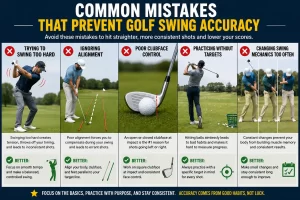
Even golfers who spend hours practicing can struggle to hit consistent, straight shots if they’re making a few common mistakes. The good news is that many accuracy problems aren’t caused by a lack of athletic ability—they’re the result of habits that can be corrected with proper practice and awareness. If you’ve been searching for how to improve golf swing accuracy, avoiding these mistakes can produce noticeable improvements without making major swing changes.
Understanding what causes inconsistent ball striking allows you to spend less time fighting your swing and more time building reliable golf swing mechanics. Whether you’re learning how to improve golf swing accuracy for beginners or looking to fine-tune your game, eliminating these errors is one of the best ways to improve golf swing accuracy.
Trying to Swing Too Hard
One of the biggest myths in golf is that swinging harder automatically leads to better shots. In reality, excessive effort usually creates tension in your hands, arms, and shoulders, making it much more difficult to maintain clubface control and proper swing path control.
When golfers try to overpower the golf ball, they often lose balance, rush the transition from backswing to downswing, and struggle to return the clubface square at impact. The result is usually slices, hooks, and inconsistent contact.
Instead of chasing maximum power, focus on making smooth, balanced swings with solid tempo. You’ll often discover that relaxed swings produce nearly the same distance while dramatically improving accuracy and consistency.
Ignoring Alignment
Many golfers unknowingly aim several yards left or right of their intended target before they even begin the swing. Poor target line alignment forces the body to make last-second compensations that rarely produce consistent results.
Always begin by aligning the clubface directly at your target before positioning your feet, hips, knees, and shoulders parallel to the target line. Using alignment sticks during practice is one of the easiest ways to build consistent setup habits and eliminate unnecessary aiming errors.
Improving alignment alone can significantly improve golf swing accuracy, especially for players who frequently miss the fairway despite making solid contact.
Poor Clubface Control
According to the modern ball flight laws, the clubface has the greatest influence on the golf ball’s starting direction. Even a well-executed swing path can’t overcome a clubface that’s open or closed at impact.
Poor clubface control often causes pushes, pulls, slices, and hooks. Golfers who consistently strike the ball off the heel or toe also struggle with directional control because they fail to achieve centered clubface contact.
Improving your grip, maintaining proper wrist position, and practicing face-awareness drills will help you deliver the clubface square more consistently. Over time, this leads to straighter ball flights and tighter shot dispersion.
Practicing Without Targets
Another common mistake is treating the driving range like a place to simply hit golf balls instead of practicing specific shots. Many golfers stand on the range and hit one club repeatedly without choosing targets or evaluating the quality of each shot.
Purposeful practice is far more effective. Select a different target for every swing, change clubs frequently, and imagine you’re playing an actual round of golf. This approach develops better focus, reinforces good decision-making, and helps you learn how to improve golf swing accuracy consistently under realistic playing conditions.
Adding practice games, pressure drills, and measurable goals keeps every range session productive while accelerating improvement.
Changing Swing Mechanics Too Often
Perhaps the biggest mistake of all is constantly searching for a new swing tip after every poor round. Many golfers watch instructional videos, read articles, or receive conflicting advice from friends, then attempt to change multiple aspects of their swing all at once.
Constantly changing your golf swing mechanics prevents your body from developing consistent movement patterns. Instead of mastering one improvement, golfers end up restarting the learning process over and over.
Choose one area to improve at a time, whether it’s clubface control, swing path control, tempo, or alignment. Practice that change consistently over several weeks before evaluating your results. Small, gradual improvements almost always produce better long-term success than frequent major swing overhauls.
By avoiding these common mistakes, you’ll build a more reliable golf swing that produces straighter shots and lower scores. Combine these corrections with the nine expert tips covered throughout this guide, and you’ll have a proven roadmap for mastering how to improve golf swing accuracy, increasing consistency, and enjoying more confidence every time you step onto the golf course.
Final Thoughts: Improve Your Golf Swing Accuracy One Step at a Time
Learning how to improve golf swing accuracy isn’t about discovering one magical swing tip or making a complete swing overhaul overnight. It’s about mastering the fundamentals, practicing with purpose, and making small improvements that add up over time. Every great golfer, from beginners to tour professionals, builds consistency by focusing on repeatable habits rather than chasing perfection.
Throughout this guide, we’ve covered nine expert strategies that can help you hit straighter, more consistent golf shots. You learned why accuracy is more valuable than distance, how to build a repeatable setup, improve clubface control, develop better swing path control, maintain balance, create smoother tempo, practice with purpose, strengthen your golf swing mechanics, understand the ball flight laws, and follow a structured weekly improvement plan. Together, these proven techniques provide a complete roadmap for golfers who want to improve golf swing accuracy and lower their scores.
The key to lasting improvement is resisting the temptation to change everything at once. Instead, choose one area of your game that needs the most attention and focus on it until it becomes second nature. If your alignment is inconsistent, spend a few practice sessions improving target line alignment. If you’re struggling with slices, concentrate on clubface control and achieving more centered clubface contact. By making one improvement at a time, you’ll build a swing that’s both reliable and repeatable.
Remember, consistency always beats perfection. Every golfer hits an occasional poor shot—even the best players in the world. What separates good golfers from great golfers is their ability to minimize mistakes and repeatedly produce solid swings under pressure. If you’re wondering how to improve golf swing accuracy consistently, the answer lies in developing repeatable fundamentals, practicing with intention, and trusting the process. Small improvements made week after week eventually become significant gains on the golf course.
Most importantly, enjoy the journey. Golf is a game of continuous learning, and every practice session provides an opportunity to become a better player. Stay patient, celebrate your progress, and don’t get discouraged by temporary setbacks. The more you commit to building sound fundamentals, the more confident you’ll become every time you stand over the golf ball.
Ready to take your game to the next level? Keep practicing the techniques you’ve learned in this guide, track your progress, and continue refining your swing one step at a time. If you’re looking for even more in-depth training, step-by-step practice plans, and proven drills to accelerate your improvement, be sure to explore The Golf Swing Lab. With the right instruction and consistent practice, you’ll develop the confidence to hit more fairways, attack more greens, and play your best golf yet.
Improve your driving accuracy for lower scores https://www.golfdigest.com/story/improve-your-driving-accuracy-for-lower-scores
Frequently Asked Questions About How to Improve Golf Swing Accuracy
How can I improve golf swing accuracy consistently?
If you want to learn how to improve golf swing accuracy consistently, start by focusing on the fundamentals that produce repeatable results. Build a consistent setup, maintain proper target line alignment, and work on returning the clubface square at impact. Practice with specific targets instead of simply hitting balls, and develop a pre-shot routine that you use before every swing. Tracking your practice sessions and identifying recurring shot patterns will also help you make smarter adjustments over time. Consistency comes from repeating good habits—not constantly changing your swing.
What are the best ways to improve golf swing accuracy?
Some of the best ways to improve golf swing accuracy include improving clubface control, developing better swing path control, maintaining good balance, and practicing with purpose. Focus on making centered clubface contact rather than swinging as hard as possible. Using alignment sticks, impact tape, and structured practice drills can significantly improve your ball striking. Learning the ball flight laws also allows you to diagnose your misses and make more effective swing adjustments instead of guessing what went wrong.
How do beginners improve golf swing accuracy?
For golfers wondering how to improve golf swing accuracy for beginners, the key is mastering the basics before worrying about advanced swing techniques. Start with a neutral grip, athletic posture, and proper target line alignment. Practice making smooth, controlled swings instead of trying to generate maximum distance. Spend time hitting short and mid-irons before moving to longer clubs, and always aim at a specific target during practice. As your golf swing mechanics become more consistent, your accuracy will naturally improve.
Why do I keep hitting the ball left or right?
Shots that consistently miss left or right are usually caused by poor clubface control, incorrect swing path control, or alignment errors. According to the ball flight laws, the clubface has the greatest influence on the ball’s starting direction. A clubface that’s open at impact often causes pushes and slices, while a closed clubface commonly produces pulls and hooks. It’s also important to check your stance and target line alignment, as many golfers unknowingly aim away from their intended target before they even begin the swing.
Does clubface control matter more than swing path?
Yes. While both are important, clubface control has the greatest influence on where the golf ball initially starts. Modern ball flight laws show that the clubface primarily determines the starting direction of the shot, while the swing path influences how much the ball curves after launch. The ideal combination is a square clubface paired with a neutral swing path. Improving both skills together is one of the fastest ways to improve golf swing accuracy and produce straighter, more consistent shots.
How long does it take to improve golf swing accuracy?
The amount of time it takes to improve depends on how often and how effectively you practice. Golfers who practice two or three times per week with structured drills often notice better contact and tighter shot dispersion within a few weeks. Developing long-term consistency usually takes several months of focused practice. The key is to work on one improvement at a time, track your progress, and avoid making constant swing changes. By practicing with purpose and reinforcing sound golf swing mechanics, you’ll steadily improve your golf swing accuracy and build confidence every time you play.