
How to Master Golf Ball Striking in 9 Powerful Steps
How to Master Golf Ball Striking Consistently
Introduction: How to Master Golf Ball Striking
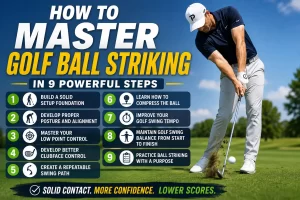
Learning how to master golf ball striking can completely change the way you play golf. You don’t necessarily need more swing speed, expensive equipment, or a picture-perfect golf swing to shoot lower scores. What you need is the ability to make solid, predictable contact often enough that you can trust where the golf ball is going.
Quality ball striking is one of the biggest differences between an inconsistent golfer and a reliable iron player. An inconsistent player might hit one beautiful iron shot followed by a thin shot, a heavy shot, and another that misses well offline. A consistent ball striker may not hit every shot perfectly, but their misses tend to be smaller and their distances much easier to predict.
So, what does good ball striking actually mean?
It starts with centered contact, but there is much more involved. Reliable ball striking requires a predictable low point in the golf swing, control of the clubface, efficient ball compression, and the ability to produce repeatable distances. When these pieces work together, your iron shots can become more accurate and your overall ball flight more predictable.
One important thing to understand when trying to master golf ball striking is that your swing doesn’t have to look perfect. Golfers have succeeded with many different swing styles. What matters most is whether you can repeatedly deliver the club to the golf ball in a position that produces effective contact.
That’s also why randomly trying different golf ball striking tips isn’t always the fastest way to improve. Building consistency becomes much easier when you work through the fundamentals in a logical order. Your setup, posture, low-point control, clubface, swing path, compression, golf swing tempo, and golf swing balance all influence what happens at impact.
In this guide, we’ll break the process down into 9 powerful steps designed to help you understand how to master golf ball striking consistently. We’ll start with basic golf setup fundamentals before progressing into the impact and swing characteristics that influence your contact and iron shot accuracy.
This progression is especially valuable if you’re learning how to improve golf ball striking for beginners because it prevents you from trying to fix everything at once. Instead, you can establish a reliable foundation and gradually build a more repeatable motion around it.
The goal isn’t to chase perfection. It’s to develop a golf swing that produces solid contact more often and gives you greater confidence over every iron shot. Master the fundamentals first, and each of the following steps becomes much easier to apply.
9 Powerful Golf Ball Striking Secrets Every Golfer Needs
Step 1: Build a Consistent Golf Setup
If you want to learn how to master golf ball striking, start by improving what happens before the club ever moves. A consistent setup gives your swing a reliable starting point and makes it much easier to return the club to the ball in a predictable position. Without solid golf setup fundamentals, even a technically sound swing can produce inconsistent contact.
Begin with your stance width. For most standard iron shots, your feet should be approximately shoulder-width apart or slightly narrower. A stance that is too wide can restrict rotation and weight transfer, while a stance that is too narrow may make it difficult to maintain golf swing balance.
Next, pay attention to ball position. With shorter irons, the ball generally sits near the center of your stance. As the clubs become longer, the ball can gradually move slightly forward. Extreme ball positions can change where the club reaches its low point, leading to fat shots, thin shots, or inconsistent ball compression.
Your distance from the golf ball matters as well. Allow your arms to hang naturally rather than reaching excessively toward the ball or standing so close that your arms have no room to swing. Combine this with athletic golf swing posture, including a comfortable hip hinge and slight knee flex.
Weight distribution should feel balanced at address. Avoid starting with excessive pressure on your heels or toes. You want to feel stable enough to rotate while maintaining control throughout the swing.
Grip pressure is another overlooked part of learning how to improve golf ball striking for beginners. Holding the club excessively tight can create unnecessary tension in your hands, arms, and shoulders. Instead, use enough pressure to maintain control without squeezing the club.
Finally, check your alignment. Your feet, hips, and shoulders should generally work together relative to your intended target line. Poor alignment can cause golfers to make unnecessary swing compensations, which can affect clubface control and iron shot accuracy.
Use a Simple Pre-Shot Setup Checklist
One of the best golf ball striking tips is to make your setup repeatable. Before each practice shot, quickly check:
- Target – Choose a specific target and establish your intended line.
- Clubface – Aim the clubface before positioning your body.
- Ball position – Match the position to the iron you’re hitting.
- Stance and posture – Establish a balanced, athletic address position.
- Grip pressure – Stay secure but relaxed.
- Alignment – Check your feet, hips, and shoulders.
- Balance – Make sure you feel stable before beginning the swing.
Many beginners focus immediately on changing their backswing or downswing when their real problem begins at address. If your stance, ball position, posture, and alignment change from shot to shot, your body has to compensate during the swing just to find the ball.
Golfers who want to master golf ball striking should therefore make their setup as repeatable as possible. Build the same foundation before every shot, and you’ll give yourself a much better opportunity to produce centered contact, predictable distance, and a consistent impact position.
Step 2: Improve Your Golf Swing Posture
Proper golf swing posture creates the athletic foundation you need to rotate efficiently, maintain balance, and return the club to the golf ball consistently. If you’re learning how to master golf ball striking, posture deserves serious attention because even small changes in your address position can influence your swing path, low point, and quality of contact.
Good posture doesn’t mean bending excessively toward the golf ball. Instead, establish an athletic position by hinging forward from your hips while keeping your spine in a comfortable, relatively neutral position. Add a slight amount of knee flex rather than squatting toward the ground. Your weight should feel balanced through your feet so you aren’t leaning heavily toward your toes or sitting back on your heels.
Your arms should also hang naturally beneath your shoulders. Reaching too far toward the ball can pull your weight forward and create unnecessary tension. Standing too close can restrict your arms and force you to make compensations during the downswing.
These basic golf setup fundamentals create enough room for your body and arms to work together.
Maintain Your Posture Through the Swing
Establishing good posture at address is only part of the equation. You also need to maintain your basic inclination as you rotate.
Golfers sometimes stand up during the downswing, move their hips toward the ball, or dramatically change their spine position before impact. When this happens, the space available for the arms and club changes. The golfer then has to make last-second adjustments with the hands and arms just to produce contact.
Poor posture can therefore affect both your swing path and low-point control. Moving closer to the ball or changing your height during the swing may contribute to heavy contact, while standing up too early can contribute to thin or inconsistent strikes. Either way, achieving centered contact becomes more difficult.
This is particularly important when learning how to improve golf ball striking for beginners. Instead of immediately trying complicated swing changes, first make sure your body is starting—and moving—from a stable athletic position.
Try This Easy Golf Posture Drill at Home
You can practice proper posture without hitting a single golf ball.
Stand upright while holding a golf club across the front of your hips. Keep your knees relatively relaxed and slowly push your hips backward while allowing your upper body to tilt forward. Once you’ve created a comfortable hip hinge, add a small amount of knee flex and allow your arms to hang naturally.
Hold this position for several seconds, return to standing, and repeat it 10 times.
You can then take your normal address position in front of a mirror and make slow practice swings while watching whether your posture changes dramatically.
One of the most useful golf ball striking tips is to remove unnecessary movement rather than continually adding new swing thoughts. Better golf swing posture gives you more room to rotate, improves golf swing balance, and makes it easier to return the club to a predictable position.
If you want to master golf ball striking, build an athletic posture you can repeat. When your body’s starting position becomes more consistent, producing solid contact becomes much easier.
Best Golf Training Program For Beginners: Why Most Golfers Never Improve
Step 3: Master Your Low Point Control
If you’re trying to learn how to master golf ball striking, low-point control is one of the most important skills you can develop. You can have excellent golf swing posture, good tempo, and plenty of clubhead speed, but if the bottom of your swing arc changes from shot to shot, consistent iron contact will remain difficult.
The low point is the lowest part of the clubhead’s arc as it travels through the hitting area. With most standard iron shots, the goal is for the clubface to contact the golf ball first and then continue downward into the turf. This is what allows golfers to create clean contact and effective ball compression without trying to scoop the ball into the air.
A useful clue is the location of your divot. With a well-struck iron shot from turf, the divot typically begins at or slightly ahead of where the golf ball was positioned—not several inches behind it. You don’t need to take a huge divot, but the location of the turf interaction can tell you a lot about your low-point control.
Why Fat and Thin Iron Shots Happen
A fat shot occurs when the club contacts the ground too far behind the ball. This can happen when pressure remains on the trail side too long, the body moves excessively away from the target, or the golfer tries to help the ball into the air.
A thin shot occurs when the club catches the ball too high on the face or near its bottom edge. Standing up through impact, losing posture, or moving the low point unpredictably can all contribute.
One of the keys to learning how to strike a golf ball consistently is allowing pressure to move toward the lead side during the downswing. This doesn’t mean aggressively lunging toward the target. Instead, the movement should help position the bottom of the swing arc far enough forward to produce ball-first contact.
Practice the Line Drill
One of the simplest golf ball striking tips for improving low-point control is the line drill.
Draw a straight line on the ground at the practice range and place the golf ball directly on the line. Hit short iron shots while focusing on contacting the ball and then brushing the turf on the target side of the line.
No ball? Practice making swings while trying to strike the ground just beyond the line.
You can also use a towel drill. Place a small towel several inches behind the golf ball. Make controlled swings while striking the ball without hitting the towel. If you repeatedly contact the towel first, your swing is bottoming out too early.
Beginners shouldn’t overcomplicate these drills with several mechanical swing thoughts. Start with half swings at a comfortable speed and focus on one simple objective: ball first, ground second.
As your low point becomes more predictable, you’ll begin producing cleaner contact, improved iron shot accuracy, more reliable distances, and better compression. Golfers who want to master golf ball striking don’t need every swing to be perfect—they need the club to reach the bottom of its arc in a predictable place.
Develop that skill, and you’ll have taken one of the biggest steps toward learning how to master golf ball striking consistently.
Step 4: Develop Better Clubface Control
If you want to learn how to master golf ball striking, you need more than solid contact—you also need control over where the golf ball starts and how it flies. That’s where clubface control becomes essential. A golfer can strike the center of the face and still miss the target badly if the clubface is significantly open or closed at impact.
For a right-handed golfer, an excessively open clubface can contribute to shots that start right or curve farther to the right, depending on the relationship between the face and swing path. A significantly closed face can send shots left or contribute to excessive draw or hook curvature. The opposite directions apply to left-handed golfers.
With iron shots, the clubface has a major influence on the ball’s initial starting direction. Your swing path also matters, especially when determining curvature, but improving face control can make your misses far more predictable.
Build Clubface Control Without Manipulating Your Hands
Your grip is one of the first places to look when working on face control. Because your hands are your connection to the golf club, an extremely strong, weak, or inconsistent grip can make returning the clubface predictably much more difficult.
Your lead wrist also influences the orientation of the clubface throughout the swing. Golfers don’t need to consciously force their wrist into an extreme position, but understanding the relationship between the lead wrist and clubface can help identify why the face repeatedly arrives open or closed.
One common mistake is trying to correct the clubface with a last-second flip of the hands. This may occasionally produce a great shot, but timing a rapid hand manipulation through impact is difficult to repeat. One of the most valuable golf ball striking tips is to develop a motion that requires fewer last-second compensations.
Try a Simple Clubface Awareness Drill
Start with a short iron and hit controlled half-swing shots toward a specific target approximately 50 to 75 yards away. Instead of focusing on distance, watch the ball’s starting direction.
Hit five to ten shots and look for a pattern. Are most starting left? Right? Near the target?
Next, make several slow practice swings and become aware of where the clubface is pointing at different stages of the swing. You can also stop shortly after impact and inspect the face rather than immediately finishing the motion. The goal isn’t to freeze the clubface perfectly square; it’s to develop awareness of what your club is doing.
As your control improves, gradually increase your swing length while maintaining the same target-oriented approach.
Golfers learning how to strike a golf ball consistently should measure success by predictable patterns, not the occasional perfect shot. Ten shots that finish within a manageable area are generally more useful than one spectacular iron followed by several large misses.
Better clubface control, combined with the low-point control from the previous step, can dramatically improve iron shot accuracy, centered contact, and confidence. To master golf ball striking, build a clubface you can deliver predictably—not one you have to rescue at the last second.
Here’s How Golfers Master Their Golf Ball Striking Without Spending Thousands On Lessons https://ultimategolfmasterypro.com/the-golf-swing-lab-2/
Step 5: Create a Repeatable Swing Path
A repeatable swing path is an important part of learning to master golf ball striking because it influences contact, starting direction, and ball flight. When the club approaches the golf ball from a dramatically different direction on every swing, it becomes much harder to control the clubface and consistently find the center of the face.
Swing path refers to the direction the clubhead is traveling through impact relative to the target line. A club can travel from the inside, from the outside, or relatively close to the target line. These are commonly described as inside-out, outside-in, and neutral swing paths.
Golfers sometimes assume they need a perfectly straight path to hit excellent shots. That’s not necessarily the case. Good players can produce effective shots with paths that travel slightly from the inside or outside. What matters more is whether the path is functional, repeatable, and works with the position of the clubface.
Understand the Clubface-to-Path Relationship
The relationship between the clubface and swing path plays an important role in determining shot curvature. For a right-handed golfer, a clubface that is open relative to the path can contribute to fade or slice spin, while a face that is closed relative to the path can contribute to draw or hook spin. The opposite applies to left-handed golfers.
Problems become more noticeable when these differences are excessive. A golfer swinging dramatically outside-in while leaving the face open can produce a large slice. An excessive inside-out path combined with a significantly closed face can produce a severe hook.
Instead of trying to manufacture a perfectly straight swing, work toward making your path more predictable.
Proper sequencing can help. When the body, arms, and club work together during the transition and downswing, you’re less likely to make dramatic compensations before impact. Rushing the upper body from the top, losing golf swing balance, or throwing the club outward can make the path much harder to control.
Try a Simple Swing Path Drill
Place two golf tees or small objects slightly wider than the clubhead, creating a small “gate” around the ball. Start with controlled half swings and try to send the clubhead through the gate without striking either object.
Another option is to place an alignment stick on the ground along your target line. Make slow practice swings while observing how the club approaches the hitting area. The goal isn’t to force the club directly along the stick. Instead, use it as a visual reference to recognize when your path becomes excessively inside-out or outside-in.
These drills are particularly useful when learning how to improve golf ball striking for beginners because they provide immediate feedback without requiring complicated technical thoughts.
As your swing path becomes more consistent, your clubface has a better opportunity to return to the ball predictably. This can improve centered contact, iron shot accuracy, and overall shot dispersion.
One of the most useful golf ball striking tips is to stop chasing one perfect swing and start developing repeatable patterns. Combine a functional swing path with good clubface and low-point control, and you’ll be much closer to producing solid iron shots you can trust on the golf course.
Step 6: Learn How to Compress the Golf Ball
Learning how to create effective ball compression is one of the most important parts of developing reliable iron play. If you want to master golf ball striking, compression helps turn an ordinary strike into the powerful, controlled contact golfers often describe as feeling almost effortless.
But what does compressing a golf ball actually mean?
With an iron, compression occurs when the clubface strikes the ball solidly while the club is being delivered with appropriate loft and a controlled impact position. The ball briefly deforms against the clubface before launching forward. From a technique standpoint, golfers usually associate good compression with ball-first contact, a predictable low point, appropriate dynamic loft, and pressure moving toward the lead side.
The key phrase is ball first. On most standard iron shots from the turf, the club should strike the golf ball before reaching the bottom of its swing arc. The club can then continue into the ground after impact. This creates the solid strike golfers are looking for without needing to scoop or lift the ball.
Understand Dynamic Loft and Shaft Lean
Dynamic loft is the amount of loft presented by the clubface at impact rather than simply the club’s stated loft. Your impact position can increase or decrease that loft.
Some forward shaft lean can accompany a compressed iron strike, but don’t make the mistake of aggressively dragging the handle toward the target. Excessive handle dragging can disrupt your natural release and create new contact problems.
Instead, focus on creating a balanced impact position where pressure has moved toward your lead side and the club can continue through the ball naturally.
This is also why trying to lift the golf ball into the air can hurt your contact. Your irons already contain loft. You don’t need to scoop underneath the ball. Trying to help it upward can move your low point behind the ball, contributing to fat and thin shots.
Compression Doesn’t Mean Swinging Harder
One of the most important golf ball striking tips is to separate compression from raw swing speed. Swinging harder doesn’t automatically create better compression.
In fact, increasing speed without controlling your low point, clubface, and balance can make contact worse.
Quality compression comes from efficient delivery. When you produce solid iron contact, you’ll often notice a more penetrating trajectory, predictable distance, improved feel, and better iron shot accuracy without feeling as though you’re trying to overpower the golf ball.
Practice This Simple Compression Drill
Take a short or mid-iron and begin with half swings. Place the ball in your normal position and choose a spot on the ground slightly ahead of it. Your objective is simple: strike the ball and then allow the club to brush the turf beyond where the ball was sitting.
You can also use the line drill from Step 3. Draw a line on the turf, place the ball on the line, and monitor where the club contacts the ground. Consistently disturbing the turf on the target side of the line provides useful feedback about your low point.
Start slowly. Don’t chase maximum distance.
Golfers learning how to strike a golf ball consistently should first develop reliable contact and then gradually add speed. Once your setup, low point, clubface, and pressure movement become more predictable, compression can begin to happen naturally.
That’s the real goal of ball compression: not forcing the golf ball into the air or swinging as hard as possible, but delivering the club efficiently enough to create crisp, powerful, repeatable iron shots.
Step 7: Improve Your Golf Swing Tempo
You can have solid mechanics and still struggle with inconsistent contact if your timing changes from swing to swing. That’s why improving golf swing tempo is such an important part of learning how to master golf ball striking consistently. A repeatable rhythm helps your body, arms, hands, and club work together instead of competing with one another.
Golf swing tempo refers to the overall timing and rhythm of your swing, particularly the relationship between the backswing and downswing. Your ideal tempo doesn’t need to match another golfer’s. Some successful players naturally swing faster, while others have slower-looking motions. What matters is developing a rhythm you can reproduce.
One of the most common tempo problems occurs during the transition. Golfers reach the top of the backswing and suddenly rush the downswing because they want to generate more power. This can throw off sequencing, disrupt golf swing balance, change the swing path, and make controlling the clubface more difficult.
Remember that smooth doesn’t necessarily mean slow. You can make an athletic, powerful golf swing while maintaining good rhythm. The goal is controlled acceleration rather than suddenly attacking the ball from the top.
Try a Simple Counting Drill
One of the easiest golf ball striking tips for improving tempo is to use a simple count.
As you make your backswing, count:
“One…two…”
Then begin the downswing on:
“Three.”
The exact numbers aren’t important. The purpose is to establish a rhythm you can repeat.
Start with short iron shots and gradually increase the length of your swing while maintaining the same cadence. Before hitting each ball, make one or two practice swings using your preferred rhythm. Then step into the shot and recreate that feeling.
Tempo becomes especially important under pressure. When golfers face a difficult shot, hazard, tight fairway, or important approach, they often speed up without realizing it. A consistent pre-shot routine and one relaxed practice swing can help preserve your normal rhythm.
If you’re trying to master golf ball striking, don’t judge tempo solely by how fast the club appears to move. Pay attention to whether your body, arms, and club remain synchronized.
When your golf swing tempo becomes predictable, it becomes easier to control your low point, maintain posture, deliver the clubface consistently, and produce solid contact. Instead of searching for more speed, develop a rhythm you can trust. That repeatable timing can become one of your greatest assets when learning how to strike a golf ball consistently.
Step 8: Maintain Golf Swing Balance From Start to Finish
Good golf swing balance involves much more than simply posing in a perfect finish after the ball is gone. Balance affects your ability to control your body throughout the entire motion, which directly influences swing path, low-point control, clubface delivery, and centered contact.
If you want to master golf ball striking, you need enough stability to generate speed without losing control of your movement.
It helps to understand the difference between pressure and weight. Golfers often talk about shifting their weight, but what you actually feel beneath your feet is changing pressure. During the backswing, pressure can increase under the trail foot as the body rotates. During the transition and downswing, pressure moves toward the lead side.
This movement should happen without excessive swaying.
If your entire body slides dramatically away from the target during the backswing, returning to a predictable impact position becomes much more difficult. Instead, focus on rotating while remaining relatively centered and allowing pressure to move naturally beneath your feet.
Don’t Sacrifice Balance for Swing Speed
Overswinging is one of the easiest ways to destroy balance. Golfers sometimes make an excessively long backswing because they believe a bigger motion automatically produces more distance. If that extra movement causes you to lose posture, sway, or struggle to return the club to the ball, the additional speed isn’t helping.
A controlled swing producing centered contact can be much more effective than a faster swing that repeatedly misses the center of the clubface.
Your finish provides useful feedback. After hitting an iron shot, you should generally be able to hold your finish with most of your pressure on the lead side without stumbling forward, backward, or sideways.
Practice Two Simple Balance Drills
First, try the feet-together drill. Hit short shots with your feet positioned close together. Begin with slow half swings. Because your base is narrower, excessive movement becomes easier to notice. Focus on maintaining your golf swing posture and allowing your body to rotate without losing stability.
Next, use the hold-the-finish drill. Hit a normal shot and hold your finish for three to five seconds. If you consistently struggle to remain stable, gradually reduce your swing speed until you can finish under control.
These drills can also improve golf swing tempo because rhythm and balance are closely connected. When you rush the transition or swing beyond your ability to remain stable, both tend to suffer.
One of the most useful golf ball striking tips is to find the fastest swing you can make while still maintaining control—not simply the fastest swing possible.
Golfers learning how to improve golf ball striking for beginners should prioritize balance before chasing additional speed. Combine controlled pressure movement, stable posture, repeatable tempo, and a balanced finish, and you’ll create a much stronger foundation for consistent contact.
Ultimately, better ball striking comes from controlling the entire motion. When balance and tempo work together, you’ll have a much better chance of producing the same quality strike swing after swing.
Step 9: Practice Ball Striking With a Purpose
The final step in learning how to master golf ball striking is turning everything you’ve worked on into a repeatable skill. You can understand setup, posture, low-point control, clubface position, swing path, compression, tempo, and balance, but those improvements need purposeful practice before they become reliable on the golf course.
Simply hitting hundreds of range balls isn’t necessarily effective practice. If you hit one ball after another without a target, routine, or specific objective, you may actually reinforce the same mistakes you’re trying to eliminate.
Think quality over quantity. Fifty focused shots can be more productive than hitting 150 balls as quickly as possible.
Combine Block Practice With Random Practice
Block practice means repeatedly working on the same skill under similar conditions. For example, you might hit 15 controlled shots with an 8-iron while focusing specifically on low-point control and centered contact.
This is useful when developing or correcting a skill.
Random practice makes your session more like playing golf. Instead of repeatedly hitting the same club toward the same target, change clubs, targets, distances, or shot types. You might hit a pitching wedge to one target, a 7-iron to another, and then a 5-iron toward a third.
Both forms of practice have value. Use block practice to develop technique and random practice to test whether that technique holds up when the task changes.
Give Every Practice Shot a Purpose
Start with shorter clubs and controlled swings. Don’t immediately grab a long iron and swing at maximum speed. Build confidence with shorter shots before gradually increasing swing length and speed.
Set a specific goal for each practice segment. For example:
- Produce ball-first contact on 8 of 10 shots.
- Hit the center portion of the clubface 7 of 10 times.
- Finish balanced for 10 consecutive swings.
- Start 6 of 10 shots within your intended target window.
Use impact feedback whenever possible. Impact tape, foot spray designed for appropriate practice use, or other clubface feedback methods can help identify where you’re striking the face. Track whether your misses tend to occur toward the heel, toe, high, or low on the clubface.
Over time, the goal is to make your strike pattern smaller and more predictable.
Take Your Ball Striking to the Golf Course
To learn how to master golf ball striking consistently, your range routine eventually needs to resemble actual golf.
Choose different targets and go through your complete pre-shot routine before every ball. Stand behind the shot, select your target, establish your alignment, take your setup, and make the swing. Avoid repeatedly dragging another ball into position and firing away.
You can even simulate playing holes by changing clubs after every shot.
Finally, measure your progress. Track centered strikes, fat and thin shots, target accuracy, and overall shot dispersion from week to week. This gives you something more meaningful than judging an entire practice session based on your best or worst shot.
The most effective golf ball striking tips aren’t magical fixes. Great ball striking develops when sound mechanics are combined with deliberate, consistent practice.
If you truly want to master golf ball striking, stop searching for one swing thought that fixes everything. Build the fundamentals, practice them with a purpose, measure your results, and gradually turn better technique into a repeatable golf skill you can trust when it matters.
Common Golf Ball Striking Mistakes to Avoid
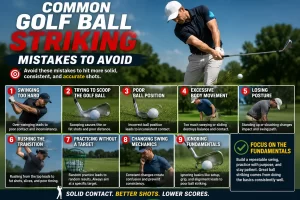
Improving your ball striking isn’t only about learning what to do correctly. It’s also about eliminating habits that make solid contact unnecessarily difficult. Many golfers unknowingly repeat the same mistakes during practice and then wonder why their contact changes dramatically from one round to the next.
One of the biggest mistakes is swinging too hard. More clubhead speed can produce additional distance, but only when you maintain control. Swinging beyond your ability to maintain golf swing balance and centered contact can lead to inconsistent strikes, poor direction, and unpredictable distances. A controlled swing that finds the center of the clubface is often more effective than an all-out swing that misses it.
Another common problem is trying to scoop the golf ball into the air. Your irons already have loft designed to launch the ball. Trying to help the ball upward can move the bottom of your swing behind it, producing fat or thin contact and reducing ball compression.
Ball position also deserves attention. If the ball moves significantly forward or backward from one shot to another, your impact conditions can change even when the swing itself remains similar. Consistent golf setup fundamentals make it much easier to establish a predictable low point.
Stop Making Unnecessary Swing Compensations
Excessive body movement can make consistent contact much harder. Large lateral sways, dramatic changes in height, and unnecessary movement toward or away from the golf ball force you to compensate during the downswing.
Similarly, losing your golf swing posture can alter the space available for your arms and club. This can change your swing path and make centered contact more difficult.
Another mistake is rushing the transition. When golfers suddenly accelerate from the top of the backswing, their arms and body can lose synchronization. Developing smoother golf swing tempo can improve sequencing without sacrificing speed.
Your practice habits matter too. Hitting ball after ball without selecting a target gives you little information about your actual iron shot accuracy. Every practice shot should have an intention, whether you’re working on strike location, trajectory, starting direction, distance, or a specific target.
Perhaps the most damaging habit is changing your swing mechanics after every poor shot. One bad strike doesn’t necessarily mean your technique needs an overhaul. Golf contains natural variability, and even excellent players hit imperfect shots.
Instead, look for patterns. If the same miss appears repeatedly, determine whether setup, low point, clubface, path, tempo, or balance is contributing to it.
Some of the best golf ball striking tips are surprisingly simple: establish a repeatable setup, maintain athletic posture, stay balanced, control your tempo, and practice with a purpose.
Golfers who continually ignore these fundamentals often search for increasingly complicated solutions. In reality, learning how to strike a golf ball consistently usually comes from doing the basics exceptionally well—and repeating them often enough that they become dependable.
Conclusion: Master Golf Ball Striking One Step at a Time
Great ball striking doesn’t develop from discovering one secret swing move. It comes from building repeatable fundamentals and gradually improving the different pieces that determine what happens at impact. When your setup, movement, and practice habits become more consistent, your contact has a much better chance of becoming consistent as well.
Throughout these nine steps, we’ve covered the major areas that can help you master golf ball striking. Start with a dependable setup and athletic golf swing posture. Develop better low-point control so you can produce ball-first contact, then improve your clubface control and swing path to create more predictable starting directions and ball flights.
From there, learn how proper impact conditions create better ball compression rather than trying to scoop the ball into the air. Develop a repeatable golf swing tempo, maintain golf swing balance from address through the finish, and finally turn those improvements into dependable performance through deliberate practice.
The important thing is not to work on all nine areas simultaneously.
If you’re currently struggling with fat and thin shots, spend more time on setup and low-point control. If you’re making solid contact but consistently missing left or right, investigate your clubface and swing path. If your contact disappears whenever you try to generate more distance, work on tempo and balance before adding more speed.
Focusing on one or two weaknesses at a time makes improvement easier to measure and prevents your swing from becoming overloaded with mechanical thoughts.
You should also expect progress to take time. Even when you understand exactly what you’re trying to accomplish, your body needs repetition to turn a new movement into a dependable skill. That’s why purposeful practice is more valuable than constantly searching for the next quick fix.
If you want to know how to master golf ball striking consistently, focus on building a process you can repeat. Establish your setup, choose a target, make a balanced swing, evaluate the result, and use that feedback to guide your next shot.
Don’t judge your progress by whether every iron shot is perfect. Instead, look for smaller misses, more centered strikes, improved iron shot accuracy, better distance control, and fewer fat or thin shots.
The next time you practice, choose the weakest of these nine areas and spend part of your session working specifically on it. Track your results and continue until that skill becomes more dependable before moving to the next.
Master the fundamentals one step at a time, practice them with purpose, and you’ll build a golf swing capable of producing the solid, predictable contact you’ve been searching for.
7 Best Ball Striking Tips Ever! https://www.golfmonthly.com/tips/7-best-ball-striking-tips-ever-204341
Frequently Asked Questions About How to Master Golf Ball Striking
How can I master golf ball striking?
Learning how to master golf ball striking starts with developing repeatable fundamentals rather than searching for one perfect swing. Build a consistent setup and athletic posture, then improve low-point and clubface control. From there, work on a functional swing path, effective ball compression, repeatable golf swing tempo, and good balance. Deliberate practice ties everything together by helping these skills become more automatic and dependable on the golf course.
How do I strike a golf ball consistently?
If you’re learning how to strike a golf ball consistently, focus first on creating conditions you can repeat. Use consistent ball position, alignment, posture, and grip pressure before every swing. Then work on controlling the bottom of your swing arc so your iron contacts the ball before the turf. Combine this with centered contact, predictable clubface delivery, and a repeatable rhythm. Consistency doesn’t mean hitting every shot perfectly; it means making your good shots and misses increasingly predictable.
How can beginners improve golf ball striking?
One of the best approaches for how to improve golf ball striking for beginners is keeping the process simple. Start with basic golf setup fundamentals and short, controlled swings rather than immediately trying to make complicated mechanical changes. Practice making centered, ball-first contact with wedges and short irons before progressing toward longer clubs. As contact improves, gradually increase swing length and speed while maintaining balance and control.
What is the secret to good ball striking?
There isn’t one secret move that guarantees great ball striking. Reliable contact comes from combining several skills, including a consistent setup, predictable low point, controlled clubface, functional swing path, good posture, balance, and efficient impact conditions. The best golf ball striking tips usually reinforce these fundamentals rather than promising an instant fix. The ultimate goal is developing movements that can be repeated under different conditions and levels of pressure.
How do I improve ball striking with my irons?
Start by improving ball position and low-point control. With most standard iron shots from the turf, you want the club to contact the golf ball before reaching the bottom of the swing arc. Maintain a stable clubface, allow pressure to move toward your lead side, and avoid trying to scoop the ball upward. Better ball compression, controlled tempo, and centered contact can improve both distance control and iron shot accuracy.
Why is my golf ball striking so inconsistent?
Inconsistent contact can have several causes. Your setup or ball position may change between shots, your low point may move unpredictably, or poor golf swing balance may force last-second compensations. Swinging excessively hard, rushing the transition, and struggling with clubface control can create additional problems. Practice habits matter too. If you constantly change mechanics after individual bad shots, it becomes difficult to develop a repeatable movement. Look for recurring patterns instead of reacting to every miss.
Does golf swing tempo improve ball striking?
Yes, developing repeatable golf swing tempo can make consistent contact easier. Good tempo helps coordinate your body, arms, hands, and club throughout the motion. Golfers who suddenly rush the transition can disrupt their sequencing, balance, swing path, and clubface delivery. Your ideal tempo doesn’t have to be slow; it simply needs to be controlled and repeatable. Using practice swings or a simple counting drill can help establish a rhythm you can reproduce.
How can I practice ball striking at the driving range?
Begin with wedges or short irons and controlled half swings while focusing on centered, ball-first contact. You can use a line drill to monitor low-point control and clubface feedback to track strike location. Once contact becomes more reliable, progress to fuller swings and longer clubs. Finish your session with target-based practice by changing clubs and targets regularly and using your complete pre-shot routine. This progression helps transfer technical improvements into the type of variable practice you’ll need on the golf course.