
How to Strike a Golf Ball Consistently: 9 Proven Ways
How to Strike a Golf Ball Consistently With Your Irons
Introduction: How to Strike a Golf Ball Consistently

Few things in golf are more frustrating than hitting one shot perfectly—solid contact, great flight, right at the target—only to follow it with a thin shot, a fat shot, a topped ball, or one that flies wildly offline. When your contact changes from swing to swing, it becomes difficult to build confidence because you never quite know which version of your golf swing will show up.
Learning how to strike a golf ball consistently doesn’t require building a technically perfect swing. In fact, many golfers make improvement harder by constantly changing their mechanics in search of perfection. Consistent golf ball striking comes from controlling a handful of fundamentals that influence what happens before, during, and immediately after impact.
It begins with a repeatable setup and posture combined with the correct ball position. From there, developing centered contact and reliable low point control can dramatically reduce fat and thin shots. Better clubface control and a predictable swing path help improve both starting direction and shot shape, while proper ball compression can produce stronger, more penetrating iron shots.
Your golf swing tempo matters too. A balanced, repeatable rhythm can make it easier to coordinate these fundamentals instead of rushing the downswing or trying to generate maximum power on every shot. Most importantly, purposeful practice helps turn better mechanics into skills you can actually trust under pressure.
In this guide, you’ll discover nine proven ways to strike a golf ball consistently, develop more predictable contact, and take your improved ball striking from the practice range onto the golf course.
How to Improve Golf Ball Striking in 7 Simple Steps
1. Build a Consistent Setup Before Every Golf Shot
If you want to learn how to strike a golf ball consistently, start by improving what happens before the club ever moves. A repeatable golf swing becomes much harder to produce when your setup changes from one shot to the next. Even small differences in posture, alignment, stance width, or distance from the ball can force your body and club to make compensations during the swing.
Begin with an athletic golf posture. Bend naturally from the hips, allow a slight flex in your knees, and keep your upper body relaxed rather than hunched or excessively upright. Your arms should hang comfortably beneath your shoulders, helping you establish the proper distance from the golf ball.
Stance width should also remain predictable. With most mid-irons, a stance around shoulder width provides a stable foundation while still allowing your body to rotate. Shorter clubs may require a slightly narrower stance, while longer clubs can benefit from a little additional width.
Alignment is another major component of consistent golf ball striking. Your feet, hips, and shoulders should work together relative to your intended target line. If your shoulders point significantly left or right while your feet are aligned differently, you may unconsciously alter your swing path or manipulate the clubface to compensate.
Your grip deserves the same attention. Constantly changing grip pressure or hand position can influence clubface control and make it difficult to produce predictable shots. Aim for a secure but comfortable grip that you can reproduce every time.
Balanced weight distribution completes the foundation. Avoid beginning with excessive pressure on your toes or heels. You should feel athletic, centered, and ready to move without losing balance.
Why Setup Is Especially Important for Beginners
When learning how to strike a golf ball consistently for beginners, advanced swing mechanics shouldn’t be the first priority. Developing a repeatable setup gives the golf swing a consistent starting point.
Create a simple pre-shot routine: choose your target, establish the clubface position, set your feet, check your posture and ball position, settle into your grip, and then swing.
The more consistently you prepare for each shot, the fewer compensations you’ll need once the club starts moving. That’s an important first step toward learning how to improve golf ball striking consistently and building a swing you can trust on the course.
2. Use the Correct Ball Position for Each Club
Ball position plays a major role in learning how to strike a golf ball consistently because it influences where the club reaches the bottom of its swing arc. Even with a solid golf swing, inconsistent ball position can change your contact, launch, and direction from one shot to the next.
With short irons and wedges, the ball is generally played near the center of your stance. This position helps encourage ball-first contact while allowing the club to reach its low point slightly ahead of the ball.
For mid-irons, the ball can move slightly forward of center. As you progress into long irons and hybrids, position it a little farther toward your lead foot. Fairway woods are typically played farther forward still, helping you produce a shallower strike while maintaining solid contact.
The driver requires the most forward ball position, usually around the inside of the lead heel. Unlike an iron, where you generally want the low point to occur after impact, the driver is commonly struck as the club approaches or moves upward from the bottom of its arc.
Problems appear when these positions become exaggerated. Playing an iron too far forward can make it difficult to reach the ball before the club bottoms out, potentially producing thin shots, weak contact, or inconsistent strikes. Playing the ball too far back can encourage an excessively steep strike, lower launch, and unwanted changes to your swing path and clubface control.
This is why ball position and low point control are closely connected. If you’re trying to develop consistent golf ball striking, you need the ball to appear in a predictable location relative to the bottom of your swing.
Simple Ball Position Check
Try this easy drill on the practice range. Place one alignment stick on the ground along your target line. Position a second stick perpendicular to it, pointing toward the ball.
Hit several shots with the same club, resetting your feet after every swing. Before hitting each ball, check its position against the perpendicular alignment stick. This prevents your ball position from gradually drifting without you noticing.
Repeat the drill with a short iron, mid-iron, hybrid, fairway wood, and driver to learn how the position changes throughout your set.
If you’re working on how to improve golf ball striking consistently, don’t overlook this seemingly simple fundamental. A predictable ball position gives your swing a consistent reference point, improves low point control, and makes reliable contact much easier to repeat.
Knowing how to strike a golf ball consistently is one thing. Turning those fundamentals into a repeatable swing you can trust under pressure is the real goal. If you’re tired of temporary fixes and want a clearer path toward better consistency, accuracy, and confidence, The Golf Swing Lab can help you put the pieces together.
3. Master Low Point Control for Ball-First Contact
One of the most important skills for learning how to strike a golf ball consistently is controlling the low point of your swing. The low point is simply the lowest point the clubhead reaches during its swing arc. With iron shots, controlling where that point occurs can make the difference between crisp contact and frustrating fat or thin shots.
For a solid iron strike, the club should generally contact the golf ball first and then continue downward into the turf. This means the low point of the swing occurs slightly ahead of the ball. When you see a good golfer take a divot with an iron, the divot typically begins after the location where the ball was sitting.
When the club reaches the ground before the ball, you get a fat shot. The turf absorbs energy from the clubhead before impact, often resulting in a short, weak shot. A thin shot occurs when the club catches the ball too high on the clubface or near its lower edge, frequently because the bottom of the swing arc isn’t occurring in the correct place.
Maintaining your posture through impact can help improve low point control. Excessively standing up, falling backward, or changing your body position during the downswing makes it much harder to predict where the club will meet the ground.
Pressure should also move toward your lead side as you approach impact. Hanging excessively on your trail side can shift the bottom of the swing backward and contribute to ground-first contact. You don’t need an exaggerated weight shift, but you should be able to finish balanced with pressure predominantly on your lead side.
For consistent golf ball striking, pay attention not only to where the ball travels but also to where your club contacts the ground.
Low Point Control Drill
A simple line drill can provide immediate feedback.
Create a straight line on the practice ground and place the golf ball just behind it relative to the target. Set up normally and hit an iron shot with the goal of contacting the ball first and having the club enter the turf on the target side of the line.
Practice initially with controlled half and three-quarter swings. Don’t worry about maximum distance. Concentrate on repeatedly moving the bottom of your swing to the correct location.
If you’re trying to understand how to improve golf ball striking consistently, mastering this skill should be a priority. Once your low point becomes predictable, ball-first contact, ball compression, and overall iron consistency become much easier to achieve.
4. Focus on Centered Contact With the Clubface
You can have a golf swing that looks technically sound and still struggle with inconsistent shots if the ball keeps contacting different areas of the clubface. That’s why centered contact is another essential part of learning how to strike a golf ball consistently.
Ideally, you want the ball contacting near the center of the clubface as often as possible. When this happens, more of the club’s energy is efficiently transferred into the golf ball, helping produce predictable distance, trajectory, and direction.
Contact toward the heel can alter ball flight and reduce consistency, while toe strikes can cost distance and produce unpredictable results. Thin strikes—where contact occurs low on the clubface—can create low, weak shots that feel noticeably different from a solid strike.
These misses aren’t just about losing a few yards. When strike location constantly changes, it becomes extremely difficult to predict distance. One 7-iron might fly your expected yardage while the next comes up significantly short even though the swings felt almost identical.
One of the easiest ways to improve is to get immediate feedback. Apply impact spray to the clubface before hitting several shots. You can also use another suitable clubface-contact indicator. After each shot, look at where the ball actually struck the face rather than relying entirely on feel.
You may quickly discover a pattern. For example, several consecutive toe strikes provide much more useful information than simply thinking, “I didn’t hit that one very well.”
Developing this awareness is one of the foundations of learning how to improve golf ball striking consistently.
Centered Contact Practice Drill
Start with a short or mid-iron and make several half swings. Your only objective is producing centered contact—not hitting the ball as far as possible.
Once you can repeatedly find the center of the clubface, progress to three-quarter swings. Continue checking your strike location after every shot.
Only move to full swings once your contact remains predictable.
Think of the progression as:
Half swings → three-quarter swings → full swings.
If your contact becomes scattered when you increase speed or swing length, return to the previous stage.
This drill teaches an important lesson about consistent golf ball striking: you don’t need to swing harder to improve. First learn to find the center of the clubface repeatedly. Once centered contact becomes reliable, you can gradually add speed while maintaining the quality of your strike.
5. Improve Clubface Control Through Impact
If you want to understand how to strike a golf ball consistently, you need to pay close attention to what the clubface is doing at impact. Clubface orientation has a major influence on the golf ball’s starting direction, so even solid contact can produce disappointing results when the face isn’t controlled.
A clubface that is relatively square to your intended target at impact gives you a much better chance of starting the ball where you want. An open clubface can send the ball farther right of the intended line for a right-handed golfer, while a closed clubface can send it farther left. The opposite applies to a left-handed golfer.
Your grip plays an important role in clubface control. If your hand position or grip pressure changes every few swings, the clubface can arrive at impact differently even when the rest of your motion feels similar. Developing a comfortable, repeatable grip gives you a more predictable starting point.
Another common mistake is excessive hand manipulation during the downswing. Golfers who see the ball starting offline may try to consciously twist, roll, or “flip” their hands at the last moment to square the clubface. Unfortunately, impact happens far too quickly for this to become a reliable correction.
Instead, work toward a repeatable release where your body rotation, arms, wrists, and club work together naturally through the hitting area. You want to maintain control through impact rather than trying to manufacture the correct clubface position at the last second.
Clubface control also works closely with centered contact. Finding the middle of the clubface becomes much more valuable when the face is delivered predictably. Combining these skills helps produce better starting direction, distance control, and consistent golf ball striking.
Clubface Awareness Drill
Choose a short iron or wedge and pick a specific target on the practice range. Start by hitting controlled half or three-quarter shots rather than full swings.
For this drill, don’t worry about distance. Instead, watch where each ball starts relative to your target.
Hit five to ten shots and look for a pattern. Are most starting left? Right? Or close to your intended line?
Avoid making dramatic changes after one poor shot. Look for repeated tendencies instead. As your starting direction becomes more predictable, gradually increase the length of your swing while maintaining the same rhythm and grip.
This simple exercise can help you develop the clubface awareness necessary to strike a golf ball consistently without relying on last-second compensations through impact.
You can practice your setup, ball position, and contact for hours—but one small swing mistake can keep bringing those frustrating fat, thin, and inconsistent shots back. If you’re learning how to strike a golf ball consistently but still can’t make your best swing show up on the course, the problem may be something you’re overlooking here’s how to fix it
6. Develop a Repeatable Swing Path
Another important part of learning how to strike a golf ball consistently is developing a swing path you can repeat. Swing path simply describes the direction the clubhead is traveling as it moves through impact relative to your target line.
For a right-handed golfer, an inside-to-out swing path means the clubhead is traveling slightly to the right of the target line through impact. An outside-to-in path means it is traveling to the left. A neutral swing path travels relatively close to the target line. The directions are reversed for left-handed golfers.
None of these paths automatically guarantees a good or bad golf shot. Problems tend to develop when the path becomes excessive or changes dramatically from swing to swing.
For example, a severe outside-to-in motion combined with an open clubface can contribute to large slices. An exaggerated inside-to-out motion can create excessive curvature in the opposite direction. Extreme paths may also make centered contact more difficult because golfers often have to make additional movements during the downswing to get the club back to the ball.
The key is not creating a mathematically perfect swing path. Instead, focus on making your path predictable and coordinating it with clubface control. When the clubface and path work together consistently, you’ll have a much better chance of controlling both starting direction and curvature.
A repeatable path also reduces the number of compensations you need through impact. That makes consistent golf ball striking much easier to develop.
Swing Path Practice Drill
Place two headcovers on the ground to create a gate around the hitting area. Position them far enough apart that your clubhead can travel through without touching either one.
Start with controlled half swings, attempting to send the club naturally through the gate while producing solid contact.
You can also place an alignment stick on the ground along your target line to give yourself a clear visual reference.
Don’t try to consciously manipulate the club into several different positions during the swing. Let the gate provide the feedback.
Once you can repeatedly swing through the gate while producing solid shots, progress to three-quarter and eventually full swings. This simple exercise helps develop the predictable swing path needed to strike a golf ball consistently without overcomplicating your mechanics.
Best Golf Training Program For Beginners: Why Most Golfers Never Improve
7. Learn How to Compress the Golf Ball
When golfers talk about ball compression, they’re usually describing the solid, powerful feeling created when the clubface strikes the ball cleanly with an iron. A well-compressed shot often produces a strong trajectory, predictable distance, and the unmistakable sensation of catching the ball flush.
Learning how to strike a golf ball consistently requires understanding one important point about compression: you don’t need to scoop the ball into the air.
Golf clubs already have loft designed to launch the ball. With an iron, your job is to deliver the club effectively, make ball-first contact, and allow the loft of the club to do the work.
Good iron compression is closely connected to low point control. The club should generally contact the ball before reaching the lowest point of its swing arc. This allows the clubhead to continue moving downward through impact, with turf contact occurring after the ball.
Some forward shaft lean at impact can also accompany a solid iron strike. However, this doesn’t mean you should aggressively push your hands forward or attempt to manufacture an extreme impact position. Your goal is a stable, repeatable impact rather than forcing the club into an unnatural position.
The opposite mistake is trying to help the ball into the air by scooping it. When golfers attempt to lift the ball, the low point can move behind it, increasing the likelihood of fat and thin shots.
At the same time, compression doesn’t mean hitting down as steeply as possible. Excessively steep contact can create its own problems. You want efficient ball-first contact—not an aggressive chopping motion.
Ultimately, ball compression, centered contact, and low point control work together. When you consistently find the center of the clubface while controlling where the club reaches the ground, compression often becomes a natural result rather than something you have to force.
Ball Compression Drill
Take a short or mid-iron and practice controlled punch shots toward a target approximately 50–70% of your normal distance.
Use a slightly shorter backswing and concentrate on making clean, centered contact. Allow your pressure to move toward the lead side and finish with your body balanced rather than trying to generate maximum clubhead speed.
Pay attention to the quality of the strike. You’re looking for solid contact and a controlled trajectory—not maximum distance.
Once you can repeatedly produce clean punch shots, gradually lengthen your swing while maintaining the same impact quality.
This progression teaches you to create compression through efficient contact rather than excessive effort, an important step toward learning how to improve golf ball striking consistently.
8. Control Your Golf Swing Tempo and Balance
When golfers struggle with distance or consistency, one of their first instincts is often to swing harder. Unfortunately, increasing effort doesn’t automatically create better shots. In many cases, swinging at maximum speed makes centered contact, balance, and clubface control less predictable.
That’s why golf swing tempo is an important part of learning how to strike a golf ball consistently.
Tempo refers to the overall rhythm and timing of your golf swing, particularly the relationship between your backswing and downswing. A golfer can have a relatively fast or slow tempo and still play excellent golf. The important factor is developing a rhythm that remains repeatable from shot to shot.
One common problem occurs during the transition from backswing to downswing. Golfers trying to generate additional power often rush this transition, causing their arms, body, and club to fall out of sequence. This can alter the swing path, change the position of the clubface, and make solid contact more difficult.
Instead of focusing on maximum speed, try making swings at roughly 70–80% effort. For many golfers, an 80% swing produces better contact and surprisingly little loss of distance because more energy is transferred through the center of the clubface.
Balance provides another useful measurement. After impact, you should be able to finish under control with most of your pressure on your lead side. If you’re regularly stumbling forward, falling backward, or stepping out of your finish, you may be swinging beyond the speed you can currently control.
Don’t worry about copying another golfer’s exact tempo. Your ideal rhythm should feel natural to your swing.
The 70–80% Swing Drill
Take a mid-iron and hit five balls at approximately 70% effort. Concentrate on three things: centered contact, balance, and rhythm.
Next, hit five shots at roughly 80% effort while maintaining the same smooth transition. Hold your finish for two or three seconds after every shot.
Pay attention to which speed produces the most predictable contact and ball flight.
You may discover that backing away from maximum effort actually improves your distance because you’re striking the center of the clubface more frequently.
Developing a comfortable, repeatable golf swing tempo removes unnecessary tension and makes consistent golf ball striking easier. The goal isn’t to swing slowly—it’s to swing at a speed you can control and repeat when it matters on the golf course.
9. Practice for Consistency Instead of Hitting More Golf Balls
Hitting hundreds of golf balls doesn’t automatically make you a better ball striker. If you’re repeatedly practicing poor contact without feedback or a specific objective, you may simply become better at repeating the same mistakes.
If you’re serious about learning how to strike a golf ball consistently, focus on the quality of your practice rather than the number of balls you hit.
Begin every practice session with a specific goal. Instead of hitting 50 consecutive 7-irons toward the middle of the range, choose a target and evaluate each shot. Pay attention to starting direction, distance, trajectory, centered contact, and where the club interacts with the ground.
Strike feedback can be especially valuable. Impact spray or another clubface-contact indicator can show whether you’re consistently finding the center or drifting toward the heel or toe.
You should also change clubs and distances regularly. On the golf course, you rarely hit the same club 20 times in succession. After developing a particular skill through blocked practice—repeating the same drill or shot—introduce random practice.
Hit a wedge toward one target, a 7-iron toward another, and then perhaps a hybrid. Go through your normal pre-shot routine before every ball.
You can even create consequences. Give yourself one point for hitting your target area and subtract one for a major miss. Suddenly, every shot has a purpose.
Golfers often search for how to hit a golf ball consistently every time, but even elite players don’t produce perfect contact on every swing. A more realistic goal is increasing the frequency of good strikes while making your misses smaller and more predictable.
20-Minute Consistent Ball Striking Practice Routine
Minutes 1–5: Centered Contact
Hit short, controlled shots while focusing exclusively on finding the center of the clubface.
Minutes 6–10: Low Point Control
Use short or mid-irons and concentrate on ball-first contact with the turf interaction occurring after the ball.
Minutes 11–15: Target Practice
Choose specific targets and alternate between several clubs and distances. Judge each shot by both contact quality and accuracy.
Minutes 16–20: Golf-Course Simulation
Change the club and target after every shot. Follow your complete pre-shot routine and imagine playing different holes on the course.
This type of purposeful practice develops more than a good range swing. It teaches you to combine low point control, clubface control, swing path, golf swing tempo, and centered contact under changing conditions.
That’s ultimately how to improve golf ball striking consistently—not by mindlessly hitting more balls, but by making every practice shot teach you something.
Common Mistakes That Make Golf Ball Striking Inconsistent
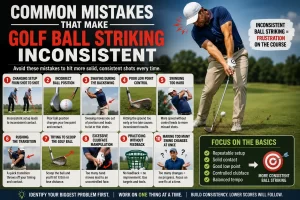
Even when you understand how to strike a golf ball consistently, a few common mistakes can quickly undo your progress. The challenge is that many golfers don’t have just one bad swing—they introduce small changes from shot to shot that make predictable contact much harder.
One of the biggest problems is constantly changing your setup. Differences in posture, stance width, alignment, or distance from the ball force your body to make compensations once the swing begins. Incorrect ball position creates similar problems by changing where the club reaches the bottom of its arc.
Excessive swaying during the backswing can also move your body away from its original position, making low point control more difficult. If the club bottoms out behind the ball, fat shots become more likely. If you compensate by pulling your body upward, thin or topped shots may follow.
Another common mistake is simply swinging too hard. Chasing maximum clubhead speed can cause you to rush the transition from backswing to downswing, disrupting your golf swing tempo, balance, and swing path.
Trying to scoop the golf ball into the air creates another consistency problem. With iron shots, allow the club’s loft to launch the ball rather than attempting to lift it. Proper ball-first contact and a predictable low point are far more important for producing solid ball compression.
Golfers can also create trouble by excessively manipulating their hands in an attempt to square the clubface. Reliable clubface control should come from a repeatable grip and coordinated release—not a last-second flip through impact.
Finally, avoid practicing without feedback. Use targets, monitor centered contact, observe turf interaction, and pay attention to patterns in your misses.
Most importantly, don’t try to fix everything simultaneously. If you’re working on how to improve golf ball striking consistently, identify your biggest problem first. Spend several practice sessions improving that one area before moving to the next.
Changing your setup, grip, tempo, swing path, and release all at once makes it nearly impossible to determine what’s actually helping. Fix one priority at a time, measure the results, and gradually build a more repeatable golf swing.
How to Strike a Golf Ball Consistently for Beginners
Learning how to strike a golf ball consistently for beginners can seem complicated because there are countless swing tips, drills, positions, and theories to think about. The good news is that you don’t need to understand every technical detail of the golf swing before you can start producing better contact.
Instead, focus on a small number of fundamentals you can repeat.
Start with your setup. Build an athletic posture with slight knee flex, bend naturally from the hips, and allow your arms to hang comfortably. Your stance should feel balanced rather than having excessive pressure toward your toes or heels. Creating the same basic setup before every shot gives your swing a reliable starting point.
Next, pay attention to ball position. With wedges and short irons, begin with the ball near the middle of your stance. A predictable ball position makes it easier to develop low point control and produce ball-first contact.
Your next priority should be centered contact. Beginners often become obsessed with distance before they can consistently find the middle of the clubface. Instead of trying to hit every shot as far as possible, concentrate on making solid contact.
This is where shorter swings can be extremely helpful.
Take a wedge or short iron and begin with half swings at a comfortable speed. Once you can repeatedly make centered contact, progress to three-quarter swings. Only move toward full swings and longer clubs after your strike becomes reasonably predictable.
As you practice, pay attention to where the club contacts the ground. With iron shots, the goal is generally to strike the ball first and then the turf. Improving this low point control can dramatically reduce fat and thin shots.
Finally, prioritize balance and golf swing tempo over speed. You should be able to complete your swing and hold your finish comfortably. If you’re falling forward, backward, or off to the side, reduce your effort until you regain control.
A simple progression is:
Wedge half swings → short-iron half swings → three-quarter swings → mid-irons → longer clubs → full swings.
If you’re learning how to strike a golf ball consistently, don’t rush this process. Building solid fundamentals first makes advanced mechanics much easier to understand later.
For beginners, consistency isn’t about creating the perfect-looking swing. It’s about developing a repeatable setup, controlling the bottom of the swing, finding the center of the clubface, and producing a balanced rhythm you can trust from one shot to the next.
Why Scratch Players Hit It Pure and How You Can Too
https://www.golfsenseitraining.com/blog/center-contact-scratch-golfer-secrets-pure-ball-striking
Conclusion: Build a Golf Swing You Can Repeat
Learning how to strike a golf ball consistently isn’t about discovering one secret swing move or building a technically perfect golf swing. Real consistency comes from controlling a collection of simple fundamentals and repeating them often enough that they become dependable on the golf course.
Start with a repeatable setup and correct ball position so every swing begins from a familiar foundation. Improve your low point control so you can produce ball-first contact with your irons, and prioritize centered contact rather than simply trying to generate more clubhead speed.
From there, better clubface control and a predictable swing path can help improve starting direction and reduce unwanted curvature. Combine those skills with proper ball compression, balanced movement, and a repeatable golf swing tempo, and you’ll have the building blocks for much more consistent golf ball striking.
But none of these fundamentals will become reliable without purposeful practice. Use drills that provide feedback, choose specific targets, monitor your strike location, and practice different clubs and distances rather than mindlessly hitting ball after ball.
Most importantly, work on one skill at a time.
Don’t expect every shot to become perfect overnight. Measure progress by how often you produce solid contact, how predictable your ball flight becomes, and whether your poor shots are becoming smaller, more manageable misses.
That’s the real goal when learning how to strike a golf ball consistently: not eliminating every bad shot, but building a repeatable golf swing that produces reliable results more often—and gives you greater confidence every time you step onto the course.
Frequently Asked Questions About How to Strike a Golf Ball Consistently
How do you strike a golf ball consistently?
Learning how to strike a golf ball consistently starts with building repeatable fundamentals. Use the same setup and posture, maintain the correct ball position for each club, and focus on centered contact. With irons, develop reliable low point control so the club contacts the ball before the turf. Consistent clubface control, a predictable swing path, balanced golf swing tempo, and purposeful practice can further improve your ability to produce reliable contact.
Why can’t I strike a golf ball consistently?
Inconsistent ball striking can have several causes, including changing your setup, incorrect ball position, poor low point control, and off-center contact. Swinging too hard or rushing the transition can also disrupt your tempo and balance. Clubface problems may create unpredictable starting directions even when contact feels solid. Rather than changing several things simultaneously, identify your most common miss and work on the fundamental most likely to be causing it.
How can beginners hit a golf ball more consistently?
Beginners should prioritize simple fundamentals instead of complicated swing mechanics. Start with a repeatable setup, correct ball position, good balance, and controlled golf swing tempo. Practice with wedges and short irons using half swings while concentrating on centered contact. Once contact becomes reliable, progress to three-quarter swings and eventually full swings. This gradual approach makes learning how to strike a golf ball consistently for beginners much more manageable.
How do I improve my ball striking with irons?
Better iron striking begins with producing ball-first contact. Work on controlling your low point so the club contacts the golf ball before interacting with the turf. Combine this with centered contact, a stable clubface, and a balanced impact position. Proper ball compression should develop from efficient contact rather than trying to aggressively hit down on the golf ball.
How do you make solid contact with the golf ball every time?
No golfer makes perfect contact every time. Instead, focus on increasing the percentage of solid strikes while reducing the severity of your misses. A repeatable setup, predictable ball position, centered contact, low point control, balance, and consistent tempo can dramatically improve your results. When golfers ask how to hit a golf ball consistently every time, a better goal is developing contact that’s reliable enough that even imperfect swings produce manageable results.
Should I hit the golf ball or the ground first with irons?
With most standard iron shots, you generally want to contact the golf ball first and the turf second. The lowest point of the swing arc should occur slightly ahead of the ball. This creates the ball-first contact associated with solid iron striking and effective compression. If the club reaches the ground before the ball, the result is often a fat shot with reduced distance.
Why do I hit the golf ball well at the range but not on the course?
Range practice is often highly repetitive. You may hit the same club from the same lie toward the same target many times, allowing yourself to develop a temporary rhythm. On the golf course, every shot can involve a different club, distance, target, lie, and level of pressure.
Make practice more realistic by changing clubs and targets frequently and going through your complete pre-shot routine before each ball. This helps turn consistent golf ball striking on the practice range into a skill you can rely on when every shot counts.