
9 Powerful Low Point Control Golf Swing Secrets That Work
Why Low Point Control Matters in the Golf Swing
Introduction: Why Low Point Control Can Transform Your Ball Striking
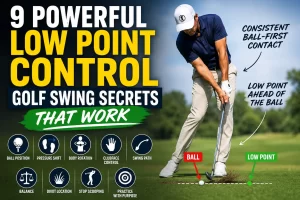
Low point control golf swing demonstrating proper ball-first contact and divot position with an iron
Improve your low point control golf swing to create cleaner contact, better divot control, and more consistent iron shots.
If you struggle with fat shots, thin shots, or iron contact that seems to change from one swing to the next, your problem may not be your entire golf swing. One of the biggest factors behind consistent ball striking is low point control golf swing mechanics—specifically, your ability to control where the clubhead reaches the bottom of its swing arc.
The golf swing low point is the lowest position the clubhead reaches as it travels through the hitting area. With most iron and wedge shots, you generally want to contact the golf ball before the club reaches the bottom of its arc. The club continues traveling downward through impact, contacts the ball first, and then interacts with the turf. This creates the ball-first, ground-second contact associated with solid iron striking.
When your low point moves around from swing to swing, consistent contact becomes much harder. If the bottom of your swing occurs too far behind the ball, the club can strike the ground first, resulting in a heavy or fat shot. If your body reacts by trying to avoid the ground, you may raise the club and catch the ball thin. This is why improving impact location and divot control can tell you so much about what is happening through impact.
You can even have a golf swing that looks technically sound and still struggle with ball striking. Good positions alone don’t guarantee that the club will reach the ground in the correct place. Changes in pressure, balance, ball position, body rotation, swing path, or release can shift the bottom of the swing arc by several inches.
Learning how to improve low point control can therefore make a dramatic difference to your irons and wedges. Better control gives you a more predictable strike, cleaner turf interaction, improved distance control, and greater confidence when standing over the ball.
The good news is that you don’t need to rebuild your entire swing. In this guide, we’ll break down 9 powerful low point control golf swing secrets covering ball position, pressure movement, body rotation, balance, clubface control, swing path, divot feedback, and simple practice drills. Master these fundamentals, and you’ll be well on your way to producing cleaner, more consistent contact.
How to Hit the Center of the Clubface: 11 Proven Secrets
What Is Low Point Control in the Golf Swing?
The golf swing low point is the lowest point the clubhead reaches during its swing arc as it travels through the impact area. Understanding where this point occurs—and learning how to control it—is one of the keys to producing clean, predictable contact. In simple terms, low point control golf swing mechanics determine whether you strike the golf ball first, the ground first, or catch the ball with the bottom portion of the clubface.
During the downswing, the clubhead travels downward toward the golf ball. It continues descending through impact until it reaches the bottom of its arc, or low point. After reaching that position, the clubhead begins traveling upward as it moves into the follow-through. Where the golf ball sits in relation to this arc has a major influence on strike quality.
The ideal low point can change depending on the club and type of shot you’re playing. With most iron shots, the goal is for the clubhead to contact the ball while it is still traveling downward, meaning the low point generally occurs slightly on the target side of the ball. This creates the familiar ball-first, turf-second strike.
When the low point occurs behind the golf ball, the club may hit the ground before reaching the ball. That often produces a fat shot and significant loss of distance. If the club doesn’t reach the ground until too far forward—or the golfer makes a compensation to avoid hitting behind the ball—the result can be thin contact. Monitoring your impact location and where the club interacts with the turf can therefore provide valuable clues about your low point.
Low point is also closely connected to angle of attack. A club traveling downward through impact has a negative angle of attack, which is typical for many iron shots. Importantly, hitting down doesn’t mean deliberately chopping steeply into the ground. The objective is to create a controlled descending strike while allowing your natural swing arc to produce the proper turf interaction.
Learning how to control low point in golf swing mechanics gives you a foundation for improving contact rather than simply reacting to bad shots. Once you understand where the club should reach the bottom of its arc, the nine secrets ahead—covering ball position, pressure, rotation, balance, swing path, clubface control, and divot feedback—become much easier to understand and apply.
The 9 Low Point Control Golf Swing Secrets
Understanding low point is important, but the real improvement comes from learning how to control it consistently. The following nine low point control golf swing secrets focus on the setup and swing factors that influence where your club reaches the bottom of its arc. Start with the fundamentals rather than trying to make complicated swing changes.
Secret #1: Position the Golf Ball Correctly
Your ball position has a major influence on your golf swing low point because it determines where the ball sits in relation to the bottom of your natural swing arc. Even if you make a reasonably consistent swing, placing the ball in the wrong position can make solid contact much more difficult.
If you position the ball too far forward, the club may reach its low point before it reaches the ball. This can encourage ground-first contact, thin shots, or compensations where you alter your body movement to reach the ball. Your impact location can become inconsistent because you’re effectively asking your swing to adjust to a poor setup.
Moving the ball too far back isn’t necessarily the answer. An excessively rearward ball position may encourage an overly steep strike, lower ball flight, or other compensations. It can sometimes make it appear that you’ve fixed your contact because the ball is easier to catch before the low point, but you’re treating the symptom rather than developing better low point control golf swing mechanics.
For many standard wedge shots, the ball can generally be positioned near the middle of the stance, while mid- and longer irons progressively move somewhat farther forward. Exact positioning varies according to the golfer, club, shot shape, and technique, so avoid treating one position as a universal rule.
Stance width matters too. A golfer can believe the ball has moved when they’ve actually changed the position of one foot. Use the center of your stance, sternum, or another consistent reference point to check your setup.
A simple practice routine is to place an alignment stick along your toe line and another perpendicular to it indicating ball position. This gives you an objective reference instead of relying on what “feels” centered.
Most importantly, ball position should complement good swing mechanics—not compensate for poor ones. The goal is to create a repeatable setup that allows your golf swing low point to occur naturally in the correct area, giving you a better opportunity to produce ball-first contact.
Secret #2: Get Your Pressure Moving Forward
One of the most important ways to improve low point control is learning how to move pressure effectively during the golf swing. For a right-handed golfer, pressure should begin moving toward the lead or left side as the swing transitions toward impact. For a left-handed golfer, the opposite applies.
This matters because your pressure movement influences where the swing arc bottoms out. If you remain heavily on your trail side through impact, the golf swing low point can stay behind the ball. That makes it easier to hit the ground first, producing the frustrating fat shots that plague many golfers.
However, moving pressure forward does not mean aggressively sliding your entire body toward the target. There is an important difference between a productive pressure shift and excessive lateral movement. Too much sliding can disrupt golf swing balance, body rotation, club delivery, and strike consistency.
Instead, think about allowing pressure to move into the lead foot as the downswing develops while maintaining enough stability to continue rotating through the shot. This combination helps move the bottom of the swing arc forward and encourages the ball-first, ground-second contact you’re trying to create.
A simple drill can help you develop this feeling. Take your normal setup with a short iron and make several small half-swings. During the downswing, feel pressure moving into your lead foot before impact. Hold your finish briefly after every swing. You should feel stable rather than falling toward the target, backward, or toward your toes.
You can initially practice the movement without a ball. Once it becomes comfortable, introduce a ball and pay attention to where the club contacts the ground. Ideally, turf interaction should begin on the target side of the ball rather than several inches behind it.
This drill is especially useful when learning how to move low point forward in golf swing mechanics because it connects pressure movement directly with ground contact.
The key is combining forward pressure with good golf swing balance. When you can move pressure toward the lead side without excessive sliding or losing posture, you give yourself a much better chance of controlling the low point and producing crisp, repeatable iron strikes.
Secret #3: Control Your Chest and Body Rotation
Proper body rotation plays an important role in developing consistent low point control golf swing mechanics. Your chest, hips, arms, and club need to work together through the hitting area so the clubhead can reach the bottom of its swing arc in a predictable location. When your body stops rotating too early, your hands and arms often have to make last-second compensations to reach the ball.
One of the most common compensations occurs when the chest stalls during the downswing. Instead of continuing to rotate through impact, the golfer slows the body and allows the hands to take over. This can lead to a “flip,” where the wrists release too early and the clubhead passes the hands prematurely. When that happens, the bottom of the swing arc can move behind the ball, increasing the chances of fat or thin contact.
Maintaining chest rotation through the strike can help prevent this pattern. You don’t need to spin your body aggressively toward the target. Instead, focus on allowing your chest to continue turning naturally as your pressure moves toward the lead side and the club travels through impact. Your arms and body should feel connected rather than as though your hands are independently trying to hit or lift the ball.
Rotation also has an important relationship with clubface control and swing path. When the body stalls, golfers may manipulate the clubface with their hands to square it at the last moment. Consistent rotation can reduce the need for these compensations and help create a more repeatable delivery of the club into the ball.
Better rotation can also stabilize your impact location. When your chest continues moving through the shot while you maintain balance and posture, the club has a better chance of reaching the ground in approximately the same area from swing to swing.
Try a simple three-quarter finish drill. Take a short or mid-iron and make slow half-swings. As you move through impact, concentrate on turning your chest toward the target and finishing with your belt buckle and chest facing forward. Hold the finish for two or three seconds to check your balance.
Start without a ball, then introduce short shots once the movement feels natural. Pay attention to where the club contacts the turf. If your ground contact becomes more predictable as your rotation improves, you’re beginning to connect body movement with better low point control golf swing consistency.
The goal isn’t maximum rotation—it’s continuous, balanced rotation that helps your clubface, swing path, and low point work together through impact.
Ever wonder why you can strike five beautiful iron shots on the range and suddenly hit the sixth one fat? Your low point may only be part of the problem. Inconsistent contact can often be traced to a few underlying swing fundamentals that golfers overlook while searching for quick fixes. Discover how those pieces fit together inside a complete improvement system here https://ultimategolfmasterypro.com/the-golf-swing-lab-2/
Secret #4: Stop Trying to Scoop the Golf Ball Into the Air
One of the biggest misconceptions among amateur golfers is believing they need to help an iron shot get into the air. Because golfers see the ball flying upward, it can feel natural to try to scoop or lift it at impact. Unfortunately, that instinct can make controlling the golf swing low point much more difficult.
Your irons already have loft designed into the clubface. When you deliver the club correctly, that loft helps launch the ball without you consciously trying to lift it. With a standard iron shot, the goal is generally to contact the ball while the clubhead is still descending and allow the club to reach its low point after impact.
Scooping can produce the opposite result. When you try to lift the ball, the wrists may release too early and the clubhead can pass the hands before it should. This early release can shift the bottom of the swing arc backward. Instead of producing ball-first contact, you may hit the turf first and catch the shot fat. Your body may then instinctively try to avoid the ground on the next swing, producing thin contact.
That’s why learning how to control low point in golf swing mechanics requires trusting the loft of the club.
Better impact mechanics can also improve compression. You don’t need exaggerated forward shaft lean or an extremely steep angle of attack. Instead, focus on delivering the club with stable body rotation, forward pressure, and a predictable impact location. When these pieces work together, the ball is compressed against the clubface before the club continues into the turf.
Try a simple punch-shot drill to reduce scooping. Take a short iron, narrow your stance slightly, and make waist-high to waist-high swings. Focus on striking the ball and finishing with your hands and club relatively low rather than immediately trying to throw the clubhead upward. Let the loft launch the ball.
Start slowly and watch where the club contacts the ground. As you improve low point control, you should begin seeing a more predictable pattern of ball-first, turf-second contact.
The lesson is simple: don’t try to lift an iron shot. Deliver the club correctly and let its loft do the work.
Secret #5: Improve Your Golf Swing Balance
When golfers work on low point, they often focus on their hands, wrists, ball position, or weight transfer. But golf swing balance can be just as important. If your body is moving unpredictably throughout the swing, the clubhead’s relationship with the ground can change along with it.
Imagine trying to strike the same spot on the ground while your body moves excessively toward your toes on one swing and toward your heels on the next. Even if your overall swing technique is reasonably good, those movements can alter your posture, swing arc, and impact location.
This is one reason balance is so important for consistent low point control golf swing mechanics.
Start by establishing an athletic setup. Your weight should feel balanced through your feet rather than heavily concentrated on your toes or heels. Maintain enough knee flex and hip bend to create a comfortable posture without feeling rigid.
During the swing, pressure will naturally move within your feet. The goal isn’t to remain completely stationary. Instead, you want controlled movement that allows you to rotate and shift pressure without losing your posture or stability.
A simple finish-position test can reveal balance problems quickly. Hit a normal iron shot and hold your finish for three to five seconds. You should be able to remain comfortably balanced on your lead side without stepping toward the ball, falling backward, or stumbling toward the target. If you repeatedly lose your balance in the same direction, that movement may be affecting your strike.
Another useful exercise is the feet-together drill. Place your feet close together and hit short shots with a wedge or short iron. Begin with small swings and focus on making centered contact while maintaining your balance. The narrow stance makes excessive body movement easier to detect because you’ll quickly feel yourself losing stability.
As your balance improves, gradually widen your stance and progress toward normal swings.
Better balance won’t automatically solve every low-point problem, but it provides a more stable foundation from which to swing. Combine good golf swing balance with proper pressure movement, rotation, and ball position, and it becomes much easier to improve low point control and produce consistent ground contact.
Secret #6: Maintain Better Clubface Control
Clubface control might not be the first thing you think about when working on your golf swing low point, but the two are closely connected. When the clubface is delivered in a predictable position through impact, your body can continue rotating naturally and the club can move through the hitting area without requiring major last-second compensations.
Problems often begin when the clubface becomes excessively open or closed during the swing. If the face is open approaching impact, for example, you may instinctively stall your rotation, flip your hands, stand up through the shot, or change your swing path in an attempt to square the clubface. A severely closed face can produce a different set of compensations as you try to prevent the ball from going left.
These reactions can alter your body position and change where the club reaches the ground. That’s why a golfer can work extensively on low point control golf swing mechanics and still struggle if clubface delivery remains unpredictable.
Your wrists play an important role. You don’t need to consciously force them into extreme positions, but you want to avoid excessive cupping, flipping, or manipulation through impact. The goal is to develop a repeatable relationship between your lead wrist, clubface, and body rotation so the face can arrive at impact consistently.
A simple half-swing drill can build this awareness. Take a short iron and make slow swings from approximately waist-high on the backswing to waist-high on the follow-through. Pay attention to how the clubface looks and feels throughout the motion. Concentrate on rotating your body through the shot rather than rapidly rolling or flipping your hands.
Hit several short shots and observe both ball flight and ground contact. If the clubface starts becoming more predictable while your turf contact improves, you’re beginning to coordinate face control with low point.
Ultimately, low point and clubface control shouldn’t be trained as completely separate skills. A stable clubface reduces the need for compensations, allowing your body rotation, pressure movement, swing path, and golf swing low point to work together more consistently.
Imagine stepping onto the course with more confidence because your swing feels predictable instead of different from one shot to the next. That’s the real goal—not chasing perfection, but developing mechanics you can trust under pressure. If you’re ready to improve your ball striking, accuracy, consistency, tempo, and overall swing, The Golf Swing Lab gives you a clear path forward.
Secret #7: Improve Your Swing Path Through Impact
Your swing path describes the direction the clubhead is traveling through the impact area relative to the target line. While golfers often associate path with hooks and slices, it can also influence how the club interacts with the ground and therefore plays an important role in low point control golf swing consistency.
An excessively steep delivery can cause the club to approach the ball at a sharp angle, sometimes producing deep divots and inconsistent strike depth. Although hitting down with an iron is normal, digging aggressively into the turf isn’t necessary for solid contact. If your divots resemble trenches, your delivery may be too steep or another part of your swing may be contributing to excessive downward movement.
Going too far in the opposite direction can create problems as well. Some golfers deliberately try to shallow the club so much that they lose posture, hang back, or throw the clubhead toward the ball. These compensations can change impact location and make the bottom of the swing arc unpredictable.
The goal is not to manufacture an extreme in-to-out or out-to-in path. Instead, you want a repeatable delivery that works with your body rotation and allows the club to reach the ground in a predictable area.
An alignment-stick practice station can help develop path awareness. Place one alignment stick on the ground parallel to your target line. Use it as a visual reference while making slow half-swings with a short iron. Concentrate on allowing your chest to rotate while the club travels naturally through the hitting area.
You can add a second reference on the ground to monitor where turf contact begins. This allows you to work on swing path and divot control simultaneously.
Avoid obsessing over making the club travel perfectly straight down the target line. Golf swings naturally move on an arc, and the exact path will vary according to the golfer and shot being played.
Instead, look for repeatability. When your body rotation, clubface, pressure movement, and swing path complement each other, your impact location becomes easier to control. That repeatable delivery gives you a much stronger foundation for developing consistent low point control and cleaner ball striking.
Best Golf Training Program For Beginners: Why Most Golfers Never Improve
Secret #8: Learn to Control Your Divot Location
Your divots can tell you a tremendous amount about what’s happening at impact. Instead of simply looking at where the golf ball travels, pay attention to where your club enters the turf. Developing better divot control gives you immediate feedback about your golf swing low point and can help you diagnose inconsistent contact.
With a typical iron shot from the turf, the club should generally contact the ball before interacting with the ground. This means the divot should begin on the target side of where the ball was positioned. The exact size and depth of the divot will vary according to the club, swing, turf conditions, and shot being played, so don’t become obsessed with creating a perfect-looking divot.
What’s more important is the starting point.
If your divot consistently begins behind the ball, your low point is probably occurring too early. This can be associated with hanging back on the trail side, an early wrist release, poor rotation, or attempting to scoop the ball into the air. These patterns frequently produce heavy or fat shots.
Excessively deep divots can indicate that the club is entering the ground too steeply. On the other hand, taking no divot isn’t automatically a problem. Some golfers naturally have shallower turf interaction. However, if you’re repeatedly hitting thin shots along with barely touching the ground, your impact location and low point deserve attention.
One of the easiest ways to evaluate this is with a line drill. On an appropriate grass practice area, draw a straight line on the turf or use another permitted reference. Make practice swings while attempting to contact the ground consistently on the target side of that line.
Pay particular attention to where each divot starts, rather than only where it points. Divot direction can provide information about club delivery, but it isn’t the same thing as low-point location. A divot can point left or right while still beginning in an appropriate location.
If you’re learning how to improve low point control in golf swing mechanics, your divots essentially become a feedback system. Instead of guessing what your club did, you can look at the ground and see where the club entered the turf.
Developing better divot control gives you measurable evidence of whether your low point is becoming more consistent—and that makes practice far more productive.
Secret #9: Practice Low Point Control With a Simple Line Drill
Understanding low point is useful, but you ultimately need a way to practice it. One of the simplest exercises for learning how to control low point in golf swing mechanics is the line drill because it gives you immediate, objective feedback after nearly every swing.
Without feedback, golfers often judge practice entirely by ball flight. You might hit a reasonable-looking shot even though the club contacted the ground slightly behind the ball. Conversely, you might make an improved swing but dislike the resulting shot for another reason. The line drill shifts your attention toward one specific objective: where did the club contact the ground?
On a grass practice area where this type of practice is permitted, draw a straight line perpendicular to your target line. You can also use another safe visual reference that doesn’t damage the practice facility.
Start without a golf ball.
Make several small swings and attempt to brush or strike the turf on the target side of the line. Don’t worry about speed or distance. Your first objective is simply to make the bottom of your swing arc occur consistently in the desired area.
Once you can do that, introduce a golf ball. Position it just ahead of the reference line in the appropriate spot for the drill so you’re training the club to contact the ball before reaching the turf on the target side. Begin with short wedge or iron swings.
After you can produce consistent contact with small swings, progress to half-swings. Continue monitoring your divot control after every shot. Only move to longer swings when your ground-contact pattern remains reasonably predictable.
Eventually, progress toward full iron swings while maintaining the same objective.
This progression is particularly useful for golfers learning how to move low point forward in golf swing mechanics. Instead of trying to force the club downward or artificially manipulate your hands, you’re training your body to produce a more predictable bottom to the swing arc.
Keep track of your results. For example, hit 10 shots and count how many times your turf contact begins in the desired area. If you achieve six out of 10, try to reach seven or eight before increasing swing length.
Quality matters more than quantity. Hitting 100 balls while repeatedly striking behind the reference line can simply reinforce the pattern you’re trying to eliminate.
When learning how to improve low point control in golf swing mechanics, deliberate repetitions are far more valuable. The line drill gives you something every golfer needs during practice: clear feedback. Once you can repeatedly control where the club meets the ground, consistent ball-first contact becomes much easier to develop.
Common Low Point Control Mistakes Golfers Should Avoid
Learning to improve your low point control golf swing mechanics isn’t only about knowing what to do correctly. It’s also important to recognize the mistakes that can make your ground contact unpredictable. Many golfers unknowingly use temporary compensations that appear to fix their contact for a few shots but never address the underlying problem.
One of the most common mistakes is hanging back on the trail side through impact. When pressure doesn’t move effectively toward the lead side, the golf swing low point can remain behind the ball, increasing the likelihood of hitting the ground first.
Another major problem is trying to scoop the ball into the air. Your irons already contain loft, so you don’t need to lift the ball manually. Scooping often causes an early wrist release, which can move the bottom of the swing arc backward and produce both fat and thin shots.
Some golfers respond by moving the ball excessively backward in their stance. While this can temporarily make ball-first contact easier, it may simply hide the underlying low-point problem. Extreme ball position can also affect trajectory, angle of attack, and overall club delivery.
Excessive upper-body movement creates another source of inconsistency. If your head, chest, or torso moves dramatically during the swing, controlling where the club reaches the ground becomes much harder. Combine that with poor balance and your low point may change from one swing to the next.
Stopping your body rotation through impact can be equally damaging. When the chest stalls, the hands may flip the clubhead toward the ball as a compensation, making ground contact less predictable.
Practice habits matter too. If you’re trying to improve low point control but never monitor where the club contacts the ground, you’re missing valuable feedback. Use divots, turf marks, or a safe reference line to identify your ground-contact pattern.
Finally, avoid changing five different swing mechanics at once. If you’re adjusting ball position, pressure, rotation, posture, and wrist action simultaneously, you won’t know which change actually helped.
Choose one issue, practice it deliberately, and monitor the results. Most importantly, don’t confuse a temporary compensation with a permanent solution. Better low point control golf swing consistency comes from developing repeatable mechanics that improve where the club contacts the ball and ground—not simply finding a quick fix that works for a handful of shots.
How to Improve Low Point Control in the Golf Swing
If you’re trying to learn how to improve low point control in golf swing mechanics, one of the biggest mistakes you can make is immediately hitting full-speed iron shots. Low point is a skill that can be trained progressively, and starting with smaller movements makes it much easier to understand where your club is actually contacting the ground.
Begin without a golf ball. On an appropriate practice area, establish a ground reference line and take your normal setup with the line representing the area around impact. Make several short swings while focusing entirely on where the club brushes or strikes the turf.
Don’t worry about making a perfect swing. Your first goal is observation.
Does the club repeatedly hit behind the reference line? Does the contact move several inches from one swing to another? Or can you consistently contact the ground on the target side? Identifying this pattern gives you a starting point for learning how to improve low point control in golf swing mechanics.
Next, work on moving pressure toward your lead side as you swing through the impact area. Avoid aggressively sliding toward the target. You want a controlled pressure shift combined with balance and continued body rotation.
Once your ground contact becomes more predictable, add a golf ball. Start with short wedge or iron shots and concentrate on contacting the ball before the turf. Watch both the strike and your divot location.
As your consistency improves, progress from small swings to half-swings, three-quarter swings, and eventually full iron shots. Don’t increase speed simply because you hit one perfect shot. Look for a repeatable pattern first.
A simple scoring system can make your practice more productive. Hit 10 shots and record how many times you produce acceptable ball-first contact with the turf interaction occurring in the desired area. Try to gradually improve your score.
This is important because golfers often judge themselves based on individual shots. One fat shot doesn’t mean your technique has failed, just as one perfect shot doesn’t mean you’ve mastered low point control.
When learning how to improve low point control in golf swing mechanics, focus on patterns across multiple swings. With deliberate practice and objective ground-contact feedback, your strike pattern should gradually become more predictable—and that’s when better low point control starts transferring to the golf course.
How To Control Your Low Point For Pure Iron Strikes https://mygolfspy.com/news-opinion/instruction/how-to-control-your-low-point-for-pure-iron-strikes/
What is low point control in a golf swing?
Low point control refers to your ability to consistently control where the clubhead reaches the lowest portion of its swing arc. During the downswing, the club travels downward, reaches its golf swing low point, and then begins moving upward through the follow-through.
Controlling this location is especially important with irons because inconsistent low point can lead to fat and thin shots. Good low point control golf swing mechanics help you produce more predictable ball-first contact, better turf interaction, and more consistent ball striking.
Where should the low point be in an iron swing?
For a standard iron shot from the turf, the low point generally occurs on the target side of the golf ball. This allows the clubhead to contact the ball while it is still traveling downward before reaching the bottom of its swing arc.
That’s why good iron strikes are often described as ball-first, ground-second contact. The exact low-point location varies depending on the golfer, club, shot, and turf conditions, so the goal isn’t to create an identical divot every time. Instead, focus on developing a consistent pattern where the club contacts the ball before the turf.
How do you move your low point forward in the golf swing?
Learning how to move low point forward in golf swing mechanics requires several parts of your swing to work together. Start with appropriate ball position and allow pressure to move toward your lead side during the downswing.
Continue rotating your chest through impact rather than hanging back or stalling your body. You should also avoid releasing the wrists too early or trying to scoop the ball upward. When ball position, pressure, rotation, balance, and release work together, the bottom of your swing arc can naturally move farther toward the target side.
Why is my golf swing low point behind the ball?
A golf swing low point that consistently occurs behind the ball can have several causes. One common problem is hanging back on the trail side instead of allowing pressure to move forward.
Trying to scoop the ball can also cause an early wrist release, making the club reach the bottom of its arc prematurely. Poor body rotation, excessive trail-side lean, balance problems, and incorrect ball position can contribute as well.
Instead of automatically moving the ball farther back, identify the underlying cause. Otherwise, you may simply create a temporary compensation rather than fixing the actual low-point problem.
How can I practice low point control?
One of the best ways to learn how to improve low point control in golf swing mechanics is with a simple line drill. Establish a safe visual reference on the practice ground and make short swings while monitoring where the club contacts the turf.
Begin without a ball and try to produce ground contact consistently on the target side of your reference. Then introduce a ball and progress from small swings to half-swings and eventually longer swings.
Pay attention to your divot control and ground-contact patterns. Ten deliberate swings with clear feedback can be more productive than repeatedly hitting balls without knowing where your club is contacting the turf.
Does ball position affect low point control?
Yes. Ball position affects the relationship between the golf ball and the bottom of your swing arc. If the ball is positioned too far forward, the club may reach its low point before making contact, potentially contributing to fat or thin shots.
Moving the ball excessively backward isn’t necessarily the solution because it can alter your angle of attack, trajectory, and overall delivery.
For consistent low point control golf swing mechanics, establish an appropriate ball position for the club you’re using and combine it with good pressure movement, balance, rotation, and club delivery. Ball position should complement your swing mechanics rather than compensate for problems elsewhere in your swing