
How to Stop Hitting Golf Shots Thin: 9 Ultimate Fixes
How to Make Ball-First Contact With Irons
Introduction
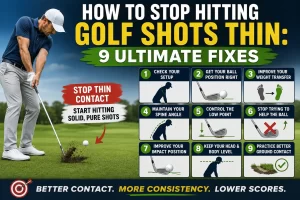
Few shots in golf are more frustrating than making what feels like a decent swing only to catch the middle or upper half of the golf ball and send it screaming across the course on a low, penetrating trajectory. Instead of feeling the satisfying compression of a solid strike, you feel a sharp, unpleasant vibration through the club and immediately know something went wrong.
This is known as a thin golf shot, and it can affect golfers of virtually every skill level. A thin shot occurs when the bottom portion of the clubface makes contact too high on the golf ball rather than striking the ball cleanly before interacting with the turf. Depending on how thin the contact is, the ball might travel reasonably close to its intended distance, fly unusually low, or shoot across the green with very little control.
If you’re trying to learn how to stop hitting golf shots thin, the good news is that thin contact usually isn’t random. In most cases, something within your setup, movement, or impact conditions is causing the clubhead to reach the ball at the wrong height or the bottom of your swing arc to occur in the wrong location.
One of the biggest keys to learning how to stop hitting thin golf shots is understanding your ground contact. With an iron, you generally want the club to strike the golf ball first and then interact with the turf immediately after impact. When your low point moves behind the ball or your body rises during the downswing, consistent contact becomes much more difficult.
Several areas of your swing can influence this. Your golf swing posture can determine whether you maintain enough space and body height through impact. Proper weight transfer helps move the low point forward, while a solid impact position makes it easier to compress the golf ball instead of trying to scoop it into the air. Developing better divot control can also provide valuable feedback about where your club is actually contacting the ground.
This becomes especially important if you’re wondering how to stop hitting thin golf shots with irons, since consistent iron play depends heavily on controlling where the club bottoms out.
Throughout this guide, we’ll break down 9 ultimate fixes designed to help you fix thin golf shots at their source. You’ll learn how to improve your posture, ball position, weight transfer, spine angle, low-point control, impact position, and ground contact while eliminating common movements that lead to thin strikes.
Whether you’re an experienced golfer dealing with an occasional thin shot or you’re searching for how to stop hitting golf shots thin for beginners, the goal is the same: create more predictable contact so you can strike your irons with greater consistency, confidence, and control.
9 Powerful Low Point Control Golf Swing Secrets That Work
Why Do Golfers Hit Thin Golf Shots?
Before learning how to stop hitting golf shots thin, it helps to understand exactly what is happening at impact. A thin golf shot occurs when the clubface contacts the ball higher than intended—often around the middle or upper portion of the ball—instead of producing clean, ball-first contact near the center of the clubface. The result is usually a low-flying shot with reduced control and an uncomfortable feeling through the hands.
One of the biggest causes is poor control of the bottom of the swing arc. With a well-struck iron shot, the clubhead should reach its lowest point slightly after the golf ball. The club strikes the ball first and then continues downward into the turf. When the club bottoms out too early, however, it may begin traveling upward again before reaching the ball. If the clubhead is too high at impact, you’re much more likely to catch the ball thin.
This is why ground contact and divot control provide valuable information about your iron swing mechanics. If you’re consistently hitting thin shots without touching the ground—or your club strikes the turf well behind the ball—there’s a good chance your low-point location needs attention.
Several swing faults can create this problem.
Standing up through impact is one of the most common. When your hips move toward the ball and your upper body rises during the downswing, the clubhead can also move upward, making clean contact difficult.
Poor weight transfer can create similar problems. Golfers who remain on their trail side through impact often leave the swing’s low point behind the ball instead of moving it toward the target.
Incorrect ball position can also contribute. Playing the ball too far forward may force you to contact it after the club has already reached the bottom of its arc.
Another common cause is losing your golf swing posture. If you change your spine angle dramatically or straighten your body before impact, the distance between your body and the golf ball changes.
Finally, many golfers unknowingly try to help the ball into the air. Instead of trusting the club’s loft, they scoop upward through impact. This can move the low point backward and produce an inconsistent impact position.
If you want to fix thin golf shots, don’t immediately start making random swing changes. First determine why you’re hitting the ball thin. A golfer struggling with ball position requires a different solution than someone losing posture or hanging back on the trail foot.
Identifying the underlying cause is especially important when learning how to stop hitting golf shots thin consistently. Once you understand whether the problem comes from posture, weight transfer, low-point control, ball position, or impact mechanics, you can apply the right correction instead of relying on temporary compensations.
Fix #1: Improve Your Golf Swing Posture
If you’re learning how to stop hitting golf shots thin, one of the first areas to check is your golf swing posture. Your posture establishes the distance between your body, hands, clubhead, and golf ball. When that relationship changes dramatically during the downswing, it becomes much harder to return the club to the correct position at impact.
A common problem occurs when golfers gradually stand up as they approach the ball. Your hips may move toward the golf ball, your legs straighten too early, and your upper body becomes more upright. As your body rises, your hands and clubhead can rise with it. Instead of the club reaching the bottom of the ball and producing solid contact, the leading edge may catch the middle or upper portion of the ball.
Maintaining your spine angle more effectively can help prevent this problem. You don’t need to freeze your upper body in exactly the same position throughout the swing. A golf swing is an athletic movement involving rotation, extension, and weight transfer. However, you want to avoid suddenly pulling your chest away from the ball or standing upright before contact.
Check Your Posture at Setup
Before changing your swing mechanics, make sure you’re starting from a balanced position. Try these simple checkpoints:
- Bend forward naturally from your hips rather than excessively rounding your back.
- Keep a slight amount of knee flex.
- Allow your arms to hang naturally beneath your shoulders.
- Keep your weight balanced through the middle of your feet.
- Avoid standing either excessively close to or far away from the golf ball.
- Maintain an athletic position that allows you to rotate freely.
These fundamentals are particularly useful when learning how to stop hitting golf shots thin for beginners because better setup positions can improve contact without requiring complicated mechanical changes.
Try the Chair Posture Drill
One easy drill can be performed at home or on the driving range using a chair.
Take your normal golf stance with the back of your hips lightly touching the edge of a chair. Make a slow backswing and downswing while maintaining some connection between your hips and the chair. As you rotate toward your imaginary target, focus on turning rather than thrusting your hips forward toward the golf ball.
Start without hitting a ball. Once the movement becomes comfortable, rehearse it several times before hitting short iron shots at the range.
The goal isn’t to force your body to stay perfectly still. Instead, you’re training yourself to maintain enough posture and space through impact so the clubhead can return to the correct height.
Improving your posture can make it significantly easier to stop hitting thin golf shots, improve ground contact, and develop a more reliable impact position. When your body maintains better structure throughout the downswing, your low point becomes more predictable—and predictable low-point control is one of the biggest keys to consistently solid iron shots.
Fix #2: Get Your Ball Position Right
If you’re trying to learn how to stop hitting golf shots thin, ball position is one of the simplest areas to check. Even with solid iron swing mechanics, placing the golf ball in the wrong position can make it much harder for the clubhead to reach the ball at the correct point in the swing arc.
With most iron shots, the goal is to strike the golf ball before the club reaches its lowest point. The clubhead then continues downward and contacts the turf on the target side of the ball. This creates the ball-first, ground-second contact associated with solid iron play.
When the ball is positioned too far forward, however, the club may reach the bottom of its swing arc before reaching the ball. By the time the clubface arrives, the clubhead may already be traveling slightly upward. This increases the possibility of catching the middle or upper portion of the golf ball and producing a thin shot.
Adjust Ball Position for Different Irons
You don’t need to play every iron from exactly the same location. As a general starting point:
- Short irons and wedges: Position the ball around the center of your stance or slightly forward of center.
- Mid-irons: Move the ball slightly forward of center.
- Long irons: Position the ball farther forward, but generally not as far forward as you would with a driver.
These are starting points rather than absolute rules. Your individual swing can influence the ideal location, so pay attention to your ground contact, divot pattern, and quality of strike.
For golfers learning how to stop hitting thin golf shots with irons, a useful checkpoint is to make sure the ball hasn’t gradually moved too far toward the lead foot.
Use a Simple Ball-Position Check
Place one alignment stick along your target line and another perpendicular to it, pointing toward the golf ball. Set up normally and look at where the ball sits relative to the center of your stance.
This provides an objective reference instead of relying entirely on feel. What appears centered from your address position may actually be several inches forward.
Beginners can make this even simpler: start with a short iron and position the ball near the center of the stance. Hit several controlled half swings while focusing on balanced posture and ball-first contact.
Correct ball position alone won’t fix thin golf shots caused by other swing faults, but it eliminates an important variable. Combine a consistent ball position with good golf swing posture, low-point control, and a stable impact position, and you’ll have a much better chance of producing predictable contact.
When the ball is positioned where your swing can naturally reach it before the low point, learning how to stop hitting thin golf shots becomes considerably easier.
Fix #3: Improve Your Weight Transfer
Proper weight transfer is another critical part of learning how to stop hitting golf shots thin consistently. If your pressure remains on your trail side for too long during the downswing, the bottom of your swing arc can remain behind the golf ball. This makes both thin and fat contact much more likely.
During the backswing, pressure naturally moves toward the trail side as your body turns away from the target. However, as you transition into the downswing, pressure should begin moving toward your lead side.
If you hang back on your trail foot and try to lift the ball into the air, your upper body may tilt excessively away from the target. The club can bottom out behind the ball and begin rising before impact. The result can be the leading edge catching the golf ball thin.
Shift Pressure Without Sliding
Improving weight transfer doesn’t mean aggressively throwing your entire body toward the target.
There is an important difference between shifting pressure and excessively sliding laterally. A good downswing involves pressure moving into the lead foot while your body continues rotating. Excessive sliding can make the low point inconsistent and create another set of contact problems.
Think of the movement as shift, rotate, and finish rather than simply lunging toward the target.
By impact, you should feel considerably more pressure under your lead foot than your trail foot. As you continue through the shot, your chest and hips rotate toward the target and you finish in a balanced position.
A good finish provides a simple checkpoint: most of your weight should be supported by your lead leg, your trail heel should be off the ground, and you should be able to hold your finish without falling backward.
Try the Step-Through Drill
A simple drill can help you develop this feeling.
Set up with a short or mid-iron and make a controlled swing. As you begin the downswing, allow your pressure to move toward the lead foot. After striking the ball, let your trail foot naturally step forward toward the target.
Start slowly with short swings rather than trying to generate maximum speed.
The drill exaggerates forward pressure movement and can be especially helpful for golfers who consistently finish with too much weight on their back foot.
Better weight transfer can improve ground contact, divot control, and your overall impact position. When pressure moves toward the lead side at the correct time, it becomes easier to position the swing’s low point beyond the golf ball and produce the ball-first, ground-second strike you’re looking for.
If you want to fix thin golf shots, pay attention to where your weight finishes. A balanced, lead-side finish is a strong sign that you’re giving the club a better opportunity to strike the ball solidly before entering the turf.
What if the reason you keep hitting thin shots isn’t the mistake you think you’re making? Many golfers spend hours changing their swing without identifying the real flaw behind their inconsistent contact. If you’re learning how to stop hitting golf shots thin, correcting the right fundamentals can save you months of frustrating trial and error learn how to correct the right fundamentals here https://ultimategolfmasterypro.com/the-golf-swing-lab-2/
Fix #4: Maintain Your Spine Angle Through Impact
If you’re trying to learn how to stop hitting golf shots thin, maintaining your spine angle through the hitting area deserves close attention. Your posture determines the distance between your upper body, hands, clubhead, and golf ball. When that relationship changes dramatically during the downswing, returning the clubface to the correct height becomes much more difficult.
One common problem is early extension. This happens when the hips move toward the golf ball during the downswing while the upper body becomes more upright. Instead of maintaining space for the arms and club to move through impact, the golfer effectively stands up.
As your body rises, your hands and clubhead can rise as well. The club may then catch the middle or upper portion of the golf ball rather than producing solid contact.
This is one reason golfers can hit thin shots even when their ball position appears correct.
Maintain Your Posture Without Staying Frozen
Maintaining your spine angle doesn’t mean your body should remain perfectly still. Your hips, shoulders, and torso need to rotate throughout the golf swing.
A better feeling is to keep your chest inclined toward the ground longer while allowing your hips to rotate behind you rather than thrust toward the golf ball.
Imagine your backside remaining close to an invisible wall behind you as you start the downswing. As your lead hip rotates toward the target, it should feel like it’s moving backward rather than directly toward the ball.
This can help preserve the space necessary for better iron swing mechanics and more consistent ground contact.
Try the Wall or Chair Drill
You can practice this movement without hitting a single golf ball.
Stand in your normal golf posture with your backside lightly touching a wall or the back of a chair. Cross your arms over your chest and make a slow backswing.
During the downswing, focus on keeping contact with the wall or chair as your hips rotate. Your trail hip will move away as your lead hip replaces it against the surface.
Perform 10–15 slow repetitions before making normal practice swings.
Don’t try to force your spine into an unnatural position. The goal is simply to reduce excessive standing up or hip thrusting before impact.
Improved posture makes it easier to control the clubhead’s vertical position and maintain a predictable impact position. When your body isn’t suddenly moving away from the golf ball, the club has a better opportunity to return to the correct height.
For golfers struggling to fix thin golf shots, this seemingly simple change can have a major effect. Better posture through impact supports improved low-point control, more predictable divots, and the solid ball-first contact needed to stop hitting thin golf shots.
Fix #5: Control the Low Point of Your Golf Swing
Understanding low-point control is one of the biggest breakthroughs you can make when learning how to stop hitting golf shots thin consistently. You can improve several parts of your golf swing, but if you can’t predict where the clubhead will reach the bottom of its arc, consistent iron contact will remain difficult.
The low point is simply the lowest point the clubhead reaches during the swing.
When hitting an iron from the turf, you generally want this point to occur on the target side of the golf ball. That allows the clubface to strike the ball while the clubhead is still moving downward, followed by contact with the ground.
In simple terms, you’re looking for:
Ball first. Ground second.
If the low point occurs behind the golf ball, the club may strike the turf first and produce a fat shot. But if the club bottoms out behind the ball without actually contacting the ground, it can begin moving upward before reaching the ball. The leading edge can then catch the ball too high and create the thin shot you’re trying to eliminate.
Use Your Divot as Feedback
Your divot can tell you a great deal about your ground contact.
With a solid iron strike, the divot should generally begin at or just beyond where the golf ball was positioned and extend toward the target. You don’t need to take a huge divot. In fact, some golfers naturally produce shallower turf interaction than others.
The important factor is where the club contacts the ground, not how much turf you remove.
This is where divot control becomes extremely useful for diagnosing thin contact.
Try the Line Drill
Draw a straight line on the practice turf using foot spray, chalk, or another practice-area-safe method. If you’re on grass, you can also use an existing reference line when appropriate.
Set up with the line approximately where the golf ball would normally be positioned.
Start by making swings without a golf ball. Your goal is to strike the ground on the target side of the line rather than behind it.
Once you can do this consistently, place a golf ball directly on the line and make controlled half swings. Focus on striking the ball first and allowing the club to contact the turf afterward.
Another option is the towel drill. Place a towel several inches behind the golf ball and make short iron swings without touching it. If you hit the towel, your low point is probably occurring too early.
For anyone wondering how to stop hitting thin golf shots with irons, low-point control should be a major priority. It connects your weight transfer, golf swing posture, impact position, and iron swing mechanics into one measurable result.
Instead of simply hoping for solid contact, learn to control where your club meets the ground. Once your low point becomes predictable, it becomes considerably easier to fix thin golf shots and develop the crisp, ball-first iron contact every golfer wants.
Fix #6: Stop Trying to Help the Ball Into the Air
One of the most common mistakes golfers make when learning how to stop hitting golf shots thin is trying to help the golf ball into the air. It sounds logical: if you want the ball to fly higher, you should swing upward and lift it. With an iron, however, that instinct can create exactly the contact problem you’re trying to eliminate.
Golf clubs already have loft built into their design. When you deliver an iron correctly, the loft of the clubface helps launch the ball. You don’t need to scoop underneath it or lean backward in an attempt to lift it off the ground.
When golfers try to scoop the ball, the hands often slow down while the clubhead passes them too early. This can cause the club to reach the bottom of its swing arc behind the ball. By the time the clubhead reaches impact, it may already be traveling upward.
The result? The leading edge catches the middle of the ball and produces another thin shot.
Let the Club’s Loft Do the Work
A better impact position generally has the hands slightly ahead of the clubhead with an iron, creating some forward shaft lean. Your pressure should also favor your lead side while your body continues rotating toward the target.
You don’t need extreme forward shaft lean. Trying to force your hands dramatically ahead can create additional problems. The goal is simply to avoid flipping or scooping the clubhead underneath the ball.
A useful impact feel is:
Strike the ball, then brush the ground in front of it.
Make several slow half swings while imagining that you’re driving the club through the golf ball rather than underneath it. Focus on allowing the clubhead to continue toward the turf after impact.
You can practice this without a ball by placing a tee or small mark on the ground. Make controlled swings and try to brush the turf immediately on the target side of the mark.
Once that movement feels comfortable, introduce a golf ball and maintain the same motion.
This simple concept can dramatically improve ground contact, divot control, and overall iron swing mechanics.
It’s particularly valuable for golfers learning how to stop hitting thin golf shots with irons because iron shots don’t require you to manually lift the ball. The loft is already there.
Trust it.
When you stop trying to help the ball upward and instead develop ball-first, ground-second contact, you’ll create a more predictable low point and give yourself a much better opportunity to fix thin golf shots for good.
The danger of repeatedly practicing thin shots isn’t just another frustrating day at the range—you may be reinforcing the exact swing habits causing the problem. The longer those movements become ingrained, the harder consistency can feel to achieve. If you’re serious about learning how to stop hitting golf shots thin, The Golf Swing Lab gives you a structured system for improving the fundamentals behind better contact
Fix #7: Improve Your Impact Position
Your impact position is the moment of truth in the golf swing. You can have a beautiful backswing and smooth transition, but if the club reaches the ball in an inefficient position, consistent contact becomes difficult. That’s why improving impact is such an important part of learning how to stop hitting golf shots thin consistently.
With a well-struck iron shot, your hands will generally be slightly ahead of the clubhead at impact. Your pressure should favor your lead side, your hips should be partially open toward the target, and your chest should continue rotating through the shot.
Your lead leg should also be providing support as you move through impact.
These positions work together to help move the swing’s low point forward and produce the desired ball-first, ground-second strike.
Don’t Force Excessive Forward Shaft Lean
Forward shaft lean can help create a strong iron impact position, but more isn’t automatically better.
Some golfers hear that their hands should be ahead of the golf ball and begin aggressively dragging the handle toward the target. This can disrupt the natural release of the club, reduce speed, and create new contact problems.
Instead, think about producing moderate forward shaft lean as a result of good body rotation, pressure movement, and sequencing.
The goal isn’t to manufacture a dramatic impact pose. It’s to deliver the club consistently.
Poor impact positions often lead to inconsistent strike location. If your weight remains on your trail foot, your hands flip underneath, or your body stands up, the clubhead’s vertical position can change dramatically. One swing may be thin, the next fat, and the next surprisingly solid.
Try a Slow-Motion Impact Rehearsal
Take your normal setup with a short iron and make a backswing to approximately waist height.
From there, slowly move into impact.
Pause and check your position. Your hands should be slightly ahead of the clubhead, your pressure should favor your lead foot, and your hips should have begun rotating toward the target. Maintain your golf swing posture rather than standing upright.
Hold the position for a few seconds before continuing into a balanced finish.
Repeat the movement 10 times before hitting several controlled half shots.
You can also use an impact bag if you have one, but don’t smash into it at full speed. Make slow, controlled movements and use the bag to develop awareness of where your hands and body are at impact.
Improving your impact position can lead to better iron swing mechanics, more predictable ground contact, and improved divot control. Most importantly, it addresses what ultimately matters when trying to stop hitting thin golf shots: delivering the club to the golf ball at the correct height, angle, and point in the swing arc.
Best Golf Training Program For Beginners: Why Most Golfers Never Improve
Fix #8: Keep Your Head and Body Level Through Impact
Excessive up-and-down movement is another common reason golfers struggle with how to stop hitting golf shots thin. If your body suddenly rises during the downswing, the clubhead can rise with it. Even a relatively small change in body height can be enough to turn what should have been solid contact into a thin strike.
This doesn’t mean your head must remain perfectly still throughout the golf swing. Trying to lock your head in one position can restrict rotation and create unnecessary tension. Some natural head and body movement is perfectly normal.
The real goal is to avoid excessive vertical movement through the hitting area.
One common cause is straightening the knees too early. As the legs straighten and the hips move toward the golf ball, the upper body becomes more upright. This movement is often associated with early extension and can pull the clubhead away from the ground.
Instead, maintain an athletic amount of knee flex as you transition into the downswing while allowing your hips to rotate. Your lead leg will eventually straighten as you move through impact, but you don’t want your entire body suddenly popping upward before you’ve struck the golf ball.
Try the Head-Level Drill
Practice this drill at home using a mirror.
Take your normal golf setup and identify where the top of your head appears in the mirror. Make several slow-motion swings while watching how much your body height changes.
You don’t need to keep your head on an exact horizontal line. Simply look for obvious upward movement as you approach impact.
You can also have a friend hold a golf club several inches above your head while you make slow practice swings. Your goal isn’t to touch the club—it’s simply to use it as a visual reference for excessive movement.
Once you become comfortable with the motion, make controlled half swings on the range while focusing on maintaining your golf swing posture through impact.
Better body-level control helps stabilize the distance between you and the golf ball. That makes it easier for the clubhead to return to a predictable height and improves your chances of creating consistent ground contact.
For golfers trying to fix thin golf shots, this is an important connection to understand: stable posture helps create a stable low point. When your body isn’t suddenly rising away from the ball, your club has a much better opportunity to produce crisp, repeatable contact.
Fix #9: Practice Better Ground Contact and Divot Control
If you want to learn how to stop hitting golf shots thin consistently, start paying attention to what happens to the ground—not just where the golf ball goes.
Your ground contact provides immediate feedback about the location of your swing’s low point. With a solid iron shot, the club should generally strike the ball first and then interact with the turf. The resulting divot usually begins around the ball’s original location or slightly on the target side of it.
You don’t need to take enormous divots to hit good iron shots. Some golfers naturally produce shallow turf interaction. What’s more important is where the club contacts the ground.
If your divot begins several inches behind the ball, your low point is probably too far back. If you repeatedly hit thin shots while barely touching the turf at all, your club may be traveling too high through impact.
That’s why divot control is such a useful diagnostic tool.
Practice the Line Drill
Draw a line on the practice ground using an appropriate temporary marker or use a natural reference on the turf.
Make several practice swings without a golf ball and try to strike the ground on the target side of the line.
Once you can do that consistently, place a golf ball on the line and repeat the same swing. Your goal is simple: ball first, turf second.
Use the Towel Drill
Place a small towel several inches behind the golf ball.
Hit controlled short-iron shots while avoiding the towel. If your club strikes it before reaching the ball, your swing is bottoming out too early.
Start with plenty of space between the towel and ball and gradually reduce the distance as your contact improves.
Practicing without a golf ball can also be extremely valuable. Without worrying about ball flight, distance, or direction, you can focus entirely on making the club contact the ground in a predictable location.
Make 10 practice swings and observe where the club brushes the turf. If those strike locations are scattered everywhere, continue practicing before introducing a ball.
This is one of the most effective ways to fix thin golf shots because it trains the movement responsible for solid contact rather than simply treating the resulting ball flight.
Develop predictable ground contact and your low point becomes more consistent. Once that happens, you’ll be far better equipped to stop hitting thin golf shots and produce the crisp iron strikes you’re looking for.
How to Stop Hitting Golf Shots Thin for Beginners
If you’re a newer golfer trying to figure out how to stop hitting golf shots thin for beginners, don’t make the mistake of turning your swing into a complicated mechanical puzzle. Thin shots can be frustrating, but beginners often improve faster by focusing on a few basic fundamentals rather than trying to control every movement in the golf swing.
Start with three priorities: posture, ball position, and where your pressure finishes.
1. Establish Balanced Golf Swing Posture
Good golf swing posture gives your arms and club enough room to move naturally.
Stand with your feet roughly shoulder-width apart, soften your knees, and bend forward from your hips. Allow your arms to hang naturally beneath your shoulders.
You should feel athletic and balanced rather than sitting excessively low or standing completely upright.
Most importantly, try to maintain your posture through the hitting area. If you suddenly stand up during the downswing, the clubhead can rise and catch the golf ball thin.
2. Check Your Ball Position
For beginners hitting a short or mid-iron, positioning the ball around the center or slightly forward of center is a good starting point.
If the ball gets too far forward, your club may reach the bottom of its swing before it reaches the golf ball. That can contribute to thin contact.
Avoid moving the ball dramatically backward as a quick fix. You’re trying to develop repeatable ground contact, not create a temporary compensation.
3. Finish on Your Lead Side
After impact, you should gradually finish with most of your pressure on your lead foot.
If you’re a right-handed golfer, that’s your left foot. For a left-handed golfer, it’s your right.
Finishing on your trail foot can encourage the club to bottom out behind the ball and make it harder to stop hitting thin golf shots.
Try This Beginner Contact Drill
Take a short iron and make several half swings rather than full swings.
Place a ball down and focus on one simple goal: strike the ball and then brush the grass immediately afterward.
Hit 10–15 shots at approximately 50% speed. Don’t worry about distance. Pay attention to your balance and where the club contacts the ground.
Once you can produce consistent contact with shorter swings, gradually progress to three-quarter swings and eventually full swings.
If you want to fix thin golf shots, build reliable contact before chasing speed. Solid setup fundamentals, balanced weight transfer, and predictable ground contact will do far more for a beginner than filling your head with complicated swing thoughts.
Common Mistakes Golfers Make When Trying to Fix Thin Shots
When golfers start researching how to stop hitting golf shots thin, it’s tempting to make an immediate swing change and hope the problem disappears. Unfortunately, some popular quick fixes can simply replace one contact problem with another.
One common mistake is moving the ball too far back. If moving it slightly back produces a solid shot, you may assume that moving it even farther back will completely eliminate thin contact. Instead, extreme ball position can alter your trajectory and encourage excessively steep contact.
Another mistake is forcing too much forward shaft lean. Having your hands slightly ahead of the clubhead can contribute to a good impact position, but aggressively dragging the handle toward the target isn’t necessary. You want efficient impact—not an exaggerated position.
Golfers also frequently hear that they should keep their head down. This can turn into trying to keep the head completely motionless. Your body needs to rotate naturally through the shot, and restricting that movement can interfere with your iron swing mechanics.
Swinging harder isn’t the answer either.
When golfers hit several thin shots, frustration often takes over and they begin increasing swing speed. But more speed doesn’t correct poor ground contact. It usually makes an existing low-point problem harder to control.
Similarly, don’t intentionally chop excessively downward at the golf ball. Although iron shots generally involve ball-first, ground-second contact, that doesn’t mean you should drive the club steeply into the turf. Your objective is to control the bottom of the swing arc—not create the deepest possible divot.
Don’t Change Everything at Once
Perhaps the biggest mistake is making five swing changes simultaneously.
You adjust your posture, move the ball backward, shift your weight differently, change your grip, and force your hands forward. Then you hit a solid shot and have no idea which change actually helped.
Instead, identify the likely root cause.
Check your setup first. Then evaluate your ball position, golf swing posture, weight transfer, impact position, and low-point control individually.
Your divots can provide valuable clues. If you practice without paying attention to where your club contacts the ground, you’re ignoring one of the easiest forms of feedback available.
When learning how to stop hitting golf shots thin consistently, don’t search for temporary compensations. Determine why your clubhead is reaching the ball at the wrong height and address that specific problem.
Fixing the underlying cause gives you a much better opportunity to build a repeatable golf swing—and prevents the frustrating cycle of replacing one swing fault with another.
Simple Practice Routine to Stop Hitting Thin Golf Shots
Once you understand how to stop hitting golf shots thin, the next step is turning those swing improvements into repeatable habits. You don’t need to hit hundreds of golf balls to make progress. A focused practice routine that emphasizes ground contact, low-point control, and strike quality can be far more productive than simply hitting full-speed shots.
Step 1: Make Practice Swings Without a Ball
Start by removing the golf ball entirely.
Make 10 slow practice swings with a short iron and focus on brushing the turf in approximately the same location every time. This removes the temptation to lift the ball into the air and allows you to concentrate exclusively on controlling the bottom of your swing.
If your club contacts the ground in a different location on every swing, continue practicing before adding a ball.
Step 2: Use the Line Drill
Create a straight line on the practice surface using a safe temporary marker or another suitable reference.
Treat the line as the golf ball’s position. Make several swings and try to contact the ground immediately on the target side of the line.
This provides instant feedback about your low point and is one of the simplest drills for golfers learning how to stop hitting golf shots thin consistently.
Step 3: Hit Short Iron Shots
Place a golf ball on your reference line and begin hitting controlled half swings with a short iron.
Forget about distance for now.
Focus on balanced golf swing posture, smooth weight transfer, and ball-first contact. Once you can strike several shots solidly, gradually increase the length of your swing.
Step 4: Check Your Divot
After each shot, examine where the club contacted the turf.
Ideally, your divot should begin around the ball’s original position or slightly toward the target. If the divot repeatedly starts well behind the ball, your low point needs additional work.
Using divot control as feedback helps you diagnose your swing rather than guessing based solely on ball flight.
Step 5: Progress to Full Swings
Once you can produce consistent contact with half swings, move to three-quarter swings and eventually full swings.
Increase speed gradually while trying to maintain the same ground-contact pattern.
If thin shots suddenly return, reduce your swing length and rebuild your contact before increasing speed again.
This progressive approach is particularly useful when trying to fix thin golf shots because you’re training consistency before power. Develop predictable ground contact first, then add speed. Over time, you’ll create more reliable iron swing mechanics and a low point you can trust on the golf course.
The Cure For Thin Shots: A Drill You Can Practice At Home https://mygolfspy.com/youtube/the-cure-for-thin-shots-a-drill-you-can-practice-at-home/
Final Thoughts on How to Stop Hitting Golf Shots Thin
Learning how to stop hitting golf shots thin becomes much easier once you understand that thin contact usually isn’t random. In most cases, the clubhead is simply reaching the golf ball at the wrong height or at the wrong point in the swing arc.
The challenge is determining why that’s happening.
For some golfers, the problem starts with poor golf swing posture. Standing up or early extending through impact can raise the clubhead and make it difficult to reach the bottom of the golf ball.
For others, poor weight transfer leaves too much pressure on the trail side and moves the low point behind the ball. Incorrect ball position, excessive vertical movement, scooping, and an inefficient impact position can create similar problems.
That’s why one of the biggest lessons from these nine fixes is to avoid changing everything at once.
If you’re trying to stop hitting thin golf shots, identify the most likely cause and work on that issue first. Give yourself enough practice time to determine whether the change is improving your contact before moving to something else.
Pay particularly close attention to ground contact.
Where your club interacts with the turf provides valuable feedback about your low point. When you’re hitting irons, developing a repeatable ball-first, ground-second strike can transform your consistency. Your divot doesn’t need to be enormous—the location and consistency of the turf interaction matter much more.
Most importantly, remember that better ball striking develops through focused practice rather than hitting ball after ball without a purpose.
Use shorter swings. Monitor your divots. Practice your low point. Check your posture and balance. Gradually increase speed only after your contact becomes reliable.
If you’ve been struggling to figure out how to stop hitting golf shots thin consistently, these nine fixes give you a systematic way to identify the problem and start correcting it.
And if you’re tired of trying to piece together your golf swing one problem at a time, The Golf Swing Lab can help you take the next step. Instead of guessing which swing changes you should make, you can follow a structured golf improvement system designed to help you build better fundamentals, improve consistency, and develop a golf swing you can trust when you step onto the course.
Frequently Asked Questions About Thin Golf Shots
What causes you to hit a golf ball thin?
A thin golf shot occurs when the clubface contacts the golf ball too high instead of producing solid contact closer to the center of the face. Common causes include standing up through impact, poor weight transfer, incorrect ball position, losing your golf swing posture, scooping the ball, and poor low-point control.
When learning how to stop hitting golf shots thin, the key is identifying which of these problems is causing your clubhead to arrive at the wrong height.
Why do I keep hitting my irons thin?
If you repeatedly hit your irons thin, your swing’s low point may be occurring too early or your body may be rising during the downswing. Hanging back on your trail foot can also cause the club to bottom out behind the ball and begin moving upward before impact.
Pay attention to your ground contact and divot location. They can reveal whether low-point control is contributing to your thin shots.
How do I stop hitting thin golf shots consistently?
To learn how to stop hitting golf shots thin consistently, focus on creating a repeatable setup and predictable low point. Maintain balanced posture, position the ball correctly, transfer pressure toward your lead side, and avoid trying to lift the ball.
Practice with shorter swings until you can consistently produce ball-first, ground-second contact before progressing to full-speed swings.
Can incorrect ball position cause thin golf shots?
Yes. Playing the golf ball too far forward can contribute to thin contact because the club may reach its lowest point before reaching the ball. The clubhead can then begin moving upward and catch the middle of the golf ball.
Ball position varies by club, but short irons are commonly played around the center or slightly forward of center, with longer irons positioned progressively farther forward.
Does standing up during the golf swing cause thin shots?
It can. Standing up or early extending during the downswing changes the distance between your body and the golf ball. As your hips move toward the ball and your upper body rises, the clubhead can also rise.
Maintaining better golf swing posture through impact can help stabilize the clubhead’s vertical position and fix thin golf shots caused by excessive body movement.
Where should my divot be when hitting an iron?
With a well-struck iron shot, the club should generally contact the golf ball first and the turf afterward. Your divot will typically begin around the ball’s original location or slightly on the target side.
The size of the divot is less important than its location. Consistent divot control is useful because it provides feedback about your swing’s low point.
How can beginners stop hitting golf shots thin?
Golfers learning how to stop hitting golf shots thin for beginners should keep things simple. Start with balanced posture, proper ball position, and a controlled weight transfer toward the lead side.
Practice half swings with a short iron and focus on brushing the turf immediately after the golf ball. Once contact becomes consistent, gradually progress to longer swings.
What is the best drill to stop hitting thin iron shots?
The line drill is one of the simplest drills for golfers learning how to stop hitting thin golf shots with irons.
Create a line on the practice surface and make swings without a ball, attempting to strike the ground immediately on the target side of the line. Once you can do this consistently, place a golf ball on the line and repeat the motion.
The drill provides immediate feedback about ground contact and low-point location, helping you develop the ball-first, ground-second strike needed for more consistent iron shots.