
7 Ultimate Golf Swing Tempo Drills for Better Timing
Golf Swing Tempo Drills You Can Practice at Home
Introduction: Why Golf Swing Tempo Matters More Than You Think
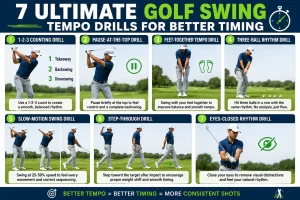
A golf swing can look technically sound and still produce frustratingly inconsistent results if the timing is off. That’s where golf swing tempo becomes so important. Tempo describes the rhythm and pace of your swing, particularly the relationship between the time it takes to complete your backswing and the time it takes to move through the downswing and impact. When that rhythm becomes repeatable, it becomes much easier to produce solid contact, control the clubface, improve accuracy, and generate reliable distance.
One of the biggest misconceptions about golf swing tempo is that you simply need to swing slower. That’s not necessarily true. Some excellent golfers have naturally quick swings, while others have much smoother, slower-looking motions. What matters is whether your backswing and downswing work together in a predictable sequence. A golfer with a relatively fast swing can have excellent tempo if the movement remains balanced and properly sequenced.
Problems often begin when backswing timing becomes rushed. If you snatch the club away from the ball, hurry to the top, and immediately attack the downswing, your body may not have enough time to complete the movements required for an efficient transition. This can cause the arms and upper body to dominate the downswing, making it more difficult to control the clubface, swing path, and point of contact.
A rushed golf swing transition can also interfere with golf swing sequencing. Instead of the body, arms, and club working together, different parts of the swing begin competing with each other. You may lose your posture, pull the club off its intended path, or struggle to shift pressure toward the target at the right time. Once that happens, golf swing balance can suffer as well.
The good news is that improving your tempo doesn’t require completely rebuilding your golf swing mechanics. The right golf swing tempo drills can train you to recognize what a balanced, properly timed swing feels like and gradually make that rhythm more automatic.
In this guide, we’ll cover seven of the best golf swing tempo drills, including the 1-2-3 Counting Drill, Pause-at-the-Top Drill, Feet-Together Tempo Drill, Three-Ball Rhythm Drill, Slow-Motion Swing Drill, Step-Through Drill, and Eyes-Closed Rhythm Drill. Whether you’re an experienced player struggling with timing or looking for golf swing tempo drills for beginners, these exercises can help you develop a smoother transition, better sequencing, and a golf swing you can repeat when it matters most.
What Is Golf Swing Tempo?
Golf swing tempo is the overall timing and pace of your golf swing, especially the relationship between how long it takes to complete the backswing and how long it takes to move through the downswing. In simple terms, tempo is the rhythm that connects the different parts of your swing into one coordinated motion.
One commonly discussed golf swing tempo is the 3:1 ratio. This means the backswing takes approximately three times as long as the downswing. For example, if a golfer takes 0.9 seconds to complete the backswing, the downswing might take roughly 0.3 seconds. However, you shouldn’t become obsessed with reproducing an exact mathematical ratio. Golfers have different swing styles, physical abilities, and natural rhythms. The more important goal is developing a tempo you can repeat consistently.
It’s also helpful to understand the difference between several terms that are sometimes used interchangeably.
Swing tempo describes the timing relationship between different portions of the swing. Swing speed refers to how quickly the clubhead is actually moving, particularly through impact. Swing rhythm describes how smooth and coordinated the overall motion feels. Golf swing sequencing, meanwhile, refers to the order in which the body, arms, hands, and club move throughout the swing.
This is why two golfers can have dramatically different-looking swings while both having excellent tempo. One player may have a quick takeaway and relatively fast overall motion, while another appears smooth and deliberate. Neither swing is automatically better. If each golfer maintains consistent backswing timing, transitions properly, and accelerates through the downswing in a coordinated sequence, both can produce excellent results.
Good tempo also supports efficient golf swing mechanics. When your timing is predictable, your body has a better opportunity to complete the backswing before beginning the golf swing transition. This can make it easier to sequence the lower body, torso, arms, and club correctly during the downswing. Better sequencing can also contribute to improved golf swing balance, centered contact, and clubface control.
So how can you identify your natural tempo?
Start by making several relaxed practice swings without trying to hit a ball. Avoid intentionally slowing down or speeding up. Pay attention to how quickly you naturally take the club back and how smoothly you change direction. If your movement is deliberate and flowing, you may naturally have a smoother tempo. If your swing moves at a comfortable middle pace, you likely have a moderate tempo. If both your backswing and transition happen quickly but remain controlled, you may naturally favor a faster tempo.
Don’t try to force your swing into someone else’s rhythm. When learning how to improve golf swing tempo, the goal is to find a pace that allows you to stay balanced, maintain proper sequencing, and reproduce your swing consistently. The best golf swing tempo drills help you refine that natural rhythm rather than replace it.
Why Poor Golf Swing Timing Causes Inconsistent Shots
Poor timing can turn an otherwise functional golf swing into an unpredictable one. When golf swing tempo changes from swing to swing, the body, arms, and club have less opportunity to work together in the correct sequence. The result can be frustrating because you might hit a perfectly solid shot followed immediately by a fat shot, thin shot, slice, or hook without understanding what changed.
One common problem is rushing the backswing. When the club is pulled away too quickly, golfers may struggle to complete their shoulder turn, maintain posture, or properly load pressure before reaching the top. Poor backswing timing can put the club and body in positions that require last-second compensations during the downswing.
Another major issue occurs when the downswing begins before the backswing has properly finished. Instead of creating a smooth change of direction, the golfer essentially has different parts of the swing moving against each other. The arms may still be traveling back while the upper body is already trying to rotate toward the target. This rushed golf swing transition can disrupt golf swing sequencing and make controlling the club much more difficult.
The consequences can appear in several different ball-flight patterns. Moving toward the ball incorrectly can shift the low point behind the ball and produce fat shots. Standing up or pulling away from the ground too early can contribute to thin shots. If poor timing causes the clubface or swing path to move left or right at impact, the golfer may experience pulls, pushes, slices, or hooks. Strike location can also move around the clubface because the golfer isn’t returning the club to impact consistently.
This is why golfers should be careful about assuming every bad shot is caused by faulty golf swing mechanics. You might spend hours changing your grip, ball position, backswing, or swing path when the underlying problem is actually tempo. If your timing constantly changes, even good mechanical positions become difficult to reproduce.
Good golf swing timing drills and golf swing tempo drills address this problem by teaching the different parts of the swing to work together. A predictable backswing gives you time to complete your movement, while a controlled transition allows the downswing to develop naturally rather than being forced from the top.
Tempo also has a direct relationship with golf swing balance. When golfers suddenly accelerate, rush the transition, or swing harder than normal, they frequently lose their stable base. Once balance disappears, consistent contact becomes much harder.
When learning how to improve golf swing tempo, don’t focus exclusively on making your swing slower. Instead, work toward a repeatable rhythm in which your backswing, transition, and downswing flow together. The best golf swing tempo drills accomplish exactly that—helping you create better sequencing, improved balance, and a swing that produces more predictable results.
If your golf swing tempo feels smooth during practice but disappears as soon as you start hitting real shots, the problem may go deeper than simply “swinging too fast.” Small mistakes in your sequencing, transition, and swing mechanics can quietly destroy your timing before you ever reach impact. Discover how to avoid these mistakes here https://ultimategolfmasterypro.com/the-golf-swing-lab-2/
Golf Swing Tempo Drill #1: The 1-2-3 Counting Drill
The 1-2-3 Counting Drill is one of the simplest ways to develop better golf swing tempo because it gives your swing an easy rhythm to follow. Instead of thinking about multiple technical positions during the backswing and downswing, you use a consistent count to control the pace of your motion. This makes it particularly useful for golfers who rush the takeaway, hurry the transition, or suddenly accelerate from the top.
Start by addressing the ball normally. As you begin the backswing, mentally say “one.” Continue moving the club back while counting “two,” and reach the top around “three.” From there, change direction and swing through the ball naturally. The exact count isn’t as important as maintaining the same rhythm from swing to swing.
Before hitting golf balls, make 10–15 practice swings using the count. Concentrate on allowing the club to move continuously rather than forcing it into specific positions. Your goal is to establish predictable backswing timing while maintaining good golf swing balance.
Once the motion feels comfortable, begin hitting short shots with a wedge or short iron. Hit approximately five balls while maintaining your count. Then gradually increase the length of your swing. Eventually, move into your mid-irons and longer clubs while trying to preserve the same overall rhythm.
One reason this is among the best golf swing tempo drills is that counting can prevent two extremely common mistakes. First, it discourages you from snatching the club away from the ball. Second, it gives the backswing enough time to develop before the golf swing transition begins. When golfers rush from the top, their arms and upper body often take over, disrupting golf swing sequencing and making consistent contact more difficult.
The drill can also improve downswing timing. You’re not trying to deliberately slow the downswing. Instead, you’re creating a more organized transition so the club can accelerate naturally toward impact.
For beginners, make the exercise even easier by starting with half swings. Count slowly and comfortably while focusing primarily on balance and solid contact. Once you can consistently strike the ball while maintaining your rhythm, gradually lengthen the swing. This simplicity makes counting one of the most practical golf swing tempo drills for beginners.
As you become comfortable, experiment slightly with the pace of your count. Some golfers naturally prefer a quicker rhythm, while others perform better with a more deliberate motion. You’re not trying to copy someone else’s swing. You’re discovering a repeatable tempo that complements your natural golf swing mechanics.
If you’re learning how to improve golf swing tempo, the 1-2-3 Counting Drill is an excellent place to start. Practice it regularly until the count becomes associated with a smooth backswing, controlled transition, and balanced finish. Eventually, you may no longer need to consciously count—the rhythm itself can become part of your natural swing.
Golf Swing Tempo Drill #2: The Pause-at-the-Top Drill
If you frequently feel as though you’re attacking the ball from the top of the backswing, the Pause-at-the-Top Drill can be one of the most effective golf swing tempo drills for improving your transition. The exercise teaches you to recognize when the backswing is actually complete before beginning the downswing, which can produce better golf swing tempo without forcing you to swing unnaturally slowly.
Start by taking your normal setup and making a comfortable backswing. When you reach the top, stop briefly for approximately one second. During that pause, keep your body balanced and avoid allowing your hands or club to collapse into a different position. Then begin the downswing smoothly and swing through to a balanced finish.
The pause should be obvious during the drill, but the goal is not to permanently add a one-second pause to your regular golf swing. Instead, exaggerating the separation between the backswing and downswing helps you become more aware of your golf swing transition. When you return to a normal swing, the transition should feel continuous and athletic rather than deliberately paused.
This exercise is particularly valuable for golfers with poor backswing timing who begin moving down before the backswing has fully developed. A rushed transition can cause the arms, shoulders, and lower body to move out of sequence. By temporarily pausing at the top, you can feel what a completed backswing is like before initiating the downswing.
As you start down, pay attention to how the lower body begins moving toward the target while the arms and club follow. You don’t need to aggressively fire your hips. Instead, look for a smooth sequence in which pressure shifts, the lower body begins unwinding, and the upper body, arms, and club respond naturally. This can improve golf swing sequencing and downswing timing.
For practice, begin with 10 slow swings without a ball. Next, hit 10 wedge or short-iron shots while maintaining the exaggerated pause. Then reduce the pause to roughly half a second for another 10 shots. Finally, hit five to 10 normal shots while trying to preserve the same calm transition.
For golfers learning how to improve golf swing tempo, this progression can make the difference between simply telling yourself to “stop rushing” and actually learning what a controlled transition feels like. Over time, the pause disappears, but the improved awareness of timing remains.
Golf Swing Tempo Drill #3: The Feet-Together Tempo Drill
The Feet-Together Tempo Drill is one of the best golf swing tempo drills for golfers who have a tendency to swing too aggressively. By narrowing your stance, you reduce your ability to rely on excessive body movement or brute force. If you rush the swing, your loss of balance becomes immediately obvious.
Begin by taking your normal address position with a wedge or short iron. Instead of setting your feet at their normal width, move them close together so they’re only a few inches apart. You don’t necessarily need to make your shoes touch. The goal is simply to create a narrow enough stance that maintaining golf swing balance becomes more challenging.
Start with small half swings at approximately 50% of your normal effort. Concentrate on making a smooth takeaway, completing the backswing, transitioning without rushing, and finishing under control. Don’t worry about how far the ball travels. Distance isn’t the objective—the purpose is developing better golf swing tempo.
You’ll quickly discover why this drill works. If you suddenly accelerate from the top or try to hit the ball as hard as possible, your narrow stance makes it difficult to maintain balance. You may fall toward the target, move onto your toes, or step backward after impact. Those reactions provide immediate feedback that your swing has become too aggressive.
The drill also encourages more centered rotation. Rather than making large lateral movements during the backswing and downswing, you’ll need to rotate more efficiently around a stable base. That can help improve golf swing sequencing by encouraging the body, arms, and club to work together instead of competing against each other.
After hitting 10–15 half shots successfully, progress to three-quarter swings while keeping your feet together. Once you can produce solid contact and hold your finish consistently, hit several fuller shots. Then gradually widen your stance over another 10–15 shots until you’re back to your normal setup.
The key is carrying the rhythm you developed with the narrow stance into your regular swing.
This exercise is also one of the easiest golf swing tempo drills for beginners because the feedback is so straightforward: if you’re constantly falling out of balance, you’re probably asking your body to move faster than it can control.
When learning how to improve golf swing tempo, remember that speed itself isn’t the enemy. Uncontrolled speed is. The Feet-Together Tempo Drill helps you discover how quickly you can swing while maintaining balance, centered rotation, proper golf swing mechanics, and a smooth transition. Once you find that rhythm, the goal is to reproduce it from shot to shot.
Practicing more won’t necessarily fix an inconsistent golf swing—especially if you’re unknowingly repeating the same timing and sequencing mistakes. In fact, hundreds of rushed swings can make those habits even harder to break. If you’re tired of hitting great shots one minute and terrible ones the next, The Golf Swing Lab gives you a structured system for rebuilding your swing step by step https://ultimategolfmasterypro.com/the-golf-swing-lab-2/
Golf Swing Tempo Drill #4: The Three-Ball Rhythm Drill
The Three-Ball Rhythm Drill is one of the most effective golf swing tempo drills for golfers who tend to overthink their swing after every shot. Instead of stopping to analyze your takeaway, backswing position, transition, impact, and finish, this exercise encourages you to focus on one thing: creating the same rhythm repeatedly.
Start by placing three golf balls in a row on the practice range, leaving enough space between them to comfortably step into position for each shot. Use a wedge or short iron initially. Hit the first ball, move immediately to the second, and then hit the third while trying to reproduce exactly the same golf swing tempo on all three swings.
You don’t need to rush between shots. However, avoid standing behind each ball for a lengthy technical analysis. If the first shot isn’t perfect, resist the temptation to immediately change your golf swing mechanics. Simply move to the next ball and reproduce the same rhythm.
This continuous repetition helps prevent technical thoughts from overwhelming your natural motion. It also makes differences in backswing timing and downswing timing easier to recognize. For example, your first two swings may feel smooth and balanced, but you might suddenly attack the third ball with a quicker takeaway or aggressive transition. When that happens, you’ll often feel the difference immediately.
That’s valuable feedback.
Instead of judging the drill exclusively by where each ball finishes, evaluate whether all three swings felt similar. Did the club move away from the ball at the same pace? Did you complete the backswing before changing direction? Did the golf swing transition feel smooth? Could you hold your finish?
As your rhythm improves, repetition can help establish a natural tempo that requires less conscious thought. This is particularly useful on the golf course, where pressure often causes players to change their normal timing. If you’ve practiced repeating the same rhythm regardless of the previous result, you’re less likely to suddenly speed up after a bad shot or when facing an important tee shot.
Beginners can make this one of the easiest golf swing tempo drills for beginners by using half swings. Place three balls down and hit three controlled wedge shots at approximately 50% effort. Once you can reproduce the same rhythm and maintain golf swing balance, progress to three-quarter swings and eventually full swings.
When learning how to improve golf swing tempo, consistency of movement matters more than creating a swing that looks perfect. The Three-Ball Rhythm Drill trains you to trust your motion, maintain your golf swing sequencing, and reproduce the same tempo even when the outcome of the previous shot wasn’t exactly what you wanted.
Golf Swing Tempo Drill #5: The Slow-Motion Swing Drill
The Slow-Motion Swing Drill is one of the best golf swing tempo drills for developing awareness of how the different parts of your swing work together. When you make every practice swing at full speed, movements happen so quickly that it can be difficult to recognize where your timing or sequencing begins to break down. Slowing everything down gives you an opportunity to actually feel those movements.
Begin without a golf ball and make several swings at approximately 25% of your normal speed. Take the club back slowly while maintaining your posture and balance. Feel your shoulders and torso turning as the club travels toward the top. Allow the backswing to finish before beginning a controlled golf swing transition, then slowly move through the downswing and into a balanced finish.
Pay particular attention to the order of movement.
During the backswing, your body rotation, arms, and club should work together rather than moving independently. At the top, notice the transition between directions. During the downswing, feel how the lower body begins moving while the torso, arms, and club follow. This awareness can reveal problems with golf swing sequencing that may be difficult to notice at full speed.
For example, you may discover that your hands immediately pull the club down from the top before your lower body begins moving. You might notice excessive lateral movement during the backswing or realize that you’re losing your golf swing balance during the transition. Slow practice gives you time to recognize these tendencies without having to react to a ball.
Once you can make several balanced swings at 25% speed, increase to approximately 50%. Then progress to 60–75% while maintaining the same sequence. Eventually, return to your normal swing speed and try to preserve the movement awareness you developed during the slower repetitions.
You can also introduce golf balls gradually. Begin with short wedge shots at roughly half speed, focusing on contact rather than distance. As your confidence increases, work toward fuller swings.
Importantly, slow-motion practice doesn’t mean your normal golf swing tempo should become extremely slow. The drill is a training exercise, not necessarily the tempo you should use on the course. Its purpose is to improve your awareness so that when you return to normal speed, your movements remain coordinated.
If you’re wondering how to improve golf swing tempo, learning to recognize the relationship between your backswing, transition, and downswing is an important step. Slow-motion practice gives you that opportunity. By developing greater awareness of your golf swing mechanics, backswing timing, transition, and downswing timing, you can gradually build a natural tempo that feels athletic, balanced, and repeatable.
Best Golf Training Program For Beginners: Why Most Golfers Never Improve
Golf Swing Tempo Drill #6: The Step-Through Drill
The Step-Through Drill is one of the best golf swing tempo drills for golfers who struggle to coordinate their lower body, upper body, arms, and club during the downswing. Instead of thinking about individual positions, this exercise introduces continuous movement that can improve golf swing sequencing, pressure transfer, and overall rhythm.
Begin by taking your normal golf posture with a mid-iron or short iron. You can start with your feet slightly narrower than your regular stance to make the stepping motion easier. Make a controlled backswing, and as you begin changing direction, allow your trail foot to move toward the target. After impact, take a natural step forward so your trail foot finishes closer to or beyond your lead foot.
The movement should feel similar to throwing a ball toward a target. You’re not jumping or lunging forward. The step simply encourages pressure to move naturally toward the target as the downswing develops.
This is important for golf swing tempo because many golfers rush from the top by immediately pulling the club down with their arms and hands. When the arms dominate the golf swing transition, the lower body may become passive, making it difficult to produce consistent downswing timing.
The Step-Through Drill encourages the opposite pattern. The movement toward the target helps you feel the lower body initiating the change of direction while the torso, arms, and club follow. That doesn’t mean you should aggressively fire your hips as quickly as possible. The objective is creating an athletic sequence in which each part of the swing responds to the movement before it.
Begin with 10 practice swings without a golf ball. Make the stepping motion exaggerated enough that you can clearly feel pressure moving toward the target. Next, hit five to 10 short wedge shots at approximately 50% effort. Progress to three-quarter swings before eventually hitting fuller shots.
As you improve, gradually make the step smaller until you’re producing a normal swing while retaining the same sensation of pressure movement and sequencing.
Avoid several common mistakes. Don’t step toward the target before completing your backswing, don’t lunge your entire upper body forward, and don’t make the step so aggressive that you lose golf swing balance. Most importantly, don’t turn the drill into an exercise in swinging harder.
When learning how to improve golf swing tempo, continuous athletic movement can sometimes be more effective than obsessing over technical positions. The Step-Through Drill helps connect your backswing, transition, and downswing into one flowing motion, making it an excellent addition to your regular golf swing timing drills.
Golf Swing Tempo Drill #7: The Eyes-Closed Rhythm Drill
The Eyes-Closed Rhythm Drill takes a different approach to improving golf swing tempo. Instead of giving yourself more information about the swing, you’re temporarily removing visual feedback so you can concentrate more closely on what your body and club actually feel like as they move.
For safety, always begin this drill without a golf ball and only practice in an open area where you have plenty of space and no people, equipment, or objects within swinging distance. Take your normal stance, close your eyes, and make a relaxed practice swing at approximately 50% of your normal effort.
Without visual information competing for your attention, focus on three sensations: balance, pressure movement, and rhythm.
First, notice your golf swing balance. Can you remain centered during the backswing? Do you feel stable as you change direction? Can you complete the swing and hold your finish without stumbling?
Next, pay attention to how pressure moves through your feet. Feel the backswing develop and then notice the pressure moving toward your lead side as the downswing begins. This can increase your awareness of golf swing sequencing without requiring you to think about numerous technical positions.
Finally, listen to the club.
As the club accelerates through the hitting area, you’ll hear the familiar “whoosh.” Listen for whether that sound occurs naturally through the bottom of the swing or whether you’re aggressively accelerating too early. If you rush the golf swing transition, you may also notice that the entire motion feels abrupt rather than continuous.
Make five to 10 eyes-closed practice swings, then open your eyes and make several normal swings while attempting to reproduce the same rhythm.
Only golfers who feel completely comfortable and are practicing in a safe environment should progress to hitting a ball. If you do, start with controlled wedge shots or very short swings rather than full-speed shots. There is no need to hit balls with your eyes closed to benefit from the drill; practice swings alone can provide valuable feedback.
This is particularly helpful when you’re learning how to improve golf swing tempo because golfers sometimes become overly dependent on visual checkpoints and mechanical thoughts. By temporarily removing visual feedback, you can become more aware of backswing timing, pressure movement, transition, and downswing timing.
Among the best golf swing tempo drills, the Eyes-Closed Rhythm Drill is valuable because it helps you discover what your natural swing feels like rather than forcing you to copy someone else’s pace. The ultimate goal isn’t to develop the slowest or fastest swing possible. It’s to find a rhythm that supports your natural golf swing mechanics, keeps you balanced, and can be repeated consistently from one shot to the next.
The Best Golf Swing Tempo Drills for Beginners
Beginners often assume they need to learn every technical detail of the golf swing before they can hit consistent shots. While solid fundamentals matter, trying to control too many positions at once can make the swing feel stiff and complicated. Developing a repeatable golf swing tempo gives beginners a simpler foundation because it helps the body, arms, and club move together naturally.
Three of the easiest golf swing tempo drills for beginners are the 1-2-3 Counting Drill, Feet-Together Drill, and Slow-Motion Swing Drill.
The 1-2-3 Counting Drill is a great starting point because it gives beginners a simple rhythm to follow. Counting during the backswing can discourage a rushed takeaway and provide enough time for the backswing to develop before the downswing begins.
The Feet-Together Drill adds another important element: golf swing balance. With the feet positioned close together, swinging too aggressively makes it difficult to remain stable. Beginners quickly learn that they don’t need maximum effort to produce solid contact.
The Slow-Motion Drill is particularly useful for understanding basic golf swing sequencing. Making swings at 25–50% speed gives a new golfer time to feel the backswing, transition, downswing, and finish without everything happening at full speed.
Beginners should prioritize this rhythm before worrying about generating maximum clubhead speed. Trying to hit the ball as far as possible too early can encourage a rushed golf swing transition, poor balance, and excessive tension. Speed becomes much more useful once the golfer can control the movement producing it.
Start these golf swing timing drills with a wedge or short iron. Make half swings until you can consistently contact the ball while maintaining your balance and rhythm. Progress to three-quarter swings, and only move to full swings once your timing remains relatively consistent.
Most importantly, don’t become obsessed with achieving perfect positions. Beginners can quickly overload themselves by thinking about their grip, wrists, shoulders, hips, knees, clubface, swing path, and weight transfer simultaneously.
Instead, focus on developing a motion you can repeat.
The best golf swing tempo drills simplify the learning process by teaching rhythm, balance, and coordination. As those qualities improve, you can gradually refine your golf swing mechanics without sacrificing the natural flow of your swing.
How to Improve Golf Swing Tempo Without Swinging Slower
One of the biggest misconceptions about golf swing tempo is that a good golf swing must look slow and effortless. This leads some golfers to deliberately slow down every part of their motion, only to discover that their swing feels awkward and they lose distance. Improving tempo isn’t necessarily about swinging slower—it’s about eliminating sudden, poorly timed changes in speed.
A golfer with a naturally fast swing can have excellent tempo. Likewise, a golfer with a slow-looking swing can have poor timing. What matters is whether the backswing, golf swing transition, and downswing flow together in a predictable sequence.
Think in terms of smooth acceleration rather than simply slow versus fast.
A common problem begins during the takeaway. Some golfers jerk the club away from the ball and immediately disrupt their backswing timing. A controlled takeaway doesn’t have to be extremely slow. It simply needs to give your body, arms, and club an opportunity to begin moving together.
From there, allow the backswing to develop naturally. Trying to start the downswing before the backswing is complete can create competing movements. Your arms may still be traveling back while your lower body and shoulders are already trying to move toward the target.
A smoother golf swing transition gives those movements a better chance to occur in the proper order. As the backswing finishes, pressure can begin moving toward the target, the lower body can start unwinding, and the arms and club can respond. This improves golf swing sequencing and can produce better downswing timing without consciously trying to swing slowly.
Another mistake is accelerating too aggressively at the beginning of the downswing and then losing speed before impact. Ideally, you want the club to build speed progressively so that useful acceleration occurs through the hitting area rather than being wasted at the top.
That’s one reason the best golf swing tempo drills focus so heavily on rhythm and transition. You’re training yourself to eliminate sudden bursts of speed that interfere with balance and sequencing.
When learning how to improve golf swing tempo, pay attention to where your speed occurs rather than simply trying to reduce it. Use a controlled takeaway, allow the backswing to finish, transition smoothly, and let the club accelerate naturally through impact.
When those pieces work together, better tempo can actually help you produce more clubhead speed, not less. Instead of wasting energy through poor golf swing mechanics, you’re delivering speed at the point where it matters most—through the ball—while maintaining the balance and control necessary for more consistent contact.
Common Golf Swing Tempo Mistakes to Avoid
Even when golfers understand the importance of golf swing tempo, several common habits can cause their timing to change from one swing to the next. Recognizing these mistakes is important because what appears to be a technical swing fault can sometimes originate from poor rhythm, balance, or golf swing sequencing.
One of the most common mistakes is rushing the takeaway. Snatching the club away from the ball can immediately disrupt backswing timing and make it difficult for the shoulders, torso, arms, and club to move together. A controlled takeaway doesn’t need to be slow—it simply needs to establish a repeatable beginning to the swing.
Another mistake is making the entire backswing unnecessarily fast. When golfers hurry to the top, they often start the downswing before the backswing has fully developed. This can create an abrupt golf swing transition and force the golfer to make compensations on the way down.
Starting the downswing primarily with the arms creates similar problems. Pulling the club down aggressively can interfere with proper golf swing sequencing, preventing the lower body and torso from contributing efficiently to the motion.
Golfers also frequently try to generate maximum speed immediately from the top. Effective speed should build through the downswing rather than being forced during the first few inches of the transition. Accelerating too early can disturb the swing path, clubface control, and downswing timing.
Another warning sign is losing golf swing balance while chasing additional distance. If you’re falling toward the target, stepping backward, or struggling to hold your finish, there’s a good chance you’re swinging with more effort than you can effectively control.
Tempo can also change after a poor shot. Golfers sometimes respond to a short shot by swinging harder or react to a wild shot by deliberately slowing everything down. Constantly changing your rhythm makes consistency even harder to develop.
Practicing every shot at full speed can reinforce these problems. Incorporating golf swing tempo drills, half swings, and slow-motion repetitions gives you an opportunity to improve movement without worrying about maximum distance.
Finally, avoid filling your mind with too many mechanical thoughts. Trying to consciously control your wrists, elbows, shoulders, hips, knees, clubface, and swing path simultaneously can destroy natural rhythm.
Good golf swing mechanics still matter, but mechanics and tempo should complement each other. When learning how to improve golf swing tempo, focus on creating a balanced, repeatable motion first. Better timing can make your existing mechanics much easier to reproduce.
Golf Tempo Drills: How to Build a More Consistent Swing Rhythm
https://brucebolt.us/blogs/news/golf-tempo-drills
A Simple 15-Minute Golf Swing Tempo Practice Routine
Improving golf swing tempo doesn’t require spending hours at the driving range. A focused 15-minute routine can help you develop better backswing timing, transition, balance, and golf swing sequencing without hitting hundreds of golf balls. The key is practicing with a specific purpose rather than simply hitting shot after shot.
Minutes 1–3: Slow-Motion Practice Swings
Begin without a ball and make slow-motion swings at approximately 25–50% of your normal speed. Pay attention to your takeaway, backswing, golf swing transition, downswing, and finish. Focus on how the different parts of your body work together rather than trying to create speed.
Minutes 4–6: 1-2-3 Counting Drill
Next, hit several short shots while using the 1-2-3 Counting Drill. Establish a comfortable rhythm during the backswing and avoid suddenly attacking the ball from the top. Try to make every repetition feel similar.
Minutes 7–9: Feet-Together Swings
Move your feet close together and hit controlled wedge or short-iron shots. Concentrate on maintaining golf swing balance from address through the finish. If you’re falling out of position, reduce your effort until you can remain stable.
Minutes 10–12: Step-Through Drill
Perform the Step-Through Drill to improve pressure movement and downswing timing. Allow the lower body to initiate the change of direction while the arms and club follow naturally. Keep the movement athletic rather than forced.
Minutes 13–15: Normal Golf Shots
Return to your regular stance and hit normal shots. Don’t consciously perform any of the drills. Instead, try to reproduce the rhythm and balance you developed during the previous 12 minutes.
This routine can be performed two or three times per week, although even a few minutes of golf swing timing drills before a normal range session can be beneficial.
When evaluating your practice, don’t judge success by one perfect shot. Look at groups of shots instead. Are you maintaining similar rhythm? Is your strike becoming more predictable? Can you hold your finish consistently? Those patterns tell you more than whether one ball happened to land close to your target.
Eventually, begin taking the same rhythm onto the golf course. Use a practice swing before your shot, identify the tempo you want to reproduce, and then step up and hit without introducing additional mechanical thoughts.
The best golf swing tempo drills ultimately need to transfer to real golf. By consistently practicing this short routine, you can gradually make smoother timing feel automatic—giving you a more repeatable swing when you’re standing on the course and every shot counts.
How to Maintain Your Golf Swing Tempo on the Course
Developing good golf swing tempo on the practice range is one thing. Maintaining that same rhythm when you’re facing a narrow fairway, water hazard, difficult approach shot, or important putt for par can be much harder. Many golfers unknowingly swing faster during an actual round because pressure changes the way they move.
One of the biggest causes is trying to hit the ball farther. You might reach a long par 4, see a 180-yard approach, and immediately feel as though you need to add extra effort. That effort often appears as a faster takeaway, shortened backswing timing, or an aggressive golf swing transition. Instead of producing more distance, the rushed motion can disrupt contact, clubface control, and accuracy.
Pressure can create the same problem. Hazards, tight fairways, difficult lies, and competitive situations can increase tension and cause you to move faster than normal.
A repeatable pre-shot routine can help prevent this. Before every shot, establish the same basic sequence: choose your target, select the club, make a rehearsal swing, address the ball, and swing. Keeping your pre-shot pace relatively consistent can make it easier to reproduce your normal tempo.
During the rehearsal swing, focus on one simple tempo cue. You might think “smooth,” use the same 1-2-3 count from your golf swing tempo drills, or simply feel yourself completing the backswing before changing direction. Avoid carrying five different mechanical thoughts onto the course. Too many instructions can interfere with natural golf swing sequencing.
Breathing can help as well. If you notice yourself becoming tense, take a comfortable breath before addressing the ball. Don’t race through your setup. Walking into the shot, setting your feet, and gripping the club at a familiar pace can help establish the rhythm you want before the club even starts moving.
Most importantly, don’t intentionally change your tempo simply because you’re using a different club. Your driver swing will naturally be longer than a wedge swing, but the overall rhythm should remain familiar. Trying to smash the driver and then dramatically slowing down with a short iron creates unnecessary timing changes.
The purpose of golf swing timing drills is ultimately to develop a rhythm you can trust on the course. When pressure increases, return to your familiar pre-shot routine, one simple tempo cue, and a balanced finish. The more consistent your routine becomes, the easier it is to preserve your natural swing when the shot actually matters.
Final Thoughts: Build a Golf Swing Tempo You Can Repeat
Great golf swing tempo isn’t about making your swing as slow and smooth as possible. It’s about developing a rhythm you can repeat. Whether your natural swing is relatively fast, moderate, or deliberate, consistency comes from allowing the different parts of the swing to work together without sudden changes in speed.
That starts with reliable backswing timing. A controlled takeaway gives your body, arms, and club enough time to move together and allows the backswing to develop naturally. From there, a smooth golf swing transition helps connect the backswing to the downswing without aggressively pulling the club from the top.
Proper golf swing sequencing then allows the lower body, torso, arms, and club to work together as the downswing develops. When that sequence is supported by good downswing timing and golf swing balance, producing consistent contact becomes much easier.
The seven golf swing tempo drills covered in this guide give you several ways to develop those skills. However, you don’t need to perform all seven every time you practice. In fact, constantly jumping from one exercise to another can make improvement more complicated than necessary.
Instead, select two or three drills that address your biggest problem.
If you rush your backswing, start with the 1-2-3 Counting Drill. If you struggle with the transition, use the Pause-at-the-Top Drill. If excessive effort causes you to lose balance, practice the Feet-Together Drill. Golfers struggling with sequencing may benefit most from the Slow-Motion or Step-Through drills.
Short, consistent practice sessions are usually more valuable than occasionally spending hours hitting balls without a clear objective. Even 10–15 minutes of focused golf swing timing drills several times per week can help you become more aware of your natural rhythm.
Most importantly, improving tempo doesn’t mean abandoning your existing golf swing mechanics. Better timing can actually make those mechanics easier to repeat because your body has more opportunity to move in the correct sequence.
If you’re learning how to improve golf swing tempo, don’t chase someone else’s perfect-looking swing. Find the rhythm that allows your swing to remain balanced, coordinated, and repeatable.
That’s ultimately what the best golf swing tempo drills are designed to accomplish: not a prettier swing, but a golf swing you can trust from the first tee to the final hole.
Frequently Asked Questions About Golf Swing Tempo
What is the ideal golf swing tempo?
The ideal golf swing tempo is a pace that allows you to complete your backswing, transition smoothly, maintain balance, and consistently deliver the club through impact. There isn’t one perfect tempo for every golfer. Some players naturally swing faster than others. Rather than copying another player’s pace, focus on developing a repeatable relationship between your backswing and downswing.
What is a 3:1 golf swing tempo?
A 3:1 golf swing tempo means the backswing takes approximately three times as long as the downswing. For example, a 0.9-second backswing would be paired with roughly a 0.3-second downswing. The 3:1 concept can provide a useful reference for understanding backswing timing and downswing timing, but golfers don’t need to reproduce an exact mathematical ratio to play consistently.
How do I improve my golf swing tempo?
If you’re wondering how to improve golf swing tempo, start by practicing at reduced speed and focusing on rhythm rather than distance. Use golf swing tempo drills such as the 1-2-3 Counting Drill, Feet-Together Drill, and Slow-Motion Swing Drill. Concentrate on completing your backswing, making a smooth golf swing transition, and maintaining balance through the finish.
What are the best golf swing tempo drills?
Some of the best golf swing tempo drills include the 1-2-3 Counting Drill, Pause-at-the-Top Drill, Feet-Together Drill, Three-Ball Rhythm Drill, Slow-Motion Swing Drill, Step-Through Drill, and Eyes-Closed Rhythm Drill. Each targets a slightly different aspect of timing, including rhythm, balance, transition, pressure movement, and golf swing sequencing.
What are the best golf swing tempo drills for beginners?
The best golf swing tempo drills for beginners are generally the 1-2-3 Counting Drill, Feet-Together Drill, and Slow-Motion Swing Drill. They’re easy to understand and allow beginners to develop rhythm and golf swing balance without becoming overwhelmed by complicated technical positions. Start with wedges and half swings before progressing to longer clubs and full swings.
How can I stop rushing my golf downswing?
Allow your backswing to finish before aggressively changing direction. The Pause-at-the-Top Drill can help you recognize what a completed backswing feels like, while the 1-2-3 Counting Drill can establish more predictable timing. Avoid trying to generate maximum clubhead speed immediately from the top. Instead, let speed build progressively through the downswing.
Should my golf backswing be slow?
Your backswing doesn’t necessarily need to be slow. It needs to be controlled and repeatable. A golfer can have relatively fast backswing timing and still maintain excellent tempo. Problems usually occur when the takeaway or backswing becomes so rushed that it disrupts balance, positioning, or the transition into the downswing.
How do I improve my golf swing transition?
Improve your golf swing transition by allowing the backswing to develop fully and avoiding an aggressive pull with the arms from the top. Drills such as the Pause-at-the-Top and Step-Through drills can help improve awareness of the change of direction. Better transition timing also supports more efficient golf swing sequencing, allowing the lower body, torso, arms, and club to work together.
Does golf swing tempo affect distance?
Yes. Golf swing tempo can influence distance because poor timing may prevent you from delivering clubhead speed efficiently through impact. Swinging harder doesn’t automatically produce more distance. A balanced, properly sequenced swing can help speed build at the right time, potentially improving both contact and energy transfer while maintaining control.
How can I maintain the same golf swing tempo on the course?
Develop a consistent pre-shot routine and use one simple tempo cue instead of thinking about several golf swing mechanics at once. Make a relaxed rehearsal swing before difficult shots and avoid suddenly swinging harder because you’re using a longer club or facing a demanding shot. Regular golf swing timing drills on the practice range can make your preferred rhythm easier to reproduce when you’re under pressure on the course.