
7 Hidden Causes of Fat Golf Shots That Hurt Your Game
Why Do I Keep Hitting Fat Golf Shots With My Irons?
Introduction: Why Fat Golf Shots Are Ruining Your Consistency
Few things are more frustrating in golf than setting up for a perfect iron shot, making what feels like a solid swing, and watching your club dig into the ground before reaching the ball. Instead of producing a clean, powerful strike, the ball travels only a fraction of the intended distance. If this sounds familiar, understanding the causes of fat golf shots could be the key to improving your performance on the course.
A fat golf shot occurs when your clubhead strikes the turf before making contact with the golf ball. This ground-first contact absorbs energy, reduces clubhead speed at impact, and often produces weak, unpredictable shots. Repeated mistakes can damage your confidence, especially when approaching greens or attempting important iron shots.
Many frustrated golfers ask, “Why do I hit fat golf shots even when my swing feels correct?” The answer often involves poor swing low-point control. Your swing’s low point is the lowest position your clubhead reaches during its arc. For consistent ball striking with irons, that low point generally needs to occur slightly ahead of the golf ball, allowing the club to contact the ball before the turf.
However, several overlooked swing faults can interfere with this process.
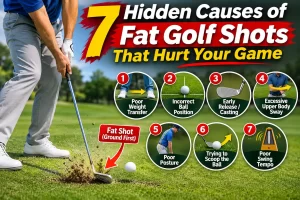
In this guide, we’ll uncover seven hidden causes of fat golf shots, including improper weight transfer, incorrect ball positioning, early club release, and poor swing tempo. More importantly, you’ll discover practical adjustments and simple drills designed to improve your golf swing mechanics, develop cleaner ball-first contact, and build the confidence needed for more consistent iron play.
9 Powerful Drills to Fix Fat Golf Shots Fast That Work
1. Poor Weight Transfer Leaves Your Swing Stuck Behind the Ball
One of the most overlooked causes of fat golf shots is poor weight transfer during the downswing. Many golfers focus on their grip, stance, and backswing while overlooking how pressure shifts between their feet throughout the swing. Without proper weight transfer, even a technically sound swing can produce inconsistent contact, reduced distance, and frustrating fat shots.
Learning how to shift pressure toward your lead foot at the right time is essential for controlling your golf swing low point and developing consistent ball striking.
How Hanging Back Causes Fat Golf Shots
Hanging back occurs when a golfer keeps too much pressure on the trail foot during the downswing instead of transferring pressure toward the lead foot. For right-handed golfers, this means remaining excessively loaded on the right side as the club approaches impact.
When this happens, the bottom of the swing arc can remain behind the golf ball. Instead of striking the ball first and then brushing the turf, the clubhead contacts the ground prematurely, producing a fat shot.
This is one of the common reasons for fat golf shots, particularly among golfers who try to help the ball into the air by leaning backward during impact.
Proper golf swing mechanics involve a coordinated pressure shift, body rotation, and controlled movement toward the target. Although pressure shifts toward the trail foot during the backswing, it should begin moving toward the lead foot during the transition and downswing.
Importantly, proper weight transfer doesn’t mean sliding your entire upper body toward the target. Excessive lateral movement can create additional swing problems. The goal is to transfer pressure while maintaining balance and allowing your body to rotate naturally.
How to Improve Weight Transfer for Cleaner Contact
One effective way to develop proper weight transfer is through the step-through drill. This exercise encourages natural movement toward the target and helps prevent your body from hanging back during impact.
Try this simple weight-transfer drill:
-
Set up with a short iron and position the ball normally.
-
Begin with a relaxed stance and make a controlled three-quarter backswing.
-
As you swing down, allow pressure to move toward your lead foot.
-
After striking the ball, let your trail foot step forward toward the target.
-
Finish balanced, with your body facing the target.
Start with slow practice swings before attempting to hit golf balls. Once the movement feels comfortable, gradually increase your swing speed.
Another useful checkpoint is your finish position. At the completion of a balanced iron swing, most of your pressure should be on your lead foot, with your trail heel raised and your chest facing the target.
Avoid three common mistakes: keeping your weight on your back foot, sliding excessively toward the target, and forcing your upper body forward too aggressively.
By improving your pressure shift and body sequencing, you can move your golf swing low point into a more favorable position, promote ball-first contact, and reduce the frequency of fat golf shots.
2. Incorrect Ball Position Changes Where Your Club Hits the Ground
Another frequently overlooked factor among the causes of fat golf shots is incorrect ball position at address. Even when your swing mechanics are relatively consistent, positioning the golf ball too far forward or too far back in your stance can interfere with clean contact.
Your ball position influences where the clubhead meets the ball relative to the bottom of your swing arc. When the ball is positioned incorrectly, you may struggle to achieve the proper golf impact position, resulting in fat shots, thin shots, and inconsistent distance control.
Understanding how ball position changes with different irons is an important step toward developing more reliable ball striking.
Why Ball Position Matters With Your Irons
If you’ve ever wondered what causes fat golf shots with irons, your setup may be part of the problem.
During a properly executed iron swing, the clubhead generally contacts the golf ball while traveling downward, with the lowest point of the swing occurring slightly ahead of the ball.
However, when the ball is positioned too far forward, the clubhead may reach the bottom of its swing arc before making contact. This increases the possibility of striking the turf first.
Ball position should also change slightly depending on the club you’re using.
-
Short irons (8-iron, 9-iron, pitching wedge): Position the ball near the center of your stance, or slightly forward of center.
-
Mid-irons (5-iron, 6-iron, 7-iron): Position the ball slightly forward of center.
-
Long irons (3-iron and 4-iron): Position the ball farther forward than with your shorter irons, generally inside the lead heel rather than directly opposite it.
These are starting points rather than rigid rules. Individual swing characteristics, club design, and stance width can influence the ideal position.
For example, a wider stance can make a ball appear farther back relative to your feet, even when its position relative to your lead foot hasn’t changed.
How to Find the Correct Ball Position
One of the easiest ways to develop a repeatable setup is through an alignment-stick drill.
Follow these steps to check your ball position:
-
Place an alignment stick on the ground pointing toward your target.
-
Position a second stick perpendicular to the target line, pointing toward the ball.
-
Take your normal stance with a 7-iron.
-
Check that the ball sits slightly forward of the center of your stance.
-
Hit several controlled shots while observing the quality of contact.
Pay attention to where your club first contacts the ground. Ideally, with a typical iron shot from the turf, the club should strike the ball before creating a divot on the target side of its original position.
If you repeatedly hit behind the ball, make small ball-position adjustments rather than dramatically changing your stance.
Also, check that your hands are positioned naturally at address and that your shoulders remain relatively level without excessive backward tilt.
Remember, moving the ball backward isn’t a universal solution for fat shots. Poor weight transfer, early club release, and other swing faults can produce the same problem.
By combining correct ball positioning with improved low-point control, you can achieve more consistent ball-first contact, strengthen your golf impact position, and develop cleaner, more predictable iron shots.
3. Early Release and Club Casting Destroy Your Impact Position
One of the most common yet misunderstood fat golf shot causes is releasing the golf club too early during the downswing. Many amateur golfers unknowingly throw the clubhead toward the ball before their hands and body have reached an effective impact position. This movement, commonly known as casting, can lead to poor contact, reduced distance, and inconsistent ball striking.
Understanding how your wrists, hands, and body work together during the downswing is essential for improving your golf swing mechanics. When these movements are properly coordinated, you can develop a more reliable impact position and reduce the likelihood of striking the ground before the ball.
What Happens When You Release the Club Too Early
Casting occurs when a golfer prematurely straightens the angle between the lead arm and the club shaft during the downswing. Instead of allowing the club to release naturally as the hands approach impact, the golfer throws the clubhead outward too soon.
This early release can cause the clubhead to reach the bottom of its swing arc behind the golf ball, resulting in ground-first contact.
Another consequence of casting is the loss of forward shaft lean at impact. With a typical iron shot, the hands are generally slightly ahead of the clubhead when the ball is struck. This helps deliver the club with an appropriate dynamic loft and promotes solid compression.
When the wrists release prematurely, the clubhead may overtake the hands too early, increasing dynamic loft and reducing the quality of contact.
Golfers who struggle with casting often experience several problems, including fat shots, thin shots, inconsistent distance, and weak iron strikes.
However, casting isn’t always caused by the hands alone. Poor body rotation, incorrect sequencing, and an attempt to lift the ball into the air can all contribute to an early release.
Simple Drills to Improve Your Golf Impact Position
One effective way to improve your golf impact position is through a controlled punch-shot drill. This exercise encourages better coordination between your hands, arms, and body while promoting cleaner ball-first contact.
Follow these steps to practice the punch-shot drill:
-
Select a pitching wedge or 9-iron and take your normal stance.
-
Position the ball near the center of your stance.
-
Make a short backswing, keeping your arms and wrists relaxed.
-
Rotate your body through impact while allowing your hands to lead the clubhead naturally.
-
Finish with a shortened follow-through, keeping the movement controlled.
Begin with half-speed swings and focus on solid contact rather than distance.
A useful checkpoint is to observe your hands and club shaft during slow-motion practice swings. Your lead wrist should remain controlled through impact without excessive cupping or an exaggerated forward press.
Avoid trying to hold your wrist angles rigidly throughout the downswing. The club must release naturally, and forcing excessive shaft lean can create additional swing problems.
The goal is to improve timing and sequencing, not eliminate wrist movement.
By developing better clubhead control and more efficient golf swing mechanics, you can reduce early casting, improve compression, and achieve more consistent iron contact.
4. Excessive Upper Body Sway Disrupts Your Swing Low Point
Another overlooked factor among the causes of fat golf shots is excessive upper body sway during the backswing and downswing. Although some lateral movement is a natural part of an effective golf swing, moving your upper body too far away from the target can make it difficult to return the club to the correct impact position.
When your head, shoulders, and torso shift excessively during the swing, the location of your golf swing low point can become inconsistent. This often results in striking the turf before the ball, producing fat shots that sacrifice both distance and accuracy.
Developing better body stability while maintaining natural rotation can help improve your swing mechanics and create more reliable ball-first contact.
How Lateral Sway Leads to Ground-First Contact
Lateral sway occurs when your upper body moves excessively sideways rather than rotating in a controlled manner during the golf swing.
For a right-handed golfer, excessive backswing sway typically involves shifting the head and upper torso too far toward the right side. This movement can make it difficult to return pressure and body position toward the lead side during the downswing.
If the upper body remains too far behind the golf ball at impact, the clubhead may reach the bottom of its swing arc before contacting the ball.
It’s important to understand the difference between a proper pressure shift and excessive sway.
A controlled pressure shift allows golfers to load into the trail foot during the backswing while maintaining balance and rotating the torso. Excessive sway, however, involves unnecessary lateral movement that can disrupt posture, timing, and club delivery.
Head movement can also influence consistency. While keeping your head perfectly still isn’t necessary, large side-to-side movements can make controlling the club’s swing arc more difficult.
These problems often become more noticeable with mid-irons and long irons, where precise low-point control is especially important for solid contact.
How to Build a More Stable Golf Swing
One practical way to reduce excessive upper body sway is through a simple wall-reference drill.
Try this drill to improve rotational stability:
-
Stand in your normal golf posture without a club, with your trail-side hip a few inches from a wall.
-
Cross your arms over your chest and establish a balanced stance.
-
Slowly rotate into your backswing while allowing your trail hip to turn naturally.
-
Avoid sliding your entire upper body sideways toward the wall.
-
Rotate back toward an imaginary impact position while shifting pressure toward your lead foot.
Repeat the movement several times before practicing with a golf club.
Another helpful technique is to make slow-motion swings while focusing on maintaining balance throughout the backswing and downswing.
Your shoulders should rotate around your torso while your hips turn naturally. Avoid locking your lower body in place, as this can restrict rotation and encourage compensations.
You can also record your swing from a face-on camera angle to observe excessive lateral movement.
Remember, the objective isn’t to eliminate all sideways motion. Effective golf swing mechanics require a coordinated combination of rotation, pressure transfer, and controlled body movement.
By reducing unnecessary sway and improving your rotational balance, you can develop a more predictable golf swing low point, achieve cleaner ball-first contact, and reduce the frequency of fat golf shots.
5. Poor Posture and Loss of Spine Angle Cause Inconsistent Contact
One of the frequently overlooked reasons for fat golf shots is poor posture at address and the inability to maintain a consistent body position throughout the swing. Many golfers concentrate on their grip, backswing, and clubhead movement without realizing how much their setup posture influences the quality of their contact.
Your posture establishes the foundation for effective golf swing mechanics. When your body is properly balanced and positioned, your arms have enough room to swing naturally, and your clubhead can follow a more predictable path toward the golf ball.
However, excessive knee bending, rounded shoulders, or unnecessary changes in body height can disrupt your swing arc and make consistent ball striking difficult.
Why Your Setup Posture Affects Ball Striking
Proper golf posture begins with an athletic stance that allows your body to rotate freely while maintaining balance.
To establish this position, stand with your feet approximately shoulder-width apart, depending on the club you’re using. Bend forward from your hips rather than rounding your upper back, and allow your knees to flex slightly.
Your arms should hang naturally beneath your shoulders without excessive reaching or tension.
One common mistake is bending the knees too much at address. This can restrict hip rotation, change your balance, and encourage unnecessary vertical movement during the swing.
Another problem is rounding your back excessively. Poor spinal alignment can make it more difficult to rotate comfortably and maintain consistent spacing between your body and the golf ball.
Changes in body height can also influence contact.
For example, if your knees flex excessively or your upper body drops toward the ground during the downswing, the clubhead may travel lower than intended and strike the turf before reaching the ball.
Conversely, standing up too early can move the club away from its intended delivery position, contributing to thin shots or other compensations.
Although some changes in spine angle and body height occur naturally during an effective golf swing, excessive or poorly timed movements can make low-point control unpredictable.
How to Maintain Better Posture Throughout Your Swing
Improving your posture doesn’t require forcing your body into a rigid position. Instead, focus on establishing a comfortable, balanced setup that supports natural rotation.
Try this simple posture-check routine:
-
Stand upright with your feet approximately shoulder-width apart.
-
Bend forward from your hips while keeping your back in a comfortable, neutral position.
-
Add a slight amount of knee flex without squatting excessively.
-
Allow your arms to hang naturally beneath your shoulders.
-
Check that your weight feels balanced across the middle of your feet.
Once you’ve established your setup, practice slow-motion swings while paying attention to your body height and balance.
Make a controlled backswing, rotate through an imaginary impact position, and finish without unnecessary dipping or standing up.
You can also record your swing from a down-the-line camera angle to observe changes in posture.
Remember, consistent ball striking depends on maintaining functional posture rather than keeping your spine perfectly fixed.
By improving your setup and reducing excessive body movement, you can develop more repeatable golf swing mechanics, control your swing low point, and reduce fat golf shots.
6. Trying to Scoop the Golf Ball Instead of Striking Down
One of the biggest misconceptions among amateur golfers is believing they must lift the golf ball into the air with their irons. This misunderstanding often leads to scooping, a common swing fault that can produce fat shots, weak contact, and inconsistent distances.
If you’re wondering how to stop hitting fat golf shots, understanding how your irons are designed to launch the ball is an important first step.
Unlike a driver, which is commonly struck with an upward angle of attack, most iron shots are played with a slightly descending clubhead at impact. The club’s loft helps launch the ball into the air while the golfer focuses on delivering the clubhead to the correct impact position.
Why Trying to Lift the Ball Creates Fat Shots
Scooping occurs when a golfer attempts to lift the golf ball by flipping the wrists, leaning backward, or allowing the clubhead to pass the hands prematurely during the downswing.
Instead of delivering the club with a controlled downward strike, the golfer tries to help the ball into the air.
Unfortunately, this movement can shift the bottom of the swing arc behind the ball.
When the clubhead reaches its lowest point too early, it may strike the turf before contacting the golf ball, producing a fat shot.
Scooping can also increase the club’s dynamic loft at impact, resulting in weaker strikes and unpredictable ball flight.
The important concept to understand is that the loft of your iron helps launch the ball. You don’t need to deliberately lift it with your hands.
During a solid iron shot, the clubhead generally contacts the ball before reaching the lowest point of its swing arc. The club then continues downward briefly, often creating a divot beyond the ball’s original position.
This combination of controlled low-point positioning and effective club delivery promotes better compression and more reliable distance control.
How to Achieve Ball-First Contact With Your Irons
One effective way to eliminate scooping and improve ball-first contact is through the towel-behind-the-ball drill.
This exercise provides immediate feedback about where your clubhead strikes the ground.
Follow these steps to practice the drill:
-
Place a golf ball on a practice mat or suitable grass surface.
-
Position a small, folded towel approximately four to six inches behind the ball.
-
Select a pitching wedge or short iron.
-
Make a controlled half swing while focusing on striking the ball without touching the towel.
-
Gradually increase your swing length as your contact improves.
If your club strikes the towel before reaching the ball, your swing low point may be occurring too far behind the ball.
Start with slow swings and increase the difficulty only when you can consistently avoid the towel. Avoid placing the towel so close that it interferes with a normal swing.
Another useful checkpoint is your divot pattern when practicing on grass.
With a typical iron shot, the divot should begin at or slightly beyond the ball’s original position, indicating that the club reached the ball before digging into the turf.
However, a large divot isn’t necessary for a successful shot. Some golfers produce excellent iron contact with relatively shallow turf interaction.
Focus on developing a natural golf impact position, with your body rotating through the shot and your hands slightly ahead of the clubhead at impact.
Avoid forcing your hands excessively forward or deliberately chopping down on the ball.
By trusting the club’s loft, improving low-point control, and practicing proper ball-first contact, you can reduce scooping and develop cleaner, more powerful iron shots.
7. Poor Swing Tempo and Rushing the Downswing Ruin Your Timing
One of the most overlooked fat golf shot causes is poor swing tempo, particularly when golfers rush their downswing in an attempt to generate more power. Many amateur golfers believe swinging faster automatically produces greater distance, but excessive effort can disrupt timing, body sequencing, and the quality of contact.
A smooth, controlled swing allows your body, arms, and club to work together efficiently. When your movements become rushed or disconnected, controlling the bottom of your swing arc becomes more difficult, increasing the likelihood of fat shots and inconsistent ball striking.
Developing a repeatable swing tempo can help improve your golf swing mechanics, encourage proper weight transfer, and produce cleaner iron contact.
How Rushing Your Swing Leads to Poor Contact
Golf swing tempo refers to the rhythm and timing of your backswing and downswing. Although individual golfers have different natural tempos, successful swings generally feature coordinated movements rather than sudden, uncontrolled changes in speed.
One common mistake occurs when golfers rush the transition from the backswing into the downswing.
Instead of allowing pressure to shift toward the lead foot while the body begins rotating, they aggressively pull the club downward with their arms and shoulders.
This can disrupt the natural sequence of the swing, causing the upper body to move too quickly relative to the lower body.
When this happens, golfers may release the club prematurely, lose balance, or struggle to control their golf swing low point.
Another problem is attempting to hit the ball harder by increasing tension in the hands, arms, and shoulders.
Excessive tension can restrict natural wrist movement and interfere with the club’s release, making solid contact less predictable.
Remember, greater clubhead speed can produce additional distance, but only when the swing remains coordinated and the ball is struck effectively.
How to Develop a Smooth and Repeatable Swing Tempo
One practical way to improve your rhythm is through a simple three-count tempo drill.
This exercise encourages a controlled backswing, smooth transition, and balanced follow-through.
Try this three-count tempo drill:
-
Count One: Begin your takeaway smoothly while allowing your shoulders and torso to rotate naturally.
-
Count Two: Complete your backswing and transition into the downswing without abruptly pulling the club downward.
-
Count Three: Swing through the ball and continue into a balanced finish.
Practice this rhythm with slow, controlled swings before attempting to hit golf balls.
As you become more comfortable, focus on coordinating your body rotation with your arm movement.
Your pressure should begin shifting toward the lead foot during the transition while your arms and club follow in a coordinated sequence.
Start by hitting short iron shots at approximately 50–60% of your normal swing speed. Once you can make consistent contact, gradually increase your speed while maintaining the same rhythm.
Avoid deliberately slowing your downswing so much that your movements become unnatural. The goal is smooth acceleration, not a slow-motion impact.
By improving tempo, sequencing, and proper weight transfer, you can develop more predictable low-point control, reduce fat golf shots, and achieve more consistent ball striking.
How to Stop Hitting Fat Golf Shots: A Simple Practice Routine
Understanding the causes of fat golf shots is important, but lasting improvement comes from applying the correct adjustments during practice. Many golfers make the mistake of changing several swing mechanics at once, making it difficult to identify which correction actually improves their contact.
If you’re serious about learning how to stop hitting fat golf shots, a structured practice routine can help you develop better low-point control, identify recurring mistakes, and build confidence with your irons.
The following three-step routine focuses on diagnosing your swing, improving turf contact, and developing repeatable ball-striking habits.
Step 1: Identify Your Main Swing Fault
Before changing your swing, determine where your clubhead contacts the ground relative to the golf ball.
When practicing on grass, examine your divot pattern after each iron shot.
If your divot begins several inches behind the ball, your club is reaching the bottom of its swing arc too early.
Pay attention to your ball flight as well. Fat shots frequently produce shorter distances and weaker contact because the club loses energy before reaching the ball.
However, not every golfer hits fat shots for the same reason. Poor weight transfer, incorrect ball position, casting, and excessive body sway can all contribute to similar results.
Use slow-motion video from face-on and down-the-line angles to identify possible swing faults before making adjustments.
Step 2: Practice Low-Point Control
One of the most effective exercises for improving your golf swing low point is the line-in-the-turf drill.
This exercise helps you identify where your club first contacts the ground.
Follow these steps:
-
Draw a straight line on a suitable grass practice area or use a removable reference line on a hitting mat.
-
Take your normal stance with the line positioned where the golf ball would normally sit.
-
Make controlled practice swings without a ball.
-
Focus on allowing your clubhead to contact the ground slightly ahead of the line.
-
Repeat until your contact location becomes more consistent.
Once you’re comfortable, place a golf ball on the line and practice making ball-first contact.
Avoid deliberately chopping down into the turf. The objective is a controlled, natural descending strike.
Step 3: Build Consistency With Short Practice Sessions
Improving your iron contact doesn’t require hitting hundreds of golf balls during every practice session.
Instead, dedicate approximately 15–20 minutes to focused low-point training.
Begin with half swings using a pitching wedge or 9-iron. Once you can produce clean contact consistently, progress to three-quarter swings before returning to full swings.
Track your results by recording how many solid strikes you achieve out of every ten shots.
For example, if you make clean contact on six out of ten attempts, your initial solid-contact percentage is 60%.
Use that number as a baseline and monitor your improvement over several practice sessions.
By combining focused diagnosis, controlled drills, and measurable progress, you can develop more reliable golf swing mechanics and achieve consistent ball striking without constantly rebuilding your swing.
Conclusion: Fix the Hidden Causes of Fat Golf Shots and Improve Your Ball Striking
Understanding the causes of fat golf shots is the first step toward developing a more reliable golf swing and improving your performance on the course. Whether you’re struggling with poor weight transfer, incorrect ball position, early club release, excessive upper body sway, poor posture, scooping, or inconsistent swing tempo, each of these mistakes can interfere with clean ball-first contact.
The key to lasting improvement is identifying the specific swing fault responsible for your inconsistent strikes rather than attempting to correct everything at once.
If you’re learning how to stop hitting fat golf shots, focus on one adjustment at a time and practice simple drills that improve your golf swing low point. As your ability to control where the clubhead contacts the ground improves, you’ll develop cleaner iron strikes, more predictable distances, and greater confidence.
Remember, consistent ball striking comes from developing repeatable golf swing mechanics, not swinging harder or making unnecessary adjustments.
Ready to take your ball striking to the next level? Discover The Golf Swing Lab and learn practical golf swing fundamentals, corrective drills, and proven techniques designed to help you eliminate frustrating swing mistakes and build a more consistent, confident golf game.
Frequently Asked Questions About the Causes of Fat Golf Shots
Why Do I Hit Fat Golf Shots With My Irons?
Fat golf shots occur when your clubhead strikes the ground before contacting the golf ball. Common causes of fat golf shots include poor weight transfer, incorrect ball position, early club release, and excessive upper body movement. These swing faults can shift your golf swing low point behind the ball, resulting in weak contact and reduced distance. Improving your impact position and controlling the bottom of your swing arc can help produce cleaner iron strikes.
What Is the Most Common Cause of Fat Golf Shots?
One of the most common underlying problems is poor golf swing low-point control. When the lowest point of your swing occurs behind the ball instead of slightly ahead of it, the clubhead contacts the turf prematurely. Hanging back on your trail foot, casting the club, and attempting to scoop the ball into the air are frequent contributors. Identifying the specific swing fault is essential for achieving consistent ball striking.
Can Incorrect Ball Position Cause Fat Golf Shots?
Yes. Positioning the golf ball too far forward in your stance can cause the clubhead to reach the bottom of its swing arc before making contact. For most standard iron shots, shorter irons are played near the center of the stance, while longer irons are positioned progressively farther forward. Proper ball positioning helps promote ball-first contact and a more reliable golf impact position.
How Do I Stop Hitting the Ground Before the Golf Ball?
If you’re wondering how to stop hitting fat golf shots, start by practicing low-point control. Place a towel several inches behind the golf ball and make controlled half swings without touching it. Focus on proper weight transfer, balanced body rotation, and allowing the club to strike the ball before the turf. Gradually increase your swing speed as your contact improves.
Does Poor Weight Transfer Cause Fat Golf Shots?
Yes. Poor weight transfer is one of the common reasons for fat golf shots. When too much pressure remains on your trail foot during the downswing, your swing low point may stay behind the golf ball. Learning to shift pressure toward your lead foot while rotating through impact can improve club delivery, encourage cleaner contact, and produce more consistent iron shots.