
7 Expert Best Golf Swing Accuracy Tips That Deliver Results
Expert Golf Swing Accuracy Tips Every Golfer Should Know
Introduction

If you ask most golfers what they want to improve, many will say they want to hit the ball farther. While extra distance can be helpful, it doesn’t always translate into lower scores. In reality, consistently hitting fairways and keeping the ball in play often has a much greater impact on your performance than adding a few extra yards off the tee. That’s why learning the best golf swing accuracy tips should be a priority for golfers of every skill level.
Accuracy is the foundation of a reliable golf game. A drive that lands in the middle of the fairway gives you a much better chance of reaching the green in regulation than a longer drive that finishes in the rough, behind trees, or in a hazard. Even professional golfers understand that keeping the ball in play is often more valuable than swinging as hard as possible. If your goal is to improve golf swing accuracy, focusing on consistency rather than raw power is one of the smartest changes you can make.
Many golfers struggle to understand why they miss shots to the left or right. In most cases, the problem comes down to a combination of poor clubface control, inconsistent swing path control, improper target line alignment, or failing to make centered clubface contact. Small flaws in your golf swing mechanics can produce dramatic changes in ball flight, causing slices, hooks, pushes, or pulls that make it difficult to play consistently. Understanding the basic ball flight laws helps explain why these misses happen and what adjustments will actually improve your accuracy.
The good news is that accuracy is a skill that can be developed through proper instruction and purposeful practice. Whether you’re searching for the best golf swing accuracy tips for beginners or wondering how to improve golf swing accuracy consistently, the right techniques can help you hit straighter shots without completely rebuilding your swing. In many cases, small improvements in alignment, impact position, and swing fundamentals produce noticeable results in just a few practice sessions.
Throughout this guide, you’ll discover seven proven strategies that golfers and instructors use to hit more fairways and reduce costly missed shots. These golf swing accuracy tips cover everything from controlling the clubface and improving your swing path to building better practice habits that create lasting consistency. You’ll also learn some of the best tips to hit the golf ball straighter, understand why accuracy matters more than distance for scoring, and gain practical drills you can use on the driving range or course. By applying these expert techniques, you’ll build a more repeatable swing, increase your confidence over every shot, and put yourself in a better position to shoot lower scores.
How to Improve Golf Swing Accuracy With These 9 Expert Tips
Why Golf Swing Accuracy Matters More Than Power
Every golfer enjoys hitting a long drive, but distance alone doesn’t guarantee lower scores. In fact, one of the best golf swing accuracy tips is to prioritize control over maximum power. A 240-yard drive in the fairway is usually far more valuable than a 280-yard drive that ends up in the trees, rough, or a water hazard. Accuracy keeps you in position to attack greens, avoid penalty strokes, and make better decisions throughout your round.
Statistics from both professional and amateur golf consistently show that players who keep the ball in play tend to score better than those who rely solely on distance. While PGA Tour professionals combine exceptional length with precision, recreational golfers often lose far more strokes from wayward shots than from a lack of yardage. Missing fairways frequently leads to difficult lies, blocked approaches, recovery shots, and unnecessary penalties that quickly add strokes to your scorecard.
Hitting more fairways also improves your scoring average because it creates easier approach shots. From the fairway, golfers can make cleaner contact with the ball, better judge spin and distance, and attack more pin locations. Compare that to hitting from thick rough, where the clubface can twist at impact and make distance control much more difficult. Simply improving your ability to improve golf swing accuracy can save several strokes during a typical round without adding a single yard to your drives.
Another reason accuracy matters is consistency. Golfers who repeatedly produce centered clubface contact develop predictable ball flights, making it easier to select clubs and trust their swings under pressure. Proper clubface control, efficient swing path control, and sound golf swing mechanics work together to create repeatable results rather than occasional perfect shots followed by frustrating misses.
Learning how to improve golf swing accuracy consistently also builds confidence. Standing over the ball knowing your swing is reliable allows you to commit fully to each shot instead of worrying about a slice or hook. Confidence leads to smoother swings, better decision-making, and fewer mental mistakes throughout the round. Whether you’re searching for the best golf swing accuracy tips for beginners or looking to refine an experienced game, improving accuracy almost always produces faster scoring improvements than chasing extra distance.
Common Reasons Golfers Struggle With Accuracy
Even talented golfers occasionally struggle to hit the ball straight. Understanding why shots miss their target is the first step toward fixing the problem. Most accuracy issues can be traced back to a few common swing fundamentals. Once you identify the cause, applying the right golf swing accuracy tips becomes much easier.
Poor Clubface Control
The clubface has the greatest influence on where the golf ball starts. According to the ball flight laws, the face angle at impact largely determines the ball’s initial direction. If the clubface is open relative to your target, the ball typically starts right for a right-handed golfer. If it’s closed, the ball usually starts left.
Many golfers mistakenly focus only on their swing path while ignoring clubface control. Even a solid swing path cannot consistently produce straight shots if the face isn’t square at impact. Developing awareness of your grip, wrist position, and clubface orientation is one of the best golf swing accuracy tips because it directly affects every shot you hit.
Swing Path Problems
Your swing path influences how the ball curves after it leaves the clubface. An over-the-top swing, where the club travels outside the target line and cuts across the ball, is one of the most common causes of slices among amateur golfers. On the other hand, an exaggerated inside-out path can produce pushes or hooks when combined with a closed clubface.
Improving swing path control helps create a more neutral delivery into the ball, allowing the clubface to work more efficiently through impact. Many golfers find that small adjustments to takeaway, body rotation, and sequencing dramatically improve their shot consistency.
Poor Alignment
One of the simplest yet most overlooked causes of inaccurate golf shots is poor target line alignment. Many golfers unknowingly aim their feet, shoulders, or even the clubface away from the intended target before the swing even begins.
Proper alignment starts with the clubface pointing at the target. From there, your feet, knees, hips, and shoulders should generally be parallel to the target line. Even a slight misalignment can encourage compensations during the swing, leading to pulls, pushes, slices, or hooks. Using alignment sticks during practice is one of the best golf swing accuracy tips for beginners because it builds consistent setup habits that carry onto the course.
Inconsistent Ball Contact
Finally, inconsistent strike quality plays a major role in poor accuracy. Shots struck off the heel or toe reduce energy transfer and often create unwanted side spin. Heel strikes commonly produce weak fades or slices, while toe strikes may encourage draws or hooks.
Thin shots and fat shots create additional problems by affecting launch angle, distance, and direction. Focusing on centered clubface contact improves both distance consistency and directional control. When combined with solid golf swing mechanics, consistent impact makes it much easier to execute the best tips to hit the golf ball straighter and develop a repeatable swing you can trust under pressure.
Tip #1 – Master Clubface Control
One of the best golf swing accuracy tips you can apply is learning how to control your clubface throughout the swing. While many golfers spend countless hours trying to perfect their swing path, the truth is that the clubface has the biggest influence on where the golf ball starts. According to the modern ball flight laws, the clubface angle at impact determines the ball’s initial direction much more than the swing path. If your clubface is square to the target at impact, you’re far more likely to hit the ball on your intended line.
Understanding face angle is essential if you want to improve golf swing accuracy. A clubface that is open relative to the target will typically send the ball to the right for a right-handed golfer, while a closed clubface usually sends it left. Even being just a few degrees off can result in a shot that finishes well away from your target. This is why golfers who struggle with slices or hooks often need to improve clubface control before making major swing changes.
The good news is that developing face awareness doesn’t require complicated drills. One effective exercise is the “half-swing accuracy drill.” Using a short iron, make controlled waist-high swings while focusing on returning the clubface square to the ball. Hit shots at only 50 to 60 percent effort and pay close attention to where the ball starts. If your shots consistently begin left or right of your target, your clubface is giving you immediate feedback.
Another excellent drill is placing an alignment stick or club on the ground aimed directly at your target. Before every swing, set the clubface square to that line before positioning your feet and shoulders. This simple routine improves both target line alignment and face awareness while reinforcing proper setup habits. Golfers searching for the best golf swing accuracy tips for beginners often see noticeable improvement simply by practicing this pre-shot routine consistently.
As you practice, use a few simple checkpoints to monitor your progress. First, make sure your grip allows the clubface to return naturally to square rather than forcing your hands to manipulate it at impact. Second, maintain a steady wrist position through the hitting zone instead of flipping or rolling your hands excessively. Finally, focus on making centered clubface contact, since off-center strikes can twist the clubface and send shots offline even when your swing is fundamentally sound.
One of the biggest mistakes golfers make is trying to fix every inaccurate shot by changing their swing path control. While swing path certainly influences shot shape, many directional problems actually begin with poor clubface control. Another common mistake is swinging harder in an effort to hit straighter shots. Increased swing speed often makes it more difficult to square the clubface consistently, leading to even larger misses. Instead, prioritize smooth tempo, solid golf swing mechanics, and a square clubface at impact.
Mastering clubface control won’t happen overnight, but it’s one of the fastest ways to improve golf swing accuracy consistently. Combined with proper alignment, sound mechanics, and purposeful practice, it forms the foundation for hitting more fairways and applying the best tips to hit the golf ball straighter every time you step onto the course.
Tip #2 – Improve Your Swing Path
After mastering clubface control, the next step is improving your swing path. One of the best golf swing accuracy tips is understanding how the club travels through the hitting area because swing path works together with the clubface to determine your shot shape. While the clubface largely controls where the ball starts, your swing path influences how much the ball curves during flight. Developing proper swing path control helps you hit straighter shots and eliminates many of the frustrating misses that plague amateur golfers.
A common mistake among recreational golfers is swinging “over the top.” In this move, the club approaches the ball from outside the target line and cuts across it through impact. Combined with an open clubface, this motion usually produces the dreaded slice. The ball starts slightly left of the target before curving sharply to the right, costing both distance and accuracy. If you’re trying to improve golf swing accuracy, correcting an over-the-top move should be one of your top priorities.
On the opposite end of the spectrum is an exaggerated inside-out swing path. While an inside-out path is often recommended for producing a slight draw, too much of it can become problematic. When paired with a closed clubface, it can cause pushes that never return to the target or hooks that curve dramatically left. The goal isn’t to swing excessively from the inside or outside—it’s to develop a neutral, repeatable path that complements a square clubface.
Good golf swing mechanics begin with maintaining a proper swing plane throughout the backswing and downswing. Rather than lifting the club steeply or dropping it too far behind your body, focus on allowing your shoulders and hips to rotate naturally while the club stays on plane. A balanced swing with proper sequencing makes it much easier to return the club to the ball consistently and produce reliable centered clubface contact.
Several simple drills can help improve your path. One effective exercise is the headcover drill. Place a headcover just outside the golf ball and slightly behind it. During your downswing, avoid striking the headcover as you swing through impact. This encourages a more efficient inside delivery instead of an over-the-top move. Another excellent drill uses two alignment sticks placed on the ground to create a swing corridor. Practice swinging the club between the sticks without touching them to improve path awareness and consistency.
If you’re searching for the best golf swing accuracy tips for beginners, remember that smoother swings almost always produce better results than trying to generate maximum power. A controlled swing with proper path and solid clubface control will consistently outperform a fast swing with poor mechanics. As you continue practicing how to improve golf swing accuracy consistently, focus on repeating the same balanced motion rather than chasing perfection. Over time, you’ll notice straighter ball flights, fewer slices and hooks, and greater confidence standing over every shot.
Most golfers don’t struggle because they aren’t practicing enough—they struggle because they’re practicing the wrong things. Continuing down that path can lead to the same frustrating slices, pulls, and inconsistent ball striking round after round. Learn exactly what to work on first with 👉 The Golf Swing Lab and start making every practice session count.
Tip #3 – Build Perfect Target Line Alignment
Even the best swing can’t overcome poor alignment. One of the easiest yet most overlooked golf swing accuracy tips is learning how to aim correctly before you ever take the club back. Many golfers unknowingly set up with their feet, hips, shoulders, or clubface pointing away from the target. When your alignment is off, your body naturally makes compensations during the swing, often leading to pulls, pushes, slices, and hooks.
Proper target line alignment always starts with the clubface. Before thinking about your stance, position the clubface so it points directly at your intended target. Since the clubface has the greatest influence on the ball’s starting direction, aiming it correctly gives every shot the best chance of beginning on line. Once the clubface is square, you can build the rest of your setup around it.
Next, check your feet. Your toes should generally be parallel to the target line rather than pointing directly at it. Many golfers accidentally aim their feet too far left or right, encouraging an improper swing path before the club even moves. Taking a few extra seconds to verify your stance can dramatically improve golf swing accuracy over time.
Hip alignment is equally important because your hips influence how your body rotates during the swing. If your hips are open at address, you may encourage an outside-in swing path that produces slices. If they’re closed too much, you may create an excessive inside-out path that leads to pushes or hooks. Keeping your hips parallel to the target line promotes balanced rotation and more efficient golf swing mechanics.
Shoulder alignment often has the biggest impact on swing direction. Golfers frequently align their feet correctly while unknowingly aiming their shoulders well left or right of the target. Since the shoulders guide the swing plane, improper shoulder alignment can cause inconsistent swing path control even when everything else looks correct. Before each shot, take one final look to ensure your shoulders are parallel to your feet and the target line.
One of the best golf swing accuracy tips is to practice with alignment sticks every time you visit the range. Place one stick on the ground pointing directly at your target and another parallel to it for your feet. This simple visual reference trains your eyes to recognize proper alignment and builds consistent setup habits. You can also place a third stick across your toes or shoulders during practice to confirm your body is positioned correctly.
As your alignment improves, you’ll naturally produce more consistent centered clubface contact, better clubface control, and more predictable ball flights. Golfers looking for the best golf swing accuracy tips for beginners often experience immediate improvement simply by fixing their setup. Combined with a sound swing path and solid fundamentals, proper alignment is one of the best tips to hit the golf ball straighter and how to improve golf swing accuracy consistently without making major swing changes.
Tip #4 – Focus on Centered Clubface Contact
One of the most overlooked yet effective best golf swing accuracy tips is learning to strike the ball from the center of the clubface. While golfers often focus on swing speed or distance, where the ball contacts the clubface has a tremendous impact on both accuracy and consistency. Even if your clubface control and swing path control are solid, off-center strikes can send the ball well off your intended target and rob you of valuable distance.
The center of the clubface, commonly called the sweet spot, is designed to transfer the maximum amount of energy to the golf ball. When you achieve centered clubface contact, the club remains more stable through impact, producing straighter shots with consistent launch, spin, and ball speed. Shots struck on the heel or toe create twisting forces that alter the clubface angle at impact, causing unexpected fades, slices, draws, or hooks even when your swing feels good.
Understanding the sweet spot is essential if you’re trying to improve golf swing accuracy. Many golfers believe they’re making solid contact because the shot feels reasonably good, but small differences in strike location can dramatically change ball flight. Consistently finding the center of the face not only improves accuracy but also creates more predictable distances with every club in your bag.
Fortunately, improving strike quality is easier than many golfers realize. One of the simplest drills is the gate drill. Place two tees slightly wider than your clubhead and position the ball between them. The goal is to swing through the gate without touching either tee. This encourages a centered strike while improving both golf swing mechanics and club delivery through impact.
Another highly effective training aid is impact tape. Apply a strip of impact tape to your clubface before hitting practice balls. After each shot, examine the strike pattern to see exactly where the ball contacted the face. If most of your strikes appear toward the heel or toe, you’ll know precisely what needs improvement. This instant feedback allows you to make small adjustments and monitor your progress over time.
A popular alternative is the foot spray drill. Lightly spray the clubface with athlete’s foot spray before hitting balls. The powder leaves a clear mark showing your strike location after every shot. This inexpensive method works just as well as impact tape and quickly reveals whether you’re consistently finding the sweet spot.
If you’re searching for the best golf swing accuracy tips for beginners, focusing on strike quality should become part of every practice session. Combined with proper target line alignment, sound clubface control, and efficient swing path control, consistent center-face contact is one of the best tips to hit the golf ball straighter. As you continue learning how to improve golf swing accuracy consistently, making centered contact will become one of the biggest contributors to lower scores and greater confidence on the course.
Tip #5 – Improve Your Golf Swing Mechanics
Strong fundamentals are the foundation of every accurate golf swing. While equipment and practice drills certainly help, lasting improvement comes from developing sound golf swing mechanics. One of the best golf swing accuracy tips is to build a repeatable swing based on proper setup, balance, and efficient body movement rather than relying on timing or athletic ability alone.
Everything starts with your posture. A balanced athletic position allows your body to rotate freely while maintaining stability throughout the swing. Stand with your feet approximately shoulder-width apart, bend slightly from your hips, and allow a small amount of knee flex. Keep your back relatively straight while letting your arms hang naturally beneath your shoulders. Good posture encourages a consistent swing plane and makes it easier to return the club to the ball with reliable centered clubface contact.
Your grip is equally important because it directly influences clubface control. A grip that’s too weak often leaves the clubface open at impact, producing slices or pushes, while an overly strong grip can promote hooks. The ideal grip allows your hands to work together naturally without excessive tension. Hold the club firmly enough to maintain control, but avoid squeezing so tightly that your wrists lose their ability to hinge smoothly during the swing.
Balance is another critical element of accuracy. Many golfers lose stability by swinging too aggressively or shifting their weight improperly. Maintaining good balance from takeaway through follow-through helps produce repeatable contact and improves swing path control. If you regularly finish off balance, it’s often a sign that you’re swinging harder than your mechanics can support.
Tempo plays a huge role in consistency. One of the most common mistakes amateur golfers make is rushing the transition from backswing to downswing. A smooth, controlled tempo allows the body, arms, and club to work together efficiently. Rather than trying to hit the ball harder, focus on maintaining a steady rhythm that you can repeat on every shot. Many golfers find that slowing down actually helps them improve golf swing accuracy while sacrificing very little distance.
Proper sequencing is another hallmark of solid mechanics. During the downswing, the lower body should initiate the movement, followed by the hips, torso, arms, and finally the club. This natural sequence creates power without forcing the swing and allows the clubface to return square to the ball more consistently. When golfers reverse this sequence by throwing their hands at the ball too early, accuracy often suffers.
Finally, pay close attention to weight transfer. During the backswing, your weight should move naturally into your trail side before shifting toward your lead side during the downswing and follow-through. Efficient weight transfer promotes better balance, improved strike quality, and more consistent ball flight laws. Golfers who stay stuck on their back foot frequently struggle with fat shots, thin shots, and inconsistent direction.
Whether you’re looking for the best golf swing accuracy tips for beginners or trying to refine an experienced swing, mastering these fundamentals provides long-term results. By combining sound posture, a proper grip, smooth tempo, efficient sequencing, and balanced weight transfer, you’ll build a swing that consistently delivers straighter shots and helps you improve golf swing accuracy consistently round after round.
Have you ever left the range feeling confident, only to lose every bit of accuracy once you reached the course? That’s usually a sign that a hidden fundamental is being overlooked. Before changing another part of your swing, see how 👉 The Golf Swing Lab helps golfers identify and correct the issues that matter most.
Tip #6 – Understand Ball Flight Laws
One of the best golf swing accuracy tips is learning the basic ball flight laws. Many golfers become frustrated because they try to fix the wrong part of their swing. They may blame their grip, stance, or swing path when the real issue is the clubface at impact. Understanding why the golf ball behaves the way it does allows you to make smarter adjustments instead of relying on guesswork.
The first concept to understand is why the ball starts where it does. For a full swing, the clubface has the greatest influence on the ball’s initial starting direction. If the clubface is square to your target at impact, the ball is likely to begin on your intended line. If the face is open, the ball typically starts to the right for a right-handed golfer. If it’s closed, the ball usually starts to the left. This is why improving clubface control is one of the fastest ways to improve golf swing accuracy.
While the clubface determines the starting direction, the relationship between the clubface and swing path control determines how the ball curves. If the clubface is slightly open relative to the swing path, the ball will fade or slice. If the clubface is closed relative to the swing path, the ball will draw or hook. The greater the difference between the face and path, the more dramatic the curve becomes.
Understanding shot curvature helps you diagnose your misses much faster. A slice usually indicates an open clubface combined with an outside-in swing path. A hook often results from a closed clubface and an excessive inside-out path. Pushes, pulls, pull-hooks, and push-slices all provide valuable clues about what happened during impact. Instead of becoming frustrated by a poor shot, use the ball’s flight as feedback that points you toward the correct adjustment.
Reading your ball flight is one of the habits that separates improving golfers from those who stay stuck. After every shot, ask yourself three simple questions: Where did the ball start? How much did it curve? Where did it finish? Answering these questions helps you determine whether your issue came from the clubface, the swing path, or a combination of both. Over time, you’ll begin recognizing patterns that make it much easier to correct mistakes on the course.
Once you understand these principles, making swing adjustments becomes far more effective. If your shots consistently start right, focus on improving clubface control rather than completely rebuilding your swing. If the ball starts on line but curves excessively, work on improving your swing path control. Combined with proper target line alignment, sound golf swing mechanics, and centered clubface contact, understanding the ball flight laws is one of the best golf swing accuracy tips for beginners and experienced golfers alike. It transforms practice from trial and error into purposeful improvement and helps you discover how to improve golf swing accuracy consistently.
Tip #7 – Create a Consistent Accuracy Practice Routine
Even the best swing fundamentals won’t produce lasting results without consistent practice. One of the best golf swing accuracy tips is developing a structured practice routine that reinforces good habits every week. Many golfers only hit a bucket of balls and hope for improvement, but purposeful practice produces much faster progress. A well-designed routine helps you improve golf swing accuracy while building confidence that carries onto the golf course.
Start by creating a weekly practice schedule that emphasizes quality over quantity. Two or three focused practice sessions each week are often more effective than one long session filled with mindless repetition. Dedicate time to specific skills such as clubface control, swing path control, target line alignment, and centered clubface contact rather than simply trying to hit as many balls as possible. Consistency in your practice schedule leads to consistency in your golf swing.
Every range session should begin with fundamental drills. Start with short wedges and half-swings to reinforce proper golf swing mechanics before progressing to longer clubs. Use alignment sticks to confirm your setup, practice center-face contact with impact tape or foot spray, and perform swing path drills that encourage a neutral delivery. Beginning each session with fundamentals builds a reliable foundation before adding speed or distance.
As your mechanics improve, transition into random practice. Instead of hitting ten consecutive shots with the same club, change clubs and targets after every shot just as you would during an actual round of golf. This approach challenges your ability to adapt and makes practice much more realistic. Random practice also helps golfers learn how to improve golf swing accuracy consistently because it develops decision-making skills instead of relying on repetition alone.
Pressure practice is another valuable addition to your routine. Create games that require you to hit a certain number of fairways or targets before ending your session. For example, challenge yourself to hit five consecutive drives between two alignment sticks or land eight out of ten approach shots within a designated target area. Adding consequences to practice increases focus and prepares you for the pressure you’ll experience on the course.
Tracking your progress is equally important. Keep a simple notebook or use a golf app to record statistics such as fairways hit, greens in regulation, common misses, and practice results. Monitoring these trends helps identify strengths and weaknesses while showing measurable improvement over time. Instead of guessing whether you’re getting better, you’ll have real data to guide your future practice sessions.
Perhaps the greatest benefit of a consistent routine is the confidence it builds. Confidence comes from preparation, not luck. When you know you’ve practiced the right fundamentals repeatedly, you’re more likely to trust your swing under pressure. Golfers searching for the best golf swing accuracy tips for beginners often discover that confidence is just as valuable as technique. By combining purposeful practice with solid ball flight laws, proper alignment, and sound mechanics, you’ll develop the habits needed to hit straighter shots, lower your scores, and apply the best tips to hit the golf ball straighter every time you tee it up.
Common Mistakes That Hurt Golf Swing Accuracy
Even golfers who understand the fundamentals can struggle with consistency if they develop bad habits. One of the best golf swing accuracy tips is learning what not to do. Many missed shots aren’t caused by a lack of talent but by simple mistakes that gradually become part of a golfer’s routine. By identifying and correcting these common errors, you’ll find it much easier to improve golf swing accuracy and produce more reliable ball flights.
Swinging Too Hard
One of the biggest misconceptions in golf is that swinging harder automatically creates better results. While extra clubhead speed can generate more distance, it often comes at the expense of control. Overswinging makes it difficult to maintain clubface control, proper balance, and consistent centered clubface contact.
Instead of trying to hit every shot as hard as possible, focus on making a smooth, balanced swing. Many golfers actually gain distance by improving strike quality and golf swing mechanics rather than increasing effort. A controlled swing almost always produces straighter, more predictable shots than one powered by maximum force.
Ignoring Alignment
Poor target line alignment is another common reason golfers miss fairways and greens. If your feet, hips, shoulders, or clubface aren’t aimed correctly before the swing starts, your body will naturally compensate during the motion. These compensations often create slices, hooks, pushes, and pulls.
Before every shot, make alignment part of your pre-shot routine. Set the clubface first, then position your feet, hips, and shoulders parallel to your target line. Spending a few extra seconds on setup is one of the easiest golf swing accuracy tips to implement and can dramatically improve consistency.
Poor Practice Habits
Simply hitting bucket after bucket of golf balls doesn’t guarantee improvement. Many golfers reinforce bad habits because they practice without a purpose. Effective practice should focus on specific skills such as swing path control, clubface control, and centered clubface contact rather than mindlessly swinging.
Create measurable goals for each practice session. Work on one or two areas at a time, evaluate your results, and make small adjustments as needed. Purposeful practice produces much better long-term improvement than simply hitting more golf balls.
Constant Swing Changes
Another mistake golfers make is constantly searching for a new swing tip after every bad round. Watching countless instructional videos or changing techniques every week prevents your body from developing consistent movement patterns. Good golf swing mechanics require repetition and patience.
Choose one improvement to focus on and give yourself time to master it before moving to the next adjustment. Whether you’re working on clubface control, alignment, or tempo, consistency in practice leads to consistency on the course.
Skipping Fundamentals
Many golfers spend hours practicing advanced shot-making while overlooking the basics. Grip, posture, balance, alignment, and tempo form the foundation of every accurate golf swing. Without solid fundamentals, it’s difficult to apply even the best golf swing accuracy tips for beginners successfully.
Revisit the fundamentals regularly, even as your game improves. Professional golfers continually practice setup and basic mechanics because they know these small details have the biggest impact on long-term performance. Mastering the fundamentals is also one of the most effective ways to learn how to improve golf swing accuracy consistently.
Best Practice Drills to Improve Golf Swing Accuracy
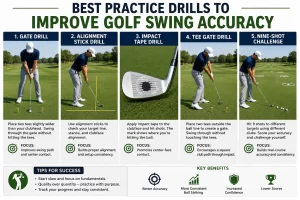
Knowing the correct techniques is only half the battle. To consistently apply the best golf swing accuracy tips, you need drills that reinforce proper movement patterns. The following exercises are simple, effective, and suitable for golfers of all skill levels. They help improve clubface control, swing path control, target line alignment, and centered clubface contact, giving you the tools to hit straighter shots with greater confidence.
Gate Drill
The gate drill is one of the best exercises for improving strike quality. Place two tees slightly wider than your clubhead with the golf ball positioned in the middle. Your goal is to swing through the gate without touching either tee.
This drill encourages precise club delivery and promotes consistent centered clubface contact. It also provides instant feedback whenever your swing path becomes inconsistent.
Alignment Stick Drill
The alignment stick drill helps eliminate one of the most common causes of inaccurate golf shots—poor setup. Place one alignment stick on the ground pointing directly at your target and a second stick parallel to it where your feet should be positioned.
Before every practice shot, confirm that your feet, hips, shoulders, and clubface are correctly aligned. Over time, this drill trains your eyes to recognize proper target line alignment, making accurate setup automatic during every round.
Impact Tape Drill
Impact tape is one of the easiest ways to improve strike consistency. Apply impact tape to your clubface and hit several shots while examining where the ball contacts the face after each swing.
If your strike pattern consistently favors the heel or toe, you’ll know exactly what needs attention. As your pattern moves toward the center of the clubface, you’ll notice better distance control and improved accuracy. This drill is especially valuable for golfers trying to improve golf swing accuracy through more consistent impact.
Tee Gate Drill
The tee gate drill focuses on controlling the club through the impact zone. Position two tees several inches in front of the golf ball, creating a narrow gate that extends toward your target.
After striking the ball, your clubhead should continue through the gate without hitting either tee. This encourages a neutral swing path control, promotes proper extension through impact, and reduces excessive outside-in or inside-out movement.
Nine-Shot Challenge
The Nine-Shot Challenge is one of the best drills for developing course-ready accuracy. Select three different clubs—for example, a wedge, a 7-iron, and a driver. Hit three shots with each club toward different targets, changing your setup and target after every swing.
The objective isn’t simply to hit perfect shots but to practice adapting to changing situations, just as you would during an actual round. This random practice format builds confidence, sharpens focus, and reinforces the ball flight laws you’ve learned throughout this guide.
Whether you’re looking for the best golf swing accuracy tips for beginners or refining an experienced game, these drills provide a structured way to build consistency. By practicing them regularly alongside sound golf swing mechanics, you’ll develop the skills needed to improve golf swing accuracy consistently and discover some of the best tips to hit the golf ball straighter every time you step onto the course.
Develop a Reliable Pre-Shot Routine
One of the biggest differences between golfers who play consistently well and those who struggle from round to round has nothing to do with athletic ability. It often comes down to preparation before the swing even begins. A reliable pre-shot routine helps remove uncertainty, improves concentration, and creates the same mental process before every shot, regardless of the club or situation.
A good routine doesn’t have to be complicated. Start by standing behind the ball and selecting a very specific target instead of aiming at a general area. Pick something small, such as a leaf, a discoloration in the fairway, or a single blade of grass several feet in front of your ball that lines up with your intended target. This makes aiming much easier once you step into your stance.
After choosing your target, take one or two practice swings with a clear purpose. Rather than swinging aimlessly, focus on the movement or tempo you want to reproduce during the actual shot. Visualize the ball flying toward your intended landing area and finishing exactly where you planned. This mental rehearsal helps eliminate doubt and encourages commitment.
Once you address the ball, avoid standing over it for too long. Excessive thinking often creates tension and hesitation, leading to poor swings. Trust the preparation you’ve already completed, take one final look at your target, and make a smooth, confident motion. The less time you spend second-guessing yourself, the more naturally your swing will flow.
Perhaps most importantly, use the same routine on every shot. Whether you’re hitting a driver on the first tee or a wedge into the final green, consistency before the swing promotes consistency during the swing. Over time, this simple habit builds confidence because your brain begins associating the routine with successful execution. Even when you experience a poor shot, maintaining the same process helps prevent frustration from affecting the next swing.
Stay Patient and Trust the Improvement Process
Every golfer wants immediate results, but meaningful improvement rarely happens overnight. Progress usually comes from making small, steady gains over weeks and months rather than discovering one magical tip that fixes every problem. Players who accept this process are far more likely to build lasting skills than those who constantly search for quick solutions.
It’s important to remember that every practice session won’t feel perfect. Some days you’ll strike the ball exceptionally well, while other days your timing may seem slightly off. These fluctuations are a normal part of learning any athletic skill. Instead of judging your progress by one range session or a single round, look for gradual trends over time. If your misses are becoming smaller, your contact is improving, or you’re recovering more quickly after mistakes, you’re moving in the right direction.
Setting realistic goals also helps maintain motivation. Rather than expecting to hit every fairway, focus on achievable improvements such as reducing major misses, making cleaner contact, or finishing each round with fewer penalty strokes. Celebrating these smaller victories creates momentum and keeps you committed to long-term development.
Another key to improvement is evaluating each round honestly. After playing, take a few minutes to reflect on what went well and what needs attention. Instead of criticizing yourself, identify one or two areas to work on during your next practice session. This approach keeps your improvement plan simple and prevents information overload.
Most importantly, enjoy the process. Golf is a game of continual learning, and even highly skilled players are always refining different parts of their technique. Staying patient, practicing with intention, and maintaining a positive mindset will allow your abilities to develop naturally. Over time, those small improvements accumulate into a more dependable swing, greater confidence under pressure, and consistently better scores on the course.
10 Proven Golf Swing Techniques to Improve Accuracy and Distance https://genoagolf.com/proven-golf-swing-techniques/
Conclusion
Improving your golf game doesn’t require a complete swing overhaul. In many cases, mastering a few key fundamentals can dramatically increase your consistency and help you hit more fairways. Throughout this guide, we’ve covered seven of the best golf swing accuracy tips that golfers of every skill level can use to build a more reliable and repeatable swing.
We also explored how sound golf swing mechanics—including posture, grip, balance, tempo, sequencing, and weight transfer—create a stable foundation for every shot. Understanding the ball flight laws gives you the knowledge to diagnose your misses and make smarter adjustments instead of relying on guesswork. Finally, developing a structured practice routine with purposeful drills and progress tracking helps reinforce these skills until they become second nature.
Perhaps the most important lesson is that accuracy almost always beats power. While long drives can be exciting, consistently finding the fairway gives you easier approach shots, fewer penalty strokes, and more scoring opportunities. Golfers who prioritize control over maximum distance often lower their scores much faster than those who focus solely on swing speed. If your goal is to improve golf swing accuracy, remember that consistency wins far more rounds than occasional monster drives.
Don’t feel like you need to master everything at once. One of the smartest ways to improve golf swing accuracy consistently is to work on a single area at a time. Spend a week improving your clubface control, then move on to alignment, swing path, or strike quality. Small improvements made consistently will produce much greater long-term results than trying to fix your entire swing in one practice session.
Whether you’re searching for the best golf swing accuracy tips for beginners or you’re an experienced golfer looking to sharpen your ball striking, the principles in this guide provide a proven roadmap for success. Stay patient, trust the process, and commit to practicing with purpose. Over time, you’ll discover that applying these golf swing accuracy tips not only helps you hit straighter shots but also builds the confidence needed to perform under pressure. Put these best tips to hit the golf ball straighter into action during your next practice session, and you’ll be well on your way to more fairways, lower scores, and a more enjoyable game of golf.
What are the best golf swing accuracy tips for beginners?
The best golf swing accuracy tips for beginners focus on mastering the fundamentals before trying advanced techniques. Start by building a consistent setup with proper target line alignment, a balanced posture, and a neutral grip. Next, work on developing solid clubface control because the clubface largely determines where the ball starts. Finally, practice making smooth, controlled swings instead of trying to generate maximum power. As your golf swing mechanics improve, you’ll naturally begin making more centered clubface contact, leading to straighter, more consistent shots. Beginners who focus on these fundamentals usually improve much faster than those who constantly chase extra distance.
How can I improve golf swing accuracy consistently?
If you want to improve golf swing accuracy consistently, create a structured practice routine that emphasizes quality over quantity. Practice two or three times each week using drills that improve clubface control, swing path control, and centered clubface contact. Pay close attention to the ball flight laws so you can understand why each shot behaves the way it does. Tracking statistics such as fairways hit, common misses, and strike quality also helps identify areas for improvement. Consistency comes from repeating good habits over time, not from making major swing changes after every round.
Why do I keep hitting the ball left or right?
Shots that consistently miss left or right usually result from problems with your clubface, swing path, or alignment. A closed clubface often sends the ball left, while an open clubface typically sends it right for right-handed golfers. Poor target line alignment can also cause directional misses before the swing even begins. Inconsistent centered clubface contact may further exaggerate these errors by twisting the clubhead at impact. Understanding the relationship between clubface control, swing path control, and the ball flight laws makes it much easier to diagnose and correct these misses.
Does clubface control really improve accuracy?
Yes. In fact, clubface control is one of the most important factors in hitting straighter golf shots. Modern ball flight laws show that the clubface largely determines the ball’s starting direction. Even if your swing path is nearly perfect, an open or closed clubface can still send the ball well away from your intended target. Learning to return the clubface square to the ball at impact is one of the best golf swing accuracy tips because it immediately improves directional consistency. Pairing solid clubface control with proper golf swing mechanics creates a much more reliable golf swing.
What practice drills improve golf swing accuracy the fastest?
Several simple drills can quickly improve golf swing accuracy. The alignment stick drill develops proper target line alignment, while the gate drill encourages centered clubface contact by promoting better strike quality. Using impact tape or the foot spray drill provides instant feedback on where the ball contacts the clubface, making it easier to improve consistency. Swing path drills using alignment sticks or headcovers also help refine swing path control. Practicing these exercises regularly is one of the best tips to hit the golf ball straighter and build a more repeatable swing.
How often should I practice accuracy drills?
For most golfers, practicing accuracy drills two or three times each week produces excellent results. Sessions of 30 to 60 minutes focused on golf swing accuracy tips, clubface control, swing path control, and centered clubface contact are usually more effective than spending hours hitting balls without a plan. Include both technical drills and random practice that simulates real on-course situations. Golfers who practice with purpose and gradually build good habits are far more likely to improve golf swing accuracy consistently than those who only practice occasionally or without specific goals. Over time, regular practice develops confidence, better ball striking, and more consistent scoring.