
7 Ultimate Golf Swing Tempo for Beginners Tips to Master
How to Find Your Golf Swing Tempo as a Beginner
Introduction: Why Golf Swing Tempo Matters for Beginners

Developing consistent golf swing tempo for beginners is one of the most important steps toward building a reliable, repeatable golf swing. You can have a good grip, proper posture, and solid alignment, but if the timing and rhythm of your swing constantly change, making consistent contact becomes much more difficult.
Golf swing tempo simply describes the rhythm and timing of your swing from the beginning of the backswing through the downswing and impact. Think of it as the pace that connects all the moving parts of your golf swing together. When your tempo is consistent, your arms, shoulders, hips, and lower body have a better opportunity to work together in the correct sequence.
One common mistake beginners make is assuming that good tempo means swinging slowly. That’s not necessarily true. A golfer can have a relatively fast swing and still have excellent tempo. The goal isn’t to deliberately slow everything down—it’s to develop a smooth golf swing where the backswing, transition, and downswing flow naturally together.
This is where many golfers run into trouble.
When you’re learning the game, it’s easy to rush the takeaway, become too quick at the top, or suddenly accelerate the club during the downswing. Inconsistent backswing timing and downswing timing can disrupt your golf swing sequencing, making it harder to return the clubface to the ball consistently. The result can be fat shots, thin shots, slices, pulls, poor accuracy, and even lost distance.
Learning how to improve golf swing tempo for beginners can help solve many of these problems without forcing you to completely rebuild your swing.
Better tempo encourages your body and club to work together instead of fighting against each other. A controlled golf swing transition can also help you generate speed at the right point in the downswing rather than wasting energy by swinging aggressively from the top.
So, what is the best golf swing tempo for beginners?
There isn’t one exact speed that every golfer needs to copy. Instead, you need to learn how to find your golf swing tempo—a natural, repeatable rhythm that allows you to stay balanced, sequence the swing properly, and make solid contact.
In this guide, we’ll break down 7 practical golf swing tempo tips designed specifically for beginners. You’ll learn how to control your backswing, improve your transition, develop better swing rhythm, match your backswing and downswing timing, eliminate unnecessary tension, practice tempo without a ball, and carry the same smooth rhythm from your practice swing into every real shot.
Master these fundamentals, and you’ll be well on your way toward building a smoother, more consistent golf swing you can trust on the course.
How to Improve Golf Swing Tempo Fast: 7 Secret Ways
What Is Golf Swing Tempo for Beginners?
Understanding golf swing tempo for beginners starts with recognizing that tempo is not simply about how fast or slow you swing the golf club. Instead, tempo describes the relationship between the time it takes to complete your backswing and the time it takes to move through the downswing toward impact.
Your backswing generally takes longer than your downswing. The club travels away from the ball as your shoulders turn and your body loads into position. Once you begin the golf swing transition, the downswing happens much faster as the body unwinds and the club accelerates toward the ball.
This is why beginner golf swing tempo shouldn’t be confused with overall swing speed.
One golfer might naturally have a quick swing, while another has a slower, more deliberate motion. Both golfers can have excellent tempo if their backswing and downswing work together in a consistent rhythm. The goal isn’t to copy how fast another golfer swings. It’s to develop a repeatable pace that allows your body and club to stay synchronized.
Understanding the 3:1 Golf Swing Tempo
One of the most commonly discussed golf swing tempo tips is the 3:1 tempo concept. In simple terms, this means the backswing takes roughly three times as long as the downswing.
For example, imagine counting:
“One…two…three” during the backswing and “go” during the downswing.
This doesn’t mean beginners need to measure every swing with a stopwatch or obsess over achieving a mathematically perfect 3:1 ratio. Golfers have different body types, flexibility levels, swing speeds, and natural rhythms. Trying too hard to manufacture an exact ratio can actually create tension and make your swing less athletic.
Instead, use the 3:1 idea as a general reference for developing better backswing timing and downswing timing.
When learning how to find your golf swing tempo, pay attention to how smoothly the different parts of your swing connect. A good backswing should flow naturally into the transition rather than suddenly changing from slow to extremely fast.
This is where golf swing sequencing becomes especially important.
Your shoulders, hips, arms, hands, and club all need to work together in the proper order. If your arms suddenly race ahead of your body or you aggressively pull the club down from the top, your sequencing and swing rhythm can quickly break down.
The best golf swing tempo for beginners is therefore not necessarily the fastest or slowest. It’s the tempo you can repeat while maintaining balance, solid contact, and proper sequencing.
As you learn how to improve golf swing tempo for beginners, focus less on achieving a perfect number and more on developing a smooth golf swing that feels controlled, athletic, and repeatable. Once you establish that rhythm, improving the rest of your swing becomes much easier.
1. Start With a Smooth and Controlled Backswing
One of the easiest ways to improve golf swing tempo for beginners is to develop a smooth, controlled backswing. Many beginners rush the takeaway because they’re already thinking about hitting the ball hard before the club has even moved away from it. That initial burst of speed can make the rest of the swing much harder to control.
When you snatch the club away from the ball, your hands, arms, shoulders, and body can quickly fall out of sync. Instead of building an organized motion, you may reach the top of the backswing in a poor position and then have to make last-second corrections during the downswing.
This is why good backswing timing plays such an important role in golf swing sequencing.
However, there’s an important difference between making a controlled backswing and deliberately making an extremely slow one. Trying to move the club back in slow motion can create tension and destroy your natural swing rhythm. Your goal should be smooth and controlled—not slow and mechanical.
Use a Simple Mental Count
One of the easiest golf swing tempo tips for beginners is using a mental count.
As you begin your backswing, quietly count:
“One…two…three.”
Allow the club to reach the top naturally during the count, then begin your downswing. You don’t need to force your swing into an exact timing formula. The purpose of counting is simply to prevent yourself from rushing the club away from the ball.
Better backswing timing can also make the golf swing transition much easier. When you arrive at the top under control, you have a better opportunity to change direction smoothly instead of immediately throwing your hands and arms toward the ball.
So how do you know if your backswing tempo is too fast?
Common warning signs include losing your balance, feeling sudden tension in your hands or shoulders, jerking the club away during the takeaway, struggling to complete your shoulder turn, or feeling as though you have to make corrections during the downswing.
If these problems sound familiar, don’t automatically try to swing slower. Instead, focus on making the first part of your swing smoother.
When learning how to improve golf swing tempo for beginners, developing a controlled takeaway is an excellent starting point. A smoother backswing gives the rest of your swing time to develop naturally and can help produce better sequencing, improved balance, and more consistent contact.
The best golf swing tempo for beginners often begins with something simple: take the club away smoothly, stay relaxed, and let your natural rhythm control the motion.
2. Master Your Golf Swing Transition
The golf swing transition is the brief change of direction between completing the backswing and beginning the downswing. It may happen quickly, but it’s one of the most important parts of developing consistent golf swing tempo for beginners.
It’s also where many beginner swings fall apart.
A golfer may make a perfectly reasonable backswing and then suddenly attack the ball from the top. The hands and arms accelerate aggressively, the upper body takes over, and the smooth rhythm established during the backswing disappears almost instantly.
Instead of thinking about hitting the ball as soon as you reach the top, think about changing direction smoothly.
A good transition allows the lower body and torso to begin moving toward the target while the arms and club respond naturally. You don’t need to consciously force your hips to fire as hard as possible. The goal is simply to avoid starting the downswing by aggressively throwing your hands and arms at the ball.
This smoother change of direction can improve golf swing sequencing because it gives your body, arms, and club a better opportunity to work together.
Try This Simple Golf Swing Transition Drill
One useful drill for improving beginner golf swing tempo is the pause-at-the-top drill.
Take your normal setup and make a controlled backswing. When you reach the top, pause briefly before beginning the downswing. You only need a short pause—just enough to become aware of the change in direction.
During the pause, keep your hands and shoulders relaxed.
Then begin the downswing smoothly rather than immediately pulling the club toward the ball. Start with several practice swings without hitting a golf ball. Once the motion feels comfortable, hit short shots at approximately 50–70% of your normal effort.
The pause isn’t necessarily something you want to exaggerate during your normal golf swing. It’s a training exercise designed to help you recognize when you’re rushing the transition.
As you become more comfortable, gradually reduce the pause until the backswing and downswing blend together into one continuous motion.
If you’re trying to learn how to find your golf swing tempo, pay close attention to this part of the swing. You should feel as though the club changes direction naturally rather than violently.
A smoother transition can improve backswing timing, downswing timing, balance, and overall swing rhythm. Most importantly, it can help you create a smooth golf swing that produces speed progressively instead of wasting it at the beginning of the downswing.
Master the transition, and you’ll have taken a major step toward building the repeatable tempo that every beginner golfer needs.
If you’re working on golf swing tempo for beginners but your swing still feels rushed or inconsistent, tempo may not be the only problem. Small mistakes in your sequencing, posture, transition, or alignment can quietly throw off your entire swing—even when your rhythm feels right. Fixing those hidden problems can make improvement much easier. Fix those problems here https://ultimategolfmasterypro.com/the-golf-swing-lab-2/
3. Find a Swing Rhythm You Can Repeat
One of the biggest misconceptions about golf swing tempo for beginners is that every golfer should swing at exactly the same pace. In reality, there isn’t one perfect tempo that works for everyone. Some golfers naturally move faster, while others are more comfortable with a slower, more deliberate motion.
What matters most is finding a swing rhythm you can repeat from one shot to the next.
If you’re wondering how to find your golf swing tempo, start by making several relaxed practice swings without worrying about distance or ball flight. Pay attention to the pace that feels comfortable rather than forcing yourself to copy the rhythm of another golfer.
Next, experiment with slightly different tempos.
Make five practice swings at a slower pace, five at your normal pace, and five slightly faster. You don’t need to make dramatic changes. You’re simply looking for the rhythm that allows you to stay balanced while making a smooth golf swing from beginning to finish.
Once you begin hitting balls, pay attention to which tempo consistently produces the best contact.
Use a Simple Verbal Swing Cue
A verbal cue can be one of the easiest golf swing tempo tips for establishing repeatable rhythm.
For example, you might use:
“One…two…three…go.”
The first three beats can represent the backswing, while “go” represents the change of direction into the downswing.
You can also experiment with words or phrases that naturally match your preferred rhythm. The specific words aren’t important. What matters is creating a cadence that prevents your swing from becoming dramatically faster or slower from shot to shot.
When learning how to improve golf swing tempo for beginners, prioritize repeatability over maximum speed. Trying to generate every possible yard by swinging harder can create tension and disrupt your golf swing sequencing.
A repeatable rhythm can also improve center-face contact. When your backswing timing, transition, and downswing occur at a predictable pace, your body has a better chance of returning the club to impact consistently.
Solid center-face contact is especially important because a controlled swing that strikes the center of the clubface can produce better results than a faster swing with inconsistent contact.
The best golf swing tempo for beginners is ultimately the rhythm that allows you to remain balanced, relaxed, and consistent. Find a pace you trust, practice it repeatedly, and let speed develop naturally as your swing becomes more efficient.
7 Golf Swing Tempo Consistency Secrets Most Golfers Never Discover
4. Match Your Backswing Timing With Your Downswing Timing
Good golf swing tempo for beginners depends on creating a natural relationship between your backswing timing and downswing timing. These two parts of the swing don’t move at the same speed, but they should complement each other and create one continuous, coordinated motion.
Problems often develop when there’s a dramatic change of pace.
For example, a beginner might make an extremely slow backswing and then suddenly attack the ball with an aggressive downswing. The swing goes from slow and controlled to fast and tense almost instantly.
That sudden acceleration can disrupt the golf swing transition, causing the arms, hands, and upper body to race ahead of the rest of the body. Once that happens, consistent golf swing sequencing becomes much more difficult.
The result may be fat shots, thin shots, slices, pulls, or inconsistent center-face contact.
Use the 3:1 Tempo Concept as a Guide
A useful way to understand the relationship between the backswing and downswing is the commonly discussed 3:1 tempo concept.
In simple terms, the backswing takes roughly three times as long as the downswing.
You don’t need to pull out a stopwatch or obsess over achieving an exact ratio. Instead, use the concept to understand that the backswing generally develops over a longer period while the downswing naturally happens faster.
Try this simple counted-beat drill.
Take your setup and begin the backswing while mentally counting:
“One…two…three.”
As you reach the top and change direction, use:
“Go.”
Make 10–15 practice swings using this cadence before hitting golf balls. Then hit several shots while maintaining the same rhythm.
The goal isn’t to force an artificial pause. You want the backswing, transition, and downswing to flow together naturally.
This drill can be especially useful when learning how to find your golf swing tempo because it gives you a simple reference point for recognizing when you’re rushing.
Most importantly, proper timing doesn’t mean sacrificing clubhead speed.
A smooth golf swing can still be extremely powerful. In fact, better sequencing can allow you to build speed progressively through the downswing rather than wasting energy by accelerating too aggressively from the top.
Among the most useful golf swing tempo tips for beginners is remembering this simple principle: smooth doesn’t mean slow.
When your backswing and downswing work together, you can produce a swing that feels controlled while still generating plenty of speed through impact.
5. Stop Trying to Hit the Golf Ball Too Hard
One of the most common problems with golf swing tempo for beginners starts with a simple thought: If I swing harder, the ball will go farther.
While generating clubhead speed is important for distance, maximum physical effort doesn’t automatically create maximum distance. In fact, trying to crush every shot can make it much harder to strike the ball solidly.
When beginners try to swing at 100% effort, they often begin overswinging. The backswing may become longer than normal, backswing timing becomes rushed, and the golf swing transition can turn into an aggressive move toward the ball.
That’s a quick way to destroy consistent beginner golf swing tempo.
Excessive effort can also create tension in your hands, forearms, shoulders, and upper body. When those muscles tighten, it becomes harder for the club to move freely and for your body to maintain proper golf swing sequencing.
Instead of trying to overpower the golf ball, allow your speed to develop naturally.
Try the 70–80% Effort Drill
One of the simplest golf swing tempo tips is practicing at approximately 70–80% of your perceived maximum effort.
Take a mid-iron and hit five balls while intentionally feeling as though you’re only using about 70% effort. Don’t worry about how far the shots travel.
Instead, evaluate three things:
Balance, contact, and swing rhythm.
Then hit another five balls at approximately 80% effort while maintaining the same smooth motion.
Many beginners are surprised to discover that their shots don’t lose as much distance as expected. Some may even hit the ball farther because they’re making better center-face contact.
That’s because distance isn’t produced by effort alone. Efficient sequencing, clubhead speed, and solid contact all matter.
A centered strike from a controlled swing can easily outperform an off-center strike produced by an uncontrolled maximum-effort swing.
Learning how to improve golf swing tempo for beginners therefore involves discovering how much effort you actually need. You want enough speed to make an athletic swing without creating so much tension that your mechanics and timing break down.
The best golf swing tempo for beginners should feel powerful but controlled.
Think less about hitting the golf ball and more about swinging smoothly through it. When you reduce unnecessary tension and stop chasing maximum effort, you may discover that relaxed speed produces the combination of distance, accuracy, and consistency you’ve been trying to achieve.
6. Practice Golf Swing Tempo Without a Golf Ball
Sometimes the easiest way to improve golf swing tempo for beginners is to remove the golf ball completely.
Why?
Because the moment a ball is placed in front of many beginners, their mindset changes. Instead of making the same relaxed practice swing they made seconds earlier, they suddenly feel the need to hit the ball.
That instinct can cause the hands to tighten, the backswing to speed up, and the downswing to become overly aggressive.
Removing the ball allows you to concentrate entirely on swing rhythm, movement, balance, and golf swing sequencing without worrying about where the shot goes.
Start by making continuous practice swings.
Swing back and through several times without stopping, allowing the club to move naturally from one side of your body to the other. Don’t try to generate maximum speed. Focus on developing a comfortable rhythm you could repeat again and again.
Try the Feet-Together Tempo Drill
Stand with your feet almost touching and make several half or three-quarter practice swings.
Because your stance is narrow, swinging too aggressively makes it much easier to lose your balance. This encourages a smoother motion and helps you feel how your arms and body work together.
Next, try a slow-motion sequencing drill.
Make an intentionally slow backswing and notice how your shoulders, hips, arms, and club move. Reach the top, feel the golf swing transition, and slowly rehearse the change of direction into the downswing.
This isn’t intended to become your normal swing speed. You’re using slow motion to become more aware of the sequence.
Once you understand the movement, gradually increase your speed while maintaining the same order and rhythm.
These rehearsals are especially useful when learning how to find your golf swing tempo because they remove the pressure of producing a good shot. You can simply concentrate on what a coordinated swing feels like.
After 10–20 practice swings, place a ball down.
Make one rehearsal swing using your preferred tempo, address the ball, and try to reproduce exactly the same motion. Start with short shots before progressing toward full swings.
One of the most valuable golf swing tempo tips is learning to make your real swing feel like your practice swing. If you can transfer the same relaxed backswing timing, smooth transition, and controlled downswing timing to the ball, you’ll be much closer to developing a smooth golf swing you can repeat on the course.
Practicing more won’t necessarily fix your swing if you’re repeatedly practicing the wrong movement. Poor tempo, rushed transitions, and inconsistent sequencing can become harder to correct when they’re repeated hundreds of times. Instead of reinforcing the same frustrating mistakes, The Golf Swing Lab gives you a structured approach for improving the fundamentals behind a smoother, more consistent swing.
7. Use the Same Tempo From Practice Swing to Real Shot
One of the strangest things about golf swing tempo for beginners is how often a golfer can make a beautiful, relaxed practice swing and then completely change their rhythm the moment a golf ball is placed in front of them.
The practice swing looks smooth and balanced. Then the real swing becomes faster, tighter, and more aggressive.
This usually happens because the golfer stops thinking about the swing itself and starts thinking about the result. They want to hit the ball farther, avoid a bad shot, or steer the ball toward the target. That extra pressure can cause the takeaway to speed up, the golf swing transition to become rushed, and the downswing to lose its natural rhythm.
A simple pre-shot routine can help prevent that change.
Start by standing behind the ball and selecting your target. Then make one rehearsal swing using your preferred beginner golf swing tempo. Focus on the rhythm rather than the mechanics.
Once that practice swing feels good, step into your setup and try to preserve the exact same feeling.
Avoid standing over the ball for too long. The longer you freeze at address, the easier it becomes to tense your hands, shoulders, and arms. Too much hesitation can also interrupt your natural swing rhythm.
Instead, use a simple trigger to begin the swing.
That trigger might be a small club waggle, a slight forward press, or a mental cue such as:
“Smooth.”
You could also use the same counted rhythm you’ve practiced throughout this article.
The goal is to make your real swing feel like an extension of your practice swing rather than a completely different motion.
This is one of the most useful golf swing tempo tips because consistency is built through repetition. The more often you use the same pre-shot routine, rehearsal swing, and starting cue, the easier it becomes to reproduce the same backswing timing and downswing timing under pressure.
When learning how to find your golf swing tempo, don’t judge success based on one perfect shot. Look for a rhythm you can repeat over dozens of swings.
Eventually, that tempo can begin to feel automatic.
And that’s exactly what you want: a smooth golf swing that doesn’t suddenly change just because there’s a ball sitting in front of you.
Best Golf Training Program For Beginners: Why Most Golfers Never Improve
How to Improve Golf Swing Tempo for Beginners
Learning how to improve golf swing tempo for beginners doesn’t require changing everything about your golf swing at once. In fact, trying to fix too many things during one practice session can make your timing worse.
A better approach is to work through the seven tips in a simple progression.
Start with half swings. Use a wedge or short iron and make controlled swings at roughly 50–70% of your normal length. Focus on maintaining smooth backswing timing, a relaxed golf swing transition, and balanced downswing timing.
Once those half swings feel repeatable, gradually move toward three-quarter swings and then full swings.
Wedges and short irons are ideal starting clubs because they’re easier to control. You can concentrate on swing rhythm without feeling the same temptation to generate maximum distance that often appears with a driver or long iron.
After your tempo becomes more consistent with shorter clubs, gradually introduce mid-irons, longer irons or hybrids, fairway woods, and finally the driver.
Don’t immediately judge your progress only by where the golf ball lands.
Instead, pay attention to strike quality.
Ask yourself: Did I make center-face contact? Was I balanced at the finish? Did my swing feel smooth? Did my backswing and downswing maintain the same general rhythm as my previous shot?
Those questions can tell you much more about your progress than one unusually long or straight shot.
It’s also important to work on one tempo problem at a time.
If you’re rushing the takeaway, spend a practice session primarily working on your backswing. If your trouble starts at the top, focus on smoothing out the transition. If you swing harder when a ball is present, return to practice swings and the 70–80% effort drill.
This focused approach helps improve golf swing sequencing without overwhelming you with too many swing thoughts.
The best golf swing tempo for beginners is built through consistent practice, not one marathon range session.
Even 10–15 minutes of purposeful tempo practice several times per week can help you develop a more repeatable motion. Over time, the individual pieces begin working together naturally, allowing you to create a smoother, more confident swing without consciously controlling every movement.
Best Golf Swing Tempo for Beginners
So, what is the best golf swing tempo for beginners? The answer isn’t a single speed or timing ratio that every golfer should try to copy. Golfers have different body types, levels of flexibility, swing lengths, athletic abilities, and natural movement patterns. A tempo that feels effortless for one player may feel completely unnatural for another.
That’s why finding your own repeatable rhythm is more valuable than trying to imitate someone else’s swing.
The commonly discussed 3:1 tempo guideline can provide beginners with a useful starting point. It suggests that the backswing takes approximately three times as long as the downswing. However, you shouldn’t treat 3:1 as an absolute rule or worry about measuring every swing.
Instead, think of it as a reminder that your backswing timing and downswing timing should work together.
Another important distinction is the difference between smooth and slow.
A smooth golf swing can still generate significant clubhead speed. Smoothness describes how naturally the different parts of the swing flow together, especially through the golf swing transition. Swinging excessively slowly, on the other hand, can sometimes make your motion feel forced and interfere with your natural athletic rhythm.
When learning how to find your golf swing tempo, allow that natural rhythm to play a role. Make several relaxed swings and pay attention to the pace that allows you to move freely without losing control.
How will you know when you’ve found it?
Look for four important signs: contact, balance, sequencing, and repeatability.
You should be making reasonably consistent contact near the center of the clubface. You should also be able to finish your swing under control rather than falling toward or away from the target.
Your golf swing sequencing should feel coordinated rather than rushed, and most importantly, you should be able to reproduce approximately the same rhythm repeatedly.
Don’t abandon a comfortable tempo simply because one shot goes offline. Golf is never going to produce perfect results on every swing.
When working on golf swing tempo for beginners, judge your rhythm over a series of shots. If you’re consistently balanced, making better contact, and repeating the same general motion, you’ve probably found a tempo worth developing.
Common Beginner Golf Swing Tempo Mistakes
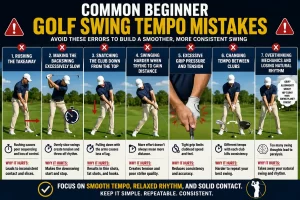
Improving beginner golf swing tempo becomes much easier when you know which mistakes to avoid. Many tempo problems aren’t caused by complicated swing mechanics. They’re caused by golfers changing the pace, tension, or sequence of their swing without realizing it.
One of the most common mistakes is rushing the takeaway. When the club is pulled away too quickly, the hands and arms can become disconnected from the body’s rotation, disrupting golf swing sequencing before the backswing has really begun.
The opposite problem can happen too.
Some beginners hear that they need better tempo and deliberately make the backswing excessively slow. This can create a stiff, mechanical motion that destroys natural swing rhythm. Remember, smooth doesn’t necessarily mean slow.
Another major mistake is snatching the club down from the top.
You might have excellent backswing timing, but if your hands aggressively pull the club toward the ball during the golf swing transition, your downswing timing can quickly become inconsistent.
Trying to gain distance by swinging harder creates similar problems. Maximum effort often produces excessive tension, particularly in the hands, forearms, shoulders, and upper body. That tension can make it harder for the club to accelerate naturally.
Excessive grip pressure can be especially troublesome. You need enough pressure to control the club securely, but squeezing it unnecessarily hard can restrict your wrists and increase tension throughout your arms.
Another overlooked mistake is changing tempo depending on the club.
Some golfers make smooth wedge swings but immediately increase their effort when they pick up a driver. Your swing will naturally change somewhat between clubs, but your basic rhythm doesn’t need to disappear simply because you’re holding a longer club.
Finally, avoid becoming so obsessed with mechanics that you lose your natural athletic motion.
Thinking simultaneously about your takeaway, wrists, elbows, shoulders, hips, knees, transition, and impact can make it almost impossible to swing freely.
One of the most valuable golf swing tempo tips is therefore to simplify.
Choose one tempo problem to work on, use a simple rhythm cue, and allow your body to react naturally. That’s often far more effective than trying to consciously control every position in your swing.
Simple Golf Swing Tempo Practice Routine for Beginners
You don’t need to spend hours at the driving range to improve golf swing tempo for beginners. A focused 10–15 minute practice routine can help you develop better swing rhythm, improve your timing, and make your golf swing feel more natural.
The key is practicing with a purpose rather than simply hitting ball after ball.
Try this five-step routine during your next practice session.
1. Make 10 Smooth Practice Swings
Begin without a golf ball. Make 10 relaxed practice swings while focusing entirely on rhythm.
Let the club move smoothly through the backswing, golf swing transition, and downswing. Avoid trying to generate maximum speed.
Pay particular attention to your backswing timing. You want the club to move away from the ball smoothly rather than being jerked back with your hands.
2. Hit 10 Half Swings With a Short Iron
Next, grab a wedge or short iron and hit 10 balls using half swings.
Don’t worry about distance. Your objective is solid contact and balance.
Half swings make it easier to feel proper golf swing sequencing because there are fewer moving parts to control. Try to reproduce approximately the same rhythm on every shot.
3. Make 10 Counted-Tempo Swings
Now introduce a simple counting drill.
As you swing back, mentally count:
“One…two…three.”
Then use “go” as you transition into the downswing.
You don’t have to achieve a mathematically perfect 3:1 ratio. The count simply gives you a consistent reference for coordinating your backswing timing and downswing timing.
This is one of the easiest golf swing tempo tips to use whenever your swing begins feeling rushed.
4. Hit 10 Shots at 70–80% Effort
Next, hit 10 shots using approximately 70–80% of your perceived maximum effort.
Keep your hands, arms, and shoulders relaxed and concentrate on producing a smooth golf swing.
Notice what happens to your contact. You may discover that reducing effort actually produces cleaner strikes because you’re no longer disrupting your sequencing by trying to overpower the ball.
5. Finish With 10 Normal Swings
Finally, hit 10 shots using your normal swing.
Don’t deliberately slow yourself down. Instead, try to carry the same rhythm you developed during the previous exercises into a full, athletic motion.
This is where you’re beginning to discover how to find your golf swing tempo.
Most importantly, don’t judge this routine entirely by distance.
After each shot, evaluate four things: balance, contact, transition, and finish.
Did you strike the ball reasonably close to the center of the clubface? Did the transition feel smooth? Were you balanced through impact? Could you hold your finish comfortably?
When learning how to improve golf swing tempo for beginners, these indicators can be more valuable than simply watching how far the ball travels.
Practice this routine consistently, and your beginner golf swing tempo can gradually become less of something you consciously control and more of a natural rhythm you can trust every time you step over the ball.
Golf for Beginners: What is The Perfect Golf Swing Tempo? https://www.performancegolf.com/blog/golf-for-beginners-what-is-the-perfect-golf-swing-tempo
Final Thoughts on Golf Swing Tempo for Beginners
Mastering golf swing tempo for beginners isn’t about discovering one magical swing speed or copying the rhythm of a professional golfer. Great tempo comes from developing a motion you can repeat consistently while maintaining balance, control, and solid contact.
Your natural tempo may be faster or slower than another golfer’s—and that’s perfectly fine.
Instead of chasing someone else’s swing, concentrate on building your own repeatable swing rhythm. Your backswing should feel controlled, your golf swing transition should flow naturally into the downswing, and your speed should develop without feeling as though you’re forcing the club toward the ball.
Remember the seven golf swing tempo tips covered throughout this guide: start with a smooth and controlled backswing, master your transition, find a rhythm you can repeat, match your backswing and downswing timing, stop trying to hit the ball too hard, practice your tempo without a golf ball, and carry the same rhythm from your practice swing into your real shots.
You don’t need to master all seven overnight.
Choose one area that causes you the most trouble and work on it during your next practice session. Once that part of your swing becomes more comfortable, move on to the next.
As you practice, pay attention to golf swing sequencing, balance, and center-face contact rather than judging every swing solely by distance. A smooth golf swing that consistently finds the center of the clubface will usually serve you better than an uncontrolled swing built around maximum effort.
Learning how to improve golf swing tempo for beginners ultimately comes down to repetition. The more frequently you practice the same controlled rhythm, the easier it becomes to reproduce when you’re standing over an actual shot on the course.
Ready to Build a Golf Swing You Can Trust?
If you’re tired of fixing one swing problem only to have another appear, improving tempo may be only one piece of the puzzle.
The Golf Swing Lab gives you a complete step-by-step system for improving the fundamentals that influence your golf swing—including tempo, consistency, accuracy, ball control, posture, alignment, and more.
Instead of jumping between random golf tips and hoping something works, you can follow a structured system designed to help you understand your swing and build more repeatable mechanics.
Frequently Asked Questions About Golf Swing Tempo for Beginners
Understanding golf swing tempo for beginners can take some experimentation because every golfer moves differently. These frequently asked questions cover some of the most common concerns beginners have about swing rhythm, timing, speed, and consistency.
What Is the Best Golf Swing Tempo for Beginners?
The best golf swing tempo for beginners is a controlled, repeatable rhythm that produces consistent contact and allows you to remain balanced throughout the swing. There isn’t one exact tempo that every beginner should copy.
Some golfers naturally swing faster than others. Instead of trying to match another golfer’s pace, concentrate on coordinating your backswing timing, transition, and downswing. If you can repeatedly make solid contact while maintaining balance and a smooth motion, you’ve likely found a tempo that works well for your swing.
How Do I Find My Natural Golf Swing Tempo?
If you’re wondering how to find your golf swing tempo, start with relaxed practice swings without a golf ball. Experiment with slightly slower and faster rhythms and determine which pace feels easiest to repeat.
You can also use a simple counting drill. Try counting “one-two-three” during the backswing and using “go” as you transition into the downswing.
Then begin hitting balls while maintaining the same rhythm. Pay attention to strike consistency rather than distance alone. The tempo that repeatedly produces solid center-face contact, good balance, and a comfortable finish is usually a good starting point.
Should Beginners Have a Slow Golf Swing Tempo?
Beginners don’t necessarily need a slow golf swing. They need a smooth golf swing.
There’s an important difference.
Swinging too slowly can make your motion feel mechanical and unnatural, while swinging too quickly can disrupt your sequencing. Smooth tempo means your backswing, golf swing transition, and downswing flow together without sudden changes in pace.
One of the most useful golf swing tempo tips is to think “smooth, not slow.” Allow the club to accelerate naturally rather than deliberately forcing the entire swing to move slowly.
What Is the 3:1 Golf Swing Tempo?
The 3:1 golf swing tempo concept describes the approximate relationship between backswing and downswing timing.
In simple terms, the backswing takes roughly three times as long as the downswing.
For example, you might mentally count “one-two-three” during your backswing and use “go” for your downswing.
Beginners shouldn’t become obsessed with producing a mathematically perfect 3:1 ratio. Instead, use the concept as a general guide for understanding how backswing timing and downswing timing work together to create consistent swing rhythm.
Why Do I Rush My Golf Downswing?
Beginners often rush the downswing because they’re trying too hard to generate clubhead speed or hit the ball farther.
Excessive tension in the hands, arms, and shoulders can make the problem worse. Another common cause is an abrupt golf swing transition, where the golfer reaches the top and immediately pulls the club toward the ball with the hands and arms.
Try reducing your effort to around 70–80% during practice and concentrate on changing direction smoothly. Improving your transition and golf swing sequencing can help speed develop naturally later in the downswing.
Can Better Golf Swing Tempo Increase Distance?
Yes, improving your golf swing tempo can potentially help you hit the ball farther, particularly if poor timing currently causes inconsistent contact.
Distance isn’t determined by effort alone. Clubhead speed, centered contact, launch conditions, and efficient sequencing all influence how far the golf ball travels.
When learning how to improve golf swing tempo for beginners, better rhythm can help the body, arms, and club work together more efficiently. Instead of wasting speed by aggressively accelerating from the top, you can build speed progressively through the downswing.
Better tempo can also improve your chances of striking the ball near the center of the clubface. A centered strike with a controlled swing may travel farther than an off-center strike produced by swinging at maximum effort.
Ultimately, the goal isn’t simply to swing faster. It’s to combine speed with good golf swing sequencing, balance, and consistent contact. When those pieces work together, better distance can become a natural result of a more efficient swing.