
7 Simple Golf Swing Tempo Drills for Smoother Swings
Golf Tempo Drills for Better Backswing Timing
Introduction
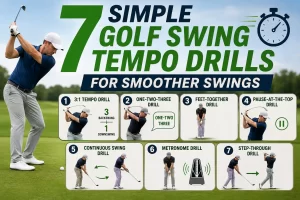
Golfers spend countless hours working on grip, posture, alignment, clubface position, and other elements of golf swing mechanics, yet one important part of a consistent swing often gets overlooked: tempo. You can have solid fundamentals, but if the different parts of your swing don’t flow together smoothly, producing consistent shots can become much more difficult.
Golf swing tempo is essentially the rhythm and timing of your swing from takeaway through impact and into the finish. When that rhythm becomes rushed or inconsistent, problems can quickly appear. Poor backswing timing may cause you to snatch the club away from the ball or reach the top of the swing before your body is properly positioned. An aggressive transition can then throw off your golf swing sequencing, making it harder for your lower body, torso, arms, and club to work together.
The result can be inconsistent contact, poor golf swing balance, reduced accuracy, and even lost distance.
One of the biggest misconceptions about tempo is that a smooth golf swing must be slow. That’s not necessarily true. Many great golfers swing the club extremely fast while maintaining excellent rhythm. Swing speed describes how quickly the club is moving, while tempo describes how the different stages of the swing relate to one another.
In other words, you don’t necessarily need to swing slower—you need to swing in better sequence.
That’s where golf swing tempo drills can make such a difference.
Instead of constantly thinking about complicated swing positions, tempo exercises allow you to develop a repeatable rhythm you can actually feel. The best golf swing tempo drills can help improve the relationship between your backswing and downswing while creating a smoother golf swing transition.
They can also help eliminate one of the most common problems among amateur golfers: rushing from the top.
When the transition becomes too quick, the upper body often takes over before the lower body has a chance to initiate the downswing. Practicing golf tempo drills and golf swing rhythm drills can teach you to complete your backswing, transition smoothly, and accelerate through the ball with better downswing timing.
You don’t need complicated equipment or hours on the driving range to start seeing improvement, either. Many simple golf swing tempo drills can be practiced at home without hitting a single ball, making them especially useful as golf swing tempo drills for beginners.
In this guide, you’ll learn seven practical drills designed to develop a smoother, more repeatable swing. We’ll work on everything from a simple 3:1 tempo and counting technique to feet-together swings, transition pauses, continuous swings, metronome training, and a step-through drill.
The goal isn’t to create a picture-perfect golf swing.
It’s to help you discover a rhythm you can repeat when it matters—so your swing feels smoother, more balanced, and easier to trust every time you step over the ball.
7 Golf Swing Tempo Consistency Secrets Most Golfers Never Discover
What Is Golf Swing Tempo and Why Does It Matter?
Golf swing tempo is the rhythm and timing of your golf swing from the moment you start the club back until you complete the downswing and move through impact. Put simply, it’s how smoothly the different parts of your swing flow together. Developing consistent tempo can make your swing feel more controlled, balanced, and repeatable without requiring you to completely rebuild your golf swing mechanics.
One important distinction is the difference between tempo and swing speed. Swing speed refers to how fast the clubhead is traveling, particularly through impact. Tempo describes the timing relationship between different phases of the swing. A golfer can have a fast swing while maintaining excellent tempo, just as another golfer can swing slowly but still have poor rhythm.
This is why the goal of golf swing tempo drills isn’t simply to make you swing slower. The goal is to develop a predictable sequence that you can repeat from shot to shot.
The Connection Between Your Backswing and Downswing
Good tempo depends heavily on the relationship between backswing timing and downswing timing. When golfers rush the backswing, they often arrive at the top before their body and club are properly synchronized. When they rush the downswing, the arms and upper body may take over too early, disrupting the golf swing transition.
A smoother rhythm gives the different parts of your body more opportunity to work together. Your backswing can develop naturally, your transition becomes less abrupt, and your downswing can unfold in a more coordinated sequence.
That’s one reason golf swing rhythm drills can be so useful for improving golf swing sequencing. Instead of obsessing over individual positions, you’re training your body to coordinate the entire motion.
Better sequencing can also improve ball striking. When your body, arms, and club arrive at impact in a more predictable order, it becomes easier to produce consistent contact. Good tempo can also support better golf swing balance, helping you finish shots under control instead of falling toward or away from the target.
There Isn’t One Perfect Tempo for Everyone
Another important point is that every golfer’s ideal tempo can be slightly different.
Some players naturally have quick, energetic swings. Others have slower, more deliberate motions. Neither style is automatically better. What matters most is whether the rhythm remains consistent and allows the golfer to deliver the club effectively.
That’s why the best golf swing tempo drills help you discover a repeatable rhythm rather than forcing you to copy someone else’s swing.
If you’re new to the game, golf swing tempo drills for beginners can be especially valuable because they encourage you to develop rhythm before adding excessive speed or complicated swing thoughts. Even a few simple golf swing tempo drills can teach you what a balanced, coordinated swing should feel like.
Once you discover a tempo that matches your natural motion, the real objective is simple: repeat it consistently. That repeatability can make your swing easier to trust and provide a stronger foundation for better contact, accuracy, and overall consistency.
1. Use the 3:1 Golf Swing Tempo Drill
One of the most popular golf swing tempo drills is the 3:1 tempo drill. The basic idea is simple: your backswing takes roughly three times as long as your downswing. Rather than thinking about exact fractions of a second, you can use the 3:1 concept as a rhythm cue that helps prevent you from rushing the club to the top or starting the downswing too aggressively.
For example, imagine counting “one-two-three” as the club travels back and then using “four” as you swing down and through the ball. The objective isn’t to mechanically force every swing into an exact numerical ratio. Instead, the counting pattern gives you a consistent reference for coordinating your backswing timing and downswing timing.
Start by making slow practice swings without a golf ball. Take the club back while mentally counting “one-two-three,” then swing through on “four.” Continue until the motion begins to feel natural.
Once you’re comfortable with the movement, gradually increase your swing speed while maintaining the same basic rhythm. This is an important distinction. Increasing speed doesn’t mean abandoning your tempo. Your entire swing can become faster while the relationship between the backswing and downswing remains relatively consistent.
That’s what makes this one of the best golf swing tempo drills for developing a repeatable motion.
How the 3:1 Drill Can Improve Your Transition
The transition from backswing to downswing is where many golfers lose their rhythm. A player may make a relatively controlled backswing and then suddenly attack the ball from the top. That abrupt change can disrupt golf swing sequencing, cause excessive upper-body movement, and negatively affect golf swing balance.
Practicing the 3:1 drill encourages a smoother golf swing transition because you’re allowing the backswing to develop before accelerating through the downswing. Your lower body, torso, arms, and club have a better opportunity to work together rather than competing to start the downswing.
There are several mistakes to avoid when practicing this drill. Don’t intentionally make an extremely slow backswing simply to satisfy the count. Avoid pausing at the top unless you’re specifically practicing a pause drill, and don’t aggressively jerk the club downward when you reach the final count.
Most importantly, don’t become obsessed with achieving a mathematically perfect ratio. The purpose of these golf tempo drills is to improve rhythm, not turn your swing into a stopwatch exercise.
For golfers learning simple golf swing tempo drills, think of 3:1 as a helpful framework. Start slowly, find a comfortable rhythm, and gradually build toward your normal swing speed while preserving the same smooth sequence.
2. Practice the One-Two-Three Golf Tempo Drill
If you’re looking for one of the easiest golf swing tempo drills to practice almost anywhere, try the one-two-three golf tempo drill. It requires no special training equipment and gives you a simple rhythm you can repeat until smoother timing begins to feel natural.
The concept is straightforward.
As you begin your backswing, count “one-two” as the club moves away from the ball and toward the top. Then use “three” as your cue to transition into the downswing and swing through impact.
You can say the numbers quietly or count them mentally:
One… two… THREE.
The count acts almost like an internal metronome. Instead of thinking about several pieces of your golf swing mechanics at once, you have one simple rhythm to follow.
This can be particularly helpful for golfers who rush their swings.
When a golfer becomes focused on hitting the ball hard, the backswing may become increasingly quick and the transition increasingly aggressive. Using a consistent count can help regulate backswing timing and prevent the sudden change of pace that frequently occurs at the top.
Practice the Rhythm Before Hitting Golf Balls
This is also one of the easiest golf swing tempo drills for beginners because you don’t even need a golf ball to get started.
Take your normal address position and make several relaxed practice swings. Count “one-two” during the backswing and “three” as you swing through the imaginary impact position. Focus on maintaining good golf swing balance and finishing each swing under control.
Don’t worry about clubhead speed yet.
Once you can repeat the rhythm comfortably, place a ball down and begin with short or three-quarter shots. Continue using the same count. The presence of the ball often causes golfers to instinctively speed up, so your objective is to maintain the same rhythm you established during your practice swings.
After several successful shots, gradually progress toward full swings.
These types of golf swing rhythm drills can also help improve golf swing sequencing because the count encourages the swing to unfold in an organized order. The backswing has time to develop, the golf swing transition becomes smoother, and the club can accelerate naturally through the downswing.
As you become comfortable, you may eventually stop consciously counting altogether. That’s perfectly fine. The purpose of simple golf swing tempo drills like this one is to train a repeatable feeling.
Eventually, “one-two-three” should become less of something you consciously think about and more of a rhythm your body recognizes automatically whenever you swing the club.
If you’ve practiced golf swing tempo drills but your swing still feels rushed or inconsistent, tempo may not be the only problem. A small mistake somewhere else in your swing can throw off your timing and make even good rhythm difficult to repeat. Before you spend another range session trying to fix the wrong thing, discover how the pieces of a smoother swing fit together. Discover the Complete Golf Swing Improvement System
3. Try the Feet-Together Golf Swing Rhythm Drill
The feet-together drill is one of the most effective golf swing rhythm drills for learning how tempo and balance work together. Because your stance is much narrower than normal, you can’t rely on excessive body movement or brute force to create speed. Instead, you’re encouraged to make a controlled swing in which your body, arms, and club work together.
Start by addressing the ball normally, then move your feet close together so they’re only a few inches apart. You don’t necessarily need your shoes touching—the goal is simply to create a narrow enough stance that maintaining your balance requires a smooth, controlled motion.
Begin with several practice swings without a ball.
Make easy half swings at roughly 50 percent of your normal effort. Focus on maintaining your posture and staying balanced from the beginning of the backswing through the finish.
Once that feels comfortable, progress to three-quarter swings.
The narrower stance immediately exposes one of the biggest problems golfers encounter when practicing golf swing tempo drills: trying to generate too much speed too quickly.
Let Balance Control Your Tempo
If you aggressively pull the club back, lunge toward the ball, or attack the downswing with your upper body, maintaining your golf swing balance becomes difficult. You may feel yourself falling toward the target, moving onto your toes, or stepping backward after impact.
That’s useful feedback.
Instead of trying to correct several pieces of your golf swing mechanics individually, reduce your effort and make another swing. Continue until you discover a pace that allows you to remain balanced.
As your rhythm improves, pay attention to how naturally the backswing flows into the golf swing transition and then into the downswing. Ideally, you should feel the motion building rather than suddenly exploding from the top.
This makes the feet-together exercise one of the best golf swing tempo drills for golfers who tend to overswing or lose control when they try to hit the ball harder.
It’s also an excellent choice among golf swing tempo drills for beginners because the feedback is immediate. You don’t need complicated technology to know whether you’re improving. If you’re constantly losing your balance, there’s a good chance you’re using more effort than you can control.
After making several balanced half and three-quarter swings, gradually widen your stance. Start with your feet slightly apart, then eventually return to your normal setup.
The key is to preserve the same smooth rhythm as your stance becomes wider.
These simple golf swing tempo drills aren’t about learning to swing with your feet together permanently. You’re using the narrow stance to discover a controlled rhythm and then transferring that feeling into your regular swing.
If you can maintain the same balance and tempo from a normal stance, you’ve successfully carried the lesson from the drill onto the golf course.
7 Golf Swing Tempo Consistency Secrets Most Golfers Never Discover
4. Use the Pause-at-the-Top Tempo Drill
The transition from backswing to downswing happens quickly, which makes it one of the easiest places for golfers to lose their rhythm. The pause-at-the-top drill is one of the most useful golf swing tempo drills for golfers who feel like they’re rushing from the top or attacking the ball before their backswing is complete.
To practice it, take your normal setup and begin the backswing at a comfortable pace.
Make a normal backswing until you reach the top. Instead of immediately starting down, briefly pause before beginning the downswing.
The pause doesn’t need to last several seconds. You’re simply creating enough separation between the backswing and downswing to become aware of what happens during your golf swing transition.
Start without a ball and make several slow practice swings.
Backswing.
Pause.
Downswing.
Finish.
Once the movement feels comfortable, introduce a golf ball and begin with shorter shots before progressing toward full swings.
Stop Rushing the Golf Swing Transition
One of the biggest advantages of this exercise is that it makes rushing extremely obvious.
Golfers who struggle with downswing timing sometimes begin moving their shoulders and arms toward the ball before the rest of the body is ready. When the upper body dominates the transition, the natural sequence of the swing can become disrupted.
The pause gives you an opportunity to feel a different order of movement.
After reaching the top, briefly hold your position and then begin the downswing smoothly rather than throwing your hands and shoulders toward the ball. You may start noticing how your lower body, torso, arms, and club can work together more efficiently.
That’s where this drill becomes particularly valuable for golf swing sequencing.
The objective isn’t to permanently install a noticeable pause in your normal swing. Instead, you’re exaggerating the feeling during practice so you can recognize what a smooth transition feels like. As you progress, gradually shorten the pause until your backswing and downswing flow together naturally.
This is also one of the more useful golf swing tempo drills for beginners because it encourages golfers to separate rhythm from raw speed. You can concentrate on completing the backswing before worrying about accelerating the club.
Combine this exercise with other golf tempo drills and you’ll begin developing greater awareness of your backswing timing, transition, and downswing.
When you return to your normal swing, think less about physically stopping the club and more about preserving the sensation you learned from the drill: complete the backswing, transition smoothly, then accelerate through the ball.
That’s the real purpose of the pause-at-the-top drill—creating enough patience at the top for better sequencing to take over.
5. Practice the Continuous Swing Tempo Drill
The continuous swing drill is one of the simplest golf swing tempo drills for developing a natural rhythm without becoming distracted by the golf ball. Instead of making one swing, stopping, resetting, and starting again, you’ll make several smooth back-and-forth swings in one continuous motion.
The idea is to let the club flow naturally while paying attention to rhythm, balance, and the change of direction at each end of the swing.
Start by taking your normal golf stance without placing a ball in front of you. Hold the club with comfortable grip pressure and begin making relaxed half swings. Swing the club back, through the imaginary impact position, toward the target, and then allow it to reverse direction and swing back again.
Continue the movement without stopping.
Back… through… back… through.
Try making five to ten continuous swings while maintaining approximately the same pace throughout the exercise.
Don’t worry about hitting balls initially. Removing the golf ball takes away the temptation to suddenly increase effort as you approach impact. Instead, you can concentrate entirely on how the club moves and how your body responds.
Feel the Club’s Natural Momentum
One of the biggest benefits of this exercise is learning to feel the club’s natural momentum.
Many golfers unknowingly create excessive tension in their hands, wrists, forearms, and shoulders. That tension can interfere with golf swing mechanics and make the swing feel like a series of forced movements instead of one connected athletic motion.
As you make continuous swings, experiment with slightly lighter grip pressure and relaxed arms. You should begin to feel the clubhead moving more freely.
This is why continuous swings are among the most useful golf swing rhythm drills. Because you’re repeatedly changing direction, your body naturally searches for an efficient rhythm that allows the club to keep moving.
The exercise can also improve golf swing balance and golf swing sequencing. If you’re swinging too aggressively, you’ll probably struggle to maintain your posture and continue moving smoothly. Reduce the effort until you can complete several swings without losing control.
Pay particular attention to your golf swing transition. The club shouldn’t suddenly jerk in the opposite direction. Instead, feel a smooth change of direction followed by natural acceleration.
Once you’ve established a comfortable rhythm, place a ball down.
Make two or three continuous practice swings, then step into the shot and try to reproduce the same feeling. Start with half or three-quarter shots before progressing to full swings.
This progression makes the exercise particularly useful among golf swing tempo drills for beginners. You’re learning the movement first and adding the ball second.
As your confidence increases, these simple golf swing tempo drills can help you stop thinking about individual swing positions and start feeling the entire motion. That’s ultimately what good tempo should feel like: a connected, balanced swing in which the backswing, transition, downswing, and follow-through blend naturally into one fluid movement.
Here’s the frustrating part: repeating the same swing mistake hundreds of times doesn’t automatically make it disappear—it can make that movement feel even more familiar. If your tempo, balance, sequencing, or contact keeps breaking down, hitting more balls without a clear plan may leave you stuck in the same cycle. The Golf Swing Lab gives you a structured system for working on the pieces that create a more repeatable swing. Stop Guessing and Start Building a Better Golf Swing
6. Use a Metronome for Consistent Golf Swing Tempo
A metronome isn’t just for musicians. It can also be a surprisingly effective training tool for golfers who struggle to repeat the same rhythm from swing to swing. Of all the golf swing tempo drills you can practice, metronome training provides one of the clearest external references for determining whether your timing is actually consistent.
A metronome produces a repeating beat at a selected speed. Instead of guessing whether one swing was faster or slower than another, you can coordinate specific parts of your swing with the beat.
Start by choosing a comfortable tempo rather than immediately searching for the “perfect” setting.
Take your normal address position without a golf ball and listen to several beats before swinging. Once you’re comfortable with the rhythm, coordinate your takeaway, backswing, and downswing with the repeating sound.
For example, you might begin the takeaway on one beat, use the following beats to establish your backswing timing, and use another beat as the cue for your downswing and acceleration through the impact area.
The exact pattern matters less initially than your ability to repeat it.
Build a Tempo You Can Repeat
Golfers sometimes become too focused on finding one magical tempo that’s supposed to produce the perfect golf swing. In reality, the more important objective is developing a rhythm that works with your natural golf swing mechanics and that you can reproduce consistently.
That’s what makes metronome practice one of the best golf swing tempo drills for developing repeatability.
If one swing follows a comfortable rhythm and the next is dramatically faster, your golf swing sequencing can change as well. Your backswing may become shorter, your golf swing transition may become rushed, and your downswing timing can become harder to control.
A consistent beat gives you immediate feedback when your rhythm begins speeding up.
You can also practice these golf tempo drills indoors. Provided you have enough safe space to swing, you don’t need a golf ball or driving range. You can even practice the movement slowly without a club if space is limited.
Begin with slow swings and focus entirely on matching your movement to the beat. After several repetitions, gradually increase the pace while maintaining the same general timing relationship.
Eventually, progress to normal-speed swings and then introduce golf balls at the range.
Like many simple golf swing tempo drills, the goal isn’t to make you dependent on a training aid. The metronome simply teaches your body what repeatable rhythm feels like.
Over time, that rhythm can become internalized, allowing you to step onto the course and recreate a smoother swing without consciously thinking about every individual movement.
7. Practice the Step-Through Golf Swing Tempo Drill
The step-through drill combines rhythm, movement, and golf swing balance to help you develop a more athletic motion. Unlike some golf swing tempo drills that primarily focus on counting or timing, this exercise encourages you to feel how pressure shifts through your body as the swing changes direction.
Start with a slightly narrower stance than you would normally use.
Make your backswing at a comfortable pace while maintaining your balance. As you begin the downswing, allow your trail foot to move forward so that you take a small step toward the target as the club swings through.
For a right-handed golfer, that means stepping forward with the right foot after the downswing begins. A left-handed golfer would perform the movement in the opposite direction.
Don’t try to make the step excessively large.
The movement should feel natural and athletic rather than forced.
Begin with slow practice swings without a golf ball. Once you understand the movement, progress to easy half swings and then three-quarter shots.
Improve Pressure Shift and Golf Swing Sequencing
One reason this is among the best golf swing tempo drills is that it encourages the body and club to work together instead of allowing the arms to dominate the downswing.
When golfers try to generate additional distance, they sometimes throw their hands and shoulders toward the ball from the top. This can disrupt the golf swing transition and make it difficult to transfer pressure effectively toward the target.
The step-through motion encourages your body to continue moving toward the finish.
It can also improve golf swing sequencing by helping you feel how the lower body and upper body interact. Instead of treating the downswing as an isolated movement of the arms, you’re creating a coordinated athletic motion involving the entire body.
Think about other sports that involve throwing or striking. Athletes frequently use their lower body to support the movement before transferring energy through the torso and into the arms. The step-through drill encourages a similar sense of connection.
For golfers practicing golf swing tempo drills for beginners, start slowly. Don’t worry about clubhead speed or distance. Your first goal should be completing the movement while maintaining control.
As your balance improves, gradually increase the speed.
You may notice that your downswing timing begins to feel more natural because you’re no longer trying to create all your speed with your hands and arms. Instead, the club accelerates as part of a larger sequence.
Eventually, return to your regular stance and normal golf swing. You won’t actually step toward the target during a standard shot. Instead, try to preserve the sensation of pressure moving forward and the body continuing through the shot.
Among the golf swing rhythm drills in this guide, the step-through drill is particularly useful for developing a swing that feels less mechanical and more athletic—helping your backswing, transition, downswing, and finish flow together as one connected movement.
Best Golf Training Program For Beginners: Why Most Golfers Never Improve
Best Golf Swing Drills For Beginners

If you’re relatively new to golf, you don’t need to practice every tempo exercise at once. In fact, trying to master all seven golf swing tempo drills during the same practice session can make learning more complicated than it needs to be.
A better approach is to start with one of the simplest exercises: the one-two-three counting drill.
Make several practice swings while counting “one-two” during the backswing and “three” as you swing down and through the imaginary impact position. This gives you an easy rhythm to follow without forcing you to think about numerous pieces of your golf swing mechanics simultaneously.
Once that feels comfortable, add the feet-together drill.
Narrowing your stance provides immediate feedback about your golf swing balance. If you rush the club or swing with excessive effort, maintaining your balance becomes more difficult. Make easy half swings until you can consistently finish under control, then gradually progress toward three-quarter swings.
The 3:1 drill can be introduced next. This teaches you to recognize the timing relationship between your backswing and downswing without forcing either part of the swing.
These are some of the best golf swing tempo drills for beginners because they’re simple, require very little equipment, and emphasize rhythm instead of complicated positions.
Learn the Rhythm Before Adding Speed
Whenever possible, practice these exercises without a golf ball first.
The moment a ball appears, many beginners instinctively try to hit it rather than swing through it. That can increase tension and cause the downswing to become rushed.
Removing the ball allows you to focus entirely on your rhythm.
Make five to ten relaxed practice swings and pay attention to backswing timing, the golf swing transition, and your finish. Once you can repeat the movement comfortably, introduce a ball and begin with short or three-quarter shots.
Most importantly, don’t chase speed.
Good tempo isn’t about swinging as slowly as possible, but beginners should first learn to control the club before attempting maximum clubhead speed. As your golf swing sequencing improves, speed can be added gradually without sacrificing rhythm.
Avoid trying all seven drills during one session. Choose one or two simple golf swing tempo drills, practice them consistently, and give yourself time to recognize the sensations they’re designed to teach.
Once those movements begin feeling natural, introduce another exercise.
This progressive approach can make golf tempo drills much more effective because you’re building one skill at a time instead of overwhelming yourself with several different swing thoughts.
How Golf Swing Tempo Improves Swing Mechanics
Good tempo does more than make a golf swing look smooth. It can help organize the movements that make up your golf swing mechanics, allowing different parts of the body and club to work together more efficiently.
Think of the golf swing as a sequence rather than a collection of separate positions.
Your takeaway leads into the backswing. The backswing flows into the transition. The transition initiates the downswing, which moves through impact and into the finish. When the timing of one stage becomes rushed, the effects can carry into everything that follows.
That’s why practicing golf swing tempo drills can have such a powerful effect on the overall motion.
Better backswing timing, for example, gives you an opportunity to complete your turn without snatching the club away from the ball. From there, a smoother golf swing transition can prevent the upper body from immediately taking over as you change direction.
The result can be more efficient golf swing sequencing.
Instead of the shoulders, arms, hips, and club all competing to move first, the swing can unfold in a more coordinated pattern.
Better Timing Can Produce Better Contact
The downswing is another area where rhythm matters.
If you suddenly accelerate from the top, your downswing timing can become inconsistent. One swing may produce solid contact while the next results in a fat, thin, pulled, or poorly struck shot.
Practicing golf tempo drills encourages acceleration to occur as part of the natural sequence rather than through a sudden burst of effort.
Tempo can also improve golf swing balance.
When your swing becomes rushed, your weight and pressure may move unpredictably. You might fall toward the ball, hang back through impact, or struggle to maintain a controlled finish. A balanced rhythm gives your body more opportunity to support the movement of the club.
This is one reason golf swing rhythm drills can improve ball striking even though they don’t necessarily focus directly on impact positions.
Better timing can make those positions easier to reach naturally.
When your backswing, transition, and downswing occur in a predictable sequence, you have a better chance of returning the club to the ball consistently.
That doesn’t mean good tempo automatically fixes every swing fault. Grip, posture, alignment, clubface control, and other fundamentals still matter. However, even technically sound positions become difficult to repeat when the swing’s rhythm changes constantly.
The best golf swing tempo drills therefore serve an important purpose: they help connect your mechanics into one coordinated motion.
Instead of building a swing that only works when you’re consciously controlling every position, you’re developing a rhythm that can make those mechanics easier to repeat naturally.
How to Build a Simple Golf Swing Tempo Practice Routine
You don’t need to spend hours on the driving range to improve your tempo. A focused 15–20 minute routine using a few golf swing tempo drills can help you develop better rhythm without overwhelming yourself with technical swing thoughts.
The key is practicing with a purpose.
Start with approximately five minutes of continuous practice swings without hitting a ball. Make relaxed back-and-forth swings and allow the club to flow naturally. Focus on maintaining good golf swing balance while keeping unnecessary tension out of your hands, arms, and shoulders.
Don’t worry about speed during this stage. You’re simply establishing a smooth rhythm.
For the next five minutes, introduce either the counting drill or metronome work. If you’re counting, use a consistent verbal or mental cue during each swing. If you’re using a metronome, choose a comfortable beat and coordinate your movement with it.
This portion of the routine is particularly useful for improving backswing timing and preventing a rushed golf swing transition.
Next, spend approximately five minutes working on one specific drill.
You might choose the 3:1 drill, feet-together drill, pause-at-the-top drill, or step-through exercise. Avoid jumping between several golf tempo drills during the same five-minute period. Giving one exercise your full attention makes it easier to recognize the feeling you’re trying to develop.
Gradually Add Speed Without Losing Your Rhythm
Once you’ve established a comfortable tempo, start hitting golf balls at approximately 50–70% effort.
This is where many golfers make a mistake. They create a beautiful rhythm during their practice swings and then immediately swing as hard as possible when a ball is placed in front of them.
Resist that temptation.
Hit several controlled shots while maintaining the same golf swing sequencing you felt during the drills. Pay attention to your balance, downswing timing, and finish rather than judging success entirely by distance.
As your confidence increases, gradually move toward your normal swing speed.
The challenge is to increase speed without changing the underlying rhythm.
Finish the session by hitting several normal golf shots without consciously performing a drill. Try to preserve the same tempo you developed earlier while allowing your normal golf swing mechanics to take over.
A simple routine might look like this:
Minutes 1–5: Continuous practice swings
Minutes 6–10: Counting or metronome work
Minutes 11–15: One specific tempo drill
Minutes 16–20: Normal shots while preserving the same rhythm
For players looking for golf swing tempo drills for beginners, this short routine provides plenty of structure without becoming complicated.
Consistency matters more than marathon practice sessions. Repeating these simple golf swing tempo drills regularly can help your preferred rhythm become increasingly familiar until you no longer have to consciously manufacture it.
How Do You Know When Your Golf Swing Tempo Is Improving?
Improving your golf swing tempo isn’t always accompanied by a dramatic increase in distance or an immediate drop in your score. Often, the first signs are much simpler: your swing starts feeling easier, more balanced, and more predictable.
One of the clearest indicators is a more balanced finish.
After hitting a shot, you should be able to hold your finish comfortably rather than stumbling forward, falling backward, or stepping sideways to regain your balance. Improved golf swing balance suggests you’re controlling the movement rather than allowing excessive effort to control you.
You may also notice less tension.
When golf swing tempo drills begin working, many golfers feel like they don’t have to force the club through the swing. The hands, arms, and shoulders can remain more relaxed while the club develops speed naturally.
Another positive sign is a smoother golf swing transition.
Instead of reaching the top and immediately attacking the ball, you’ll begin to feel a more controlled change of direction. Your backswing timing and downswing timing start working together instead of feeling like two separate movements.
Look for Better Contact and Predictable Ball Flight
Your ball striking can provide additional clues.
As your golf swing sequencing becomes more consistent, you may begin finding the center of the clubface more frequently. You won’t hit every shot perfectly, but your misses may become less severe.
For example, instead of alternating between a heavy shot, a thin shot, and a solid strike, you may begin producing several similar strikes in succession.
Ball flight can become more predictable as well.
If five swings produce five completely different shots, your timing may still be changing significantly. But when several consecutive shots begin launching at similar heights and starting in similar directions, that’s an encouraging sign that your swing is becoming more repeatable.
This is why the best golf swing tempo drills aren’t necessarily the exercises that make your swing look dramatically different. They’re the ones that help you repeat the same motion more consistently.
Eventually, you may notice the most important improvement of all: you stop thinking about tempo as much.
The counting disappears. You don’t consciously think about your metronome. You aren’t standing over the ball trying to manufacture the perfect transition.
Your rhythm simply starts feeling automatic.
That’s the ultimate objective of practicing golf tempo drills and golf swing rhythm drills. You’re training a repeatable pattern until your body becomes familiar with it.
When you can step over the ball, make your normal swing, maintain your balance, and produce similar contact without consciously controlling every movement, your tempo is becoming something you can trust—not just something you practice.
Find Your Rhythm: 6 Tempo Drills for a Flawless Golf Swing https://hackmotion.com/best-golf-swing-tempo-drills/
Final Thoughts on Golf Swing Tempo Drills
Developing better golf swing tempo doesn’t mean forcing yourself to swing slowly. The real objective is creating a repeatable rhythm that allows your backswing, transition, downswing, and follow-through to work together as one coordinated motion.
That’s what makes golf swing tempo drills so valuable.
Instead of constantly changing individual pieces of your golf swing mechanics, tempo practice can help you connect those pieces. Better backswing timing can lead to a smoother golf swing transition, while improved downswing timing can make it easier for your body, arms, and club to arrive at impact in a more predictable sequence.
But don’t expect perfect tempo after one practice session.
Like most parts of golf, consistency develops through repetition.
The more often you practice a comfortable rhythm, the easier it becomes to recognize when your swing is becoming rushed. Eventually, you’ll also become better at reproducing that rhythm without consciously thinking about every part of the motion.
If you’re just getting started, don’t try to master all seven exercises at once.
Choose one or two of the best golf swing tempo drills from this guide and incorporate them into your normal practice routine. The one-two-three counting drill, feet-together drill, or continuous swing drill can be particularly useful golf swing tempo drills for beginners because they’re easy to understand and don’t require complicated equipment.
Spend several minutes developing rhythm before worrying about speed.
Once you can repeat the movement while maintaining good golf swing balance and golf swing sequencing, gradually increase your effort. The goal is to add speed without allowing your tempo to disappear.
Make Tempo Part of Your Regular Golf Practice
Tempo shouldn’t be something you work on once and then forget.
Consider spending the first 10–15 minutes of your regular range sessions performing a few simple golf swing tempo drills. You can make practice swings, use a counting rhythm, work with a metronome, or perform one of the other golf swing rhythm drills covered in this guide before moving into your normal practice.
You can also return to these drills whenever your swing begins feeling rushed or out of sync.
Remember that your ideal rhythm doesn’t have to look exactly like another golfer’s. Some players naturally swing faster, while others use a more deliberate motion. What matters is finding a tempo that allows you to stay balanced, sequence the swing effectively, and repeatedly deliver the club to the ball.
Ultimately, the best tempo is one you don’t have to fight to create.
Practice it often enough, and your rhythm can begin to feel natural—giving you a smoother, more controlled, and more repeatable golf swing when you need it most.
Frequently Asked Questions About Golf Swing Tempo Drills
What are the best golf swing tempo drills?
The best golf swing tempo drills are exercises that make it easier to develop a smooth, repeatable rhythm. Good options include the 3:1 tempo drill, one-two-three counting drill, feet-together drill, pause-at-the-top drill, continuous swing drill, metronome practice, and step-through drill.
You don’t necessarily need to practice all of them. Choose one or two drills that address your biggest problem. For example, golfers who rush from the top may benefit from the pause-at-the-top drill, while players struggling with golf swing balance may find the feet-together drill particularly useful.
The goal is to find a rhythm you can consistently reproduce rather than forcing your swing to match someone else’s.
What is the ideal tempo for a golf swing?
There isn’t one perfect golf swing tempo that every golfer must use. Players naturally have different swing speeds, body movements, and styles.
A commonly discussed guideline is approximately a 3:1 relationship between backswing and downswing duration. However, golfers shouldn’t become obsessed with reproducing an exact mathematical ratio.
Your ideal tempo should allow your backswing timing, golf swing transition, and downswing timing to work together smoothly while helping you remain balanced throughout the swing.
Consistency is ultimately more important than chasing one supposedly perfect number.
How can beginners improve golf swing tempo?
Beginners should start with simple golf swing tempo drills before worrying about generating maximum clubhead speed.
The one-two-three counting drill is an excellent starting point. Count “one-two” during the backswing and “three” as you swing down and through. You can practice without hitting golf balls, allowing you to concentrate entirely on rhythm.
Other useful golf swing tempo drills for beginners include continuous swings and feet-together swings. Once you develop better control, gradually introduce full shots while preserving the same rhythm.
Should your backswing be slower than your downswing?
Generally, the backswing takes longer to complete than the downswing because the club is being positioned and the body is preparing to change direction. The downswing naturally occurs more quickly as the club accelerates toward impact.
However, you shouldn’t deliberately make an extremely slow backswing followed by an explosive downswing.
A better approach is to use golf tempo drills to create a smooth relationship between the two movements. The transition should feel controlled rather than abrupt, allowing speed to develop naturally as the club approaches impact.
Can golf swing rhythm drills improve ball striking?
Yes, golf swing rhythm drills can contribute to better ball striking by helping make your overall motion more repeatable.
Inconsistent rhythm can disrupt golf swing sequencing, making it harder for the lower body, torso, arms, and club to work together. When your sequencing changes dramatically from swing to swing, returning the club to a predictable impact position becomes more difficult.
Better tempo alone won’t correct every technical fault, but it can make sound golf swing mechanics easier to repeat. More consistent timing can lead to more centered contact and more predictable shots.
Should golf swing tempo stay the same with every club?
Your swing will naturally feel somewhat different depending on the club and type of shot you’re playing. A short wedge shot won’t have exactly the same swing length or speed as a full driver swing.
However, your underlying rhythm should remain relatively consistent.
Try to avoid dramatically changing your tempo simply because you’re holding a longer club. For example, golfers often rush their driver because they’re trying to generate additional distance.
Practicing golf swing tempo drills with several different clubs can help you preserve a familiar rhythm throughout the bag. Try hitting several wedges, mid-irons, hybrids, and drivers while maintaining the same general sense of timing.
The club may change and your swing speed may change, but your underlying rhythm should still feel familiar, balanced, and repeatable.