
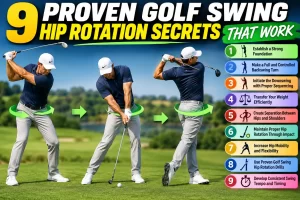
9 Proven Golf Swing Hip Rotation Secrets That Work
How to Rotate Your Hips Correctly During the Golf Swing
Introduction: Why Golf Swing Hip Rotation Matters
Are you struggling to generate more distance, maintain consistent ball contact, or hit accurate golf shots? The problem might not be your grip, stance, or equipment. Poor golf swing hip rotation could be preventing you from unlocking your full potential on the course. Many golfers focus heavily on their arms and shoulders while overlooking the important role their hips play in producing a powerful, controlled, and repeatable swing.
Your hips are essential to efficient golf swing mechanics because they help coordinate movement between your lower and upper body. When your hips rotate correctly, they contribute to effective weight transfer, improved golf swing sequencing, and greater clubhead speed. This coordinated movement allows your body to generate power without relying entirely on your arms.
However, improper hip movement can create several frustrating problems. Excessive sliding, restricted rotation, or poorly timed lower body rotation may contribute to slicing, inconsistent ball striking, reduced distance, and poor balance. Simply turning your hips faster isn’t the solution. Proper golf hip rotation requires controlled movement, smooth swing tempo, and effective coordination throughout the swing.
The good news? Learning how to improve golf swing hip rotation doesn’t have to be complicated. With the right techniques, practical drills, and consistent practice, you can develop more efficient movement patterns that support better performance.
In this guide, you’ll discover 9 proven golf swing hip rotation secrets designed to help you improve your mechanics, generate more power, maintain better balance, and develop a more accurate, consistent golf swing.
9 Powerful Golf Swing Sequencing Secrets You Need to Know
What Is Proper Golf Swing Hip Rotation?
Proper golf swing hip rotation refers to the controlled turning of your pelvis throughout the golf swing. This movement plays an essential role in generating power, maintaining balance, and coordinating your upper and lower body. When performed correctly, hip rotation helps golfers create an efficient swing that promotes consistent ball striking, improved accuracy, and greater distance.
Understanding how your hips should move during each phase of the swing is an important step toward developing better golf swing mechanics.
Understanding Hip Rotation in the Golf Swing
During the backswing, your hips rotate away from the target as your shoulders turn and your body prepares to deliver the club. For a right-handed golfer, the trail hip moves backward, allowing the pelvis to turn while maintaining a stable, athletic posture.
As the downswing begins, pressure shifts toward your lead foot while your hips start rotating toward the target. This coordinated movement helps transfer energy through your body and into the golf club.
At impact, your pelvis is typically rotated open toward the target, allowing your arms and club to move through the hitting area. During the follow-through, your hips continue rotating until your body reaches a balanced finish.
One important distinction is the difference between rotation and excessive lateral swaying. Proper rotation involves turning your pelvis while controlling side-to-side movement. Excessive swaying can disrupt weight transfer, affect your swing path, and make consistent contact more difficult.
Your hips must also work together with your shoulders, torso, and arms. Effective golf swing sequencing allows these body segments to move in a coordinated pattern rather than independently.
Why Proper Golf Hip Rotation Improves Performance
Efficient hip rotation in golf swing mechanics can contribute to increased clubhead speed by helping your body generate and transfer rotational energy. Rather than relying primarily on arm strength, golfers can use coordinated lower-body movement and torso rotation to produce a more powerful swing.
Proper hip movement also supports consistent ball striking. When your pelvis rotates with good timing, it becomes easier to maintain posture, control your swing path, and deliver the club more consistently at impact.
Additionally, controlled body rotation helps maintain balance throughout the swing. Excessive sliding, early extension, or poorly timed hip movement can disrupt your stability and make accurate shots more challenging.
Learning how to rotate hips in golf swing movements effectively is not about achieving the fastest possible rotation. It’s about developing the right combination of mobility, stability, sequencing, and timing.
By improving these fundamentals, you can build a more efficient, repeatable swing that supports greater distance, improved accuracy, and better overall performance on the golf course.
9 Proven Golf Swing Hip Rotation Secrets That Work
Secret #1: Establish the Correct Golf Stance and Posture
One of the most important secrets to improving golf swing hip rotation starts before you even begin your backswing. Your stance and posture establish the foundation for efficient body movement, allowing your hips to rotate naturally while maintaining balance, stability, and control. Without a proper setup, even golfers with excellent flexibility may struggle to generate consistent power and accuracy.
Start With the Correct Stance Width
Your stance width directly influences how freely your hips can rotate throughout the swing. A stance that is excessively wide may restrict movement and make it difficult to transfer pressure efficiently. Conversely, a stance that is too narrow can reduce stability and make maintaining balance more challenging.
For most golfers, a good starting point is positioning your feet approximately shoulder-width apart when using a driver. With shorter irons, a slightly narrower stance often provides sufficient stability while allowing comfortable lower body rotation.
Experiment with small adjustments until you find a stance that supports both balance and unrestricted movement.
Maintain an Athletic Golf Posture
Proper golf hip rotation also depends on establishing an athletic posture at address. Begin by standing tall, then hinge forward from your hips while keeping your spine in a comfortable, relatively neutral position.
Allow your knees to flex slightly without dropping into an exaggerated squat. Your arms should hang naturally beneath your shoulders, helping you maintain a relaxed position.
Avoid bending excessively at the waist or rounding your upper back. These positions can interfere with efficient rotation and make it harder to maintain your posture during the downswing.
Standing too upright can also create problems by limiting your ability to rotate comfortably while delivering the club on a consistent path.
Distribute Your Weight Evenly
Balanced weight distribution is another essential component of effective golf swing mechanics. At address, begin with your pressure distributed approximately evenly between both feet, making adjustments as appropriate for the club and shot.
Maintain pressure through the middle of your feet rather than leaning excessively toward your toes or heels. This creates a stable foundation for coordinated weight transfer and hip movement.
Use These Simple Setup Checkpoints
Before making your next practice swing, check the following:
-
Position your feet at a comfortable width for the club you’re using.
-
Maintain slight knee flex and hinge naturally from your hips.
-
Keep your spine relatively neutral and your shoulders relaxed.
-
Distribute your pressure evenly between your feet.
-
Make a slow practice backswing to confirm your hips can rotate without losing balance.
Remember, learning proper hip rotation in golf swing mechanics begins with establishing a reliable setup. When your stance and posture allow your body to move freely, you’ll be better prepared to develop efficient golf swing sequencing, generate controlled power, and deliver more consistent shots on the course.
Secret #2: Master Hip Rotation During the Backswing
Developing proper golf swing hip rotation during the backswing is essential for generating power, maintaining balance, and preparing your body for an efficient downswing. Many amateur golfers make the mistake of either restricting their hip movement too much or allowing excessive lateral swaying. Both problems can interfere with golf swing mechanics and make consistent ball striking more difficult.
The key is learning how to rotate your hips naturally while maintaining a stable foundation and allowing your upper and lower body to work together.
Allow Your Trail Hip to Rotate Backward
During the backswing, your trail hip should move backward as your pelvis rotates away from the target. For right-handed golfers, this means allowing the right hip to turn behind you while your shoulders continue rotating.
This movement creates room for your torso to turn and helps establish an effective backswing position. Rather than pushing your hips sideways, focus on rotating around your body while maintaining your posture.
A helpful swing thought is to imagine your trail hip moving toward an imaginary wall positioned behind you. This encourages rotation instead of excessive lateral movement.
Maintain Balance Throughout the Backswing
Proper hip rotation in golf swing mechanics requires a combination of mobility and stability. As your body turns, pressure generally shifts toward your trail foot, particularly toward the inside portion of that foot.
However, avoid allowing your weight to move excessively outside your trail foot. This can create instability and make it harder to transition smoothly into the downswing.
Maintain comfortable knee flex, keep your head relatively stable, and allow your shoulders and hips to rotate together naturally.
Avoid Restricting Your Hip Turn
Some golfers believe they must keep their hips almost completely stationary during the backswing to create more power. However, excessive restriction can limit shoulder rotation, create unnecessary tension, and reduce your ability to complete a comfortable backswing.
Effective golf swing sequencing depends on allowing sufficient pelvic rotation while maintaining coordination between your lower body and torso.
Your ideal amount of hip rotation will depend on your flexibility, physical capabilities, and individual swing characteristics. Instead of forcing a specific angle, focus on making a balanced, unrestricted turn.
Practice the Trail Hip Rotation Drill
Try this simple drill to improve your backswing movement:
-
Stand in your normal golf posture without holding a club.
-
Place your hands across your chest.
-
Slowly rotate your shoulders and hips into a backswing position.
-
Focus on moving your trail hip backward rather than sideways.
-
Maintain your balance and hold the position for two seconds.
-
Return to your starting position and repeat 10–15 times.
Once you become comfortable with the movement, repeat the exercise while holding a golf club across your shoulders.
Mastering this fundamental movement can help you develop smoother body rotation, improved swing tempo, and a more controlled transition into the downswing. With consistent practice, you’ll establish a stronger foundation for generating power without sacrificing balance or accuracy.
Secret #3: Start the Downswing With Proper Lower Body Sequencing
One of the most effective ways to improve golf swing hip rotation is to master the transition from the backswing into the downswing. This critical movement determines how efficiently your body transfers energy, generates clubhead speed, and delivers the golf club to the ball. Many amateur golfers lose power and accuracy because their hips, shoulders, and arms move out of sequence during the transition.
Understanding proper golf swing sequencing can help you develop a smoother, more powerful downswing without relying on excessive effort.
Begin the Transition With a Controlled Pressure Shift
As your backswing approaches completion, pressure should begin shifting toward your lead foot. For right-handed golfers, this means gradually increasing pressure beneath the left foot as your body prepares to rotate toward the target.
This movement often begins before the club reaches the very top of the backswing. Rather than making a sudden sideways lunge, focus on a controlled pressure shift that allows your lower body to initiate the transition naturally.
Effective weight transfer helps establish a stable foundation for pelvic rotation while supporting balance throughout the downswing.
Coordinate Your Hips, Torso, and Arms
Proper hip rotation in golf swing mechanics involves more than simply turning your lower body toward the target. Your pelvis, torso, arms, and golf club must move in a coordinated sequence to generate efficient speed.
During the early downswing, your pelvis generally begins rotating toward the target while your upper body completes its transition. Your torso then accelerates, followed by the arms and club as they move toward impact.
These movements overlap rather than occurring as completely separate actions. The goal is to develop smooth coordination that allows energy to transfer efficiently through your body.
Avoid Spinning Your Hips Too Aggressively
A common mistake among amateur golfers is attempting to rotate their hips as quickly as possible from the top of the backswing.
Although lower body rotation contributes to power, aggressively spinning your hips can disrupt your swing tempo and cause your upper body and arms to fall out of sequence.
This may contribute to poor contact, inconsistent swing paths, and difficulty controlling the clubface.
Instead of forcing maximum hip speed, concentrate on maintaining balance while allowing your pelvis to rotate progressively through the downswing.
Practice the Slow-Motion Sequencing Drill
Use this simple exercise to improve coordination between your lower and upper body:
-
Begin in your normal golf stance while holding a club.
-
Make a slow backswing and pause briefly near the top.
-
Gently shift pressure toward your lead foot.
-
Allow your pelvis to begin rotating toward the target.
-
Let your torso, arms, and club follow naturally.
-
Continue into a balanced follow-through.
-
Repeat 10–15 times before gradually increasing your swing speed.
Perform this drill without hitting golf balls initially so you can concentrate on movement quality rather than distance.
Mastering proper lower body rotation and downswing sequencing can help you generate more efficient power, improve impact consistency, and develop a smoother golf swing. Remember, successful hip rotation depends on timing and coordination—not simply how fast you can turn your hips.
Secret #4: Improve Weight Transfer for More Powerful Hip Rotation
Developing effective weight transfer is one of the most important elements of golf swing hip rotation. When your lower body moves efficiently, you create a stronger foundation for generating clubhead speed, maintaining balance, and delivering consistent golf shots. However, many amateur golfers misunderstand weight transfer and mistakenly believe they need to shift their entire body dramatically from one side to the other.
The secret is learning how to coordinate pressure shifts with controlled hip rotation rather than relying on excessive lateral movement.
Understand the Difference Between Weight Transfer and Pressure Shift
Although golfers often use these terms interchangeably, weight transfer and pressure shift describe different aspects of movement.
Weight transfer generally refers to changes in how your body’s mass is distributed throughout the swing. Pressure shift describes how the force applied against the ground changes between your feet.
During the backswing, pressure typically increases beneath your trail foot as your body rotates away from the target. As the downswing transition begins, pressure moves toward your lead foot, helping prepare your body for rotation through impact.
Importantly, pressure can shift toward your lead foot before your body’s center of mass moves significantly in that direction.
Understanding this distinction can help you develop more efficient golf swing mechanics without unnecessary swaying.
Use Lead-Side Pressure to Support Hip Rotation
As your downswing begins, increasing pressure beneath your lead foot provides a stable foundation for lower body rotation.
For right-handed golfers, this means establishing pressure beneath the left foot while allowing the pelvis to rotate toward the target.
This coordinated movement helps your body generate rotational speed while maintaining balance and posture.
Effective golf swing sequencing allows the pressure shift, pelvic rotation, torso movement, and arm swing to work together rather than competing against one another.
Avoid Excessive Lateral Hip Sliding
One common mistake is pushing the hips aggressively toward the target instead of allowing them to rotate.
Excessive lateral sliding can disrupt your posture, change the club’s delivery path, and make solid contact more difficult.
Although some lateral pelvic movement is normal, the goal is to combine controlled movement toward the lead side with continued rotation.
Focus on finishing with your body balanced over your lead leg rather than forcing your hips sideways.
Practice the Step-Through Weight Transfer Drill
This simple drill can help improve pressure movement and proper golf hip rotation.
-
Begin in your normal golf stance with a short iron.
-
Position your feet slightly closer together than usual.
-
Make a slow, controlled backswing.
-
As you begin the downswing, step your lead foot toward the target.
-
Allow your hips and torso to rotate naturally as your arms swing through.
-
Finish with your weight supported primarily by your lead leg.
-
Repeat 10–15 times using smooth, controlled movements.
Start without a golf ball, then progress to gentle practice shots once you feel comfortable.
By improving your weight transfer and pressure shift, you can create more efficient hip rotation in golf swing movements, maintain better stability, and develop a more powerful, repeatable swing without sacrificing accuracy.
Secret #5: Create Better Hip and Shoulder Separation
One of the most effective techniques for improving golf swing hip rotation is developing better separation between your hips and shoulders. This movement helps golfers generate rotational power, improve swing efficiency, and maintain proper coordination throughout the downswing. When your upper and lower body work together with the correct timing, you can produce greater clubhead speed without relying entirely on arm strength.
However, creating effective hip and shoulder separation requires controlled movement, flexibility, and proper golf swing sequencing rather than forcing your body into uncomfortable positions.
Understand Hip and Shoulder Separation
Hip and shoulder separation refers to the difference between the rotational positions of your pelvis and upper torso during the golf swing. Golf instructors sometimes call this the X-factor because the angle between your shoulder line and hip line resembles an X when viewed from above.
During the backswing, your shoulders generally rotate farther than your hips, creating rotational separation between your upper and lower body.
As the downswing begins, your pelvis starts rotating toward the target while your torso transitions into the downswing. This coordinated movement can temporarily increase the separation between your hips and shoulders.
Effective body rotation helps establish the conditions for generating clubhead speed and transferring energy efficiently through the swing.
Coordinate Your Pelvis and Torso Rotation
Proper hip rotation in golf swing mechanics involves different body segments rotating at different speeds throughout the swing.
During the downswing, the pelvis typically begins accelerating before the upper torso reaches its peak rotational speed. The torso, arms, and club then accelerate in an overlapping sequence as the club approaches impact.
This coordinated movement helps golfers develop efficient lower body rotation while maintaining control of the club.
Rather than attempting to rotate every body segment simultaneously, focus on allowing your movements to flow naturally from the ground upward.
Avoid Forcing Excessive Separation
A common mistake is trying to maximize hip and shoulder separation by restricting the hips or twisting the upper body excessively.
Although some separation can contribute to an efficient swing, forcing extreme positions may create unnecessary muscular tension, reduce balance, and place additional stress on your lower back.
Your ideal amount of separation depends on your mobility, strength, and individual swing characteristics.
The goal is to develop comfortable, controlled rotation rather than achieving a specific angle.
Practice the Controlled Torso Rotation Drill
Use this simple drill to improve coordination between your hips and shoulders:
-
Stand with your feet approximately shoulder-width apart and your knees slightly flexed.
-
Hold a golf club horizontally across your shoulders.
-
Slowly rotate your upper body into a comfortable backswing position while allowing your hips to turn naturally.
-
Begin the transition by gently shifting pressure toward your lead foot.
-
Allow your pelvis to rotate toward the target as your torso follows.
-
Continue rotating into a balanced finish without forcing additional separation.
-
Repeat 10–15 times using slow, controlled movements.
Practice this exercise regularly while maintaining relaxed muscles and comfortable movement.
Improving hip and shoulder separation can help you develop smoother swing tempo, more efficient rotational sequencing, and better overall swing mechanics. When your pelvis and torso move together with proper timing, you’ll be better positioned to generate consistent power while maintaining balance and control throughout your golf swing.
Secret #6: Maintain Proper Hip Rotation Through Impact
One of the most important elements of golf swing hip rotation is maintaining controlled lower-body movement as the club approaches impact. Many amateur golfers make a reasonable backswing and initiate the downswing correctly but struggle to continue rotating their hips through the hitting area. This can reduce swing efficiency, interfere with club delivery, and make consistent ball striking more difficult.
Learning to maintain proper hip rotation through impact can help you generate more efficient power, improve accuracy, and develop a smoother, more repeatable golf swing.
Understand the Proper Hip Position at Impact
During an effective full golf swing, your pelvis is generally rotated open toward the target when the club contacts the ball. For right-handed golfers, this means the hips have turned to the left of their original address position.
The exact amount of rotation varies depending on the golfer’s flexibility, swing characteristics, and club selection. Rather than attempting to achieve a specific angle, focus on allowing your hips to rotate naturally while maintaining balance and posture.
Proper golf hip rotation at impact also works together with weight transfer. As pressure increases beneath your lead foot, your pelvis can continue rotating toward the target, supporting efficient golf swing sequencing.
Create Space for Your Arms and Golf Club
One major benefit of effective lower body rotation is creating room for your arms and club to travel through the impact zone.
As your pelvis rotates, it helps position your body so your hands and arms can move through the hitting area without becoming crowded.
When combined with appropriate posture and torso movement, this can support a more consistent swing path and better club delivery.
However, simply opening your hips farther does not guarantee improved contact. Your pelvis, shoulders, arms, and club must work together with coordinated timing.
Avoid Stalling Your Hip Rotation
A common swing fault occurs when golfers slow or stop their pelvic rotation too early during the downswing.
This can cause the arms to overtake the body’s rotation, potentially contributing to inconsistent clubface control, poor contact, and unpredictable ball flight.
Some golfers compensate by flipping their wrists through impact, while others lose posture or struggle to maintain an effective swing path.
Although pelvic rotational speed naturally changes throughout the downswing, the goal is to avoid an unnecessary stall that disrupts your overall movement pattern.
Practice the Impact-Position Rehearsal Drill
This simple drill can help you understand how to rotate hips in golf swing movements while maintaining proper impact positioning.
-
Begin in your normal golf stance while holding a short iron.
-
Slowly move the club into a halfway backswing position.
-
Shift pressure toward your lead foot as you begin rotating your hips toward the target.
-
Stop when your hands approach the impact area.
-
Check that your pelvis is slightly open, your posture remains stable, and your arms have room to move.
-
Continue slowly into a balanced follow-through.
-
Repeat 10–15 times before practicing at a slightly faster speed.
Avoid forcing your hips into an exaggerated open position or locking your body into a rigid impact pose.
With consistent practice, improving hip rotation in golf swing movements through impact can help you develop better coordination, more reliable ball striking, and greater control over your golf shots. The key is maintaining smooth, continuous movement rather than trying to force maximum rotational speed at impact.
Secret #7: Increase Hip Mobility and Flexibility
Improving hip mobility and flexibility is an essential part of developing effective golf swing hip rotation. Many golfers struggle to make a complete backswing or rotate efficiently through impact because their hips lack the mobility needed for comfortable movement. Limited hip mobility can contribute to restricted body rotation, inconsistent swing mechanics, and compensations that reduce power and accuracy.
The good news is that incorporating a few simple mobility exercises into your practice routine can help improve your range of motion, support better balance, and make your golf swing feel more natural.
Understand How Hip Mobility Affects Your Golf Swing
Your hip joints must move through several directions during the golf swing, including internal rotation, external rotation, flexion, and extension.
Internal hip rotation occurs when your thigh rotates inward relative to your pelvis, while external rotation occurs when your thigh rotates outward. Both movements contribute to the coordinated turning of your lower body.
During the backswing and downswing, your hips use different combinations of these movements to support pelvic rotation and weight transfer.
When mobility is limited, golfers may compensate by excessively swaying, lifting their heels, changing their posture, or placing additional rotational demands on their lower back.
Improving mobility can help you achieve more comfortable lower body rotation while supporting efficient golf swing sequencing.
Exercise #1: 90/90 Hip Rotations
This exercise helps develop internal and external hip rotation.
-
Sit on the floor with both knees bent approximately 90 degrees, positioning one leg in front of your body and the other to the side.
-
Keep your torso upright and your movements controlled.
-
Slowly rotate your knees toward the opposite side, moving into the reverse 90/90 position.
-
Use your hands for support if necessary.
-
Repeat 8–12 times, alternating sides.
Avoid forcing your knees toward the floor or pushing through discomfort.
Exercise #2: Standing Hip Circles
Standing hip circles can improve general hip mobility while challenging balance and coordination.
-
Stand upright beside a wall or sturdy chair for support.
-
Lift one knee comfortably toward your chest.
-
Slowly move your knee outward, creating a controlled circular motion.
-
Return your leg to the starting position.
-
Complete 8–10 circles in each direction before switching legs.
Keep your upper body relatively stable and avoid exaggerated movements.
Exercise #3: Half-Kneeling Hip Flexor Stretches
This stretch targets muscles at the front of your hips that can influence pelvic positioning.
-
Kneel on one knee with your opposite foot positioned in front.
-
Maintain an upright torso and gently tighten your abdominal muscles.
-
Slightly tuck your pelvis underneath your body.
-
Shift forward until you feel a comfortable stretch along the front of your trailing hip.
-
Hold for 20–30 seconds before switching sides.
-
Repeat twice on each side.
Use padding beneath your knee if needed.
Improve Mobility Gradually for Lasting Results
Learning how to improve golf swing hip rotation through mobility training requires patience and consistency. Perform these exercises several times per week, gradually increasing your comfortable range of motion as your flexibility improves.
Never force painful movements or attempt to achieve extreme rotation. If you experience persistent hip discomfort, consult a qualified healthcare professional.
By combining improved mobility with proper golf swing mechanics, controlled weight transfer, and consistent practice, you can develop smoother hip rotation, better balance, and a more efficient golf swing that supports greater power and accuracy.
Secret #8: Use Proven Golf Swing Hip Rotation Drills
One of the most effective ways to improve golf swing hip rotation is through consistent practice with drills that develop proper movement patterns. While understanding the mechanics of hip rotation is important, practicing these movements helps golfers build better coordination, balance, and muscle control throughout the swing.
Many amateur golfers struggle with excessive hip sliding, early extension, or poorly timed lower body rotation. Fortunately, the following three drills can help correct these common mistakes while promoting more efficient golf swing sequencing and consistent ball striking.
Drill #1: Alignment Stick Hip Rotation Drill
The alignment stick hip rotation drill helps golfers visualize how their pelvis should rotate during the backswing and downswing.
How to Perform the Drill:
-
Stand in your normal golf posture with your feet approximately shoulder-width apart.
-
Hold an alignment stick horizontally across the front of your hips, using both hands to keep it in position.
-
Slowly rotate into your backswing, allowing your trail hip to move backward.
-
Begin the downswing by shifting pressure toward your lead foot.
-
Rotate your pelvis toward the target while maintaining balance.
-
Continue into a comfortable follow-through position.
Common Swing Fault Addressed: Excessive lateral hip sliding instead of controlled rotation.
Recommended Practice: Complete 10–15 slow repetitions, focusing on smooth movement rather than speed.
Drill #2: Chair or Wall Hip-Depth Drill
This drill helps golfers maintain posture and avoid early extension, a common problem that occurs when the pelvis moves excessively toward the golf ball during the downswing.
How to Perform the Drill:
-
Position a sturdy chair or stand near a wall with your backside lightly touching the surface.
-
Assume your normal golf stance and posture.
-
Make a slow backswing while allowing your trail hip to move backward along the reference surface.
-
Begin your downswing and allow your lead hip to move backward as your pelvis rotates.
-
Maintain your hip depth without forcing your body against the chair or wall.
-
Finish in a balanced position.
Common Swing Fault Addressed: Early extension and loss of posture during the downswing.
Recommended Practice: Perform 10–12 controlled repetitions before progressing to practice swings without the reference surface.
Drill #3: Step-Through Downswing Drill
The step-through drill helps golfers coordinate weight transfer, hip rotation, and upper-body movement during the transition.
How to Perform the Drill:
-
Begin with your feet slightly closer together than your normal stance.
-
Hold a short iron and make a controlled backswing.
-
As the downswing begins, step your lead foot toward the target.
-
Allow your hips and torso to rotate naturally as your arms swing through.
-
Continue into a balanced finish with most of your pressure supported by your lead foot.
-
Repeat the movement without rushing the transition.
Common Swing Fault Addressed: Poor weight transfer and improper downswing sequencing.
Recommended Practice: Complete 10–15 repetitions, starting without a golf ball before progressing to gentle practice shots.
Practice These Drills for Consistent Improvement
To develop proper golf hip rotation, choose one drill that addresses your biggest swing problem and practice it regularly. Begin with slow, controlled movements before gradually increasing your swing speed.
Recording your practice swings from a face-on or down-the-line camera angle can also help you identify improvements in posture, balance, and hip movement.
By incorporating these exercises into your routine, you can develop more efficient golf swing mechanics, improve swing tempo, and create a stronger foundation for generating power and accuracy. Remember, mastering hip rotation in golf swing movements requires repetition, patience, and consistent attention to proper technique.
Secret #9: Develop Consistent Swing Tempo and Hip Rotation Timing
One of the most overlooked secrets to improving golf swing hip rotation is developing consistent swing tempo and proper timing. Many amateur golfers focus on rotating their hips faster to generate additional power, but speed alone does not guarantee better results. Without coordinated movement between your lower body, torso, arms, and golf club, excessive hip rotation can actually reduce efficiency and make accurate ball striking more difficult.
The key to a powerful, repeatable golf swing is learning how to coordinate your hip movement with the natural rhythm of your entire body.
Understand Why Hip Rotation Timing Matters
Proper golf hip rotation depends on the coordinated movement of several body segments throughout the swing. During the backswing, your hips and shoulders rotate away from the target as your body prepares for the downswing.
As the transition begins, pressure shifts toward your lead foot while your pelvis starts rotating toward the target. Your torso, arms, and golf club then accelerate in an overlapping sequence that supports efficient energy transfer.
When these movements occur with effective timing, golfers can generate clubhead speed while maintaining balance and control.
However, when your hips rotate too aggressively or become poorly synchronized with your upper body, your golf swing sequencing may become disrupted.
Avoid Rushing the Downswing
One common mistake among recreational golfers is attempting to generate maximum power immediately from the top of the backswing.
This often causes golfers to spin their hips excessively, pull their shoulders toward the target, or accelerate their arms before their body is properly positioned.
These movements can contribute to inconsistent swing paths, poor contact, and reduced accuracy.
Instead of trying to swing harder, focus on making a smooth transition that allows your lower body rotation and upper-body movement to work together naturally.
Use Smooth Swing Tempo to Improve Consistency
Consistent swing tempo helps golfers repeat their movement patterns more reliably from one swing to the next.
A controlled backswing gives your body time to rotate comfortably, while a coordinated transition allows your hips, torso, and arms to accelerate without unnecessary tension.
Remember that smooth tempo does not necessarily mean swinging slowly. Skilled golfers can generate tremendous clubhead speed while maintaining a consistent rhythm.
The goal is to eliminate rushed, uncontrolled movements while preserving efficient acceleration through impact.
Practice the Three-Count Swing Tempo Drill
This simple drill can help improve proper hip rotation in golf swing movements while developing better rhythm and coordination.
-
Begin in your normal golf stance with a short iron.
-
Start your backswing while mentally counting “one.”
-
Continue your backswing and count “two” as you approach the top.
-
Count “three” as you transition smoothly into the downswing and swing through the ball.
-
Allow your hips to rotate naturally while maintaining balance and posture.
-
Finish with your body facing the target and your weight supported primarily by your lead leg.
-
Repeat 10–15 times without hitting a ball before progressing to gentle practice shots.
Avoid treating the count as three separate stops. The movement should remain continuous and rhythmic.
Progress Gradually Toward Normal Swing Speed
Begin by performing slow-motion practice swings at approximately 50% of your normal speed. Once your movements feel coordinated, gradually increase to 70–80% before returning to full-speed swings.
Focus on maintaining the same rhythm and balance as your speed increases.
Mastering consistent swing tempo and hip rotation timing can help you develop smoother golf swing mechanics, more efficient power generation, and improved shot consistency. By prioritizing coordination over excessive effort, you’ll be better prepared to produce powerful, accurate golf shots with a repeatable swing.
Common Golf Swing Hip Rotation Mistakes to Avoid
Even golfers who understand the fundamentals of golf swing hip rotation can develop habits that limit power, accuracy, and consistency. Small mistakes in lower-body movement can disrupt golf swing sequencing, affect balance, and make solid ball striking more difficult. Recognizing these common problems and learning how to correct them can help you develop more efficient golf swing mechanics.
Excessive Hip Sliding Instead of Rotating
One of the most common mistakes amateur golfers make is sliding their hips excessively toward the target rather than rotating them through the downswing.
Although some lateral movement is natural, excessive sliding can disrupt balance, change your swing path, and make consistent impact more challenging.
How to Correct It: Practice slow-motion swings while focusing on moving your lead hip backward as your pelvis rotates toward the target. Maintain pressure beneath your lead foot without forcing your entire body sideways.
Spinning the Hips Too Early
Some golfers believe rotating their hips as quickly as possible will automatically generate more clubhead speed. However, aggressively spinning your hips from the top can cause your arms and torso to fall out of sequence.
This may contribute to inconsistent contact, poor clubface control, and reduced accuracy.
How to Correct It: Focus on shifting pressure toward your lead foot while allowing your hips to rotate progressively. Proper weight transfer and lower body rotation should work together rather than occurring as disconnected movements.
Restricting Hip Rotation During the Backswing
Excessively restricting your hips during the backswing can limit shoulder rotation, create unnecessary tension, and make it difficult to generate comfortable rotational power.
Some golfers mistakenly try to keep their pelvis completely stationary while turning their shoulders.
How to Correct It: Allow your trail hip to move naturally backward during the backswing while maintaining balance. Avoid forcing a specific rotation angle that exceeds your comfortable mobility.
Losing Posture During Hip Rotation
Early extension occurs when your pelvis moves toward the golf ball and your body loses some of its forward bend during the downswing.
This movement can reduce the space available for your arms, affect club delivery, and contribute to inconsistent ball striking.
How to Correct It: Practice the chair or wall hip-depth drill to develop awareness of your pelvic movement. Focus on maintaining comfortable posture while allowing your hips to rotate naturally.
Avoiding these mistakes can help you achieve proper golf hip rotation, improve swing tempo, and develop more consistent movement patterns. Remember, effective hip rotation depends on balance, mobility, and coordinated timing rather than forcing excessive speed or movement.
How to Improve Golf Swing Hip Rotation at Home
Improving golf swing hip rotation doesn’t require expensive training equipment, professional instruction every week, or hours at the driving range. With a few simple exercises and consistent practice, you can develop better hip mobility, improve lower body rotation, and strengthen the movement patterns that contribute to a powerful, accurate golf swing.
Practicing at home also allows you to focus on proper golf swing mechanics without worrying about hitting the ball or achieving maximum distance.
Practice Without Hitting Golf Balls
One of the easiest ways to improve proper golf hip rotation is through mirror rehearsals. Stand in front of a full-length mirror and slowly move through your backswing and downswing while observing your posture, balance, and hip movement.
Pay attention to whether your trail hip moves backward during the backswing and whether your pelvis rotates toward the target during the downswing.
Slow-motion practice swings are particularly helpful because they allow you to concentrate on golf swing sequencing without rushing your movements.
You can also use a sturdy chair or wall as a reference point to monitor hip depth. Position your backside lightly against the surface and practice rotating while maintaining your posture.
This exercise can help reduce excessive hip sliding and early extension.
Build a Simple Weekly Hip Rotation Practice Routine
A structured 10-minute routine can help you develop more consistent movement patterns without overwhelming your practice schedule.
Try the following routine three to five days per week:
-
Minutes 1–3: Hip Mobility Exercises. Perform controlled standing hip circles and 90/90 hip rotations to improve comfortable movement.
-
Minutes 4–6: Lower Body Sequencing Drills. Practice slow backswing and downswing transitions while coordinating weight transfer with pelvic rotation.
-
Minutes 7–8: Hip-Depth Rehearsals. Use a chair or wall to reinforce proper posture and controlled rotation.
-
Minutes 9–10: Controlled Practice Swings. Make smooth swings while maintaining balance, proper sequencing, and consistent swing tempo.
Record your swing from face-on and down-the-line angles once or twice per week. Compare your recordings to identify improvements in hip movement, posture, and balance.
Remember, learning how to improve golf swing hip rotation takes patience. Focus on making small, repeatable improvements rather than attempting dramatic swing changes in a single practice session.
Consistent practice can help you develop smoother body rotation, more efficient movement, and greater confidence in your golf swing.
How Proper Hip Rotation Can Improve Golf Swing Power and Accuracy
Developing effective golf swing hip rotation can make a significant difference in your ability to generate power, strike the ball consistently, and improve overall accuracy. While many amateur golfers attempt to increase distance by swinging their arms harder, efficient lower-body movement helps create a more coordinated and powerful swing.
When your hips, torso, arms, and golf club work together with proper timing, you can produce greater swing efficiency without sacrificing balance or control.
How Hip Rotation Contributes to Clubhead Speed
Proper golf hip rotation plays an important role in the kinetic chain, the coordinated sequence of movements that transfers energy through your body and into the golf club.
During the downswing, pressure shifts toward your lead foot as your pelvis begins rotating toward the target. Your torso, arms, and club then accelerate through an overlapping sequence, helping generate clubhead speed.
Efficient golf swing sequencing allows these movements to work together rather than relying primarily on upper-body strength.
However, faster hip rotation does not automatically produce greater clubhead speed. If your hips rotate too aggressively or become poorly synchronized with your torso and arms, you may lose efficiency and struggle to deliver the club consistently.
The goal is coordinated acceleration, not maximum hip speed.
How Hip Rotation Supports Better Ball Striking
Proper hip rotation in golf swing mechanics can also contribute to improved accuracy by supporting a more consistent swing path and impact position.
When your pelvis rotates with appropriate timing, it helps create space for your arms and allows your body to maintain a more stable posture through impact.
Effective weight transfer and controlled body rotation can also improve balance, making it easier to repeat your swing mechanics from one shot to the next.
However, hip rotation is only one component of accurate ball striking. Your grip, clubface alignment, swing path, setup, and impact location all influence the direction and quality of your shots.
By combining efficient lower body rotation with proper technique and consistent practice, you can develop a more powerful, controlled, and repeatable golf swing that supports greater distance and improved accuracy on the course.
Final Thoughts: Master Golf Swing Hip Rotation for Better Results
Mastering golf swing hip rotation is an important step toward developing a more powerful, accurate, and consistent golf swing. By applying these nine proven secrets, you can improve your stance, backswing rotation, downswing sequencing, weight transfer, hip and shoulder separation, impact position, mobility, practice techniques, and swing tempo.
Remember, proper golf hip rotation isn’t about turning your hips as fast as possible. It’s about combining athletic posture, controlled body rotation, flexibility, balance, and coordinated timing to create an efficient swing.
Focus on improving one aspect of your technique at a time. Incorporate simple drills into your practice routine, monitor your progress, and avoid forcing uncomfortable movements.
With patience, consistent practice, and attention to proper golf swing mechanics, you can develop smoother hip rotation, generate more efficient power, and achieve more reliable ball striking.
Start practicing these techniques today and take another step toward building a powerful, accurate, and repeatable golf swing! Get access to The Golf Swing Lab here https://ultimategolfmasterypro.com/the-golf-swing-lab-2/
Frequently Asked Questions About Golf Swing Hip Rotation
How much should your hips rotate in the golf swing?
The ideal amount of golf swing hip rotation varies depending on your flexibility, mobility, swing style, and physical capabilities. Many skilled golfers rotate their pelvis approximately 30–50 degrees during the backswing, although individual differences are common. Focus on comfortable rotation, balanced posture, and efficient movement rather than forcing a specific angle.
Should your hips rotate first in the downswing?
Your lower body generally helps initiate the downswing as pressure shifts toward your lead foot and your pelvis begins rotating toward the target. However, proper golf swing sequencing involves overlapping movements between your hips, torso, arms, and club rather than completely separate actions.
How do you improve hip rotation in the golf swing?
Start by establishing an athletic stance and maintaining proper posture. Incorporate hip mobility exercises, controlled rotation drills, and slow-motion practice swings. Consistent practice with attention to weight transfer, balance, and swing tempo can help improve your overall movement patterns.
What happens if you don’t rotate your hips in golf?
Insufficient hip rotation can restrict your backswing, reduce efficient power generation, and interfere with your swing path. It may also contribute to inconsistent contact, poor balance, and unnecessary compensations involving your arms and upper body.
Can too much hip rotation cause a golf slice?
Excessive or poorly timed hip rotation can contribute to swing-path problems that produce slicing. However, a slice primarily results from an open clubface relative to the club’s swing path. Improving rotation timing and clubface control can help produce straighter shots.
How can beginners practice proper golf hip rotation?
Beginners should start with slow-motion swings, mirror rehearsals, and simple chair or wall drills. Focus on maintaining balance while allowing your hips to rotate naturally. Gradually increase swing speed as your coordination and confidence improve.
Does hip rotation increase golf swing speed?
Efficient hip rotation can contribute to greater clubhead speed by supporting coordinated energy transfer through the body. However, faster hip movement alone doesn’t guarantee additional distance. Proper sequencing, centered contact, and efficient club delivery are equally important.
Should your hips be open at impact in golf?
Yes. During an effective full golf swing, the pelvis is generally rotated open toward the target at impact. The exact amount varies according to individual mechanics, flexibility, and club selection. Focus on maintaining posture, balance, and coordinated rotation rather than forcing an exaggerated impact position.