
9 Powerful Golf Ball Striking Drills for Better Contact
Best Golf Ball Striking Drills for Better Contact
Introduction: Why Golf Ball Striking Drills Improve Your Contact
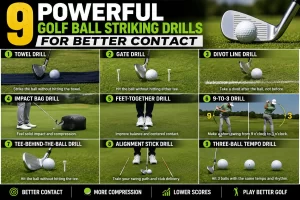
Consistent ball striking is one of the biggest differences between golfers who can trust their swing on the course and those who never quite know what kind of shot is coming next. You might make what feels like the same swing twice, only to hit one shot solidly and the next one thin, fat, or off the toe. Developing better contact isn’t simply about swinging harder or spending more time at the driving range. It’s about training the specific skills that allow the clubhead to return to the ball consistently.
Quality ball striking depends on several elements working together. Centered contact helps transfer energy efficiently from the clubface to the golf ball, while low point control determines whether you strike the ball before the ground with your irons. Clubface control influences the direction the ball starts, and swing path affects both contact and ball flight. Your golf swing tempo also matters because rushing the transition or swinging beyond your comfortable speed can make all of these elements harder to repeat.
This is why simply hitting bucket after bucket of golf balls doesn’t always produce improvement. Repeating an inconsistent movement can actually reinforce the same contact problems you’re trying to eliminate. Instead of measuring practice by how many balls you hit, it is usually more productive to practice with a specific purpose and immediate feedback.
That’s where golf ball striking drills can make such a difference. Well-designed drills isolate individual pieces of the impact sequence and give you a clear objective for every swing. Rather than trying to think about five different swing mechanics simultaneously, you can concentrate on one skill at a time and gradually build a more reliable impact pattern.
In this guide, we’ll cover nine powerful ball striking drills, including the towel drill for low point control, the gate drill for centered contact, the divot line drill, impact bag drill, feet-together drill, 9-to-3 drill, tee-behind-the-ball drill, alignment stick drill, and three-ball tempo drill. Together, these golf drills for better contact address many of the fundamental skills needed to strike the ball more consistently.
If you’ve been wondering how to improve golf ball striking, the answer doesn’t have to involve rebuilding your entire golf swing. Focused practice can help you identify exactly where your contact is breaking down, work on that specific weakness, and gradually transfer the improvement into your normal swing. The goal of the following drills is simple: develop cleaner contact, better ball compression, and a repeatable strike you can trust when you take your game from the practice range to the golf course.
How to Improve Ball Striking With Irons: 7 Easy Fixes
1. The Towel Drill for Better Low Point Control
One of the most important skills in consistent iron play is controlling where the club reaches the bottom of the swing. Ideally, the clubhead contacts the golf ball first and reaches its lowest point slightly ahead of the ball. When that low point moves behind the ball, the club can strike the ground too early, producing fat shots, reduced distance, and inconsistent contact. This makes low point control an essential part of learning how to improve golf ball striking.
The towel drill is one of the simplest golf ball striking drills for developing this skill because it gives you immediate feedback without requiring complicated equipment. All you need is a golf ball, a small towel, and enough space to make controlled iron swings.
Place a folded towel flat on the ground approximately four to six inches behind the golf ball. Take your normal setup and begin with a wedge or short iron. Instead of making a full swing immediately, start with controlled half swings at roughly 50% to 60% of your normal speed. Your objective is simple: strike the golf ball without allowing the clubhead to touch the towel.
If you repeatedly hit the towel before contacting the ball, your swing’s low point is probably occurring too early. When you consistently miss the towel and strike the ball first, you’re developing a more predictable impact pattern. This can lead to cleaner turf interaction, more centered contact, and improved ball compression because you’re delivering the club more efficiently through impact.
For golfers searching for golf ball striking drills for beginners, make the exercise easier by starting with the towel six to eight inches behind the ball and using small swings. Once you can produce clean contact consistently, gradually move the towel closer and increase your swing length. Eventually, progress from wedges to mid-irons while maintaining the same ball-first strike.
A common mistake is placing the towel too close to the ball immediately. This can make the drill unnecessarily difficult and encourage golfers to make unnatural movements simply to avoid the towel. Another mistake is trying to chop steeply downward at the ball. The goal isn’t to create the steepest possible swing; it’s to develop consistent low point control while maintaining good balance and golf swing tempo.
Why the Towel Drill Improves Ball-First Contact
The biggest advantage of the towel drill is its immediate feedback. You don’t have to guess whether your club reached the ground too early—the towel tells you instantly.
By repeatedly striking the ball while avoiding the towel, you train your swing to move its low point forward. Over time, this can help establish the ball-first, ground-second contact pattern associated with solid iron shots.
Like many effective ball striking drills, the towel drill works best when you prioritize quality over quantity. Make several controlled swings, evaluate the feedback, and then hit a few normal shots without the towel. Alternating between the drill and regular swings helps transfer the improved contact pattern into your normal golf swing, making this one of the most practical golf drills for better contact you can add to your practice routine.
2. The Gate Drill for Centered Contact
Hitting the center of the clubface consistently is one of the foundations of reliable ball striking. Even when your swing looks technically sound, contact toward the heel or toe can reduce ball speed, change distance, and make your shot pattern less predictable. That’s why developing centered contact should be a major priority when practicing golf ball striking drills.
The gate drill is a simple way to train this skill because it provides instant feedback about how accurately you’re delivering the clubhead through impact. To set it up, place a golf ball on the ground and position one tee just outside the toe of your clubhead and another just inside the heel. The two tees create a small “gate” for the clubhead to travel through.
When you’re first learning the drill, leave enough room so the clubhead can pass comfortably between the tees. About half an inch of clearance on each side is a good starting point for many golfers, although you can make the gate wider if necessary.
Begin with a wedge or short iron and make controlled half swings. Don’t worry about distance. Your goal is to strike the ball while allowing the clubhead to pass cleanly through the gate without touching either tee. Once you can accomplish this repeatedly, gradually increase your swing length and speed while maintaining the same quality of contact.
If you consistently hit one of the tees, you’re receiving useful information about your club delivery. Contact with either side of the gate indicates that the clubhead isn’t returning to the impact area as consistently as it could. Rather than immediately making major swing changes, slow down and concentrate on balance, golf swing tempo, and making a repeatable motion.
Improving centered contact can produce noticeable results. Strikes closer to the clubface’s sweet spot generally transfer energy more efficiently to the golf ball, helping create more predictable ball speed and carry distance. Consistent strike location also makes it easier to evaluate other elements of your swing, including clubface control and swing path.
For these reasons, the gate drill is one of the best golf ball striking drills for better contact. It’s also one of the most useful golf drills for better contact because the feedback is simple: pass through the gate cleanly and strike the center of the face.
How to Make the Gate Drill More Challenging
As your contact improves, gradually narrow the distance between the tees. Make small adjustments rather than turning the drill into an impossible test.
You can also progress from half swings to three-quarter swings and eventually full swings. Another option is to alternate between one gate-drill shot and one normal shot. This helps transfer the improved strike pattern into your regular swing.
The goal isn’t to create the narrowest possible gate. It’s to develop a club delivery pattern that produces centered contact repeatedly—even when you begin adding normal swing speed.
3. The Divot Line Drill for Consistent Ball-First Contact
When you hit an iron shot from the turf, the location of your divot can reveal a great deal about the quality of your contact. For a well-struck iron shot, the club should generally contact the golf ball before interacting with the ground, with the divot beginning on the target side of the ball’s original position. The divot line drill is one of the most effective ball striking drills for learning this ball-first contact pattern.
To perform the drill, create a straight line on the practice ground perpendicular to your target line. Depending on the practice facility, you can use marking spray, chalk, or simply establish a visible reference line in the turf. Make sure the practice facility permits whatever marking method you choose.
Place the golf ball directly on or just ahead of the line toward the target. Take your normal address position with a wedge or short iron and begin with small, controlled swings. Your objective is to strike the ball and have the club contact the turf on the target side of the reference line.
Don’t try to dig a large divot. The purpose of the drill is to control where the club reaches the ground, not how much turf you remove.
If your club repeatedly strikes the ground behind the line, your low point is occurring too early. This is a common cause of fat iron shots because the club loses speed before reaching the golf ball. Improving low point control allows you to create cleaner contact and can contribute to better ball compression.
Start with short swings at a comfortable speed. Once you can consistently produce turf contact on the target side of the line, progress to three-quarter swings. Eventually, work toward full iron shots while preserving the same low point pattern.
This makes the divot line drill especially valuable for golfers learning how to improve golf ball striking. Instead of guessing about the quality of your impact, you have visible evidence after almost every swing.
What Your Divot Pattern Reveals About Your Golf Swing
Your divot pattern acts like a record of what happened through impact. If your divot consistently begins behind the ball’s original position, your swing’s low point is likely occurring too early. This can contribute to heavy or fat shots.
If the club contacts the ground directly underneath the ball, you’re getting closer, but your margin for error may still be small. Ideally, with many standard iron shots from the turf, you want the club to contact the ball first and the ground afterward.
Divots beginning ahead of the ball’s original position generally indicate that you’ve successfully moved the low point forward. Combined with centered contact, appropriate clubface control, and a repeatable swing path, this can produce much more reliable iron strikes.
Among practical golf ball striking drills, the divot line drill is particularly useful because it makes an otherwise invisible part of the golf swing easy to see. Instead of relying solely on how the shot feels, you can use the ground itself as feedback and gradually develop a more repeatable ball-first strike.
4. The Impact Bag Drill for Better Ball Compression
A solid impact position is one of the keys to producing powerful, consistent iron shots. At impact, golfers should feel as though the club is moving through the ball with stability, rotation, and pressure favoring the lead side rather than hanging back and trying to scoop the ball into the air. The impact bag drill is one of the most useful golf ball striking drills for developing a better understanding of this position.
Start by placing an impact bag on the ground where you would normally position the golf ball. Make sure the bag is designed for golf practice and properly filled according to its instructions. Take your normal setup using a short or mid-iron. Rather than making a full-speed swing, begin with small, controlled motions into the bag.
As the club reaches the bag, focus on maintaining balance while allowing your body to rotate toward the target. You should feel pressure moving into your lead side while your chest continues rotating through impact. Your hands may be slightly ahead of the clubhead with many iron shots, but don’t exaggerate this position.
One of the biggest mistakes golfers make with this drill is attempting to manufacture extreme forward shaft lean. Forcing the hands excessively forward can create an unnatural impact position and may negatively affect clubface control. The objective isn’t to freeze yourself in a dramatic-looking impact pose. Instead, use the bag to develop awareness of how the body, arms, and club work together through the hitting area.
This can help improve ball compression when transferred to actual shots. After making several controlled swings into the bag, remove it and hit a few short iron shots. Try to reproduce the same balanced rotation and lead-side pressure without consciously forcing the club into a particular position.
Alternate between impact bag rehearsals and actual shots. This allows the drill to become more than a static exercise and helps transfer the improved impact sensation into your normal swing.
Understanding Ball Compression at Impact
Ball compression is sometimes misunderstood as simply hitting down on the golf ball as aggressively as possible. In reality, effective compression results from efficient club delivery combined with centered contact, appropriate loft at impact, sufficient clubhead speed, and predictable low point control.
Trying to chop down excessively can actually make your swing path and contact less consistent. Instead, think about delivering the club through the ball while staying balanced and continuing your rotation.
Among ball striking drills, the impact bag drill is valuable because it lets you experience impact without worrying about ball flight. Once that feeling becomes familiar, return to hitting golf balls and concentrate on reproducing it naturally. Combined with the other golf drills for better contact in this guide, it can help you develop a more efficient strike without unnecessarily rebuilding your entire swing.
You can practice the best golf ball striking drills and still struggle with inconsistent contact if one small flaw keeps creeping back into your swing. The frustrating part? You may not even realize which part of your swing is causing the problem. If you’re tired of guessing every time you step onto the range, discover a more structured approach to building a repeatable golf swing The Golf Swing Lab
5. The Feet-Together Drill for Balance and Centered Contact
It’s difficult to strike the golf ball consistently when your body is moving excessively throughout the swing. Too much lateral movement, poor balance, or an aggressive transition can change where the club reaches the ground and where the ball contacts the clubface. The feet-together drill simplifies your motion and makes balance one of your primary objectives.
To perform the drill, take a wedge or short iron and address the golf ball with your feet close together. They don’t necessarily need to touch, but your stance should be much narrower than normal. Position the ball comfortably near the middle of your stance and begin with short, controlled half swings.
Because your stance is narrow, swinging aggressively will quickly expose balance problems. Instead, focus on maintaining your posture while allowing your upper body and hips to rotate naturally. You should be able to complete the swing without stumbling, falling away from the ball, or making a sudden effort to regain your balance.
This is one reason the exercise works particularly well as one of the golf ball striking drills for beginners. There aren’t many complicated positions to remember. The golfer simply needs to make a balanced motion and produce solid contact.
The drill can also improve awareness of the clubhead. When excessive body movement is reduced, it becomes easier to feel where the club is throughout the swing and deliver it more consistently through impact. That can lead to improved centered contact and better control over the swing’s low point.
Your golf swing tempo also becomes important. Many golfers discover that they strike the ball more consistently when they reduce their effort level and allow the swing to develop naturally. A controlled swing at 60% or 70% speed may produce considerably better contact than trying to hit every shot at maximum effort.
As your balance improves, gradually widen your stance. Start with your feet together, progress to a slightly wider stance, and eventually return to your normal setup. Try to maintain the same rhythm and balance at every stage.
Why Better Balance Leads to Better Ball Striking
Balance creates a more stable foundation for your golf swing. When posture, rotation, and pressure movement work together, it becomes easier to control where the clubhead returns at impact.
Poor balance can influence several aspects of ball striking simultaneously. Losing posture can change your distance from the ball, excessive lateral movement can affect low point control, and rushing the swing can interfere with clubface control and swing path.
The feet-together drill addresses these problems without forcing you to think about each one individually. Instead, it encourages a simpler, more controlled motion.
For golfers wondering how to improve golf ball striking, this is an important lesson: more speed doesn’t automatically produce better shots. Developing balance, rhythm, and repeatable contact first gives you a stronger foundation for adding speed later. That’s why the feet-together drill remains one of the simplest and most effective golf ball striking drills for developing consistent contact.
6. The 9-to-3 Drill for Controlled Ball Striking
The 9-to-3 drill is one of the most effective golf ball striking drills for golfers who struggle to maintain solid contact when making a full swing. Instead of immediately trying to fix problems at maximum speed, this exercise shortens the motion so you can concentrate on impact, rotation, and control.
Imagine your golf swing moving around the face of a clock. During the backswing, swing the club until your arms are roughly parallel to the ground—the approximate 9 o’clock position. From there, rotate through the ball and finish with your arms approximately parallel to the ground on the target side, around the 3 o’clock position.
The exact positions don’t need to be perfect. The purpose is to create a compact swing that allows you to focus on the impact area without worrying about completing a full backswing or follow-through.
Start with a wedge and make several slow 9-to-3 swings. Concentrate on centered contact rather than distance. You want to hear and feel a clean strike while maintaining your balance throughout the motion. Once your contact becomes consistent, gradually introduce a short iron and then a mid-iron.
Reducing swing length makes diagnosing problems much easier. If you’re still hitting shots fat, thin, toward the heel, or off the toe with a shortened swing, you can concentrate on fundamentals such as low point control, posture, and balance without the additional speed and movement of a full swing.
The drill can also improve clubface control. During these shorter swings, pay attention to how the clubface moves through impact rather than aggressively manipulating it with your hands. Allow your body to continue rotating toward the target as the club moves through the hitting area. This coordinated rotation can help stabilize your motion and make the strike more repeatable.
For golfers learning how to improve golf ball striking, this is particularly useful because it removes unnecessary complexity. Instead of making constant mechanical changes, you’re learning to reproduce solid impact with a manageable motion.
Build Solid Contact Before Adding Swing Speed
Many golfers make the mistake of trying to develop speed before they can consistently control contact. Unfortunately, adding speed magnifies small errors in swing path, balance, clubface delivery, and low point control.
Start by making 9-to-3 swings at approximately 50% to 60% effort. Once you can repeatedly produce solid contact, gradually increase your speed while preserving the same golf swing tempo and balance.
From there, extend the backswing and follow-through a little at a time until you’re making nearly full swings. If contact begins deteriorating, shorten the swing again.
Among the best golf ball striking drills for better contact, the 9-to-3 drill teaches an important principle: earn your speed through consistency. Mastering a controlled strike first gives you a much better foundation for producing powerful, repeatable golf shots later.
7. The Tee-Behind-the-Ball Drill for Cleaner Iron Contact
If you frequently hit your irons fat, the problem may not be the golf ball itself—it may be where your club reaches the bottom of the swing. The tee-behind-the-ball drill is one of the simplest ball striking drills for learning to move that low point forward and produce cleaner ball-first contact.
To set up the drill, place a tee in the ground approximately four to six inches behind the golf ball. Push the tee far enough into the ground that it creates a visible reference point without becoming an obstacle that encourages an unnatural swing. Take your normal address position with a wedge or short iron.
Begin with controlled half swings. Your goal is to strike the golf ball cleanly without contacting the tee behind it.
If your club repeatedly strikes the tee before reaching the ball, that’s immediate feedback that your club is interacting with the ground too early. An early low point can cause fat shots because the club loses energy before reaching the ball. It can also make contact unpredictable, producing a mixture of heavy and thin shots as you subconsciously attempt to compensate.
As you perform the drill, focus on maintaining balance and allowing pressure to move naturally toward your lead side as you rotate through impact. You don’t need to dramatically lunge toward the target or force your hands forward. Instead, concentrate on making a controlled swing in which the club reaches the ball before the ground.
Once you can consistently avoid the tee, move it slightly closer to the ball. You might progress from six inches to five, then four, increasing the challenge gradually rather than immediately creating an extremely narrow margin for error.
This progression makes the exercise one of the more accessible golf ball striking drills for beginners. Beginners can start with the tee farther away and make small swings before gradually increasing both swing length and difficulty.
How This Drill Helps Eliminate Fat Golf Shots
The greatest advantage of the tee-behind-the-ball drill is that it teaches low point control through external feedback. Instead of consciously thinking, “I need to hit down harder,” you simply have a clear task: strike the golf ball without touching the tee.
That distinction is important. Trying to chop aggressively downward can create other problems with swing path, clubface control, and overall rhythm. The goal is not to produce the steepest swing possible. It’s to create an efficient ball-first strike followed by appropriate turf interaction.
After several successful repetitions, remove the tee and hit normal iron shots while maintaining the same feeling. Pay attention to strike quality, divot location, and ball compression.
When combined with the other golf drills for better contact in your practice routine, the tee-behind-the-ball drill can help transform low point control from something you consciously think about into a more repeatable part of your normal golf swing.
Best Golf Training Program For Beginners: Why Most Golfers Never Improve
8. The Alignment Stick Drill for Swing Path Control
Your swing path plays an important role in both the direction of your shots and the quality of your contact. When the club travels excessively from outside-to-in or inside-to-out, it can become more difficult to return the clubhead consistently to the golf ball. Combined with poor clubface control, an extreme path can produce slices, hooks, pulls, pushes, and off-center strikes.
The alignment stick drill is one of the most useful golf ball striking drills for developing awareness of how the club is traveling through the impact area. Because alignment sticks provide a clear visual reference, they can help you recognize path tendencies without making complicated mechanical changes.
Start by placing one alignment stick on the ground parallel to your target line. This gives you a visual reference for alignment and the general direction of your swing. A second stick can be placed flat on the ground to create a safe visual guide for the desired club path. Avoid positioning an alignment stick where your club could strike it at speed or where a deflection could cause injury.
Before hitting golf balls, make several slow practice swings. Watch how the clubhead travels relative to your visual references. If the club is moving dramatically across the target line from either direction, reduce your speed and rehearse a more neutral, repeatable motion.
Once you’re comfortable with the movement, begin hitting short shots with a wedge or short iron. Start at approximately 50% effort and concentrate on centered contact, balance, and consistent club delivery. As your strike becomes more reliable, gradually progress to longer swings and mid-irons.
It’s important to understand that you’re not trying to force the clubhead to travel perfectly straight toward the target throughout the swing. Golf swings naturally travel on an arc, and appropriate path can vary depending on the golfer and intended shot. The objective is to avoid extreme or inconsistent movement that makes solid contact harder to repeat.
Improving path consistency can also make low point control and clubface delivery more predictable, which is why this drill works so well alongside other ball striking drills.
How Swing Path Affects Golf Ball Striking
An extreme swing path can cause more than directional problems. When the club approaches the ball from a dramatically incorrect direction, you may create a glancing strike instead of delivering the center of the clubface efficiently into the ball.
For example, a golfer with an excessive outside-to-in path may struggle with slices and pulls while also producing inconsistent heel or toe contact. An extreme inside-to-out delivery can create its own contact and directional problems.
This is why swing path and clubface control should be considered together. Ball flight depends heavily on how the face and path interact through impact.
Among the best golf ball striking drills for better contact, alignment stick practice is especially useful because it provides a visual reference without forcing you to constantly analyze technical positions. Start slowly, develop a consistent path, and then add speed while maintaining good golf swing tempo. The result can be a more predictable club delivery and more reliable centered contact.
There’s nothing more frustrating than spending hours practicing only to take the same fat shots, thin strikes, and unpredictable misses back onto the golf course. Worse, repeatedly practicing the wrong movement can make an inconsistent swing even harder to correct. If you’re ready to stop guessing and start working through your swing with a structured improvement system, The Golf Swing Lab can show you what to work on next.
9. The Three-Ball Tempo Drill for Repeatable Contact
You can have good swing mechanics and still struggle with ball striking if your tempo changes from one shot to the next. Many golfers make smooth practice swings but suddenly rush their transition or swing significantly harder when a golf ball is placed in front of them. The three-ball tempo drill is one of the simplest golf ball striking drills for developing a more repeatable rhythm.
Start by placing three golf balls on the practice area with enough space between them to comfortably reset your stance for each shot. Use the same club for all three balls—preferably a wedge or short iron when you’re first learning the drill.
Hit the first ball using a comfortable swing speed. Then move to the second ball, repeat your setup, and attempt to reproduce exactly the same rhythm. Do the same with the third ball.
Your objective isn’t to hit each shot farther than the previous one. Instead, try to make all three swings feel as similar as possible. Pay attention to your setup, backswing pace, transition, balance, and finish.
This exercise can quickly expose changes in golf swing tempo. If your first shot is solid but the second and third become progressively less consistent as you try to generate more distance, excessive effort may be affecting your contact.
The transition from backswing to downswing deserves particular attention. A rushed transition can disrupt your sequence, alter your swing path, affect clubface control, and make it more difficult to return the center of the clubface to the ball. A controlled transition gives the different parts of your swing more opportunity to work together.
After hitting all three balls, compare the results. Don’t judge the shots only by distance. Ask yourself which shot produced the best centered contact, which swing felt most balanced, and whether your rhythm changed.
This turns the drill into a valuable diagnostic exercise as well as one of the easiest golf drills for better contact.
Find the Golf Swing Tempo That Produces Your Best Contact
Good tempo doesn’t necessarily mean swinging slowly. Some golfers naturally have quicker swings, while others perform better with a smoother pace. What matters most is whether your tempo remains controlled and repeatable.
Experiment with different effort levels during the three-ball drill. You might hit one set at approximately 60% effort, another at 70%, and another closer to your normal speed. Compare your contact rather than simply comparing distance.
You may discover that slightly reducing effort produces dramatically better ball compression and centered strikes without sacrificing much distance. That’s because solid contact allows energy to transfer more efficiently to the golf ball.
For golfers learning how to improve golf ball striking, this is an important lesson. More speed is useful only when you can control it. Once you identify the golf swing tempo that consistently produces your best strikes, practice repeating that rhythm until it begins to feel natural.
Ultimately, the three-ball tempo drill teaches you to value repeatability over maximum effort—a skill that can make your ball striking considerably more dependable when you move from the driving range to the golf course.
How to Practice Golf Ball Striking Drills Effectively
Knowing several golf ball striking drills is useful, but how you practice them can be just as important as the drills themselves. One of the biggest mistakes golfers make is attempting to work on too many things during a single range session. Performing all nine drills every time you practice can overload you with swing thoughts and make it difficult to determine what’s actually improving your contact.
Instead, choose your ball striking drills according to the specific problem you’re experiencing. If you’re frequently hitting fat iron shots, prioritize exercises that improve low point control, such as the towel drill or divot line drill. If you’re making contact toward the heel or toe, spend more time on the gate drill and centered contact. Golfers struggling with direction may benefit from working on swing path or clubface control, while players whose contact deteriorates as they swing harder can focus on golf swing tempo.
For most practice sessions, one or two specific golf drills for better contact are enough. Begin with a wedge or short iron and make slower, controlled swings. Starting at 50% to 70% effort allows you to concentrate on contact without the additional difficulty created by maximum swing speed. Once your strike pattern improves, gradually progress to mid-irons and eventually longer clubs.
Just as importantly, don’t spend your entire session hitting shots with training aids. Alternate between several drill repetitions and several normal golf shots. For example, make five swings using the towel drill, remove the towel, and hit three normal shots. This helps determine whether the improvement is transferring into your regular golf swing.
Ultimately, that’s the purpose of the best golf ball striking drills for better contact. The goal isn’t to become great at performing drills—it’s to develop a better impact pattern that works when the training aids disappear.
Track your progress by monitoring strike location, divot position, ball flight, and overall consistency. Over time, these indicators can help you determine which drills are producing meaningful improvement and which areas still require work.
A Simple 30-Minute Ball Striking Practice Routine
You don’t need to spend hours at the driving range to work on how to improve golf ball striking. A focused 30-minute practice session can be highly productive when every segment has a specific purpose.
5 minutes — Warm-up and short swings: Begin with wedges and easy half swings. Focus on balance, rhythm, and solid contact rather than distance.
5 minutes — Low point drill: Use the towel, divot line, or tee-behind-the-ball drill to practice ball-first contact and improve low point control.
5 minutes — Centered contact drill: Use the gate drill to develop a more repeatable strike location across the clubface.
5 minutes — Swing path or clubface drill: Use alignment sticks or controlled short swings to improve club delivery and face awareness.
5 minutes — Tempo drill: Perform the three-ball tempo drill while attempting to reproduce the same rhythm, balance, and contact on every shot.
5 minutes — Normal shots without training aids: Finish by removing all practice aids and hitting regular golf shots. Maintain the same controlled tempo and impact sensations you developed during the drills.
This final stage is especially important. Whether you’re using advanced exercises or golf ball striking drills for beginners, successful practice should eventually produce a golf swing that requires fewer conscious thoughts. Structured practice develops the movement; normal shots teach you to trust it.
Common Mistakes When Practicing Golf Ball Striking Drills
Even the best golf ball striking drills can become ineffective if they’re practiced without a clear purpose. One of the most common mistakes golfers make is trying to work on too many drills at once. Switching constantly between low point, swing path, tempo, balance, and clubface exercises can create information overload. Instead, identify your biggest contact problem and focus on one or two ball striking drills that directly address it.
Another mistake is swinging too fast. Many golfers immediately return to full-speed swings because they want to see how far the ball travels. But when you’re learning a new movement or improving contact, slower swings make it easier to control low point control, centered contact, and clubface control. Speed should be added only after the strike becomes more reliable.
It’s also important not to judge every shot by ball flight alone. A shot can fly reasonably well even when contact isn’t ideal. Pay attention to where the ball strikes the clubface, where your divot begins, and whether the strike feels solid. Using impact tape, foot spray, or simple visual feedback can help you identify patterns that aren’t obvious from ball flight.
Trying to hit down excessively is another common problem. Golfers sometimes hear that good iron players compress the ball and assume they need to chop steeply downward. In reality, better ball compression comes from efficient club delivery, centered contact, and a predictable low point—not from forcing the club into the ground.
Avoid changing several swing mechanics at the same time as well. If you’re adjusting your grip, posture, swing path, transition, and tempo simultaneously, it becomes difficult to know which change is helping. This is especially important when using golf ball striking drills for beginners, where simplicity makes learning easier.
Every practice session should also have a specific goal. Instead of hitting 100 balls aimlessly, decide what success looks like. For example, you might try to produce eight out of ten centered strikes or create five consecutive divots beginning ahead of the ball.
Finally, make sure you’re transferring the drill into your normal swing. Alternate drill repetitions with regular shots so you can learn to reproduce the improvement without training aids.
The biggest lesson is that improvement rarely happens instantly. Deliberate practice produces better results than mindlessly hitting hundreds of golf balls because every swing has a purpose, a measurable outcome, and useful feedback. If you’re learning how to improve golf ball striking, focus on quality repetitions, gradual progress, and consistent practice rather than expecting one range session to fix everything.
Golf Ball Striking Drills for Beginners
If you’re new to golf or struggling to make consistent contact, the best place to start isn’t with complicated swing mechanics. Simple, feedback-based golf ball striking drills can help you understand what solid contact feels like while giving you clear information about what happens on each swing.
Two of the most important skills for beginners are centered contact and low point control. Centered contact means consistently striking the golf ball near the middle of the clubface, while low point control refers to controlling where the club reaches the bottom of its swing. With iron shots, developing a predictable low point helps create the ball-first contact needed for cleaner, more consistent strikes.
Start with a wedge, short iron, or mid-iron rather than immediately practicing with longer clubs. Shorter clubs are generally easier to control and allow you to concentrate on making solid contact instead of generating maximum distance. Begin with half swings and gradually progress to three-quarter swings as your consistency improves.
This is also why beginners shouldn’t obsess over swing speed. A golf ball struck near the center of the face with a controlled swing can produce a much better result than one struck poorly at maximum effort. Focus first on contact, balance, and a repeatable golf swing tempo. Speed and distance can be developed later.
Three exercises in particular work well as golf ball striking drills for beginners. The towel drill provides immediate feedback about low point control because hitting the towel indicates that the club is reaching the ground too early. The gate drill helps develop centered contact by requiring the clubhead to pass between two tees. The feet-together drill encourages balance, rhythm, and body control while reducing unnecessary movement.
These drills are effective because they give you simple objectives rather than filling your head with technical swing thoughts.
As your contact becomes more predictable, you can progress to additional ball striking drills targeting clubface control, swing path, tempo, and ball compression. Don’t rush that progression. If you’re learning how to improve golf ball striking, building a reliable foundation with shorter, controlled swings will usually be more productive than immediately trying to copy a powerful full swing.
Develop consistency first. Once you can repeatedly find the center of the clubface and control where the club contacts the ground, you’ll have a much stronger foundation for progressing to longer clubs, faster swings, and more advanced practice.
Conclusion: Build Better Contact One Drill at a Time
Better ball striking doesn’t come from finding one secret swing move or hitting hundreds of golf balls as quickly as possible. It comes from developing several fundamental skills that work together through impact. Centered contact, low point control, clubface control, swing path, balance, and golf swing tempo all contribute to your ability to produce clean, predictable golf shots.
The nine golf ball striking drills covered in this guide give you different ways to develop those skills. The towel, divot line, and tee-behind-the-ball drills can help improve low point control. The gate drill focuses on centered contact. The impact bag can develop awareness of efficient impact and ball compression, while the feet-together drill emphasizes balance. The 9-to-3 drill simplifies the swing so you can focus on contact, alignment sticks provide feedback about club delivery, and the three-ball tempo drill teaches you to reproduce the same rhythm from one shot to the next.
That doesn’t mean you need to practice all nine exercises every time you visit the driving range.
Instead, identify the biggest weakness in your current ball striking and select one or two drills that directly address it. If you’re hitting shots fat, work on low point control. If you’re consistently missing the center of the face, prioritize the gate drill. If your contact disappears whenever you swing harder, spend more time working on balance and tempo.
This targeted approach makes your practice more purposeful and allows you to measure improvement.
Consistency also matters more than quantity. Fifty focused shots with clear feedback can be more valuable than hitting 200 balls without knowing what you’re trying to improve. Alternate between golf drills for better contact and normal golf shots so the skills developed during practice gradually become part of your regular swing.
Ultimately, learning how to improve golf ball striking is about developing an impact pattern you can repeat—not creating a perfect-looking golf swing.
Use these ball striking drills patiently, track your contact patterns, and gradually increase swing length and speed as your consistency improves. The real test isn’t how well you can perform a drill on the practice range. It’s whether the improved contact remains when you remove the training aids, step onto the golf course, and need to produce a reliable shot when it matters.
3 Ball-Striking Drills You Can Do At The Range Today
https://mygolfspy.com/news-opinion/instruction/3-ball-striking-drills-you-can-do-at-the-range-today/
Frequently Asked Questions About Golf Ball Striking Drills
What are the best golf ball striking drills for better contact?
Some of the best golf ball striking drills for better contact include the towel drill, gate drill, divot line drill, feet-together drill, and 9-to-3 drill. Each targets a different part of consistent ball striking. The towel and divot line drills improve low point control, while the gate drill develops centered contact. The feet-together drill improves balance and golf swing tempo, and the 9-to-3 drill helps golfers develop controlled, repeatable contact before progressing to full swings.
What golf ball striking drills are best for beginners?
The best golf ball striking drills for beginners are generally simple exercises that provide immediate feedback. The towel drill is useful for learning ball-first contact, while the gate drill helps golfers recognize heel and toe strikes. The feet-together drill is another beginner-friendly option because it develops balance and rhythm without requiring complicated swing thoughts. Beginners should start with wedges or short irons and use half swings before gradually increasing swing length and speed.
How can I improve my golf ball striking?
If you’re wondering how to improve golf ball striking, concentrate on the fundamentals that determine impact quality. These include centered contact, a predictable low point, clubface control, swing path, balance, and consistent tempo. Instead of trying to change everything simultaneously, identify your biggest weakness and select ball striking drills designed specifically to improve it.
What drill helps you stop hitting golf shots fat?
The towel drill, divot line drill, and tee-behind-the-ball drill are excellent golf drills for better contact when fat shots are the primary problem. Each provides feedback about where the club reaches the ground. If you’re contacting the towel, striking behind the divot line, or hitting the tee behind the ball, your low point may be occurring too early. The goal is to develop ball-first contact rather than aggressively chopping down at the ball.
How do you practice centered contact?
The gate drill is one of the easiest ways to practice centered contact. Place two tees slightly wider than the clubhead and attempt to strike the ball without contacting either tee. You can also apply impact tape or a light coating of foot spray designed to leave a temporary mark on the clubface, when appropriate for your equipment, to see exactly where each shot makes contact. Track your strike pattern and gradually work toward producing more shots near the center of the face.
How can I compress the golf ball better?
Better ball compression comes from efficient club delivery rather than simply trying to hit down harder. With a typical iron shot, focus on making ball-first contact with the low point occurring ahead of the ball while maintaining centered contact and proper body rotation. Good clubface control and a consistent swing path also contribute to efficient impact. Trying to manufacture excessive forward shaft lean or an extremely steep attack can make contact less reliable.
How often should I practice ball striking drills?
Short, focused practice sessions several times per week can be more productive than occasionally hitting hundreds of golf balls without a specific goal. Even 20 to 30 minutes of structured practice can help when you concentrate on one or two golf ball striking drills at a time. Alternate drill repetitions with normal golf shots and monitor strike location, divot position, ball flight, and consistency. Over time, the goal is to transfer what you learn from the drills into a natural, repeatable golf swing you can trust on the course.