
How to Improve Ball Striking With Irons: 7 Easy Fixes
Iron Ball Striking Tips for More Consistent Contact
Introduction
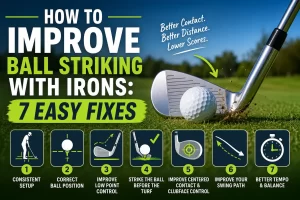
Few things in golf are more frustrating than hitting one iron shot perfectly and then watching the next one come off the clubface fat, thin, or off the toe. One swing produces that crisp sound and powerful flight every golfer wants, while the next leaves you wondering what changed. When this happens repeatedly, it’s easy to assume your entire golf swing needs to be rebuilt.
Fortunately, learning how to improve ball striking with irons doesn’t have to involve complicated swing changes. In many cases, inconsistent contact comes from a handful of fundamentals that can be identified, practiced, and corrected. Improving your setup, controlling where the club reaches the bottom of its swing, and developing more centered contact can make a noticeable difference in the quality and consistency of your iron shots.
If you want to improve iron ball striking, the goal isn’t simply to swing harder. You need to create conditions that allow you to strike the ball cleanly, control the clubface, and produce better ball compression without sacrificing accuracy.
In this guide, we’ll break down seven easy fixes covering consistent setup, ball position, low point control, ball-first contact, clubface control, swing path, and golf swing tempo and balance. Whether you’re an experienced player struggling with inconsistency or you’re learning how to make solid contact with irons, these fundamentals can help you build a more dependable iron game.
How to Strike a Golf Ball Consistently: 9 Proven Ways
Why Consistent Iron Ball Striking Is So Difficult
Iron shots can be challenging because the impact conditions are different from those of a driver. With an iron, you generally want the clubhead to contact the golf ball before reaching the lowest point of the swing arc. The club continues downward through impact, with the bottom of the swing occurring slightly ahead of where the ball was positioned. This creates the ball-first, turf-second contact associated with solid iron striking.
The problem is that relatively small changes can disrupt this sequence. Changing your posture, ball position, weight distribution, or distance from the ball can move the bottom of your swing arc. If the club reaches the ground too early, you may hit a fat iron shot, losing distance and speed before the clubface reaches the ball. If the club bottoms out too early but misses the turf, you may compensate by raising the club and produce a thin shot.
Contact location on the clubface matters as well. Heel and toe strikes reduce the quality of contact and can cause noticeable changes in distance and direction. That’s why centered contact is one of the most important iron ball striking tips to work on. The more consistently you find the center of the face, the easier it becomes to predict how far your irons will travel.
Another common mistake is trying to scoop the golf ball into the air. Your irons already have loft designed to launch the ball. Attempting to lift the ball can interfere with low point control, add unnecessary hand action, and make solid contact much more difficult.
What Good Iron Ball Striking Should Feel Like
A well-struck iron shot should feel solid and controlled rather than forced. The clubface meets the ball first, followed by controlled turf interaction, while a stable clubface and predictable swing path help send the shot toward the intended target.
Good iron ball striking also produces a more predictable launch and repeatable distance. Instead of wondering whether your 7-iron will travel 120 yards or 150 yards because of inconsistent contact, you begin developing reliable distance patterns.
If you’ve been searching for how to hit irons consistently every time, don’t start by trying to perfect every part of your golf swing at once. Start with the fundamentals that have the greatest influence on impact. The following seven fixes will help you build those fundamentals one at a time and develop cleaner, more consistent iron contact.
Fix #1: Build a Consistent Iron Setup
Before making major changes to your golf swing, take a close look at your setup. Many golfers searching for how to improve ball striking with irons immediately start changing their backswing, downswing, or wrist positions when the real problem begins before the club ever moves. A consistent address position gives your swing a reliable starting point and makes it much easier to produce repeatable contact.
Start with an athletic posture. Your knees should have a comfortable amount of flex rather than being locked straight or excessively bent. Tilt forward from the hips while maintaining a natural spine angle. You should feel balanced and ready to move without tension.
Stance width is another important part of your setup. For most standard iron shots, your feet should be roughly shoulder-width apart, although the exact width can change slightly depending on the club. Your weight should feel balanced between your feet at address rather than excessively favoring your heels or toes.
Pay close attention to your distance from the golf ball. Standing too close can restrict your arms and encourage heel contact, while standing too far away can force you to reach and contribute to toe strikes. When your distance changes from swing to swing, the club travels through a slightly different area at impact, making centered contact much harder to repeat.
Grip pressure matters as well. Hold the club securely without squeezing it excessively. Too much tension in your hands and forearms can interfere with your golf swing tempo and make natural clubface rotation more difficult.
Finally, check your alignment. Your feet, hips, and shoulders should work together relative to your intended target line. Developing a simple pre-shot routine that checks your target, alignment, posture, and ball position can help you recreate the same starting position before every iron shot.
Why Setup Is Especially Important for Beginners
If you’re learning how to improve ball striking with irons for beginners, developing a repeatable setup should be one of your first priorities. Beginners often make the mistake of changing swing mechanics after every poor shot. One fat shot leads to a different ball position, a thin shot leads to a posture adjustment, and a shot off the toe leads to another swing change.
That constant experimentation makes it difficult to determine what is actually causing the problem.
Instead, build one dependable setup and practice repeating it. Use alignment sticks during practice to check your feet and target line, and periodically record your setup from behind and face-on to check your posture and distance from the ball.
A consistent setup won’t guarantee a perfect shot every time, but it removes unnecessary variables. Once your starting position becomes repeatable, improving low point control, clubface control, swing path, and ball compression becomes much easier. It’s one of the simplest but most important iron ball striking tips for golfers who want cleaner contact and more predictable results.
Fix #2: Correct Your Ball Position
Ball position may seem like a small setup detail, but it can have a major influence on the quality of your iron contact. If you’re learning how to improve ball striking with irons, checking where you position the ball should be one of your first priorities. Even a good golf swing can produce inconsistent results when the ball moves too far forward or backward from one shot to the next.
For most golfers, short irons are played near the middle of the stance or slightly forward of center. As you move into your mid-irons, the ball can gradually move a little farther forward. With long irons, it will generally sit farther forward than it does with a wedge or short iron. These are starting points rather than rigid measurements because stance width, swing characteristics, and the type of shot you’re playing can influence the ideal position.
Problems develop when these positions become inconsistent. If the ball moves too far forward, the club may reach the bottom of its swing before making contact. This can contribute to fat shots, thin shots, pulls, and other inconsistent strikes. It can also make effective low point control more difficult.
Moving the ball too far back creates a different set of problems. It can encourage a lower trajectory, change the clubface and loft delivered at impact, and potentially produce an excessively steep strike. Depending on your clubface control and swing path, incorrect ball position can also contribute to pushes and pulls.
The goal isn’t to find a magical ball position that guarantees perfect shots. It’s to develop a predictable starting point that makes centered contact and ball-first impact easier to repeat.
Simple Ball Position Check
One of the easiest iron ball striking tips is to use two alignment sticks on the practice range.
Place the first stick on the ground parallel to your target line. Place a second stick perpendicular to it, pointing toward the ball. This second stick gives you a clear visual reference for where the ball sits relative to your stance.
Hit several shots without changing that reference point. Pay attention to contact, trajectory, and where the club interacts with the turf. You can perform the same drill by laying spare clubs on the ground if alignment sticks aren’t available.
This drill is particularly useful when learning how to improve ball striking with irons for beginners because it removes guesswork from the setup.
Most importantly, don’t move the ball after every poor shot. One bad strike doesn’t necessarily mean your ball position was wrong. Look for patterns across several shots.
When your ball position becomes repeatable, you give yourself a better opportunity to develop consistent ball compression, control the bottom of the swing arc, and learn how to make solid contact with irons. Combine that consistency with good posture and alignment, and you’ve created a much stronger foundation for improving your iron ball striking.
Fix #3: Improve Your Low Point Control
If there is one skill that can dramatically improve iron ball striking, it’s learning to control where your club reaches the bottom of its swing. This is known as low point control, and it’s one of the most important fundamentals for golfers learning how to improve ball striking with irons.
In simple terms, the low point is the lowest part of the clubhead’s swing arc. On a normal iron shot, you want the club to contact the golf ball while it is still moving downward, with the bottom of the swing occurring slightly on the target side of the ball. This creates the familiar ball-first, turf-second contact associated with crisp iron shots.
When the low point moves behind the ball, problems begin. If the club reaches the ground before the ball, you hit a fat shot. The turf absorbs energy before the clubface reaches the ball, resulting in weak, unpredictable shots.
Some golfers instinctively compensate for this by pulling their body upward or trying to lift the club through impact. Instead of hitting the ground, they may catch the middle or bottom of the golf ball and produce a thin shot. This is why alternating between fat and thin shots can sometimes be connected to the same underlying problem: inconsistent low point control.
Pressure movement also influences where the swing bottoms out. During the downswing, pressure should move toward the lead side as the body continues rotating. Golfers who hang back excessively can struggle to move their low point forward consistently.
Avoid trying to deliberately lift the golf ball. Your iron already has loft. Your job is to deliver the club consistently and allow that loft to launch the shot.
Try the Line Drill for Better Low Point Control
The line drill is one of the simplest iron ball striking tips for developing better contact.
Draw a straight line on the turf or use a visible reference line on a practice mat. Imagine that the line represents your ball position. Set up normally and make several practice swings without a ball.
Your goal is to have the club contact the ground on the target side of the line, not behind it.
Make several swings and inspect the strike marks. Once you can repeatedly contact the target side of the line, place a golf ball directly on the line and repeat the same motion.
Start with controlled half or three-quarter swings rather than trying to generate maximum speed. This is especially helpful for golfers learning how to improve ball striking with irons for beginners because it provides immediate feedback without requiring complicated swing thoughts.
If you’ve been wondering how to make solid contact with irons, improving where your swing bottoms out is an excellent place to start. Better low point control creates the conditions for ball-first contact, improved ball compression, and more predictable iron shots.
How Golfers Are Mastering Their Golf Swing In Less Than 7 Days Without Spending Thousands On Golf Lessons https://ultimategolfmasterypro.com/the-golf-swing-lab-2/
Fix #4: Learn to Strike the Ball Before the Turf
One of the biggest differences between inconsistent and reliable iron striking is the order in which the club contacts the ball and ground. With a normal iron shot, you want the clubface to contact the golf ball first and then interact with the turf.
Many golfers do the opposite because they instinctively try to help the ball into the air. They see the ball sitting on the ground and feel as though they need to scoop underneath it. But your iron’s loft is already designed to launch the golf ball. Trying to lift it can cause the club to bottom out too early and produce fat, thin, or inconsistent contact.
Instead, focus on creating a controlled descending strike. As you move through the downswing, pressure should continue moving toward your lead side while your body rotates through the shot. Maintain your posture rather than standing up through impact, and allow your hands and clubhead to continue naturally toward the target.
Your divot can provide useful feedback. On a well-struck iron shot from turf, the divot will generally begin around the ball’s original location and extend toward the target. A divot that consistently starts well behind the ball can indicate that your low point is occurring too early.
However, don’t turn taking a divot into the objective. You don’t need to aggressively drive the club into the ground. The goal is ball-first contact and controlled turf interaction.
How Ball-First Contact Improves Compression
Better ball-first contact also helps create improved ball compression. You don’t need to make this concept overly technical. Compression simply describes the interaction between the clubface and golf ball during a solid strike under good impact conditions.
When you combine centered contact with a stable clubface and proper low point, your iron shots can produce a stronger flight, more predictable distance, improved feel, better directional control, and greater overall consistency.
This doesn’t mean you should force your hands dramatically ahead of the golf ball or try to hit steeply downward. Excessive shaft lean or an overly steep angle of attack can create an entirely different set of problems.
Instead, allow good impact conditions to develop from proper setup, pressure movement, posture, clubface control, and continued rotation through the shot.
For golfers trying to learn how to hit irons consistently every time, the goal should be repeatability rather than exaggeration. Combine a predictable low point with ball-first contact, and you’ll have two of the most important pieces needed to produce cleaner, more powerful, and more consistent iron shots.
Fix #5: Improve Centered Contact and Clubface Control
You don’t necessarily need more swing speed to hit better iron shots. One of the fastest ways to improve iron ball striking is to become more consistent at finding the center of the clubface. A centered strike allows the club to transfer energy to the golf ball more efficiently, helping produce better distance, feel, and consistency without requiring you to swing harder.
If you’re learning how to improve ball striking with irons, start paying attention to where the ball actually contacts the clubface. Different strike locations can produce noticeably different results.
A toe strike occurs toward the outer portion of the clubface and can reduce ball speed and distance. A heel strike occurs closer to the hosel and can also produce poor distance and directional control. Contact too high on the face can change launch and reduce the quality of the strike, while contact too low on the face often feels thin and can produce a lower, less predictable ball flight.
The goal is centered contact. When you repeatedly strike the ball near the center of the clubface, you’ll generally produce more efficient energy transfer and more predictable carry distances. That means you can focus less on generating additional speed and more on creating a repeatable strike.
However, strike location is only part of the equation. Clubface control also plays a major role in where your iron shots travel. The direction the clubface is pointing at impact strongly influences the golf ball’s initial starting direction. Your clubface and swing path then work together to influence the ball’s overall flight.
This is why improving contact and clubface control together can make such a significant difference when you’re trying to learn how to hit irons consistently every time.
Use Face Spray to Find Your Strike Pattern
A simple range drill can tell you more about your iron contact than guessing based on how the shot felt.
Apply a light coating of golf impact spray to the clubface according to the product instructions. You can also use another club-safe impact marking method designed to reveal contact location. Hit five to ten shots using your normal swing, then inspect the pattern left on the face.
Don’t judge your entire golf swing from one shot. Instead, look for a pattern.
Are most strikes toward the toe? Are you consistently contacting the heel? Is your strike moving all over the clubface? Or are most shots clustered near the center?
Once you identify the pattern, you can make small adjustments to your setup, posture, distance from the ball, and balance rather than randomly changing your swing.
For golfers wondering how to make solid contact with irons, this kind of immediate feedback is extremely valuable. Combine a consistent setup with good low point control, centered contact, and a stable clubface, and you’ll create better conditions for ball compression, predictable distance, and more accurate iron shots.
Sometimes the best iron ball striking tips aren’t about swinging faster—they’re about making the speed you already have more effective.
Best Golf Training Program For Beginners: Why Most Golfers Never Improve
Fix #6: Improve Your Swing Path Without Overcomplicating It
If you’re learning how to improve ball striking with irons, understanding swing path can help you develop more predictable contact without getting lost in complicated golf swing mechanics. In simple terms, swing path describes the direction the clubhead is traveling as it moves through the impact area.
Your swing path doesn’t need to be perfectly straight to hit good iron shots. In fact, because the golf swing moves around the body on an inclined arc, trying to force the club straight down the target line can create unnecessary tension and manipulation.
Problems can occur when the path becomes excessive. A club traveling dramatically from outside to inside can contribute to pulls, slices, and inconsistent strikes. An excessively inside-to-out path can create pushes, hooks, and contact problems of its own. These tendencies become even more noticeable when combined with inconsistent clubface control.
Instead of chasing a perfectly straight path, work toward a more neutral and predictable delivery.
Body rotation plays an important role. Your arms and body should work together rather than competing with each other. If your body stops rotating and your hands attempt to rescue the swing through impact, controlling both path and clubface becomes more difficult. Likewise, excessive body movement without properly synchronized arms can make it difficult to return the club to the ball consistently.
The goal is coordination. Allow your body to continue rotating while your arms and club move naturally through the hitting area. Avoid consciously forcing the club into a particular position during the downswing.
Remember that swing path and face angle work together. A predictable path combined with a stable clubface gives you a much better opportunity to produce centered contact, predictable starting direction, and consistent ball flight.
Simple Swing Path Drill
One of the easiest iron ball striking tips for improving path is to create a visual guide on the practice range.
Place an alignment stick on the ground parallel to your target line. Then place a headcover several inches outside and slightly behind the golf ball. Make controlled half or three-quarter swings while avoiding the headcover.
If your club travels excessively from outside to inside, you may strike the headcover. Move slowly at first and focus on allowing your arms and body to work together.
The objective isn’t to force the club onto an artificially perfect path. You’re simply creating feedback that encourages a more predictable delivery.
Combine that improved path with good low point control and clubface awareness, and you’ll have another important piece of learning how to make solid contact with irons consistently.
Fix #7: Use Better Golf Swing Tempo and Balance
Trying to hit your irons harder doesn’t always mean you’ll hit them farther. In fact, swinging at maximum effort can destroy many of the fundamentals you’ve worked to improve. If you want to understand how to improve ball striking with irons, learning to control your golf swing tempo and maintain balance can be just as important as improving your swing mechanics.
Good tempo begins with a smooth takeaway. You don’t need to move the club away from the ball unusually slowly, but you should avoid snatching it back with excessive tension. A controlled backswing gives your body, arms, and club an opportunity to remain synchronized.
The transition from backswing to downswing is particularly important. Many golfers rush from the top because they want to generate more speed. This can disrupt sequencing, alter the swing path, and make clubface control more difficult.
Instead, allow speed to develop progressively through the downswing.
Balance provides another useful indicator of swing quality. After hitting an iron shot, you should generally be able to finish under control with your pressure primarily on your lead side. If you’re stumbling backward, falling toward the ball, or stepping out of your finish, there’s a good chance you’re swinging with more effort than you can consistently control.
Reducing unnecessary tension can help as well. Excessively tight hands, arms, and shoulders can interfere with rhythm and make it harder to produce centered contact.
The 80% Iron Swing Drill
The 80% drill is a simple way to discover how much speed you actually need to hit quality iron shots.
Choose a mid-iron and hit five to ten balls at approximately 80% of your normal maximum effort. Don’t focus on distance initially. Instead, evaluate five things: center contact, balance, rhythm, starting direction, and distance consistency.
Can you repeatedly find the center of the clubface? Can you hold your finish? Are your shots starting in a similar direction? Are your carry distances becoming more predictable?
Once you can produce consistent strikes at 80%, gradually add speed while maintaining the same quality of contact and balance. If your strike pattern deteriorates, reduce the effort again.
For golfers trying to learn how to hit irons consistently every time, this drill reinforces an important lesson: controlled speed usually beats uncontrolled effort.
When smooth golf swing tempo, balance, centered contact, ball compression, clubface control, and low point control begin working together, your iron swing becomes much more repeatable—and that’s ultimately the foundation of consistently solid ball striking.
Common Iron Ball Striking Mistakes to Avoid
Knowing how to improve ball striking with irons isn’t only about learning what to do correctly. It’s also about eliminating habits that make solid contact more difficult. Many golfers unknowingly create additional inconsistency by changing their technique after every poor shot or trying to force the golf ball to behave.
If you’re working to improve iron ball striking, watch for these common mistakes during your next practice session.
Trying to Scoop the Ball Into the Air
One of the biggest mistakes is attempting to lift the golf ball off the ground. Your iron already has loft built into the clubface to produce the necessary launch.
Trying to scoop the ball can cause your weight to remain on the trail side and move the bottom of your swing behind the ball. That makes proper low point control much harder and can lead to fat and thin shots.
Instead, trust the club’s loft. Focus on making ball-first contact and continuing your rotation through the shot. Better impact conditions will help produce the launch and ball compression you’re looking for.
Swinging Too Hard
More effort doesn’t automatically produce better iron shots. When golfers swing excessively hard, they often lose balance, rush their golf swing tempo, and make it harder to control the clubface.
Prioritize centered contact over maximum speed. A controlled strike from the center of the clubface can produce more predictable distance than a harder swing that catches the heel or toe.
Moving the Ball Position After Every Bad Shot
Don’t assume every poor shot means your ball position needs to change.
Constantly moving the ball forward and backward introduces another variable into your swing. Instead, establish a consistent ball position for each type of iron and evaluate several shots before making an adjustment.
This is especially valuable when learning how to improve ball striking with irons for beginners, because a repeatable setup makes it easier to identify the actual cause of poor contact.
Practicing Without Checking Contact
You can’t efficiently improve something you’re not measuring. During practice, pay attention to both clubface contact and where the club strikes the turf.
Impact spray can reveal whether you’re consistently striking the heel, toe, or center of the face. When practicing from grass, your turf interaction can provide additional feedback about whether your low point is occurring before or after the ball.
These simple checks can help you understand how to make solid contact with irons rather than relying entirely on feel.
Making Too Many Swing Changes at Once
Finally, avoid trying to fix everything during one range session.
Changing your grip, posture, ball position, swing path, clubface position, and tempo simultaneously makes it nearly impossible to determine which adjustment actually helped.
Choose one variable and work on it for a group of shots. Once that movement becomes more comfortable and repeatable, move to the next priority.
Some of the most effective iron ball striking tips are surprisingly simple: establish a consistent setup, gather feedback, make one adjustment at a time, and give each change enough practice before deciding whether it works.
How to Practice for Better Iron Ball Striking
Knowing how to improve ball striking with irons is only useful if you turn those fundamentals into repeatable habits. Instead of hitting an entire bucket of balls as quickly as possible, organize your practice around specific skills. A simple 50-ball routine can help you improve iron ball striking while giving you useful feedback after every group of shots.
10 Shots — Setup and Ball Position
Use your first 10 shots to focus exclusively on your address position. Check your posture, stance width, alignment, distance from the ball, and ball position before every swing.
Don’t worry about hitting perfect shots. Your goal is to recreate the same setup 10 times. A consistent starting position removes variables and makes it easier to diagnose problems later.
10 Shots — Low Point Control
For the next 10 balls, concentrate on low point control and ball-first contact. Pay attention to where the club interacts with the ground.
If you’re practicing on grass, look for turf contact beginning around the ball and continuing toward the target. The goal isn’t to take a huge divot. You’re training the club to reach the bottom of its swing after contacting the ball.
10 Shots — Centered Contact
Now shift your attention to centered contact. Apply golf impact spray to your clubface or use another club-safe method for identifying strike location.
Hit 10 shots and examine the pattern. Are you consistently finding the toe, heel, or center? Look at the entire group rather than judging your technique from one poor strike.
10 Shots — Tempo
Use the next 10 shots to work on golf swing tempo. Make controlled swings at roughly 70–80% effort.
Focus on a smooth takeaway, controlled transition, good balance, and a stable finish. Don’t chase maximum distance. Quality of contact is the priority.
10 Shots — Target Practice
Finish by combining everything you’ve practiced.
Choose a realistic target and go through your normal pre-shot routine before each ball. Change targets occasionally so the practice feels more like playing on the course. Monitor your starting direction, clubface control, swing path, strike quality, and distance.
This final stage helps transfer your technical practice into actual golf shots.
Structured practice is one of the most valuable iron ball striking tips because every shot has a purpose. Rapidly hitting 50 balls without checking setup, contact, or results can simply reinforce existing mistakes.
If you’re trying to learn how to hit irons consistently every time, practice with feedback instead of simply accumulating swings. Fifty deliberate shots focused on setup, low point, contact, tempo, and targets can be far more productive than a much larger bucket hit without a plan.
How to Improve Ball Striking With Irons for Beginners
If you’re learning how to improve ball striking with irons for beginners, one of the best things you can do is keep the process simple. You don’t need to understand every technical detail of the golf swing before you can start making cleaner, more consistent contact. Your first goal should be developing a repeatable strike.
Start with a short or mid-iron rather than a long iron. Clubs such as a 7-, 8-, or 9-iron are generally easier to control and allow you to focus on contact instead of maximum distance. Begin with half swings and gradually increase the length of your swing as your consistency improves.
Controlled speed is equally important. Beginners often assume they need to swing hard to produce good shots, but excessive effort can make centered contact, balance, and golf swing tempo more difficult to control. Start at a comfortable speed that allows you to finish in balance.
Next, develop a consistent setup. Use the same basic posture, alignment, ball position, and distance from the ball before each shot. From there, concentrate on producing ball-first contact and improving low point control. Your goal is to strike the golf ball before the club reaches the bottom of its swing arc.
Don’t become overwhelmed by complicated discussions about wrist angles, shaft positions, or advanced swing mechanics. Those concepts may become useful later, but they aren’t necessary when you’re first learning how to make solid contact with irons.
Instead, monitor where the ball contacts the clubface. Developing centered contact will help produce better energy transfer, more predictable distance, and improved ball compression.
As your strike becomes more reliable, gradually increase your swing length and speed. This approach gives you a foundation you can build upon instead of constantly changing your technique.
When it comes to beginner iron ball striking tips, consistency should come before power. Learn to strike the ball predictably first. Distance becomes much easier to develop once solid contact becomes a habit.
Conclusion: Start Striking Your Irons More Consistently
Learning how to improve ball striking with irons doesn’t require rebuilding your entire golf swing. More often, better iron contact comes from improving a few important fundamentals and practicing them consistently.
Start with a consistent setup so every swing begins from a reliable position. Establish the correct ball position, then improve your low point control so you can produce ball-before-turf contact. From there, work toward centered contact and clubface control, develop a more predictable swing path, and use smooth golf swing tempo and balance instead of trying to overpower every shot.
Most importantly, don’t try to fix all seven areas at the same time.
Identify the biggest weakness in your current iron game. If you’re hitting shots fat, start with low point control. If you’re finding the heel or toe repeatedly, concentrate on centered contact. If your strike disappears whenever you swing harder, spend time improving tempo and balance.
Practice that one skill until you begin seeing a more predictable pattern, then move to the next area.
You probably won’t learn how to hit irons consistently every time overnight, and even great golfers occasionally mishit shots. The real goal is to make your good strikes more frequent and your misses more manageable.
Build these seven fundamentals one at a time, practice them with purpose, and you’ll be on your way to cleaner contact, better ball compression, more predictable distances, and greater confidence every time you pull an iron from the bag.
Titleist Tips: Consistent Ball Striking Leads to More Consistent Golf
Frequently Asked Questions About How to Improve Ball Striking With Irons
How can I improve my ball striking with irons?
If you want to learn how to improve ball striking with irons, start by developing a consistent setup and ball position. From there, work on low point control so the club contacts the ball before reaching the bottom of the swing arc. Improving centered contact, clubface control, and swing path can make your shots more predictable. Finally, use a smooth golf swing tempo rather than trying to generate maximum speed on every shot. Practicing these fundamentals individually can help you develop a more repeatable iron swing.
Why is my iron ball striking so inconsistent?
Inconsistent iron contact can come from several areas, including changing your setup from shot to shot, poor low point control, off-center strikes, excessive tension, poor balance, or inconsistent tempo. Start by identifying your typical miss. If you alternate between fat and thin shots, check where your club reaches the bottom of its swing. If you frequently hit the heel or toe, use impact spray to identify your strike pattern. Improving one problem at a time is usually more productive than constantly changing your entire swing.
How do you make solid contact with irons?
Learning how to make solid contact with irons begins with creating ball-first contact. On a standard iron shot, the club should generally contact the golf ball before reaching the lowest point of the swing. Combine a predictable low point with a centered strike, stable posture, and continued body rotation through impact. Avoid trying to scoop the ball into the air. Trust the loft of the iron to produce the launch.
How do I hit my irons consistently every time?
If you’re wondering how to hit irons consistently every time, focus on repeatability rather than trying to create a perfect swing. Establish the same setup and ball position, use controlled tempo, maintain balance, and prioritize centered contact. Structured practice can also help. Divide your range sessions into specific areas such as setup, low point, contact, tempo, and target practice instead of hitting ball after ball without feedback.
How can beginners improve ball striking with irons?
When learning how to improve ball striking with irons for beginners, start with a short or mid-iron and make controlled half or three-quarter swings. Focus on basic posture, ball position, balance, ball-first contact, and finding the center of the clubface. Don’t worry about generating maximum speed or mastering complicated swing positions. Once your contact becomes more predictable, gradually increase the length and speed of your swing.
Why do I keep hitting my irons fat?
Fat iron shots usually occur when the club contacts the ground before the golf ball. This means the low point of the swing is occurring too early. Possible causes include hanging back on the trail side, inconsistent ball position, changing posture during the swing, or trying to scoop the ball upward. Work on moving pressure toward the lead side and practice the line drill to develop better low point control.
How do I compress my irons better?
Better ball compression starts with creating solid impact conditions rather than trying to aggressively hit down on the golf ball. Focus on ball-first contact, a controlled low point, pressure moving toward the lead side, centered contact, and continued rotation through impact. You don’t need excessive forward shaft lean or an extremely steep downswing. A repeatable strike with good clubface control can produce stronger flight, better feel, and more predictable distance.