
9 Powerful Tips on How to Fix a Golf Slice Fast
Golf Slice Drills That Actually Work

Introduction
If you’ve ever watched a golf shot start straight and then curve dramatically to the right, you’re not alone. Learning how to fix a golf slice fast is one of the most common goals among amateur golfers because slicing remains the number one ball-flight problem in the game. Whether you’re a beginner or an experienced player, a slice can quickly turn a promising round into a frustrating experience.
A golf slice occurs when the ball curves excessively from left to right for a right-handed golfer. While many golfers assume the problem is caused by one specific swing flaw, the reality is that several factors can contribute to a slice. Poor golf grip fundamentals, an open clubface at impact, an incorrect golf swing path, or an over the top swing can all cause the ball to curve away from the target. The challenge is that many golfers attempt to fix the symptom rather than addressing the root cause.
The effects of a slice go far beyond simply missing fairways. A slice often robs golfers of valuable distance because sidespin reduces the efficiency of the strike. Instead of producing a powerful, penetrating ball flight, sliced shots tend to fly higher and shorter than intended. Accuracy also suffers because the ball consistently moves away from the target line. Over time, repeated slices can damage a golfer’s confidence, causing tension, hesitation, and additional swing mistakes.
The good news is that most golfers can fix a golf slice without completely rebuilding their swing. In many cases, a few simple adjustments to grip, setup, alignment, and clubface position can produce noticeable improvements in a short period of time. If you’re searching for the best way to fix a golf slice fast, you’ll be happy to know that the solutions are often much simpler than most players expect.
In this guide, you’ll learn nine powerful tips designed to help you fix slice in golf swing mechanics and hit straighter shots more consistently. We’ll cover everything from improving clubface control and developing an inside out swing path to correcting common driver mistakes for golfers wondering how to fix a driver slice fast. These techniques are also ideal for players searching for how to fix a golf slice fast for beginners, as they focus on the fundamental causes of the problem.
Before diving into the solutions, it’s helpful to understand a basic concept known as ball flight laws. Modern ball flight research shows that the clubface has the biggest influence on where the ball starts, while the swing path largely determines how the ball curves. For a right-handed golfer, a slice typically occurs when the clubface is open relative to the swing path at impact. This creates sidespin that causes the ball to curve to the right. Once you understand this relationship, it becomes much easier to identify the changes needed to hit straighter, more accurate golf shots.
The good news is that a slice is not a permanent problem. With the right knowledge and practice, you can begin making meaningful improvements and start hitting more fairways sooner than you might think.
What Causes a Golf Slice?
Understanding the true cause of a slice is the first step toward learning how to fix a golf slice fast. Many golfers assume a slice is caused by a single swing flaw, but the reality is that several factors often work together to produce that frustrating left-to-right curve. By understanding what happens at impact and identifying the most common mistakes, you can begin making adjustments that lead to straighter, more consistent golf shots.
Understanding Ball Flight Laws
Modern golf instruction relies heavily on ball flight laws, which explain why the golf ball behaves the way it does after impact. If you’re trying to fix a golf slice, understanding these laws can save you countless hours of frustration.
The two biggest factors that influence ball flight are the clubface angle and the golf swing path. The clubface primarily determines where the ball starts, while the swing path plays a major role in how the ball curves. For a right-handed golfer, a slice usually occurs when the clubface is open relative to the swing path at impact.
For example, imagine your clubface is pointing slightly right of the target while your swing path is moving even farther left. This combination creates a glancing blow that generates sidespin, causing the ball to curve dramatically to the right. The greater the difference between the clubface angle and swing path, the larger the slice becomes.
An open clubface is often the biggest culprit when golfers try to fix slice in golf swing mechanics. Even if your swing path improves, an open face can still send the ball curving away from the target. This is why clubface control is such an important skill for golfers who want straighter shots.
The curvature itself is created by the spin axis of the golf ball. When the ball spins with a tilted axis, it produces side movement during flight. A slice creates a spin axis tilted to the right, resulting in the familiar banana-shaped ball flight that most golfers dread. Once you understand this relationship between clubface angle, swing path, and spin, it becomes much easier to identify the adjustments needed to correct the problem.
The Most Common Slice Mistakes
Several swing faults consistently appear among golfers searching for the best way to fix a golf slice fast.
One of the most common mistakes is the over the top swing. This occurs when the club moves outside the target line during the downswing and cuts across the golf ball. An over-the-top move almost always creates an out-to-in swing path, which is a major cause of slicing.
A weak grip is another frequent issue. When the hands are positioned poorly on the club, it becomes difficult to square the clubface at impact. This often leaves the face open and increases slice spin.
Poor alignment can also contribute to slicing. Many golfers unknowingly aim left of the target and then make compensations during the swing that worsen their slice pattern. Proper setup is critical for creating an effective inside out swing path.
Improper weight transfer is another common problem. Golfers who remain on their back foot or shift incorrectly during the downswing often struggle to deliver the club from the proper angle. This can lead to inconsistent contact and increased curvature.
Finally, many golfers simply lack consistent clubface control. If the clubface remains open through impact, even a relatively good swing path can still produce a slice. This is why many golfers searching for how to fix a driver slice fast often discover that improving face control provides the quickest results.
The good news is that every one of these mistakes can be corrected. In the following tips, you’ll learn practical ways to improve your grip, setup, swing path, and impact position so you can start hitting straighter shots and learn how to fix a golf slice fast for beginners and experienced players alike.
9 Simple Steps to Master the Best Way to Fix a Slice in Golf
Tip #1: Strengthen Your Golf Grip for Better Clubface Control
One of the fastest ways to learn how to fix a golf slice fast is to improve your grip. Many golfers spend countless hours working on swing mechanics when the real problem starts with how they hold the club. Your grip directly influences the position of the clubface throughout the swing and plays a critical role in determining whether the face arrives square, open, or closed at impact.
A weak grip is one of the most common reasons golfers struggle to fix a golf slice. In a weak grip position, the hands are rotated too far toward the target, making it difficult to square the clubface through impact. As a result, the face often remains open, producing the slice spin that sends the ball curving to the right.
There are several signs that your grip may be too weak. If your shots consistently start left and curve sharply right, or if you struggle with clubface control, your grip could be contributing to the problem. Another common sign is seeing very few knuckles on your lead hand when looking down at address.
To build a stronger grip, start by placing your lead hand on the club so that two to three knuckles are visible when you look down. Then position your trail hand so it fits comfortably underneath the lead hand. This stronger position helps the clubface rotate more naturally through impact and can dramatically reduce slice spin.
Before every shot, use a few simple grip checkpoints:
- Check that two to three knuckles are visible on your lead hand.
- Ensure the “V” formed by your thumb and index finger points toward your trail shoulder.
- Maintain light grip pressure to promote better wrist movement.
- Confirm both hands work together as a unit.
While strengthening your grip can be highly effective, avoid overdoing it. Some golfers rotate their hands excessively, creating hooks instead of slices. Others grip the club too tightly, reducing feel and limiting natural clubface rotation.
For golfers searching for the best way to fix a golf slice fast, improving golf grip fundamentals often provides immediate results. Combined with better clubface control, a stronger grip can help square the face at impact and reduce the excessive curve that causes slices. If you’re wondering how to fix a golf slice fast for beginners, this is one of the easiest and most effective adjustments to make.
Many golfers spend months trying to learn how to fix a golf slice fast, but they keep making the same hidden mistakes without realizing it. The frustrating part is that a slice is often caused by just one or two swing flaws that most golfers never identify on their own. If you’re tired of guessing, discover the hidden slice mistakes inside The Golf Swing Lab https://ultimategolfmasterypro.com/the-golf-swing-lab-2/
Tip #2: Fix Your Setup and Alignment
Another powerful solution for golfers learning how to fix a golf slice fast is improving their setup and alignment. Even golfers with solid swing mechanics can struggle if they begin from a poor address position. Proper alignment helps create a more efficient swing motion and reduces the compensations that often lead to slicing.
Many golfers unknowingly aim left of the target. When this happens, the body instinctively makes adjustments during the swing to send the ball back toward the intended target. These compensations frequently produce an outside-to-inside golf swing path, which is one of the primary causes of a slice.
To improve alignment, start by positioning your feet parallel to the target line. Then ensure your hips and shoulders are aligned in the same direction. A common mistake is aligning the feet correctly while the shoulders remain open to the target. Open shoulders often encourage an over the top swing, making it difficult to produce an inside out swing path.
One of the best training aids for alignment is a pair of alignment sticks. Place one stick on the ground pointing directly at your target and position a second stick parallel to it along your toe line. This simple setup provides immediate feedback and helps train proper body alignment during practice sessions.
Before every swing, use these setup checkpoints:
- Feet aligned parallel to the target line.
- Hips square to the target.
- Shoulders square to the target.
- Ball positioned correctly for the club being used.
- Weight balanced evenly between both feet.
Proper alignment offers several benefits beyond helping you fix slice in golf swing mechanics. It promotes a more consistent swing path, improves contact quality, and makes it easier to return the clubface square at impact. Many golfers who struggle with how to fix a driver slice fast discover that correcting their setup instantly improves both accuracy and ball flight.
When combined with a stronger grip, proper alignment creates a solid foundation for every swing. It allows you to make more natural movements, improve ball flight laws outcomes, and develop the consistency needed to hit straighter shots. For golfers looking for the best way to fix a golf slice fast, mastering setup and alignment is a crucial step toward lasting improvement.
Tip #3: Stop Swinging Over the Top
If you’re searching for how to fix a golf slice fast, one of the most important swing flaws to address is the dreaded over the top swing. This move is responsible for countless slices among amateur golfers and often works hand-in-hand with an open clubface to create excessive left-to-right ball flight.
An over-the-top swing occurs when the club moves outside the target line during the transition from backswing to downswing. Instead of dropping into a natural slot behind the body, the club approaches the ball from above and outside the target line. This creates an out-to-in golf swing path, which is a major contributor to slicing.
You can often recognize an over-the-top move by observing your divots or ball flight. Divots that point left of the target and shots that start left before curving right are classic signs. Golfers who struggle to fix a golf slice frequently discover that this swing pattern is one of their biggest issues.
The reason an over-the-top move creates a slice comes down to ball flight laws. When the club swings across the ball from outside to inside while the clubface remains open relative to the path, the ball develops slice spin and curves dramatically to the right.
Fortunately, there are several simple drills that can help shallow the downswing. One effective drill is the “headcover drill.” Place a headcover just outside the target line and slightly behind the ball. If your club approaches from outside, you’ll hit the headcover. This encourages a more efficient path from the inside.
Another useful drill is the “pump drill.” During practice swings, pause at the top of your backswing and slowly rehearse dropping the club into a shallower position before swinging through. This helps train the proper downswing sequence.
Improving your transition is equally important. Many golfers start the downswing with their shoulders, which forces the club outside the target line. Instead, focus on initiating the downswing with your lower body while allowing your arms and club to follow naturally.
Learning to create an inside out swing path is one of the most effective ways to reduce slicing. As the club approaches the ball from inside the target line, it becomes much easier to square the clubface and hit straighter shots. For golfers wondering how to fix a driver slice fast, eliminating the over-the-top move often produces some of the quickest improvements.
Tip #4: Learn the Inside Out Swing Path
Developing an inside out swing path is one of the most powerful techniques for golfers who want to learn how to fix a golf slice fast. Once you understand how this swing path works, you’ll have a much easier time controlling ball flight and producing straighter shots.
An inside-out swing path simply means the club approaches the golf ball from slightly inside the target line and continues moving outward after impact. This is the opposite of the outside-to-inside path commonly seen in golfers who struggle to fix slice in golf swing mechanics.
Why does this matter? According to modern ball flight laws, swing path has a significant influence on ball curvature. When combined with proper clubface control, an inside-out path helps reduce slice spin and promotes straighter or even slightly drawing ball flights.
One reason many golfers struggle to fix a golf slice is that they unknowingly swing across the ball. Even if they strengthen their grip or adjust their setup, an improper swing path can continue producing curved shots. That’s why developing an inside-out motion is such an important part of the solution.
A great drill for learning this movement is the “gate drill.” Place two alignment sticks or tees in the ground just wider than your clubhead. Position them so the club must approach from the inside to pass through cleanly. This drill provides instant feedback and helps train the correct path.
Another effective drill is placing a headcover just outside the target line several inches behind the ball. This encourages the club to approach from the inside rather than cutting across the ball.
While practicing, be careful not to exaggerate the movement. Some golfers become so focused on swinging from the inside that they start dropping the club excessively underneath the plane. This can create hooks, blocks, and inconsistent contact.
To monitor your progress, pay close attention to your ball flight. If your shots begin flying straighter with less rightward curvature, you’re moving in the right direction. Video analysis can also be extremely helpful for identifying improvements in your golf swing path.
For golfers searching for the best way to fix a golf slice fast, learning an inside-out path can be a game-changing adjustment. Combined with proper grip, alignment, and face control, it creates the foundation for more consistent shots and better overall performance. It’s also one of the most effective strategies for golfers researching how to fix a golf slice fast for beginners, since it directly addresses one of the primary causes of slicing.
Best Golf Training Program For Beginners: Why Most Golfers Never Improve
Tip #5: Square the Clubface at Impact
When golfers search for how to fix a golf slice fast, they often focus entirely on swing path while overlooking one of the biggest factors influencing ball flight—the clubface. According to modern ball flight laws, the clubface has the greatest influence on where the ball starts and plays a major role in how it curves. This is why improving clubface control is essential for anyone trying to fix a golf slice.
Many golfers become obsessed with perfect backswing positions, but the reality is that impact matters far more. You can have a less-than-perfect backswing and still hit excellent shots if the clubface is square when it meets the ball. On the other hand, a technically beautiful backswing won’t help much if the clubface remains open at impact.
An open clubface is one of the primary reasons golfers struggle to fix slice in golf swing mechanics. When the face points right of the target relative to the swing path, it creates the slice spin that causes the ball to curve. The farther open the face is, the more severe the slice typically becomes.
One effective drill for learning to square the clubface is the half-swing drill. Make controlled swings at 50 percent speed while focusing on returning the clubface square through impact. Slowing down the motion allows you to develop awareness of how the face behaves during the swing.
Another useful exercise is the impact bag drill. Strike an impact bag or similar training aid while concentrating on delivering a square clubface. This helps build the feeling of proper impact position without worrying about ball flight.
Wrist movement also plays an important role in face control. Many slicers hold the clubface open by keeping their wrists too rigid through impact. Learning to allow natural wrist rotation can help the clubface square more effectively. This doesn’t mean flipping the wrists excessively, but rather allowing them to release naturally through the hitting area.
Use these checkpoints to improve consistency:
- Maintain a neutral or slightly strong grip.
- Avoid excessive tension in your hands and forearms.
- Focus on a square clubface at impact rather than perfect backswing positions.
- Monitor ball flight for signs of improved face control.
- Practice at slower speeds before increasing swing speed.
For golfers wondering how to fix a driver slice fast, better clubface control often delivers immediate results. Combined with an improved inside out swing path, a square clubface can dramatically reduce slicing and produce straighter, more powerful shots.
Here’s what many golfers don’t realize: practicing the wrong swing movement over and over doesn’t just slow improvement—it can actually make your slice harder to fix. The longer bad habits become ingrained, the more difficult they are to change. If you’re serious about learning how to fix a golf slice fast, start following the proven step-by-step training inside The Golf Swing Lab https://ultimategolfmasterypro.com/the-golf-swing-lab-2/
Tip #6: Improve Your Weight Transfer
Another key factor in learning how to fix a golf slice fast is improving your weight transfer. Many amateur golfers unknowingly make poor weight-shift movements that contribute to an inefficient golf swing path, inconsistent contact, and excessive slicing.
During an effective golf swing, weight should gradually shift from the trail side during the backswing toward the lead side during the downswing and follow-through. This movement helps position the body correctly and allows the club to approach the ball from a more efficient angle.
Poor weight transfer often causes golfers to stay on their back foot through impact. When this happens, the upper body tends to dominate the downswing, which can encourage an over the top swing and an outside-to-inside path. These movements make it much harder to fix a golf slice and often produce weak, glancing contact.
Another common mistake is sliding laterally instead of rotating properly. Excessive sliding can disrupt balance and make it difficult to consistently return the clubface square to the ball. Maintaining proper sequencing is critical for both accuracy and power.
A simple drill to improve weight transfer involves making practice swings with your feet together. As you begin the downswing, step toward the target with your lead foot and swing through. This drill encourages proper weight movement and helps golfers feel the correct sequence of motion.
Another effective drill is the lead-foot pressure drill. During practice swings, focus on feeling increased pressure under your lead foot as you start the downswing. This promotes better lower-body engagement and encourages a more natural transition.
Balance is equally important. Throughout the swing, you should feel athletic and stable rather than falling backward or lunging toward the target. Maintaining balance allows the body to rotate efficiently and supports better clubface control through impact.
Improving weight transfer provides several important benefits:
- Promotes a more efficient inside out swing path
- Helps square the clubface more consistently
- Increases distance through better energy transfer
- Improves contact quality
- Enhances overall swing consistency
Golfers searching for the best way to fix a golf slice fast often overlook weight transfer because it feels less obvious than grip or alignment changes. However, proper weight shift plays a major role in creating an effective swing motion. For players researching how to fix a golf slice fast for beginners, mastering this fundamental movement can significantly improve both accuracy and power while reducing slice-producing swing faults.
Tip #7: Adjust Your Driver Setup
Many golfers who search for how to fix a golf slice fast are actually struggling most with their driver. While they may hit their irons reasonably well, the driver often produces the biggest slices and the most frustration. Understanding why driver slices occur and making a few setup adjustments can help you start hitting straighter tee shots almost immediately.
One reason driver slices are so common is the length of the club. Because the driver shaft is longer than any other club in the bag, it creates a larger swing arc and makes it more difficult to maintain consistent clubface control. Even small mistakes in face angle or golf swing path can result in significant curvature.
The driver’s lower loft also plays a role. Unlike irons, which can help reduce the appearance of side spin, a driver tends to magnify swing flaws. This is why golfers often search specifically for how to fix a driver slice fast even when their iron shots look relatively straight.
Tee height is one of the easiest adjustments to make. Many golfers tee the ball too low, which encourages a steep, downward strike. A proper driver setup should allow you to hit slightly upward on the ball. As a general guideline, about half of the golf ball should sit above the top edge of the driver at address.
Ball position is equally important. Placing the ball too far back in your stance can encourage an over the top swing and an open clubface. For most golfers, the ball should be positioned just inside the lead heel. This allows more time for the clubface to square and promotes a more efficient inside out swing path.
Additional driver-specific setup tips include:
- Maintain a wider stance for stability.
- Position your spine slightly away from the target.
- Keep your shoulders relaxed.
- Avoid excessive tension in your arms and hands.
- Focus on sweeping the ball rather than hitting down on it.
If you’re trying to fix a golf slice, improving your driver setup can provide some of the quickest results. Combined with better grip, alignment, and face control, these adjustments can dramatically reduce the rightward curve that plagues many amateur golfers.
For players searching for the best way to fix a golf slice fast, correcting setup errors with the driver often leads to immediate improvements in both distance and accuracy. Even golfers learning how to fix a golf slice fast for beginners can benefit from these simple but effective setup changes.
Tip #8: Practice with Purpose Using Slice-Fixing Drills
Many golfers spend hours at the driving range yet continue struggling with the same slice year after year. If you’re serious about learning how to fix a golf slice fast, it’s important to understand that random practice rarely produces lasting improvement. Purposeful practice focused on specific goals is far more effective.
One of the biggest mistakes golfers make is simply hitting ball after ball without a clear objective. While this may feel productive, it often reinforces existing habits rather than correcting them. To successfully fix slice in golf swing mechanics, you need drills that directly target the causes of your slice.
Several drills are particularly effective for helping golfers fix a golf slice. The alignment stick drill is excellent for improving golf swing path. Place an alignment stick along your target line and another parallel to your feet. This setup helps reinforce proper alignment and encourages a more consistent path.
The headcover drill is another proven option. Position a headcover just outside the target line and slightly behind the ball. To avoid striking the headcover, you’ll naturally learn to approach the ball from a better angle and develop a more effective inside out swing path.
The slow-motion swing drill is also highly beneficial. By swinging at reduced speed, you can focus on improving clubface control, sequencing, and body movement without worrying about distance.
Creating a structured practice routine is essential. Instead of hitting 100 balls aimlessly, divide your session into specific sections:
- Warm-up with short swings.
- Practice grip and setup fundamentals.
- Work on one slice-fixing drill.
- Hit target-oriented shots.
- Finish with simulated on-course swings.
Measuring progress is equally important. Track factors such as starting direction, curvature, fairways hit, and overall contact quality. Video recordings can also provide valuable feedback and help identify improvements in your swing.
Consistency should always be the ultimate goal. Many golfers search for the best way to fix a golf slice fast, but lasting improvement comes from repeating correct movements over time. By practicing with purpose and focusing on the fundamentals that influence ball flight laws, you’ll gradually develop a more reliable swing and straighter ball flight.
For golfers wondering how to fix a driver slice fast or how to fix a golf slice fast for beginners, structured practice may be the missing piece. A focused approach not only accelerates improvement but also helps build confidence that carries onto the golf course.
Tip #9: Focus on One Change at a Time
One of the most overlooked aspects of learning how to fix a golf slice fast is managing the mental side of improvement. Many golfers become so eager to eliminate their slice that they attempt to change every part of their swing at once. Unfortunately, this approach often creates confusion, inconsistency, and even more frustration.
A common reason golfers struggle to fix a golf slice is information overload. They watch multiple videos, read conflicting advice, and try to implement several swing changes during the same practice session. One swing thought focuses on grip, another on the takeaway, another on clubface control, and another on the inside out swing path. The result is often a swing that feels unnatural and difficult to repeat.
Instead, focus on one priority at a time. If your grip is causing the clubface to remain open, fix that first. If your biggest issue is an over the top swing, dedicate your practice sessions to improving your golf swing path before worrying about other mechanics.
A step-by-step improvement plan can accelerate your progress:
- Evaluate the primary cause of your slice.
- Select one adjustment to focus on.
- Practice the change consistently for several sessions.
- Measure results before moving on.
- Add the next improvement only after the previous one becomes comfortable.
Tracking results on the course is equally important. Pay attention to fairways hit, starting direction, and shot curvature. Even if your slice hasn’t completely disappeared, a reduction in curve often indicates that you’re moving in the right direction.
Patience is essential during swing changes. Golfers searching for the best way to fix a golf slice fast sometimes expect instant perfection. While some adjustments produce quick results, lasting improvement usually requires repetition and consistency.
For long-term success, continue refining your fundamentals. Maintain solid golf grip fundamentals, monitor your alignment, and regularly review your swing path. Small improvements made consistently over time often produce the biggest gains. Whether you’re learning how to fix a driver slice fast or how to fix a golf slice fast for beginners, focusing on one change at a time will help you build a more reliable and repeatable golf swing.
Common Mistakes Golfers Make When Trying to Fix a Slice
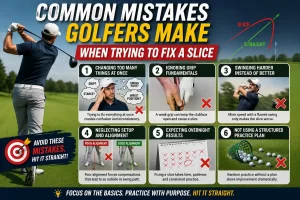
Many golfers unknowingly make their slice worse while attempting to correct it. Understanding these common mistakes can help you avoid unnecessary frustration and improve your chances of successfully learning how to fix a golf slice fast.
The biggest mistake is changing too many things at once. A golfer might adjust their grip, stance, swing path, takeaway, and weight transfer all during the same range session. This makes it nearly impossible to determine which change is helping and which change may be creating new problems.
Another frequent mistake is ignoring golf grip fundamentals. Many golfers focus exclusively on swing mechanics while overlooking the grip’s influence on clubface control. Since an open clubface is one of the primary causes of a slice, grip should always be evaluated before making major swing changes.
Swinging harder instead of better is another common error. When golfers see the ball curving right, they often respond by increasing swing speed. Unfortunately, swinging harder usually magnifies flaws in the golf swing path and makes it even more difficult to square the clubface.
Poor setup and alignment are also frequently overlooked. Many golfers attempting to fix slice in golf swing mechanics spend hours working on the downswing while their feet, hips, and shoulders remain improperly aligned. Even the best swing changes can struggle to succeed when built on a faulty setup.
Finally, many golfers expect overnight results. While certain adjustments can produce immediate improvements, lasting change requires practice and repetition. Golfers who abandon a new technique after one disappointing range session often miss out on long-term success.
Avoiding these mistakes can make the process of learning how to fix a golf slice fast much smoother and more effective.
How Long Does It Take to Fix a Golf Slice?
One of the most common questions golfers ask is how long it takes to completely eliminate a slice. The answer varies from player to player, but understanding the factors involved can help set realistic expectations as you work to fix a golf slice.
Several factors influence improvement speed. The severity of the slice, the underlying cause, and the golfer’s willingness to practice all play important roles. A golfer with a minor setup issue may see improvement within a single practice session, while someone with multiple swing flaws may require several weeks of focused work.
Practice frequency is one of the biggest factors. Golfers who practice two or three times per week typically improve faster than those who only hit balls occasionally. Consistent repetition helps reinforce better movement patterns and improves both clubface control and golf swing path.
Skill level also matters. Experienced golfers often identify and correct issues more quickly because they already possess a solid understanding of swing mechanics. Beginners learning how to fix a golf slice fast for beginners may need additional time to develop fundamental skills such as grip, alignment, and body sequencing.
For most golfers, realistic expectations are important. Significant improvements can often occur within a few practice sessions, but completely eliminating a slice may take several weeks or even months of consistent work.
Fortunately, progress is usually easy to recognize. Common signs that you’re improving include:
- Less rightward curve on your shots.
- Straighter starting lines.
- Improved contact quality.
- Increased distance.
- More fairways hit during rounds.
- Greater confidence over the ball.
Golfers looking for how to fix a driver slice fast often notice some of these improvements very quickly after making setup and grip changes. However, the most successful players understand that lasting results come from building solid fundamentals and practicing them consistently.
If you remain patient and continue applying the techniques covered in this guide, you’ll gradually develop a more reliable swing, better ball flight laws outcomes, and the confidence that comes from hitting straighter golf shots. The key is staying committed to the process and focusing on steady improvement rather than instant perfection.
How to Fix a Slice in Golf https://www.treetops.com/how-to-fix-a-slice/
Frequently Asked Questions About How to Fix a Golf Slice Fast
What is the fastest way to fix a golf slice?
The fastest way to learn how to fix a golf slice fast is to identify the root cause of your slice and focus on correcting it. For many golfers, the biggest issues are an open clubface, a weak grip, or an outside-to-inside golf swing path. Strengthening your grip, improving clubface control, and developing a more effective inside out swing path can often produce noticeable improvements in just a few practice sessions. While there is no single solution that works for everyone, focusing on the fundamentals typically delivers the quickest results.
Can a stronger grip fix a slice?
Yes, a stronger grip can help many golfers fix a golf slice. A weak grip often makes it difficult to square the clubface at impact, leaving the face open and creating slice spin. By strengthening your grip and improving your golf grip fundamentals, you can help the clubface return to a more neutral position through impact. However, grip is only one piece of the puzzle. If your slice is also caused by an over the top swing or poor alignment, those issues should be addressed as well.
Why do I only slice my driver?
Many golfers struggle with the driver because it is the longest club in the bag and requires more precise timing. The lower loft of the driver also tends to exaggerate swing flaws. If you’re searching for how to fix a driver slice fast, start by checking your setup, tee height, ball position, and grip. An open clubface combined with an improper swing path is one of the most common reasons golfers slice the driver while hitting their irons relatively straight.
How do beginners fix a golf slice fast?
For golfers searching for how to fix a golf slice fast for beginners, the best approach is to focus on the basics. Start with proper grip, alignment, posture, and ball position before making major swing changes. Many beginners can significantly reduce their slice by improving clubface control and learning the fundamentals of an inside out swing path. Consistent practice and simple drills are often more effective than trying to overhaul the entire swing at once.
What drills help eliminate a slice?
Several drills can help golfers fix slice in golf swing mechanics. The alignment stick drill helps improve setup and swing path, while the headcover drill encourages a more inside approach to the ball. Slow-motion practice swings can improve sequencing and face control, and impact bag drills can help golfers learn what a square clubface feels like at impact. The most effective drill depends on the underlying cause of your slice, but structured practice is essential for lasting improvement.
Can lessons help fix a slice quicker?
Yes, professional lessons can often accelerate the process of learning how to fix a golf slice fast. A qualified instructor can identify swing flaws that may be difficult to recognize on your own and provide personalized feedback based on your specific swing characteristics. Lessons can help improve your understanding of ball flight laws, golf swing path, and clubface control, allowing you to make more targeted improvements. While self-practice can be highly effective, many golfers find that professional guidance helps them eliminate bad habits and achieve results more quickly.