
How To Fix Fat Golf Shots Instantly With These 7 Secret Tips
If You Can’t Fix Fat golf Shots Instantly Try These 7 Secret Tips
Secret Tip #6 – Improve Your Tempo And Rhythm
Why Swing Tempo Affects Ball Striking
Many golfers searching for how to fix fat golf shots instantly focus entirely on swing positions while ignoring one of the biggest factors in solid contact — tempo and rhythm. Even golfers with decent mechanics can struggle with chunked iron shots if their swing tempo becomes rushed or out of control.
One of the most common problems is a rushed transition at the top of the backswing. Many players become overly aggressive starting the downswing, especially when trying to hit the ball harder. This sudden change of direction often throws the club off plane and causes the swing bottom to move behind the golf ball.
Overpowering the downswing is another major reason golfers struggle with heavy iron shots. Instead of allowing the swing to flow naturally, many players try to force speed with their arms and upper body. This creates poor sequencing, loss of balance, and inconsistent golf impact position.
Timing issues are also extremely common among amateur golfers. Golf requires multiple moving parts to work together in sequence. If the body, arms, and club become out of sync, clean contact becomes very difficult to repeat consistently.
Golfers who constantly struggle with hitting fat golf shots often notice that the problem becomes worse under pressure because tension speeds up their tempo and destroys rhythm.
How Better Tempo Helps Fix Fat Golf Shots Instantly
Improving tempo can create surprisingly fast improvements in ball striking. A smoother swing allows the club to return to impact in a much more controlled position while improving overall golf swing consistency.
Smoother sequencing is one of the biggest benefits of proper tempo. When the downswing starts gradually from the ground up, the body and arms stay synchronized more effectively. This helps improve low point control and reduces chunked golf shots.
Better tempo also improves balance throughout the swing. Golfers with smooth rhythm typically stay more centered during transition and maintain better posture through impact. This creates cleaner turf interaction golf mechanics and more reliable contact.
Low point control becomes easier when the swing is not rushed. Aggressive transitions often cause golfers to release the club too early or fall backward through impact. A controlled tempo allows the club to approach the ball with a more stable descending blow golf motion.
If you want a simple fix for fat golf shots, slowing down your transition and improving rhythm can often produce immediate results.
Tempo Drills For Consistency
The count drill is one of the easiest ways to improve rhythm. During your swing, count “1” during the backswing and “2” during the downswing. This helps create a smoother pace and prevents rushing from the top.
The pause-at-the-top drill is another excellent exercise. Make a full backswing, pause briefly at the top, and then start the downswing slowly. This teaches patience and improves sequencing during transition.
Metronome practice is also highly effective for building repeatable rhythm. Many professional golfers use tempo training devices or metronomes to maintain consistent swing pacing. Practicing with a steady rhythm can dramatically improve timing and contact.
These drills can help golfers stop hitting fat golf shots with irons while improving balance, sequencing, and ball striking consistency.
Secret Tip #7 – Build Better Golf Swing Mechanics
Common Swing Mechanics That Cause Fat Golf Shots
If you continue hitting fat golf shots despite working on setup and tempo, poor swing mechanics may be the hidden problem. Many golfers develop compensations over time that make consistent ball striking extremely difficult.
One major issue is early extension. This happens when golfers stand up during the downswing instead of maintaining posture through impact. Early extension changes the swing arc and often causes the club to strike the turf too early, leading to heavy iron shots and inconsistent contact.
Poor spine angle is another common problem. Golfers who lose posture during the swing often struggle with low point control because the body changes position dramatically before impact. Maintaining a stable spine angle helps the club return to the ball more consistently.
Casting the club is also a huge contributor to chunked iron shots. Casting occurs when the wrists unhinge too early during the downswing, causing the clubhead to release prematurely. This movement destroys shaft lean and moves the low point behind the golf ball.
These swing flaws are some of the main reasons why beginners hit fat golf shots every time without understanding the true cause of the problem.
Proper Mechanics For Cleaner Iron Contact
Rotating through impact is one of the keys to cleaner iron shots. Instead of stopping the body and flipping the hands, great ball strikers continue rotating through the golf ball while maintaining balance and posture.
Maintaining posture throughout the swing is equally important. Stable posture helps preserve the swing arc and allows the club to approach the ball with better consistency. Golfers who stay in posture typically create much better turf interaction golf mechanics.
A stable club path also improves contact dramatically. Excessive manipulation with the hands often causes inconsistent strikes. Allowing the body rotation to control the swing creates a more repeatable golf impact position and better compression.
When these mechanics work together properly, golfers can create a powerful descending blow golf motion that produces clean ball-first contact.
Practice Routines For Long-Term Improvement
Slow-motion swings are one of the best ways to improve mechanics. Practicing in slow motion allows golfers to feel proper sequencing, posture, and rotation without rushing through the movement.
Video analysis is another extremely effective training tool. Many golfers are unaware of their swing flaws until they watch themselves on camera. Recording your swing can quickly reveal issues involving posture, balance, and weight transfer.
Structured range sessions are also critical for long-term improvement. Instead of mindlessly hitting balls, focus each session on one specific skill such as low point control, balance, or tempo. Purposeful practice creates much faster improvement.
By improving your swing mechanics gradually over time, you can dramatically increase golf swing consistency while learning how to fix fat golf shots instantly and permanently.
Conclusion
How To Fix Fat Golf Shots Instantly Starts With Fundamentals
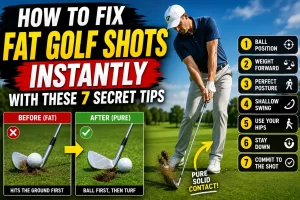
Learning how to fix fat golf shots instantly does not require a complete swing rebuild. In many cases, the biggest improvements come from mastering a few simple fundamentals that directly affect contact, balance, and consistency. Golfers often overcomplicate the problem when the real solution usually comes down to improving movement patterns, sequencing, and impact control.
Throughout this guide, we covered 7 secret tips that can dramatically improve your ball striking and help eliminate chunked iron shots. You learned how improving low point control helps create cleaner ball-first contact and more reliable turf interaction golf mechanics. We also discussed how proper weight transfer keeps the body moving correctly through impact instead of hanging back on the trail foot.
You discovered why scooping the golf ball creates heavy iron shots and how maintaining forward shaft lean produces a better descending blow golf motion. Improving golf swing balance was another major focus because stable posture and centered movement are critical for golf swing consistency.
We also covered the importance of proper ball position and how even small setup mistakes can affect your angle of attack and contact quality. Better tempo and rhythm help synchronize the swing while preventing rushed transitions and poor sequencing. Finally, we discussed how improving overall swing mechanics can create long-term consistency and cleaner iron contact.
One of the biggest lessons golfers should remember is that consistency matters far more than perfection. Many players become frustrated because they expect every shot to feel perfect immediately. The truth is, even professional golfers constantly work on fundamentals like balance, timing, and low point control. Improvement happens gradually through repetition and smart practice.
The good news is that small changes can create very fast results. Sometimes a simple adjustment involving posture, setup, or tempo can instantly improve contact and reduce hitting fat golf shots. This is especially true for golfers who struggle with poor balance or improper weight transfer.
If you truly want to stop hitting fat golf shots with irons, focus on building solid fundamentals first. Practice the drills in this guide consistently and pay attention to your setup, balance, and sequencing during every swing.
The more you improve your low point control, golf impact position, and overall mechanics, the easier clean ball striking becomes. Over time, your confidence will grow, your contact will improve, and your golf swing consistency will become much more reliable.
Stick with the process, stay patient, and keep practicing. Every great golfer started exactly where you are now — learning how to control the club, improve contact, and build confidence one swing at a time.