
How to Measure Golf Swing Speed for Distance: 7 Powerful Ways
Best Ways to Measure Golf Swing Speed
Introduction — Why Measuring Golf Swing Speed Matters
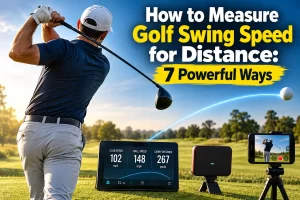
If you want to hit the golf ball farther, knowing how fast you actually swing the club is far more useful than simply guessing. Many golfers assume they are generating plenty of speed because their swing feels powerful, but effort and clubhead speed aren’t necessarily the same thing. Learning how to measure golf swing speed gives you a measurable starting point and makes it easier to determine whether your training is producing real improvements.
Golf swing speed, commonly called clubhead speed, refers to how fast the clubhead is traveling during the swing, typically measured in miles per hour (mph). When you’re working on increasing distance, clubhead speed matters because greater speed creates the potential to transfer more energy into the golf ball. However, speed by itself doesn’t guarantee longer shots.
That’s where ball striking becomes important. A golfer can produce impressive clubhead speed but still lose distance by making inconsistent or off-center contact. Ball speed measures how quickly the golf ball leaves the clubface after impact. Ideally, your golf swing mechanics, timing, and contact work together so that as much of your clubhead speed as possible is converted into ball speed.
Another useful measurement is smash factor, which compares ball speed with clubhead speed. In simple terms, it helps show how efficiently you’re transferring energy from the club to the ball. Two golfers could generate similar swing speeds but produce noticeably different distances because one consistently strikes the ball closer to the center of the clubface.
This is why establishing a baseline through golf swing speed measurement can be so valuable. Once you know your normal speed, you can test changes to your golf swing tempo, mechanics, strength, or speed training and see whether they’re actually helping. Instead of thinking, “I feel like I’m swinging faster,” you’ll have numbers you can compare over time.
Fortunately, learning how to measure golf swing speed for distance doesn’t require guesswork. There are several options ranging from advanced launch monitors and a dedicated swing speed radar to golf simulators, smartphone technology, ball-speed calculations, driving-distance estimates, and slow-motion video analysis.
In this guide, we’ll break down seven powerful ways to measure golf swing speed, explain the strengths and limitations of each method, and show you how to use the information to build more efficient golf swing power and ultimately create more distance on the course.
9 Shocking Golf Swing Speed Mistakes Killing Your Power
1. Use a Launch Monitor to Measure Golf Swing Speed
One of the most comprehensive ways to learn how to measure golf swing speed is by using a launch monitor. Instead of simply telling you how fast the club is moving, many launch-monitor systems provide several pieces of data that help explain what happens before, during, and immediately after impact. This makes them particularly useful for golfers who want to understand how their speed translates into actual distance.
Depending on the device, a launch monitor may provide measurements such as clubhead speed, ball speed, launch angle, spin rate, carry distance, and total distance. Looking at these numbers together provides a much clearer picture of your overall golf swing power and efficiency than clubhead speed alone.
For example, you could increase your clubhead speed without gaining much distance if your ball striking becomes less consistent. An off-center strike can reduce ball speed and produce inefficient launch conditions, meaning some of the extra speed you created never becomes usable distance. On the other hand, improving contact may allow you to hit the ball farther even when your clubhead speed stays relatively unchanged.
This highlights an important difference between measuring swing speed and measuring distance performance. Clubhead speed tells you how quickly the club is moving, while carry and total distance show what that speed ultimately produced. When learning how to measure golf swing speed for distance, you want to understand both sides of that equation.
Avoid judging your swing based on a single shot. One unusually fast swing—or one poor strike—can distort your results. Instead, hit several shots using the same club and look at your averages. This creates a more reliable golf swing speed measurement and makes it easier to compare future practice sessions.
Launch-monitor data can also reveal what’s actually limiting your distance. If clubhead speed is increasing but ball speed isn’t, contact quality or golf swing mechanics may deserve more attention. If contact is consistently strong but speed remains low, developing additional speed may offer greater potential for distance gains.
Which Launch Monitor Numbers Matter Most for Distance?
Several launch-monitor measurements are especially useful when evaluating distance. Clubhead speed shows how fast the club is moving, while ball speed indicates how much speed is transferred to the golf ball. Comparing these numbers gives you smash factor, a useful indicator of strike efficiency.
Carry distance tells you how far the ball travels through the air before landing, while total distance adds the amount of rollout after landing. Launch angle and spin rate provide additional context because they influence the ball’s trajectory and how efficiently its speed is converted into distance.
The key is not to become obsessed with one number. A golfer with tremendous clubhead speed can still lose distance through poor contact, excessive spin, or inefficient launch conditions. By evaluating clubhead speed, ball speed, smash factor, launch, spin, and distance together, you get a much more complete picture of how effectively your swing is producing distance.
2. Measure Golf Swing Speed With a Swing Speed Radar
A swing speed radar is one of the most convenient tools for golfers who want to learn how to measure golf swing speed without needing a full launch-monitor setup. These devices are designed to detect the speed of the clubhead as it moves through the hitting area, giving you immediate feedback after each swing. This makes radar especially useful for golfers working specifically on increasing clubhead speed.
Most swing speed radar units use Doppler radar technology to detect movement and calculate how quickly the clubhead is traveling. After you swing, the device displays a speed reading, usually in miles per hour. Unlike more advanced systems that analyze ball flight, launch angle, spin, and carry distance, a basic radar unit focuses primarily on speed. This simplicity makes it particularly useful during dedicated speed-training sessions.
Proper placement is important when learning how to measure golf swing speed accurately. Because models can differ, always follow the manufacturer’s setup instructions. Generally, the radar should be positioned where it has a clear view of the clubhead traveling through the impact area. An incorrect angle, excessive distance, or objects interfering with the radar’s detection area can produce inconsistent readings.
One of the biggest advantages of radar training is instant feedback. Suppose you’re experimenting with a different golf swing tempo or trying to improve sequencing between your lower body, torso, arms, and club. Instead of guessing whether the change generated more speed, you can swing and immediately see the result.
Don’t make the mistake of treating your fastest reading as your normal swing speed. Take several swings—such as five to ten—and calculate an average. If your readings were 91, 92, 90, 94, and 93 mph, for example, your average would be 92 mph. Tracking averages provides a much better golf swing speed measurement for comparing your progress over time.
Several mistakes can create misleading results. These include changing the radar position between swings, switching clubs during a test, swinging unnaturally hard just to produce a bigger number, or comparing measurements taken under very different conditions.
Depending on the radar model, you may be able to measure speed while hitting golf balls or while making practice swings without a ball. No-ball swings are particularly convenient for speed training and can even provide an option for golfers researching how to measure golf swing speed at home, provided they have enough space to swing safely.
However, hitting a ball provides additional context. Ultimately, how to measure golf swing speed for distance isn’t only about producing the highest possible number. Your increased speed needs to work alongside efficient golf swing mechanics and solid ball striking so that additional clubhead speed is converted into useful ball speed and distance.
How Accurate Is a Golf Swing Speed Radar?
A quality swing speed radar can be a useful tool for golfers who want to track clubhead speed, but you shouldn’t expect every radar device to produce exactly the same number. Different units can use different radar technology, algorithms, positioning requirements, and measurement methods. As a result, one device might show a slightly different swing speed than another even when measuring similar swings.
This doesn’t necessarily make either device useless. When learning how to measure golf swing speed accurately, consistency is often more important than comparing your numbers across several different devices. If you establish a baseline using one radar, continue using that same unit whenever possible. This gives you a consistent reference point for evaluating whether your speed is improving.
For example, if your typical swings average 90 mph on one radar and several weeks later average 94 mph under similar conditions, that trend may be more meaningful than comparing the 94-mph reading against a different device. Your goal should be to track repeatable progress rather than chase one unusually high number.
Setup can also influence golf swing speed measurement. Incorrect radar positioning, excessive distance from the hitting area, an improper angle, or objects moving within the radar’s detection area may affect readings. Always follow the manufacturer’s instructions because recommended placement can differ between models.
The environment matters as well. Indoor and outdoor setups can differ, and nearby movement or inconsistent positioning may make readings less repeatable. If you’re comparing training sessions, try to recreate similar testing conditions each time.
Most importantly, use radar readings as part of a larger picture. Increasing clubhead speed is valuable, but improved speed should eventually translate into better ball striking, ball speed, and distance. Tracking those additional measurements can help determine whether your increased speed is actually improving performance.
15 Golf Swing Speed Secrets for a Faster More Powerful Swing
3. Use a Golf Simulator to Measure Golf Swing Speed
Another convenient way to learn how to measure golf swing speed is to use a modern golf simulator. Simulators have become popular because they allow golfers to hit normal shots while receiving immediate feedback about their swing and ball flight. Depending on the technology being used, a simulator may provide clubhead speed, ball speed, carry distance, total distance, launch angle, spin, and other useful measurements.
You can find simulator technology at many indoor golf facilities, club-fitting centers, teaching studios, and practice facilities. This makes it possible to obtain detailed information without purchasing your own launch monitor or radar.
However, it’s important to understand the difference between club data and ball data. Club data describes what the golf club is doing during the swing and around impact. This can include clubhead speed and, depending on the system, information about club path or face delivery. Ball data measures what happens after impact, including ball speed, launch angle, spin, and resulting trajectory.
When you’re learning how to measure golf swing speed for distance, both categories can be valuable. Clubhead speed tells you how much speed you’re producing, while ball speed and distance help reveal how effectively you’re transferring that speed into the golf ball.
To establish a realistic baseline, warm up normally before recording your results. Then hit several shots with the same club rather than relying on your fastest swing. Remove obvious mishits if they don’t represent your normal swing and calculate or review the average from your quality shots. This gives you a much more useful picture of your typical speed.
Simulator sessions can also expose connections between golf swing mechanics, golf swing tempo, speed, and distance. For example, you may discover that your fastest swings aren’t your longest because your contact quality decreases when you try to swing harder. A slightly slower but centered strike could produce higher ball speed, a better smash factor, and more consistent distance.
When comparing sessions over time, use the same club whenever possible. Switching between clubs makes your results difficult to compare because different club lengths, lofts, and designs naturally produce different speeds and ball-flight characteristics. Keeping the club and testing process consistent makes simulator data far more useful for tracking genuine improvement.
Your swing speed reading might reveal more than you think. If your numbers aren’t improving despite regular practice, there’s a good chance simply swinging harder isn’t the answer. The real breakthrough often comes from identifying the parts of your swing that are wasting power before it ever reaches the clubhead. See How to Build a Faster, More Efficient Golf Swing → https://ultimategolfmasterypro.com/the-golf-swing-lab-2/
4. Use a Smartphone App to Measure Golf Swing Speed
If you don’t own a launch monitor or swing speed radar, a smartphone app may provide another convenient way to estimate your clubhead speed. Golf technology has advanced considerably, and some apps can use video, phone sensors, audio, or other forms of analysis to estimate different aspects of your swing. For golfers researching how to measure golf swing speed at home, this can be an accessible place to start.
The exact measurement method depends on the app. Some video-based apps analyze recorded swings and use information from the club’s movement to estimate speed. Other systems may work with sensors or compatible external devices to collect additional swing information. Certain apps may also analyze sounds associated with the swing and impact to calculate timing or other performance data.
The biggest advantage is convenience. Most golfers already own a smartphone, so an app may allow you to begin tracking your swing without immediately purchasing specialized equipment. This can be particularly useful if your main goal is to establish a rough baseline and monitor whether your golf swing mechanics, training, or golf swing tempo are changing over time.
However, smartphone measurements shouldn’t automatically be treated as equivalent to data from a dedicated radar or high-quality launch monitor. Accuracy can depend on the app, phone hardware, camera frame rate, recording angle, lighting, distance from the golfer, and the measurement method being used. Some apps may provide an estimate rather than directly measuring clubhead speed.
Consistency is therefore important when learning how to measure golf swing speed accurately with a phone. Place your smartphone in the same general position for each testing session and use a stable tripod or secure stand whenever possible. Never place the phone where it could be struck by the club or golf ball. Maintain a safe distance and make sure you have enough room to complete a full swing.
Use the same club, similar camera position, and similar testing conditions whenever possible. Record several swings instead of relying on a single result. This gives you a more meaningful golf swing speed measurement and makes it easier to identify trends.
Can You Measure Golf Swing Speed With Your Phone?
Yes, a smartphone can potentially help you measure or estimate golf swing speed, but it’s important to have realistic expectations. The accuracy you receive depends heavily on the technology being used.
A dedicated radar or launch monitor is specifically designed to measure golf-related movement or ball-flight characteristics. A smartphone, by comparison, may rely on calculations derived from video, audio, sensors, or information supplied by another connected device. That distinction matters when you’re trying to determine how to measure golf swing speed for distance as precisely as possible.
For example, an app might report that your swing speed increased from one training period to another. Even if those measurements aren’t as precise as a professional launch-monitor session, consistent testing with the same setup may still help you identify whether your speed is trending upward.
This makes smartphone apps particularly useful for tracking progress. If you use the same phone, app, club, recording position, and testing procedure, changes in the readings may provide useful feedback about your training.
Just remember that increased estimated speed doesn’t automatically mean increased distance. Ultimately, ball striking, ball speed, smash factor, launch conditions, and contact quality determine how effectively your speed is converted into distance. A smartphone app can be a helpful and inexpensive measurement tool, but golfers seeking highly precise numbers should consider periodically comparing their results with a dedicated radar or launch monitor.
5. Calculate Golf Swing Speed From Ball Speed
If you know your ball speed but don’t have a device that directly measures clubhead speed, you can estimate your swing speed using smash factor. This method can be useful when learning how to measure golf swing speed, especially if the equipment you’re using provides ball data but doesn’t directly measure the movement of the club.
Ball speed and clubhead speed are closely connected. Clubhead speed measures how fast the club is moving around impact, while ball speed measures how fast the golf ball travels immediately after leaving the clubface. The efficiency of that transfer is represented by smash factor.
The basic calculation is:
Smash Factor = Ball Speed ÷ Clubhead Speed
If you already know your ball speed and have a reasonable smash-factor estimate, you can rearrange the calculation:
Clubhead Speed = Ball Speed ÷ Smash Factor
For example, suppose your driver produces a ball speed of 142 mph and your smash factor is 1.45. Divide 142 by 1.45:
142 ÷ 1.45 = approximately 97.9 mph
Your estimated clubhead speed would therefore be about 98 mph.
This can be a helpful form of golf swing speed measurement, but there is an important limitation. If you’re assuming the smash factor rather than actually measuring it, your calculated swing speed is only an estimate. Using an inaccurate smash factor will also make your estimated clubhead speed inaccurate.
Contact quality is one reason this matters. Poor ball striking, such as hitting the ball significantly away from the center of the clubface, can reduce ball speed even when your clubhead speed remains relatively high. As a result, two swings made at similar speeds can produce noticeably different ball speeds and distances.
This is particularly important when determining how to measure golf swing speed for distance. The goal isn’t simply to create more speed. You want to transfer that speed efficiently into the golf ball.
What Is a Good Smash Factor for Measuring Swing Speed?
There isn’t one ideal smash factor that applies to every golf club. Smash factor varies depending on the club being used, impact conditions, equipment, and quality of contact. That’s why you should be careful about applying a single assumed value to every shot in your bag.
With a driver, golfers generally seek a higher smash factor because efficient center-face contact can transfer a large percentage of the club’s energy into ball speed. With higher-lofted clubs, smash factor is naturally lower, so comparing a wedge’s number directly with a driver’s would be misleading.
More importantly, smash factor can reveal something that raw swing speed cannot: efficiency.
Suppose you’re trying to increase golf swing power and begin swinging harder. Your clubhead speed rises, but your contact moves away from the center of the face. Your ball speed may improve very little—or could even decrease—because the additional speed isn’t being transferred efficiently.
Conversely, improving your golf swing mechanics and center-face contact could increase ball speed and distance without increasing clubhead speed at all. This is why golfers shouldn’t become obsessed with producing the highest possible speed reading.
When learning how to measure golf swing speed accurately, direct clubhead-speed measurement from suitable equipment is preferable when available. But ball speed and smash factor can provide valuable additional information. By evaluating clubhead speed, ball speed, contact quality, and distance together, you can determine whether you truly need more speed or simply need to make better use of the speed you already have.
6. Estimate Golf Swing Speed From Driving Distance
If you don’t have access to a launch monitor or swing speed radar, your driving distance can provide a rough indication of how much clubhead speed you may be producing. This isn’t the most precise method for learning how to measure golf swing speed, but it can give you a useful starting point when specialized equipment isn’t available.
The basic idea is simple: golfers who generate more clubhead speed generally have the potential to produce greater ball speed and hit longer drives. However, there isn’t a universal formula that can convert driving distance into exact swing speed because distance is influenced by far more than how quickly the clubhead is moving.
One of the first distinctions to understand is carry distance versus total distance. Carry distance measures how far the ball travels through the air before first contacting the ground. Total distance includes both carry and the distance the ball rolls afterward.
When determining how to measure golf swing speed for distance, carry distance is generally more useful for comparisons because rollout can vary dramatically. A drive that lands on a firm, dry fairway might roll considerably farther than the same shot landing on soft or wet turf. Using total distance could therefore make it appear that your swing speed increased even when it didn’t.
Environmental conditions create additional complications. A strong tailwind can add distance, while a headwind can reduce it. Elevation also matters because a ball can travel differently depending on altitude. Temperature, turf firmness, and other course conditions can further affect the final result.
Your equipment and ball flight matter as well. Launch angle, spin rate, driver loft, golf-ball characteristics, and quality of ball striking all influence distance. A golfer with efficient launch conditions and center-face contact may hit the ball considerably farther than another golfer producing similar clubhead speed.
For these reasons, driving distance should be treated as an estimate rather than a replacement for an actual golf swing speed measurement. If you want to know how to measure golf swing speed accurately, a suitable radar or launch-monitor system is a better choice.
Why Distance Alone Doesn’t Tell You Your Exact Swing Speed
Imagine two golfers who both generate the same clubhead speed. It’s tempting to assume their drives should travel approximately the same distance, but that isn’t necessarily what happens.
The first golfer might consistently find the center of the clubface and produce efficient ball speed, launch, and spin. The second golfer might strike the ball toward the heel or toe, generate excessive spin, or launch the ball at less-efficient conditions. Even though their raw clubhead speeds are identical, their resulting distances could be noticeably different.
This demonstrates why smash factor and contact efficiency are so important. Clubhead speed creates distance potential, but your ability to transfer that speed into the golf ball determines how much of that potential you actually use.
Equipment can further widen the difference. Driver loft, shaft characteristics, clubhead design, and golf-ball selection can influence launch and spin. Combine those variables with differences in golf swing mechanics, and distance alone becomes an unreliable way to determine an exact swing-speed number.
That’s why golfers interested in how to measure golf swing speed for distance should evaluate more than the final yardage. Clubhead speed, ball speed, smash factor, launch conditions, spin, and carry distance provide a much more complete picture.
Ultimately, efficient golf swing power isn’t about swinging as hard as possible. It’s about combining usable speed with efficient mechanics and solid contact so that more of your available energy becomes ball speed and distance.
Putting more hours into practice won’t necessarily produce more clubhead speed if you’re repeatedly practicing the wrong movement. You could spend weeks chasing speed only to create more tension, worse contact, and inconsistent results. Instead of guessing which part of your swing needs attention, follow a step-by-step approach designed to help you build better mechanics, power, and consistency. Discover The Golf Swing Lab Training System → https://ultimategolfmasterypro.com/the-golf-swing-lab-2/
7. Record Your Golf Swing in Slow Motion
Recording your golf swing in slow motion is another useful way to evaluate the movements that influence clubhead speed. While video alone may not provide the same precise golf swing speed measurement as a dedicated radar or launch monitor, it can help you understand why certain swings produce more or less speed. This makes slow-motion recording a valuable complement when learning how to measure golf swing speed and improve your overall performance.
Modern smartphones and cameras capable of recording at higher frame rates can capture details that are difficult to see at normal speed. When you watch your swing frame by frame, you can examine your takeaway, backswing, transition, downswing, impact position, and follow-through. This provides a closer look at the golf swing mechanics responsible for producing efficient clubhead speed.
However, it’s important to understand the limitations. Ordinary slow-motion video generally shouldn’t be treated as a replacement for a dedicated swing speed radar or launch monitor when you want an exact clubhead-speed reading. Calculating precise speed from video requires accurate information about frame rate, distance, perspective, scale, and club movement. Small errors in any of these areas can produce inaccurate estimates.
Where video becomes especially valuable is in analyzing golf swing tempo, sequencing, and rotation. You can examine whether your lower body begins the downswing efficiently, whether your upper body and arms are properly sequenced, and whether unnecessary tension or rushed movements are interfering with speed.
One effective approach is to combine slow-motion video with radar or launch-monitor data. Record several swings while measuring their speed. Then compare a faster swing with a slower one.
For example, suppose one swing measures 95 mph while another reaches 100 mph. Watching both recordings side by side may reveal differences in hip rotation, transition, balance, arm movement, or sequencing. You may discover that your faster swing actually looks smoother because the body and club are working together more efficiently.
This approach can also help golfers who want to know how to measure golf swing speed at home. If you have enough room to swing safely, video can be used alongside a compatible radar or other measurement device to track both your numbers and your mechanics.
Ultimately, generating more golf swing power isn’t simply about moving every part of your body faster. Efficient sequencing allows energy to build through the swing and transfer into the club at the right time. Improving that sequence may help increase clubhead speed while maintaining balance, control, and solid ball striking.
When determining how to measure golf swing speed for distance, think of slow-motion video as the explanation behind the numbers. A radar or launch monitor can tell you how fast you swung, while video can help reveal what you did differently to create that speed.
How to Measure Golf Swing Speed Accurately
Learning how to measure golf swing speed accurately requires more than simply making one swing and recording the number on a launch monitor or swing speed radar. Golf swings naturally vary from one attempt to another, so the goal should be to create a repeatable testing process that gives you a realistic picture of your normal clubhead speed.
Start by using the same club every time you compare results. A driver will normally produce different clubhead-speed numbers than an iron because of differences in club length, design, and how each club is swung. If you establish your baseline with a driver, continue using that driver when measuring future progress.
You should also warm up before beginning your test. Measuring your first few swings immediately after arriving at the range can produce numbers that don’t accurately represent your normal speed. Make several comfortable swings first and gradually work toward your regular golf swing tempo before recording your baseline.
Once you’re ready, take multiple measurements. Rather than focusing on one swing, record a series of quality swings and calculate an average. For example, if five representative swings produce speeds of 92, 94, 93, 95, and 91 mph, your average is 93 mph. That number provides a much more useful golf swing speed measurement than simply claiming your swing speed is 95 mph because that happened to be your fastest attempt.
Obvious mishits can sometimes be removed when you’re specifically trying to establish a representative speed baseline. However, don’t automatically eliminate every shot that produces a result you don’t like. Frequent mishits may reveal an important problem with your golf swing mechanics or ball striking, particularly if you’re losing contact quality as you attempt to swing faster.
Testing conditions should also remain as consistent as possible. Use the same measurement device, club, golf ball type, and general setup whenever practical. If you’re comparing distance as well, environmental conditions such as wind and temperature can introduce additional variables.
When determining how to measure golf swing speed for distance, track ball speed alongside clubhead speed whenever your equipment allows it. Clubhead speed tells you how quickly the club is moving, while ball speed helps show whether that speed is being transferred efficiently through impact. Looking at smash factor can provide even more insight into that relationship.
Most importantly, don’t chase one unusually high reading. If your normal driver speed is around 95 mph and you suddenly record one swing at 101 mph, that doesn’t necessarily mean your new baseline is 101 mph.
The better goal is to gradually increase your average repeatable speed while maintaining solid contact, balance, and control. That’s when additional golf swing power becomes much more likely to translate into useful distance on the golf course.
How to Measure Golf Swing Speed at Home
You don’t necessarily need to visit a golf course, fitting center, or indoor simulator facility to track your clubhead speed. If you’re interested in how to measure golf swing speed at home, several practical options can provide useful feedback, including a swing speed radar, compatible launch monitor, smartphone app, or slow-motion video.
A dedicated swing speed radar is one of the simplest choices because it can provide immediate speed readings without requiring extensive ball-flight data. Some radar devices can also measure practice swings without a golf ball, making them particularly convenient for home speed training. A compatible launch monitor can provide more detailed information, potentially including clubhead speed, ball speed, carry distance, launch conditions, and other measurements depending on the device.
Smartphone apps and video provide lower-cost alternatives. An app may estimate swing speed using video, sensors, audio, or compatible hardware, while slow-motion recording allows you to study golf swing mechanics, sequencing, rotation, and golf swing tempo. Video alone isn’t necessarily the best choice for obtaining an exact speed number, but it can help explain why your speed changes.
Regardless of which method you choose, safety should come first. You need enough room to complete your entire golf swing without the club contacting a ceiling, wall, furniture, light fixture, another person, or anything else around you. If you don’t have a sufficiently large indoor area, an open outdoor location may be a safer option.
If your equipment requires you to hit a golf ball, using a properly installed golf net can create a home practice setup. Make sure the net and surrounding area are designed to safely contain your shots. If you’re using a radar that measures non-contact swings, you may not need to hit a ball at all. However, remember that practice-swing speed doesn’t tell you how well you’re transferring that speed through ball striking.
Once your setup is ready, establish an initial baseline. Warm up, use the same club, make several swings, and calculate your average rather than recording only your fastest attempt. This provides a more useful golf swing speed measurement for future comparisons.
Consider keeping a simple weekly log containing the date, average clubhead speed, fastest speed, club used, and—when available—ball speed and smash factor. Testing under similar conditions once a week can make progress easier to identify without becoming overly focused on normal day-to-day fluctuations.
This approach becomes especially valuable when following a speed-training program. Measure your baseline before beginning the program, record your progress at consistent intervals, and perform another test after completing it.
When learning how to measure golf swing speed for distance, the goal isn’t simply to see a larger number on the screen. You want your increased speed to eventually produce greater ball speed and usable distance while maintaining solid contact and control. By testing consistently at home, you can determine whether your training is creating genuine improvements in golf swing power instead of relying on how fast your swing happens to feel.
How Golf Swing Speed Affects Distance
Golf swing speed plays an important role in how far you can hit the ball because greater clubhead speed creates the potential to transfer more energy into the golf ball at impact. In simple terms, if two swings are equally efficient, the swing with greater clubhead speed generally has greater distance potential. This is one reason learning how to measure golf swing speed can be so useful when you’re trying to increase distance.
However, clubhead speed is only one part of the equation. The speed you create must be transferred efficiently from the clubface to the golf ball. That’s where ball speed and smash factor become important.
Ball speed measures how fast the golf ball is traveling immediately after impact. Smash factor compares ball speed with clubhead speed and helps indicate how efficiently energy is being transferred. If your clubhead speed increases but your ball speed doesn’t improve proportionally, your contact may be preventing you from taking full advantage of the additional speed.
This explains why a golfer with a slightly slower swing can sometimes hit the ball farther than someone swinging faster. A centered strike can produce efficient energy transfer, while a faster swing that catches the ball significantly toward the heel or toe may lose ball speed. Good ball striking can therefore outperform uncontrolled speed.
Launch conditions also influence how that ball speed becomes distance. Launch angle affects the trajectory of the shot, while spin influences how the ball behaves during flight. Too much or too little spin, combined with inefficient launch conditions, can prevent a golfer from maximizing distance even when clubhead and ball speeds are relatively strong.
This is why how to measure golf swing speed for distance should involve more than looking at a single speed reading. When possible, evaluate clubhead speed alongside ball speed, smash factor, launch angle, spin, and carry distance.
Your golf swing mechanics and golf swing tempo also contribute to usable distance. Efficient sequencing can help build speed while maintaining balance and control through impact. The goal isn’t simply to swing harder. It’s to produce speed through efficient movement and then deliver the clubface consistently enough to turn that speed into solid contact.
Swing Speed vs. Ball Speed: What’s the Difference?
Swing speed—more specifically, clubhead speed—measures how quickly the clubhead is moving, typically around impact. Ball speed measures how quickly the golf ball travels immediately after being struck.
The two measurements are related, but they aren’t interchangeable.
Clubhead speed tells you about the speed you’re producing with the club. Ball speed tells you more about the result of the collision between the clubface and golf ball. Tracking both provides a much clearer picture of your performance than tracking either number alone.
For example, suppose your golf swing speed measurement shows that your clubhead speed has increased after several weeks of training. That’s encouraging, but if your ball speed remains almost unchanged, the additional clubhead speed isn’t being converted efficiently into performance. Poor contact could be one possible reason.
Conversely, your clubhead speed could remain relatively stable while your ball speed increases. Improved center-face contact and more efficient ball striking may allow you to transfer energy more effectively without actually swinging faster.
This relationship is why smash factor can be useful. It helps connect clubhead speed with ball speed so you can evaluate efficiency rather than raw speed alone.
When learning how to measure golf swing speed accurately, don’t view your clubhead-speed number in isolation. Track ball speed whenever your equipment allows it. Together, the two measurements can help reveal whether you need to generate more golf swing power or simply make better use of the speed you already have.
Best Golf Training Program For Beginners: Why Most Golfers Never Improve
Common Golf Swing Speed Measurement Mistakes
Learning how to measure golf swing speed isn’t difficult, but several common mistakes can make your results misleading. If you’re using your measurements to evaluate training progress or determine your potential for more distance, consistency is essential.
One of the easiest mistakes is measuring your swing before warming up. Your first few swings may be slower or less coordinated than your normal golf swing. Take several comfortable practice swings first and gradually work toward your normal speed before recording your baseline.
Another mistake is using only your fastest swing. If you record 94, 95, 96, 95, and 101 mph, calling your normal swing speed 101 mph would give you a distorted picture. The average of several representative swings is generally much more useful for tracking progress.
You should also avoid regularly comparing measurements from different devices. A launch monitor, simulator, smartphone app, and swing speed radar may use different technologies or calculations. When possible, use the same device for your baseline and future comparisons.
Changing clubs between tests creates another problem. Your driver, fairway woods, and irons aren’t expected to produce identical clubhead speeds. If you establish your baseline with a driver, use the same driver when performing your next golf swing speed measurement.
Mishits also deserve attention. You don’t necessarily need to include an obvious outlier when establishing a representative baseline, but repeatedly ignoring poor contact can hide an important problem. If swinging faster causes your ball striking to deteriorate, that’s valuable information.
Another common error is confusing ball speed with clubhead speed. Clubhead speed measures how fast the club is moving, while ball speed measures how fast the ball leaves the clubface. The relationship between them helps determine smash factor, but they are two different measurements.
Driving distance can also be misleading. Total distance includes rollout, which can change dramatically based on turf firmness, wind, elevation, temperature, and other conditions. Therefore, total driving distance shouldn’t be treated as an exact substitute when determining how to measure golf swing speed for distance.
Perhaps the biggest mistake is swinging unnaturally hard just to produce a higher reading. If your normal swing is controlled and balanced but you suddenly swing with maximum effort during testing, the resulting number may not represent speed you can actually use on the golf course.
Pay attention to golf swing tempo, mechanics, and contact quality as your speed increases. Efficient golf swing mechanics can help you generate speed while remaining balanced, whereas uncontrolled effort can disrupt sequencing and reduce strike quality.
Ultimately, learning how to measure golf swing speed accurately is about repeatability. A consistent 98-mph swing that produces centered contact can be far more valuable than occasionally reaching 103 mph while spraying the ball across the clubface. Track repeatable speed, ball speed, contact, and distance together, and you’ll get a much clearer picture of whether your golf swing power is actually improving.
Final Thoughts on How to Measure Golf Swing Speed
Learning how to measure golf swing speed gives you something every golfer trying to gain distance needs: a measurable starting point. Instead of guessing whether you’re swinging faster, you can establish a baseline, track your progress, and determine whether changes to your swing or training are actually producing results.
As we’ve covered, there are several ways to measure or estimate your speed. You can use a launch monitor, swing speed radar, golf simulator, smartphone app, ball-speed calculation, driving-distance estimate, or slow-motion video analysis. Each method can provide useful information, but they don’t all offer the same level of precision.
If your primary goal is how to measure golf swing speed accurately, a suitable launch monitor or dedicated radar device will generally provide more useful direct speed measurements than trying to calculate your speed from driving distance alone. Distance estimates can be affected by wind, temperature, elevation, rollout, launch conditions, spin, and quality of contact.
Whatever measurement method you choose, establish your baseline before beginning a speed-development program. Use the same club, warm up properly, record several swings, and calculate your typical speed rather than relying on your fastest attempt. This gives you a meaningful number to compare against later.
Most importantly, don’t make a higher number on the screen your only goal.
Increasing clubhead speed creates greater distance potential, but that speed needs to become ball speed. Efficient ball striking, center-face contact, launch conditions, and smash factor all influence how much distance you ultimately produce.
That’s why developing speed should work alongside improving your golf swing mechanics. Proper sequencing can help transfer energy through your body and into the club, while controlled golf swing tempo can help you maintain balance and deliver the club more consistently. When speed, sequencing, mechanics, and solid contact begin working together, you’re building usable golf swing power rather than simply swinging harder.
Measure where you are today. Work on the areas holding your swing back. Then test again and let the numbers show you what’s improving.
And if you’re tired of trying random swing tips without knowing what you should actually work on next, The Golf Swing Lab gives you a complete step-by-step system for improving your swing. Instead of guessing your way toward better golf, you’ll learn how the key pieces of the swing work together so you can build more consistency, power, and confidence.
Ready to stop guessing and start building a better golf swing? Discover The Golf Swing Lab and start your 7-Day Swing Mastery journey today.
Frequently Asked Questions About How to Measure Golf Swing Speed
What is the easiest way to measure golf swing speed?
One of the easiest ways to measure golf swing speed is with a dedicated swing speed radar. These devices can provide an immediate clubhead-speed reading after each swing without requiring you to calculate speed manually. Some launch monitors also measure clubhead speed while providing additional information such as ball speed, launch conditions, and distance. For useful results, take several swings with the same club and calculate or review your average rather than relying on your fastest reading.
How can I measure golf swing speed at home?
If you’re researching how to measure golf swing speed at home, several options are available. You can use a swing speed radar, compatible launch monitor, smartphone app, or video-based system. Some radar devices can measure practice swings without requiring you to hit a ball, which can make them particularly convenient for home training. Whatever method you use, make sure you have enough space to swing safely and maintain a consistent setup between testing sessions.
Can I measure golf swing speed without a launch monitor?
Yes. A launch monitor isn’t your only option for golf swing speed measurement. A dedicated swing speed radar can measure clubhead speed, while some smartphone apps may estimate speed using video, sensors, audio, or connected hardware. You can also estimate swing speed from ball speed and smash factor or use driving distance as a rough reference. However, calculated estimates shouldn’t be considered as precise as suitable equipment that directly measures clubhead speed.
Can my phone measure my golf swing speed?
A smartphone may be able to estimate golf swing speed depending on the app and measurement technology being used. Some apps analyze slow-motion video, while others may use sensors, audio, or external hardware. Results can vary based on camera positioning, frame rate, lighting, and the app’s calculation method. For this reason, smartphone apps can be particularly useful for tracking trends over time, but they may not provide the same level of precision as dedicated radar or launch-monitor technology.
How accurate are golf swing speed radars?
The accuracy of a swing speed radar depends on the device, setup, positioning, and testing conditions. Different devices may produce slightly different readings, which is why consistency matters. If you’re learning how to measure golf swing speed accurately, use the same device and club whenever possible, follow the manufacturer’s positioning instructions, and compare averages from multiple swings rather than individual readings.
What golf swing speed do I need for more distance?
There isn’t one clubhead-speed number that guarantees a specific driving distance. Higher clubhead speed generally creates greater distance potential, but actual distance also depends on ball speed, smash factor, launch angle, spin, equipment, environmental conditions, and quality of contact. Instead of chasing a specific number, work on increasing repeatable speed while maintaining efficient ball striking and favorable launch conditions.
Is clubhead speed the same as ball speed?
No. Clubhead speed measures how fast the golf club is moving, while ball speed measures how fast the golf ball travels immediately after impact. The two measurements are connected, but they’re not interchangeable. Smash factor compares ball speed with clubhead speed and can help indicate how efficiently energy is being transferred through impact. Tracking both measurements can provide a clearer picture of your golf swing power and strike efficiency.
How often should I measure my golf swing speed?
You don’t need to test your golf swing speed every day to monitor progress. For many golfers, checking it at consistent intervals—such as weekly or at key points during a speed-training program—can provide useful feedback. Keep your testing conditions similar, use the same club and measurement device, warm up first, and record an average from several representative swings. Tracking these averages over time can show whether changes to your golf swing mechanics, training, or golf swing tempo are producing meaningful improvements.