
Quick Alignment Fix for Fat Golf Shots: 7 Expert Secrets
How to Fix Fat Golf Shots With Simple Alignment Adjustments
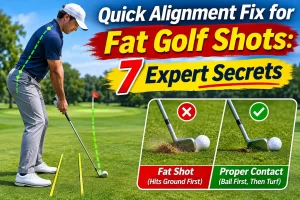
Introduction: Stop Hitting Behind the Golf Ball and Start Making Cleaner Contact
Imagine standing in the middle of the fairway, preparing to hit an iron shot toward the green. You feel confident, take your backswing, and begin your downswing, only to strike the ground several inches behind the golf ball. and start looking for a quick alignment fix for fat golf shots Instead of watching your ball soar toward the target, you see it travel a disappointing distance. If this sounds familiar, you’re not alone.
Fat golf shots are among the most frustrating mistakes golfers experience. They rob you of distance, reduce accuracy, damage confidence, and make it difficult to achieve consistent scores. Fortunately, discovering a quick alignment fix for fat golf shots could help you improve your ball striking without completely rebuilding your golf swing.
While many golfers immediately blame their swing mechanics, improper alignment is an often-overlooked contributor to inconsistent iron contact. When your feet, hips, shoulders, and clubface are poorly aligned, your body may compensate during the swing. These compensations can disrupt your balance, interfere with body rotation, and make controlling your swing low point more challenging.
Proper golf ball position, target line alignment, and golf posture fundamentals all work together to create a more reliable setup. When these fundamentals are correctly established, achieving a descending iron strike and consistent ball-first contact becomes easier.
Throughout this guide, you’ll discover seven expert secrets designed to help you:
-
Correct improper target line alignment.
-
Establish proper golf ball position.
-
Improve shoulder, hip, and foot alignment.
-
Develop consistent golf posture fundamentals.
-
Improve weight transfer and golf swing balance.
-
Develop effective forward shaft lean.
-
Establish a reliable pre-shot alignment routine.
These practical golf alignment tips and proven practice techniques will help you identify potential setup mistakes before they negatively affect your swing.
The good news is that effective fat golf shot fixes don’t always require complicated swing changes or countless hours on the driving range. Sometimes, making a few simple adjustments at address can produce noticeable improvements in contact, distance, and accuracy.
By practicing these seven alignment secrets consistently, you can develop more reliable swing fundamentals, reduce costly mishits, and build greater confidence with every iron shot. The journey toward cleaner, more consistent ball striking begins before you even take the club back.
Why Poor Golf Alignment Causes Fat Golf Shots
Many golfers assume that hitting fat golf shots is primarily caused by poor downswing mechanics. However, the underlying problem can begin before the club even moves. Improper alignment can create a chain reaction of compensatory movements that negatively affect swing direction, balance, body rotation, and impact consistency.
Understanding how to fix fat golf shots with alignment begins with recognizing how your setup influences the movement of the golf club throughout the swing.
Understanding the Connection Between Alignment and Swing Low Point
A fat golf shot occurs when the clubhead strikes the ground before making contact with the golf ball. This premature turf interaction reduces clubhead speed and energy transfer, resulting in lost distance, inconsistent accuracy, and poor ball flight.
During a well-executed iron shot, the clubhead should generally contact the golf ball before reaching the lowest point of its swing arc. This produces a descending iron strike, allowing the golfer to compress the ball effectively before the clubhead interacts with the turf.
Poor target line alignment can interfere with this process by encouraging golfers to make unnecessary compensations during the downswing. For example, a golfer whose shoulders are excessively closed may compensate by altering their swing path, restricting body rotation, or releasing the club prematurely.
These movements can shift the swing low point behind the golf ball, increasing the likelihood of hitting a fat shot.
An effective quick alignment fix for fat golf shots begins with establishing a repeatable setup that supports natural body rotation, balanced movement, and consistent low-point control.
Common Alignment Mistakes That Lead to Poor Ball Striking
Identifying common alignment mistakes is an important step toward developing effective fat golf shot fixes. Even relatively small setup inconsistencies can negatively influence impact when combined with other swing faults.
Some of the most common alignment mistakes include:
-
Misaligned feet, hips, and shoulders: Inconsistent body alignment can encourage compensatory movements and disrupt swing mechanics.
-
Excessively open or closed stance: Extreme stance positions may interfere with natural rotation and swing direction.
-
Incorrect golf ball position: Positioning the ball too far forward can increase the likelihood of contacting the ground before the ball.
-
Poor golf posture: Excessive bending, standing too upright, or reaching for the ball can negatively affect swing arc consistency.
-
Inconsistent weight distribution: Hanging back on the trail foot during the downswing can make achieving ball-first contact more difficult.
-
Improper clubface alignment: A poorly aimed clubface can encourage last-second adjustments that compromise impact consistency.
By incorporating proper golf alignment tips into your practice routine, you can reduce unnecessary swing compensations and establish a stronger foundation for consistent iron play.
Although alignment alone may not eliminate every fat shot, correcting these fundamental setup mistakes can significantly improve your ability to control the swing low point, achieve cleaner contact, and develop more reliable ball striking.
Secret #1: Correct Your Target Line Alignment for Cleaner Golf Shots
One of the most effective ways to improve iron contact is to establish proper alignment before beginning your golf swing. Many golfers unknowingly position their bodies incorrectly in relation to their intended target, creating unnecessary swing compensations that can contribute to fat shots.
If you’re searching for a quick alignment fix for fat golf shots, correcting your target line alignment is an excellent starting point.
How Proper Target Line Alignment Improves Ball Striking
Understanding the difference between your target line and body alignment is essential for developing a consistent golf setup.
The target line is an imaginary straight line extending from the golf ball toward your intended target. Body alignment refers to how your feet, knees, hips, and shoulders are positioned relative to that line.
One of the easiest ways to visualize proper alignment is to imagine a set of railroad tracks:
-
The outside railroad track: Represents the target line, along which your clubface should aim toward your intended target.
-
The inside railroad track: Represents your body alignment, with your feet, hips, and shoulders positioned generally parallel to the target line.
For right-handed golfers, the body line should point parallel and slightly left of the target. For left-handed golfers, it should point parallel and slightly right.
When your body is improperly aligned, you may instinctively adjust your swing path, alter your body rotation, or release the club prematurely to redirect the ball toward the target. These compensations can negatively affect golf swing balance and shift the swing low point behind the ball.
Establishing proper target line alignment helps reduce unnecessary compensations and supports more consistent ball-first contact.
The Two-Alignment-Stick Drill
The two-alignment-stick drill is one of the most practical golf alignment tips for developing a repeatable setup and improving iron contact.
Follow these simple steps:
-
Place an alignment stick on the ground parallel to your intended target line, safely outside the clubhead’s swing path.
-
Position a second alignment stick along your foot line, parallel to the first stick.
-
Aim your clubface toward your intended target.
-
Position your feet, hips, and shoulders parallel to the target line.
-
Check your proper golf ball position, posture, and weight distribution.
-
Begin hitting controlled half-swing iron shots.
-
Gradually progress to full swings as your contact becomes more consistent.
Pay close attention to where your clubhead first contacts the turf, the direction of your ball flight, and the quality of your impact. Ideally, your iron should strike the ball before the turf, with any divot beginning on the target side of the ball.
Common Target Line Alignment Mistakes to Avoid
Even when using alignment sticks, golfers should avoid several common mistakes:
-
Aiming their feet directly toward the target instead of parallel to the target line.
-
Allowing their shoulders to point in a different direction from their feet and hips.
-
Changing their alignment to compensate for inconsistent ball striking.
-
Neglecting clubface alignment while concentrating exclusively on body positioning.
Practicing this simple drill regularly can help establish more reliable setup habits, improve swing consistency, and reduce alignment-related fat shots without requiring a complete swing overhaul.
Secret #2: Establish Proper Golf Ball Position to Prevent Fat Shots
Establishing proper golf ball position is one of the simplest yet most important adjustments golfers can make to improve iron contact. Even when your swing mechanics are relatively sound, positioning the golf ball incorrectly can make consistent ball-first contact more difficult.
If you’re looking for the best alignment fix for fat golf shots, checking your ball position should be one of your top priorities.
Why Incorrect Ball Position Causes Inconsistent Iron Contact
Your golf ball position directly influences where the clubhead encounters the ball in relation to the lowest point of your swing arc.
When hitting an iron, the clubhead should generally contact the golf ball while traveling downward, reaching its lowest point slightly beyond the ball. This descending iron strike promotes cleaner contact, effective energy transfer, and more consistent distance.
When the golf ball is positioned too far forward, the clubhead may reach the bottom of its swing arc before making contact with the ball. This increases the likelihood of striking the ground prematurely.
However, positioning the ball excessively far back isn’t necessarily the solution. Doing so can encourage an excessively steep angle of attack, reduce effective clubface loft, and create additional swing compensations.
The objective is to establish a ball position that complements your natural swing mechanics while supporting consistent low-point control.
How to Find the Correct Ball Position for Every Iron
Although individual swing characteristics vary, the following guidelines provide a reliable starting point for establishing proper golf ball position:
-
Wedges: Position the ball near the center of your stance for standard full shots.
-
Short irons (8–9 irons): Position the ball near the center or slightly forward of center.
-
Mid-irons (5–7 irons): Position the ball approximately one ball-width forward of center.
-
Long irons (2–4 irons): Position the ball slightly farther forward to accommodate the longer club shaft and generally shallower angle of attack.
These positions should serve as starting points rather than rigid rules. Your stance width, body rotation, pressure transfer, and natural swing characteristics may require minor adjustments.
The Ball Position Checkpoint Drill
This simple practice drill is among the most accessible fat golf shot fixes for golfers struggling with inconsistent setup positions.
-
Place an alignment stick parallel to your intended target line.
-
Position a second alignment stick perpendicular to the first, between your feet and safely away from the clubhead’s path.
-
Use the second stick as a visual reference for your ball position.
-
Begin hitting controlled shots with a short iron.
-
Progress to mid-irons and long irons, adjusting ball position accordingly.
-
Observe where your clubhead contacts the turf relative to the golf ball.
-
Make small adjustments until you achieve more consistent ball-first contact.
Avoid making dramatic ball position changes after a single poor shot. Instead, evaluate your contact patterns over several swings.
Practicing this quick alignment fix for fat golf shots regularly can help you develop a repeatable setup, improve swing low-point control, and achieve cleaner, more predictable iron contact.
One of the biggest dangers of practicing with incorrect swing mechanics is that you could unintentionally reinforce the very habits responsible for your fat golf shots. Spending countless hours on the driving range doesn’t guarantee improvement if you’re repeatedly practicing the wrong movements. The Golf Swing Lab can help you take a more structured approach to identifying swing problems and developing stronger fundamentals. Stop Reinforcing Costly Golf Swing Mistakes and Discover a Smarter Way to Improve.
Secret #3: Align Your Shoulders, Hips, and Feet for a More Consistent Swing
Proper body alignment creates the foundation for an efficient and repeatable golf swing. However, many golfers concentrate exclusively on where their feet are pointing without considering the alignment of their hips and shoulders.
When these three areas are working against one another, golfers may unknowingly introduce swing compensations that contribute to inconsistent contact, reduced accuracy, and fat golf shots.
Understanding the Importance of Body Alignment
Your feet, hips, and shoulders each play an important role in establishing your setup and influencing how your body moves throughout the golf swing.
Your feet provide the foundation for stability and balance. Your hips influence lower-body movement and rotation, while your shoulders help establish the orientation of your upper body during the backswing and downswing.
For example, a golfer may correctly position their feet parallel to the target line while unknowingly allowing their shoulders to point significantly left or right of the intended direction.
This mismatch can influence the takeaway, swing path, and body rotation, potentially forcing the golfer to make compensatory movements during the downswing.
Establishing consistent body alignment is an effective quick alignment fix for fat golf shots because it helps reduce unnecessary setup variables that can interfere with swing low-point control.
How to Create a Square and Balanced Golf Setup
Developing a square and balanced setup begins with mastering several essential golf posture fundamentals.
Follow these practical golf alignment tips:
-
Establish a comfortable stance width: Position your feet approximately shoulder-width apart for a standard mid-iron shot, adjusting as necessary for different clubs.
-
Align your feet: Position your foot line parallel to the intended target line.
-
Check your hip alignment: Ensure your hips are generally square and avoid excessive twisting toward or away from the target.
-
Check your shoulder alignment: Position your shoulders generally parallel to the target line without forcing an unnatural posture.
-
Relax your arms: Allow your arms to hang naturally beneath your shoulders.
-
Maintain balanced pressure: Distribute pressure comfortably through your feet to support proper golf swing balance.
Your setup should feel athletic, comfortable, and natural rather than rigid or excessively mechanical.
The Three-Point Body Alignment Drill
The three-point body alignment drill is one of the most effective quick golf alignment tips for cleaner contact and more consistent setup habits.
-
Place an alignment stick on the ground parallel to your target line.
-
Establish your normal address position with a mid-iron.
-
Check your feet to ensure they are parallel to the target line.
-
Hold a golf club across the front of your hips to evaluate their alignment.
-
Hold the club across your shoulders to check your upper-body alignment.
-
Use a mirror, smartphone camera, or practice partner to identify inconsistencies.
-
Repeat the setup several times before hitting controlled iron shots.
A smartphone recording from behind your setup can be particularly helpful because alignment mistakes aren’t always noticeable from your normal address position.
By consistently practicing this drill, you can develop greater awareness of your body positioning, improve golf swing balance, and reduce unnecessary compensatory movements.
Over time, proper body alignment can become a natural part of your pre-shot routine, helping you achieve cleaner iron contact, greater accuracy, and more dependable ball striking without making unnecessary changes to your entire golf swing.
Secret #4: Improve Your Golf Posture to Maintain Consistent Swing Alignment
Proper golf posture is one of the most important fundamentals for developing consistent iron contact. Even when your target line alignment and ball position are correct, poor posture can interfere with body rotation, balance, and swing low-point control.
If you’re searching for a quick alignment fix for fat golf shots, improving your posture at address could help eliminate several underlying setup problems that contribute to inconsistent ball striking.
How Poor Golf Posture Contributes to Fat Shots
An effective golf setup begins with bending naturally from the hips rather than excessively rounding your back or bending from your waist. A proper hip hinge creates space for your arms to move freely while supporting natural body rotation throughout the swing.
Excessive knee flex can position your body too low and encourage unnecessary vertical movement during the swing. Conversely, standing too upright can restrict rotation and make maintaining a consistent swing arc more challenging.
Your distance from the golf ball is equally important. Standing too close may restrict arm movement, while standing too far away can encourage excessive reaching and disrupt golf swing balance.
When golfers significantly change their posture during the downswing, they may unintentionally alter the lowest point of their swing arc. This can cause the clubhead to strike the ground before reaching the golf ball.
Correcting these posture-related problems is an important component of developing effective fat golf shot fixes.
Mastering the Golf Posture Fundamentals
Developing proper golf posture doesn’t require complicated adjustments. Instead, concentrate on establishing a comfortable, athletic position that supports natural movement.
Focus on these essential golf posture fundamentals:
-
Maintain an athletic stance: Position your feet comfortably apart with a slight bend in your knees.
-
Bend naturally from your hips: Allow your upper body to tilt forward without excessively rounding your back.
-
Relax your arms: Let your arms hang naturally beneath your shoulders rather than reaching toward the golf ball.
-
Establish a comfortable spine angle: Avoid excessive bending or an overly upright position.
-
Maintain balanced foot pressure: Distribute pressure comfortably through the middle of your feet rather than leaning excessively toward your toes or heels.
-
Reduce unnecessary tension: Keep your shoulders, arms, hands, and upper body relaxed.
These adjustments help create a stable foundation for more consistent rotation, swing alignment, and ball-first contact.
The Mirror Posture and Alignment Drill
The mirror posture and alignment drill provides valuable visual feedback for identifying and correcting setup inconsistencies.
-
Stand in front of a full-length mirror with a mid-iron and sufficient space to move safely.
-
Establish your normal golf address position.
-
Examine your hip hinge, knee flex, spine angle, and arm positioning.
-
Make small adjustments to establish a comfortable, balanced setup.
-
Practice slow, controlled takeaway movements.
-
Perform abbreviated practice swings while monitoring your posture and balance.
-
Repeat the exercise for five to ten minutes daily.
Remember that maintaining effective posture doesn’t mean keeping your spine completely rigid. Your body should rotate, extend, and move naturally throughout the golf swing.
By consistently practicing this drill and reinforcing proper golf posture fundamentals, you can reduce unnecessary swing compensations, improve low-point control, and develop cleaner, more dependable iron contact.
Secret #5: Improve Weight Transfer and Golf Swing Balance for Solid Contact
Proper weight transfer and golf swing balance are essential for achieving clean, consistent iron contact. Even when golfers establish correct alignment, posture, and ball position, poor pressure transfer during the downswing can cause the clubhead to strike the ground before reaching the golf ball.
Understanding how to fix fat golf shots with alignment requires recognizing how your setup influences your ability to transfer pressure and rotate effectively throughout the swing.
Why Poor Weight Transfer Leads to Hitting Behind the Golf Ball
One of the most common mistakes golfers make is confusing proper pressure transfer with excessive lateral body movement. Effective pressure transfer involves shifting pressure between your feet while maintaining controlled body rotation rather than aggressively sliding your entire body toward or away from the target.
When golfers hang back on their trail foot during the downswing, their swing low point may remain behind the golf ball. This can encourage premature turf contact, inconsistent clubface positioning, and reduced energy transfer.
Moving pressure toward the lead side during the transition helps establish conditions for a descending iron strike and more reliable ball-first contact.
Proper alignment and balance work together by creating a stable foundation that allows the body to rotate naturally without excessive compensatory movements.
How to Maintain Proper Balance Throughout the Golf Swing
Incorporating the following fundamentals into your practice routine can help improve golf swing balance and develop more consistent iron contact:
-
Establish balanced pressure at address: Distribute pressure comfortably through both feet without leaning excessively toward your toes or heels.
-
Maintain backswing stability: Allow pressure to move toward your trail foot without excessively swaying away from the target.
-
Initiate proper pressure transfer: Begin moving pressure toward your lead foot during the transition into the downswing.
-
Continue rotating through impact: Allow your hips and upper body to rotate naturally rather than stopping prematurely.
-
Maintain a balanced finish: Complete your swing with most of your pressure supported by your lead foot.
These fundamentals represent practical fat golf shot fixes that address common balance and movement problems.
The Step-Through Weight Transfer Drill
This drill provides an effective way to develop better pressure transfer, improve body rotation, and establish more consistent swing low-point control.
-
Begin with your feet relatively close together while holding a mid-iron.
-
Make a slow, controlled backswing.
-
As you transition into the downswing, take a small step toward the target with your lead foot.
-
Allow pressure to move naturally onto your lead side.
-
Continue rotating your hips and upper body through the impact area.
-
Complete the movement in a comfortable, balanced finish.
-
Gradually incorporate this feeling into your normal golf swing.
Begin with practice swings before introducing a golf ball. Focus on rhythm, balance, and controlled movement rather than generating maximum clubhead speed.
Combining this drill with a quick alignment fix for fat golf shots can help improve pressure transfer, reduce premature ground contact, and develop more dependable iron play.
Imagine stepping onto the golf course without constantly worrying about hitting behind the ball, losing distance, or wasting another scoring opportunity. Developing a consistent golf swing starts with understanding what you’re doing wrong and how to correct it. The Golf Swing Lab can help you move beyond guesswork, strengthen your swing fundamentals, and make your practice sessions more productive. Start Here https://ultimategolfmasterypro.com/the-golf-swing-lab-2/
Secret #6: Develop Forward Shaft Lean and a Descending Iron Strike
Developing effective forward shaft lean and a descending iron strike can significantly improve the quality and consistency of your iron shots. Many golfers struggling with fat shots mistakenly attempt to lift the golf ball into the air rather than allowing the club’s loft to produce the desired ball flight.
If you’re searching for the best alignment fix for fat golf shots, combining proper setup fundamentals with effective impact mechanics is an excellent strategy.
Why Forward Shaft Lean Can Improve Iron Contact
Forward shaft lean occurs when the grip of the golf club is positioned slightly closer to the target than the clubhead at impact.
Although golfers may establish a small amount of forward shaft lean at address, the impact position is dynamic and develops through coordinated pressure transfer, body rotation, and hand movement during the downswing.
Appropriate forward shaft lean can provide several benefits:
-
Promote more effective ball-first contact.
-
Reduce excessive dynamic loft at impact.
-
Improve energy transfer between the clubface and golf ball.
-
Encourage more consistent distance and trajectory.
-
Reduce the tendency to scoop or flip the clubhead through impact.
However, golfers should avoid excessively forcing their hands toward the target. Too much forward shaft lean can reduce loft unnecessarily, encourage an overly steep strike, and create additional ball-striking problems.
The objective is to develop natural shaft lean through coordinated swing mechanics rather than artificially manipulating the club.
Understanding Ball-First Contact and a Descending Iron Strike
A descending iron strike occurs when the clubhead contacts the golf ball while still traveling downward, before reaching the lowest point of its swing arc.
Ideally, when hitting a standard iron shot from the fairway, the clubhead should strike the ball first and then interact with the turf.
Golfers who attempt to scoop the ball into the air often release the club prematurely, allowing the clubhead to reach its lowest point too early. This increases the likelihood of fat shots and inconsistent impact.
Establishing proper golf ball position, maintaining effective body rotation, and transferring pressure toward the lead side can help golfers achieve more consistent ball-first contact.
Remember, the loft of your iron is designed to launch the golf ball into the air. You don’t need to consciously lift it.
The Impact Line Drill for Eliminating Fat Shots
The impact line drill is a practical exercise for improving swing low-point control and developing more consistent iron contact.
-
Draw a straight reference line on an approved grass practice area using golf-safe marking chalk.
-
Position a golf ball directly on the reference line.
-
Establish proper alignment, posture, and ball position.
-
Begin with short, controlled half-swings.
-
Concentrate on striking the golf ball before contacting the turf.
-
Check whether your divot begins at or slightly beyond the reference line toward the target.
-
Gradually increase your swing length as your contact becomes more consistent.
If your divots consistently begin behind the reference line, reassess your ball position, pressure transfer, and body rotation.
Practicing this exercise alongside a quick alignment fix for fat golf shots can help reinforce effective forward shaft lean, improve low-point control, and develop the cleaner, more powerful iron contact that golfers strive to achieve.
Secret #7: Create a Consistent Pre-Shot Alignment Routine to Eliminate Fat Shots
Developing a consistent pre-shot alignment routine is one of the most valuable habits golfers can establish to improve ball striking. While understanding proper alignment, posture, and ball position is important, applying these fundamentals consistently before every shot is what helps produce lasting improvements.
A repeatable pre-shot routine provides a practical quick alignment fix for fat golf shots by helping golfers identify and correct potential setup mistakes before beginning their swing.
Why a Consistent Pre-Shot Routine Improves Ball Striking
Inconsistent setup positions often lead to inconsistent swing results. If your ball position, body alignment, posture, and weight distribution change from one shot to the next, controlling the lowest point of your swing becomes more challenging.
Establishing a consistent routine helps eliminate unnecessary setup variables while reinforcing positive alignment habits.
A reliable pre-shot routine offers several important benefits:
-
Improves target line alignment and clubface positioning.
-
Reinforces proper golf ball position and posture.
-
Promotes better golf swing balance.
-
Reduces unnecessary swing thoughts and last-second adjustments.
-
Builds confidence through consistent preparation.
-
Helps identify setup mistakes before executing a shot.
Rather than concentrating on multiple swing mechanics during the downswing, golfers can focus on establishing a reliable setup and committing to a smooth, controlled swing.
The Five-Step Pre-Shot Alignment Routine
Follow these five practical golf alignment tips before hitting your next iron shot:
-
Select your target and an intermediate target: Stand behind the golf ball and identify your intended target. Select a nearby reference point along your target line to simplify alignment.
-
Aim your clubface: Position the clubface square to your intended starting line before establishing your stance.
-
Align your feet, hips, and shoulders: Position your body generally parallel to the target line while maintaining a comfortable stance.
-
Check ball position, posture, and balance: Confirm that your ball position is appropriate for the selected iron and that your body feels relaxed and balanced.
-
Commit to your golf swing: Once your setup is complete, focus on executing a smooth, confident swing without introducing unnecessary mechanical thoughts.
Repeating this routine before every practice shot can help make proper alignment feel increasingly natural.
How to Practice Your Alignment Routine in Just 10 Minutes a Day
You don’t need to spend hours practicing to develop better alignment habits. A focused ten-minute practice routine can help reinforce the fundamentals.
| Practice time | Alignment exercise |
|---|---|
| Minutes 1–2 | Practice target line alignment using alignment sticks. |
| Minutes 3–4 | Check shoulder, hip, and foot alignment. |
| Minutes 5–6 | Practice proper golf ball position and posture. |
| Minutes 7–8 | Perform controlled practice swings while maintaining balance. |
| Minutes 9–10 | Hit golf balls while following the complete pre-shot routine. |
These quick golf alignment tips for cleaner contact are designed to help you develop repeatable habits rather than temporary swing compensations.
With consistent practice, your pre-shot routine can become second nature, helping you reduce alignment-related fat shots, improve iron accuracy, and approach every shot with greater confidence.
Frequently Asked Questions About Golf Alignment and Fat Golf Shots
Understanding how alignment influences your golf swing can help you identify the underlying causes of inconsistent iron contact. Below are answers to some of the most frequently asked questions about correcting alignment problems and preventing fat golf shots.
Can Poor Alignment Cause Fat Golf Shots?
Yes. Poor alignment can encourage compensatory movements that interfere with body rotation, swing path, balance, and swing low-point control. When your feet, hips, shoulders, or clubface are improperly aligned, you may instinctively adjust your swing to redirect the ball toward the target. These adjustments can increase the likelihood of striking the ground before the golf ball.
What Is the Best Alignment Fix for Fat Golf Shots?
The best alignment fix for fat golf shots is to begin by checking your target line alignment, body alignment, and proper golf ball position. Using two alignment sticks provides a simple visual reference for establishing a consistent setup. If fat shots continue, evaluate your posture, pressure transfer, and impact mechanics.
How Do I Stop Hitting the Ground Before the Golf Ball?
Focus on establishing proper ball position, transferring pressure toward your lead foot during the downswing, and maintaining natural body rotation through impact. Practicing the impact line drill can help you develop better swing low-point control and achieve a more consistent descending iron strike.
Can Moving the Golf Ball Back in My Stance Prevent Fat Shots?
Moving the golf ball slightly farther back may help if your current ball position is excessively forward. However, placing the ball too far back can encourage an overly steep swing and create additional ball-striking problems. Make small adjustments and evaluate your contact patterns before making permanent changes.
Do Alignment Sticks Help Eliminate Fat Golf Shots?
Alignment sticks are valuable training aids because they provide immediate visual feedback about target line alignment, body positioning, and ball position. Although they cannot independently correct every swing fault, they can help golfers establish consistent setup habits and reduce compensatory movements that contribute to fat shots.
How Can I Improve Forward Shaft Lean Without Forcing My Hands Forward?
Developing natural forward shaft lean requires coordinated pressure transfer, body rotation, and proper club delivery through impact. Instead of aggressively pushing your hands toward the target, concentrate on rotating through the shot and allowing the club to reach impact naturally. Controlled half-swings are particularly useful for practicing this movement.
How Long Does It Take to Correct Golf Alignment Problems?
Some golfers experience noticeable improvements during their first practice session, particularly when incorrect alignment or ball position is the primary problem. However, developing consistent alignment habits may require several weeks of regular practice.
Practicing a quick alignment fix for fat golf shots for just ten minutes a day can help reinforce proper setup fundamentals, improve golf swing balance, and gradually develop more reliable ball striking.
Final Thoughts: Master Your Golf Alignment and Eliminate Fat Shots for Good
Hitting fat golf shots doesn’t necessarily mean you need to completely rebuild your golf swing. In many cases, inconsistent ball striking begins with fundamental setup mistakes that can be corrected through focused practice, proper instruction, and greater awareness of your alignment.
Finding an effective quick alignment fix for fat golf shots begins with understanding how your setup influences your swing mechanics, balance, and ability to achieve consistent ball-first contact.
Throughout this guide, you’ve discovered seven expert secrets for improving your golf alignment and iron performance:
-
Correct your target line alignment to reduce unnecessary swing compensations.
-
Establish proper golf ball position for each iron.
-
Align your shoulders, hips, and feet for greater swing consistency.
-
Improve your golf posture to support natural body rotation.
-
Develop effective weight transfer and golf swing balance.
-
Establish forward shaft lean and a descending iron strike.
-
Create a consistent pre-shot alignment routine.
Remember, the best alignment fix for fat golf shots is one that addresses the underlying cause of your inconsistent contact rather than temporarily compensating for poor swing mechanics.
Instead of attempting to implement all seven adjustments simultaneously, concentrate on mastering one fundamental at a time. As each adjustment becomes more comfortable, gradually incorporate additional improvements into your practice routine.
While these golf alignment tips and fat golf shot fixes provide an excellent starting point, structured golf swing training can help you better understand how individual swing fundamentals work together to produce consistent results.
Are You Ready to Stop Hitting Fat Golf Shots and Finally Develop a More Consistent Golf Swing?
Imagine stepping onto the fairway with greater confidence, knowing you have the knowledge and fundamentals necessary to produce cleaner iron shots, more predictable distances, and improved accuracy.
Our FREE 21-Day Golf Swing Challenge is designed to help you strengthen your golf swing fundamentals, identify common swing mistakes, and develop more effective practice habits through structured training.
Whether you’re a beginner struggling with inconsistent contact or an experienced golfer looking to improve your performance, now is the perfect time to take action.
Join the FREE 21-Day Golf Swing Challenge today and take the next step toward cleaner ball striking, greater confidence, lower scores, and unlocking your true golfing potential! 21 Day Golf Swing Challenge