
9 Proven Golf Swing Tempo Ratio Tricks for Better Rhythm
Golf Tempo Ratio Drills for a Smoother Swing
Introduction: Why Golf Swing Tempo Ratio Matters
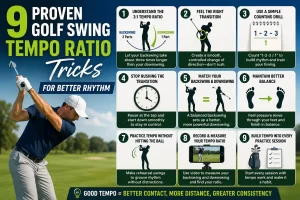
Watch a group of skilled golfers swing and you’ll quickly notice something interesting: no two golf swings look exactly alike. Some players use a long, flowing backswing, while others make a shorter, more compact move. Some swing aggressively, while others appear almost effortless. Yet all of these different swing styles can produce excellent golf shots when one important element remains consistent—timing.
That’s where your golf swing tempo ratio becomes important.
Golf swing tempo ratio describes the relationship between the amount of time it takes to complete your backswing and the amount of time it takes to move from the top of the swing to impact. Instead of focusing solely on how fast you swing the club, the golf tempo ratio looks at how the different parts of your swing work together.
One of the most commonly discussed benchmarks is a 3:1 golf swing tempo ratio. In simple terms, this means the backswing takes approximately three times as long as the downswing. For example, if your backswing takes 0.75 seconds and your downswing takes 0.25 seconds, you have a 3:1 ratio.
Why does this matter?
Your tempo influences nearly everything that happens during the golf swing. Consistent timing can produce better golf swing rhythm, helping the backswing, transition, and downswing flow together instead of feeling like separate movements. Better rhythm can also make it easier to return the clubface to the ball consistently, improving contact and clubface control.
Tempo also plays an important role in golf swing balance. When golfers suddenly rush the downswing, their body can move out of sequence, causing poor weight transfer, inconsistent contact, and unpredictable shots. A controlled golf swing transition gives the body and club more opportunity to work together, helping create better swing consistency.
However, improving tempo doesn’t mean you should simply try to swing slower.
A slow swing isn’t automatically a smooth golf swing. In fact, deliberately slowing your movements too much can interfere with your natural athletic motion and make your golf swing mechanics feel forced. The goal is to develop a repeatable relationship between your backswing and downswing while maintaining natural acceleration through the ball.
So, what is the ideal golf swing tempo ratio for your game, and how can you develop it?
In the nine tricks below, you’ll learn how to understand the 3:1 ratio, discover your natural rhythm, improve your transition, develop better balance, measure your tempo, and build consistent timing into every practice session. Most importantly, you’ll learn how to improve your golf swing tempo ratio without sacrificing speed or turning your swing into a mechanical counting exercise.
7 Ultimate Golf Swing Tempo for Beginners Tips to Master
What Is the Ideal Golf Swing Tempo Ratio?
The golf swing tempo ratio is the relationship between how long your backswing takes and how long your downswing takes. Rather than measuring how fast the clubhead is traveling, the golf tempo ratio measures the timing between these two major parts of the swing.
One of the most widely discussed ratios in golf is 3:1. This means the backswing takes approximately three times as long as the downswing.
For example, imagine your backswing takes 0.75 seconds from the beginning of the takeaway until you reach the top. If your downswing takes approximately 0.25 seconds from the top to impact, your golf swing tempo ratio would be 3:1.
This provides a useful answer to the common question, what is the ideal golf swing tempo ratio? For many full swings, 3:1 can be an excellent benchmark to experiment with because it encourages a controlled backswing followed by an athletic acceleration toward impact.
However, 3:1 shouldn’t be treated as a rigid rule.
Every golfer has slightly different golf swing mechanics, flexibility, backswing length, transition patterns, and natural movement. The goal isn’t to force your swing into an exact mathematical formula. Instead, use the ratio as a reference point for developing repeatable golf swing rhythm and better swing consistency.
Two golfers can also have dramatically different-looking swings while maintaining similar tempo ratios. One golfer might complete the entire swing quickly, while another uses a more deliberate motion. If the relationship between their backswing and downswing remains similar, both can produce smooth, well-timed swings.
Natural athletic movement is the key. Think of throwing a ball: you don’t slowly move your arm backward and then consciously calculate when to accelerate forward. The motion develops through rhythm, sequencing, and acceleration. Your golf swing should have that same athletic quality.
Golf Swing Tempo vs. Golf Swing Speed
Golf swing tempo and golf swing speed are often confused, but they’re not the same thing.
Swing speed generally describes how fast the clubhead is moving, particularly through impact. Swing tempo, on the other hand, describes the timing and rhythm of the overall motion.
That’s why simply telling yourself to “swing slower” isn’t necessarily the answer when learning how to improve golf swing tempo ratio.
Slowing every part of the swing can actually hurt your natural rhythm. An excessively slow backswing may create tension, disrupt sequencing, or cause you to suddenly accelerate during the golf swing transition. Instead of producing a smooth golf swing, you can end up with a slow takeaway followed by a rushed downswing.
A golfer can swing extremely fast while still displaying excellent tempo. Likewise, a golfer can have relatively low swing speed but poor rhythm.
The better goal is to develop a backswing and downswing that complement each other. When your tempo becomes repeatable, you’re more likely to maintain golf swing balance, control the clubface, and produce consistent contact.
So, rather than chasing an artificially slow swing, focus on developing a natural, athletic rhythm. A 3:1 golf swing tempo ratio gives you a useful starting point—but your ultimate objective is a tempo you can repeat confidently from swing to swing.
1. Learn the 3:1 Golf Swing Tempo Ratio
One of the easiest ways to develop better golf swing rhythm is to understand the relationship between your backswing and downswing. You don’t need complicated measurements or technical swing analysis to get started. The basic idea behind the 3:1 golf swing tempo ratio is surprisingly simple.
For every three units of time spent completing your backswing, approximately one unit of time is spent moving from the top of the swing to impact.
A simple way to feel this relationship is to use a counting drill. As you start your takeaway, count:
“One… two… three… GO.”
The first three counts represent the backswing, while “GO” represents the downswing toward impact. You aren’t trying to make each movement mechanically match a stopwatch. Instead, you’re teaching yourself to recognize the difference between a controlled backswing and a naturally faster downswing.
This is particularly useful for golfers who rush the golf swing transition.
When you reach the top and immediately attack the ball with your hands and upper body, your downswing can become too abrupt. Your sequencing may break down, your balance can suffer, and the clubface becomes more difficult to control. Instead of a smooth acceleration through the ball, the swing starts to feel like two disconnected movements.
That’s one reason improving your golf tempo ratio can produce better contact and swing consistency.
Understanding the 3:1 relationship also gives you a baseline. If you’re wondering how to find your golf swing tempo ratio, you can eventually use video to measure it more precisely. But before worrying about exact numbers, learn what a balanced backswing-to-downswing relationship feels like.
Think of 3:1 as a guide rather than a command. You don’t need to stand over every shot thinking about fractions and timing calculations. With enough repetition, the rhythm should become automatic.
Once that happens, your golf swing tempo ratio becomes less about counting and more about creating a repeatable athletic motion you can trust on the course.
2. Find Your Natural Golf Swing Rhythm First
While the 3:1 ratio provides a valuable benchmark, one of the biggest mistakes you can make is trying to perfectly copy another golfer’s tempo.
Every golfer moves differently.
Your flexibility, strength, backswing length, body rotation, transition, and overall golf swing mechanics influence how your swing feels. One golfer might naturally make a quick, compact swing, while another uses a longer, flowing motion. Both can produce excellent results if their timing remains consistent.
That’s why developing your natural golf swing rhythm should come before obsessing over exact numbers.
One of the easiest ways to discover that rhythm is by making practice swings without a golf ball. Notice how freely you move when there’s nothing to hit. Many golfers make beautifully balanced rehearsal swings but immediately become tense once a ball is placed in front of them.
Suddenly, they’re trying to hit the ball instead of simply swinging the club.
That tension can completely change your golf swing tempo ratio. Your grip tightens, your shoulders become tense, and the transition gets rushed. Instead of allowing the club to flow naturally, you start forcing different parts of the motion.
Compare several relaxed practice swings with several swings while hitting balls. Your goal is to make the two motions feel increasingly similar.
Signs you’re finding your natural rhythm include finishing in good golf swing balance, maintaining consistent timing from swing to swing, feeling less tension during the transition, and producing solid contact without feeling as though you’re forcing the club through impact.
A smooth golf swing doesn’t have to look slow. It should look coordinated.
You can still use the 3:1 ratio as your reference point without becoming robotic. Think of it as a framework that helps organize your natural movement rather than a strict formula you must reproduce perfectly.
As you learn how to improve golf swing tempo ratio, pay attention to the swings that feel effortless and produce your best contact. Those swings can reveal the rhythm your body naturally prefers.
Ultimately, the best tempo is one you can repeat. When your backswing, transition, and downswing begin working together naturally, you’ll develop better swing consistency without having to consciously control every movement.
3. Use a Simple Counting Drill to Control Your Tempo
One of the easiest ways to improve your golf swing tempo ratio is to use a simple counting drill. This gives your swing a clear rhythm without forcing you to think about too many mechanical positions at once.
A useful pattern is:
“1-2-3 / 1.”
The first three counts represent the backswing, while the final count represents the downswing. You are not trying to make the swing perfectly match a stopwatch. Instead, the drill helps you feel the difference between a controlled backswing and a faster, more athletic move toward impact.
Start without hitting a golf ball. Take your normal address position and make several relaxed practice swings. As the club moves away from the ball, count “1-2-3” during the backswing. Then say “1” as you begin the downswing and move through the imaginary impact position.
Do this slowly enough to recognize the rhythm, but avoid deliberately dragging the club back. The goal is to create a natural golf tempo ratio, not an artificially slow swing.
Once the movement feels comfortable, progress to half swings. Hit short shots while using the same counting pattern. Half swings are especially useful because they reduce the temptation to swing too hard and make it easier to concentrate on timing, balance, and contact.
After several solid half shots, move to full swings.
Try to keep the same overall rhythm even as your swing becomes longer and more powerful. The backswing should remain controlled, while the downswing accelerates naturally through impact. This is where the drill begins helping you develop better golf swing rhythm rather than simply teaching you how to count.
If you’re learning how to improve golf swing tempo ratio, repetition is extremely important. Perform the drill with several clubs and pay attention to whether the rhythm remains similar.
Over time, counting can improve swing consistency because it gives your body a repeatable timing pattern. Instead of making one slow swing, one rushed swing, and one aggressive swing, you begin producing movements that feel more predictable from shot to shot.
Eventually, you should no longer need to consciously count during every swing. The purpose of the drill is to train the rhythm until it becomes automatic. When that happens, your tempo becomes something you feel rather than something you calculate.
7 Golf Swing Tempo Consistency Secrets Most Golfers Never Discover
4. Stop Rushing the Golf Swing Transition
The golf swing transition is one of the most common places where good tempo breaks down.
The transition occurs as the backswing finishes and the downswing begins. It happens quickly, which is why many golfers don’t realize they’re rushing it. The club reaches the top and they immediately try to generate maximum speed with their hands, arms, and shoulders.
That aggressive move can destroy an otherwise solid golf swing tempo ratio.
When the upper body fires too quickly, proper sequencing becomes more difficult. The lower body, torso, arms, and club may stop working together, causing the downswing to feel rushed and disconnected.
Balance can also suffer. A golfer who attacks the downswing too aggressively may lunge toward the ball, fall toward the toes, or struggle to finish in a stable position.
Club path is another common casualty. When the transition becomes abrupt, the club can move outside the ideal path or become difficult to deliver consistently. That can lead to pulls, slices, weak contact, or inconsistent direction.
Most importantly, rushing the transition can hurt contact. When your body and club are no longer synchronized, finding the center of the clubface becomes much harder.
A controlled transition should not feel slow. It should feel smooth and athletic.
Imagine reaching the top of the backswing and allowing the change of direction to happen naturally rather than violently. There should be a sense that the lower body begins moving while the arms and club follow, creating a flowing sequence instead of an abrupt hit from the top.
A useful drill is the pause-at-the-top drill.
Make a backswing and briefly pause when you reach the top. Then start the downswing smoothly and hit the ball. The pause can feel exaggerated at first, but that is intentional. It teaches you to recognize how often you normally rush the transition.
After several repetitions, gradually shorten the pause until it disappears. Try to keep the same controlled feeling even during your normal swing.
This drill can help improve golf swing balance, sequencing, club path, and overall swing consistency. More importantly, it helps you understand that creating a better golf swing tempo ratio isn’t about slowing everything down. It’s about eliminating unnecessary rushing so your backswing and downswing can work together with better rhythm.
If your golf swing tempo ratio still feels inconsistent even after working on your rhythm, the problem may be somewhere else in your swing. Small mistakes in your setup, balance, sequencing, or transition can quietly throw off your timing without you realizing it. Fixing the underlying cause can make developing a repeatable swing much easier fix it here
5. Match Your Backswing and Downswing Timing
Developing a consistent golf swing tempo ratio requires your backswing and downswing to work together. If one part becomes unusually long, short, slow, or rushed, the timing of the entire swing can change.
Backswing length plays an important role in this relationship.
An overly long backswing can create additional moving parts and make it harder to begin the downswing consistently. Some golfers continue rotating or allow the club to travel farther after their body has completed its turn. This extra movement can make the golf swing transition more difficult to time and may encourage a sudden move back toward the ball.
An excessively short backswing can create the opposite problem. If you cut the backswing short but still want maximum distance, you may feel as though you have very little time to generate speed. The result can be an aggressive downswing that disrupts your golf swing rhythm.
The solution isn’t necessarily to make your backswing slower.
Artificially dragging the club away from the ball can make your swing feel mechanical and create unnecessary tension. Remember, a smooth golf swing doesn’t have to be a slow golf swing. Your backswing should feel controlled but athletic, allowing your body, arms, and club to move together naturally.
Think of your backswing as preparing the motion and your downswing as releasing the speed you’ve created.
As the backswing reaches completion, the change of direction should flow naturally into the downswing. From there, the club can accelerate toward impact without feeling as though you’re suddenly trying to manufacture speed with your hands.
This relationship is at the heart of a good golf tempo ratio.
If you’re learning how to improve golf swing tempo ratio, experiment with making several swings at different overall speeds while maintaining the same basic rhythm. You may discover that you can swing faster without feeling rushed because the relationship between your backswing and downswing remains consistent.
That’s ultimately what you’re trying to achieve: not identical swing speeds, but predictable timing.
When the backswing properly prepares the downswing, your golf swing mechanics can work more naturally. You’ll have a better opportunity to maintain sequencing, balance, and clubface control while accelerating through the ball.
Matching these two phases can help transform a swing that feels rushed and disconnected into one athletic motion. And when that motion becomes repeatable, maintaining a consistent golf swing tempo ratio becomes much easier.
6. Maintain Better Golf Swing Balance
Your balance can tell you a lot about the quality of your golf swing tempo ratio.
When timing is under control, your body has a better opportunity to move through the swing in sequence. When the swing becomes rushed, however, your body may struggle to keep up with the club. That’s why poor golf swing balance can be one of the easiest warning signs that your tempo needs attention.
Pay particular attention to what happens through your feet.
During a well-balanced swing, pressure moves naturally as your body turns and changes direction. You should feel connected to the ground rather than falling toward your toes, rocking excessively onto your heels, or making a sudden lunge toward the target.
You don’t need to consciously control every pressure shift. Instead, use your feet as feedback.
If you’re repeatedly stumbling after impact or struggling to maintain your finish, ask yourself whether you’re rushing the downswing. An aggressive transition can cause the upper body to move too quickly, changing your sequencing and making it difficult to maintain your center of balance.
A simple exercise can expose this problem immediately.
Try the hold your finish drill.
Hit a normal shot and, after impact, hold your finish for approximately three seconds. Don’t immediately step away or reach for another ball. Stay in your finishing position and notice how stable you feel.
Ideally, you should finish with your body rotated toward the target, most of your pressure supported by the lead side, and enough stability to comfortably hold the position.
If you’re falling forward, backward, or sideways after nearly every shot, something earlier in the swing may be disrupting your balance.
Now make several swings at about 70–80% effort while focusing on golf swing rhythm rather than distance. Hold each finish. Once you can consistently maintain your balance, gradually increase your speed while preserving the same rhythmic feeling.
This exercise is particularly valuable when learning how to improve golf swing tempo ratio because balance gives you immediate feedback without requiring complicated technology.
You may even notice a pattern: your worst-balanced swings are often the ones where you rush the golf swing transition.
Better balance doesn’t mean standing rigidly throughout the swing. Golf is an athletic movement, and your body should rotate and transfer pressure dynamically. The goal is controlled movement.
When your timing, pressure movement, and acceleration work together, maintaining a consistent golf tempo ratio becomes easier. You’ll also give yourself a better chance of producing solid contact, improved clubface control, and greater swing consistency from one shot to the next.
7. Practice Your Tempo Without Hitting Golf Balls
One of the simplest ways to improve your golf swing tempo ratio is to practice your swing without hitting a golf ball.
That might sound too easy, but removing the ball removes one of the biggest distractions golfers face: worrying about the result.
When there’s a ball in front of you, it’s natural to start thinking about distance, direction, contact, and ball flight. You may suddenly try to hit the ball harder or steer the clubface toward the target. Those reactions can change your golf swing rhythm and make it difficult to determine what your natural tempo actually feels like.
Rehearsal swings allow you to isolate timing.
Start by making five relaxed practice swings without a ball. Don’t worry about specific positions or complicated golf swing mechanics. Instead, pay attention to the relationship between your backswing, transition, and downswing.
After five swings, rest briefly and repeat another set.
You can also experiment with different perceived speeds. Make five swings at approximately 50% effort, five at 70%, and five at what feels like your normal playing speed. The important part is trying to maintain a similar golf tempo ratio even though the overall speed of the motion changes.
This exercise teaches an important lesson: good tempo doesn’t require one specific swing speed.
You can make a faster swing while maintaining smooth rhythm, or a slower swing without disrupting the relationship between your backswing and downswing. Through repetition, your body begins recognizing the timing pattern without requiring constant conscious thought.
That’s how you develop feel.
Once your rehearsal swings become comfortable, place a ball down and try to reproduce the same motion. Begin with a few easy shots rather than immediately trying to hit your driver as far as possible. Alternate between one rehearsal swing and one actual shot.
If the practice swing feels smooth but the actual shot feels rushed, the ball may be causing you to change your motion.
Continue alternating until the two swings begin feeling similar.
This type of practice can help your golf swing mechanics become more repeatable because you’re learning to move through positions with consistent timing rather than forcing individual movements.
Ultimately, improved swing consistency comes from repeating a motion your body recognizes. Practicing without a ball gives you an opportunity to develop that motion before introducing concerns about contact and ball flight.
Best Golf Training Program For Beginners: Why Most Golfers Never Improve
8. Record Your Swing to Measure Your Tempo Ratio
Once you understand what good tempo feels like, you can take the next step and actually measure your golf swing tempo ratio.
If you’ve wondered how to find your golf swing tempo ratio, you don’t necessarily need expensive swing-analysis equipment. A smartphone capable of recording video can give you useful information.
Position your phone where the entire swing is visible and record several normal shots. If your phone offers slow-motion recording, use it. Slow-motion footage makes identifying key points in the swing much easier.
You need to locate three moments:
Start of takeaway: when the club first begins moving away from the ball.
Top of backswing: when the backswing ends and the club begins changing direction.
Impact: when the clubface contacts the golf ball.
The time between the start of the takeaway and the top represents your backswing duration. The time between the top and impact represents your downswing duration.
You can measure these periods using video timestamps or count frames if your video software allows frame-by-frame playback.
Don’t judge your golf tempo ratio from a single swing. Record several shots and compare them. Ideally, measure some good shots and some poor shots.
You may discover that your best swings consistently produce a similar timing pattern, while your worst shots occur when your golf swing transition becomes noticeably faster or your backswing timing changes.
That information can be extremely valuable because it connects feel with measurable evidence.
How to Calculate Your Golf Swing Tempo Ratio
Once you have your backswing and downswing times, calculating the ratio is straightforward:
Backswing Time ÷ Downswing Time = Tempo Ratio
Suppose your measurements are:
Backswing: 0.75 seconds
Downswing: 0.25 seconds
Divide the backswing time by the downswing time:
0.75 ÷ 0.25 = 3.0
That gives you a golf swing tempo ratio of 3:1.
You can perform the same calculation using video frames. For example, if the backswing takes three times as many frames as the downswing, you’re approximately at a 3:1 ratio.
However, don’t become obsessed with achieving exactly 3.00 on every swing. The purpose of measuring tempo is to identify patterns and establish a useful baseline.
Record multiple swings over several practice sessions. Look for the golf swing rhythm associated with your most balanced, solidly struck shots.
Video can also help you answer a more important question than whether your ratio is mathematically perfect: Is your tempo consistent?
If your ratio changes dramatically from one swing to another, improving that consistency may help your contact, balance, clubface control, and overall performance.
By combining video feedback with the feel you’ve developed through rehearsal swings, you’ll have a much clearer understanding of how to improve golf swing tempo ratio and build timing you can repeat on the course.
There’s nothing more frustrating than hitting one beautiful shot followed by two you can’t explain. When your tempo, transition, and mechanics aren’t working together, adding more practice can sometimes mean repeating the same mistakes more often. Instead of endlessly searching for another quick fix, use a system designed to help you build a more dependable golf swing. Start Building a More Consistent Golf Swing →
9. Build Your Ideal Tempo Into Every Practice Session
Improving your golf swing tempo ratio isn’t something you should work on once and then forget. Like balance, alignment, or ball striking, tempo becomes more reliable through repetition.
The goal is to make your preferred golf swing rhythm so familiar that you can reproduce it without consciously thinking about every part of the swing. One of the best ways to accomplish this is to include a short tempo routine at the beginning of every practice session.
Start with five to ten rehearsal swings without a golf ball.
Focus on making relaxed, athletic movements while feeling the relationship between your backswing and downswing. You can use the simple “1-2-3 / 1” count from earlier if necessary. Pay particular attention to making a smooth golf swing transition instead of aggressively attacking the downswing.
Next, move to wedges or another short club.
Hit several easy shots at roughly 50–70% effort. Don’t worry about maximizing distance. Your objective is solid contact, good golf swing balance, and repeatable timing. Try to finish every swing in control.
Once your rhythm feels comfortable, progress to your mid-irons.
This is where you can gradually increase speed while trying to maintain the same basic golf tempo ratio. Your 7-iron swing will obviously feel different from a short wedge shot, but the overall relationship between the backswing, transition, and downswing should remain recognizable.
Finally, move to your driver.
The driver is where many golfers abandon their normal rhythm because they want maximum distance. Instead of suddenly swinging as hard as possible, try to preserve the timing you established with your shorter clubs. You can increase clubhead speed while still maintaining a smooth, athletic motion.
Practicing this way helps create better swing consistency throughout your entire set.
Tempo can also become a valuable reset whenever your golf swing mechanics start breaking down.
If you suddenly begin hitting poor shots during a practice session, resist the temptation to immediately make five different mechanical adjustments. Step away from the ball and make three or four relaxed rehearsal swings. Focus entirely on rhythm, balance, and transition.
Then hit another shot while recreating that feeling.
Sometimes what appears to be a mechanical problem begins with a timing problem. If your transition becomes rushed, for example, your sequencing, club path, balance, and contact can all change. Restoring your normal tempo may allow several other parts of the swing to fall back into place naturally.
Most importantly, keep repeating the process.
Learning how to improve golf swing tempo ratio isn’t about discovering one magical drill. It’s about developing a movement pattern your body recognizes and trusts.
Include a few minutes of tempo work in every practice session. Rehearse your rhythm, progress gradually through your clubs, and return to tempo whenever your swing starts feeling rushed or disconnected.
Over time, you should need fewer conscious thoughts about timing. Your golf swing tempo ratio begins to feel automatic—and that repeatable rhythm can become one of the most dependable parts of your golf swing.
How to Improve Golf Swing Tempo Ratio Without Swinging Slower
One of the biggest misconceptions about tempo is that a smoother golf swing must also be a slower golf swing. If you’re learning how to improve golf swing tempo ratio, deliberately slowing everything down may actually create more problems than it solves.
Smooth doesn’t necessarily mean slow.
A golfer can make a fast, powerful swing while maintaining excellent golf swing rhythm. What makes the swing look smooth is how well the backswing, transition, and downswing flow together—not how slowly the club moves.
The goal is controlled acceleration.
During the backswing, the club should move naturally as your body turns and prepares for the change of direction. Once the downswing begins, speed should build through the hitting area. You don’t want to eliminate acceleration in an attempt to maintain your golf swing tempo ratio. Instead, you want that acceleration to occur naturally within a repeatable sequence.
Tension is one of the biggest obstacles.
When golfers try to generate extra distance, they often squeeze the grip harder, tighten their shoulders, and tense their arms. This can turn an otherwise athletic motion into a series of jerky movements. The backswing may become restricted, followed by an aggressive golf swing transition as the golfer attempts to create speed.
Pay particular attention to grip pressure. You need enough pressure to maintain control of the club, but squeezing excessively can create unnecessary tension throughout your hands, wrists, forearms, and even shoulders.
Try making several practice swings while consciously reducing unnecessary tension. Allow your arms to feel relaxed and your body to rotate naturally. You may be surprised by how much speed you can generate without feeling as though you’re swinging harder.
Good sequencing is another major part of learning how to improve golf swing tempo ratio.
Instead of consciously manipulating how fast each part of the swing moves, focus on allowing the movements to happen in the correct order. Your backswing prepares the motion, your transition changes direction, and your downswing builds speed toward impact.
When these movements work together, your golf tempo ratio can improve without sacrificing athleticism.
Think about throwing a ball. You wouldn’t intentionally perform the throwing motion in slow motion to make it smoother. You would allow the body, arm, and hand to work together while gradually producing speed. The golf swing operates on a similar principle.
The objective isn’t to remove speed—it’s to remove unnecessary rushing.
A golfer who develops better sequencing, relaxed grip pressure, controlled body tension, and a smoother transition can maintain plenty of clubhead speed while producing better golf swing balance and swing consistency.
That’s the difference between swinging slowly and swinging smoothly. A strong golf swing tempo ratio allows you to remain athletic and aggressive through impact without letting that aggression destroy your rhythm.
Common Golf Swing Tempo Ratio Mistakes
Understanding your golf swing tempo ratio is only part of developing better rhythm. You also need to recognize the habits that can disrupt your timing. Many golfers unknowingly create tempo problems while trying to improve their swings.
Trying to Swing Too Slowly
A common mistake is assuming that better golf swing rhythm means making every part of the swing slower.
An excessively slow backswing can interfere with natural athletic sequencing. Instead of allowing your body, arms, and club to move together, you may begin consciously guiding the club into different positions. This can create tension and make the golf swing transition feel less natural.
The goal is not slow movement. It’s coordinated movement.
Rushing From the Top
The opposite problem occurs when golfers reach the top and immediately attack the downswing.
An aggressive transition can dramatically change your golf tempo ratio because the downswing suddenly becomes much quicker relative to the backswing. Your shoulders and arms may fire before the rest of the body is ready, disrupting sequencing, club path, balance, and contact.
Try to feel a smooth change of direction followed by natural acceleration rather than maximum effort immediately from the top.
Obsessing Over Exactly 3:1
While 3:1 provides a useful benchmark when learning how to improve golf swing tempo ratio, don’t turn it into a mathematical requirement for every shot.
Constantly thinking about achieving exactly 3:1 can create tension and make your swing feel robotic.
Use the ratio to understand your timing and identify patterns. Your primary goal should be developing repeatable rhythm—not producing a perfect number after every swing.
Changing Tempo After a Bad Shot
One poor shot doesn’t necessarily mean your tempo is wrong.
Golfers often react to a bad shot by immediately swinging slower, faster, shorter, or harder. Those constant adjustments make swing consistency even more difficult.
Instead, return to the rhythm you’ve established during practice. Make a relaxed rehearsal swing, regain your balance, and trust your normal motion.
Practicing Mechanics Without Practicing Rhythm
Technical positions certainly matter, but good golf swing mechanics alone don’t guarantee good shots.
You could achieve excellent positions during a slow-motion rehearsal and still struggle when hitting a ball if those positions don’t connect through proper sequencing and timing.
That’s why tempo should be included alongside mechanical practice.
If you’re working on your takeaway, backswing, transition, or impact position, eventually perform that movement at normal playing speed. Learn how the new mechanical change fits within your natural golf swing rhythm.
The best swings combine mechanics with timing. When your positions, sequencing, balance, and golf swing tempo ratio work together, you have a much better chance of repeating the motion when it matters.
How Golf Swing Tempo Ratio Changes With Different Clubs
Your golf swing won’t feel exactly the same with a wedge as it does with a driver. Club length, swing length, shot type, and the amount of speed you’re trying to generate can all influence how the motion feels.
However, that doesn’t mean your golf swing tempo ratio needs to change dramatically every time you select a different club.
With wedges and shorter irons, your swing may naturally feel shorter and more controlled. Because you’re often prioritizing distance control and solid contact instead of maximum speed, the overall swing can feel more compact.
Move into your mid-irons and the swing becomes longer. With a 6- or 7-iron, for example, you may make a fuller body turn and generate more speed while still maintaining recognizable golf swing rhythm.
The driver can create the biggest challenge.
Because golfers know the driver is designed for distance, there’s a natural temptation to swing harder. That can cause the backswing to become longer and the golf swing transition to become more aggressive. Suddenly, the rhythm you’ve maintained with every other club disappears.
Instead, try carrying the same general rhythmic feeling through the bag.
This doesn’t mean every swing must take exactly the same amount of time. A partial wedge shot and full driver swing involve different movements. What’s important is maintaining a repeatable relationship between the backswing and downswing.
Think of your golf tempo ratio as a rhythm rather than an exact clock time.
When practicing, hit several wedges before progressing through your irons and eventually reaching the driver. Pay attention to whether your transition becomes noticeably more aggressive as the clubs get longer.
If it does, make a few rehearsal swings and restore your normal rhythm.
Maintaining recognizable timing across different clubs can improve golf swing balance, contact, and swing consistency because you’re not creating an entirely different motion every time you change clubs.
This is another reason why understanding what is the ideal golf swing tempo ratio should be viewed as finding a repeatable benchmark rather than chasing a perfect number.
Whether you’re hitting a controlled iron or an aggressive driver, your swing can remain athletic and powerful while still maintaining smooth, dependable timing.
Tempo: The Cornerstone of a Great Golf Swing https://practical-golf.com/swing-tempo
Final Thoughts on Finding Your Best Golf Swing Tempo Ratio
Developing a better golf swing tempo ratio isn’t about forcing yourself to swing slowly or trying to make every swing look identical. It’s about creating a repeatable rhythm that allows your backswing, transition, and downswing to work together naturally.
For many golfers, the commonly discussed 3:1 golf tempo ratio provides an excellent starting point. Thinking of the backswing as taking roughly three times as long as the downswing can help you recognize when you’re rushing the transition or disrupting your natural timing.
But don’t become obsessed with producing exactly 3:1 on every swing.
Your individual golf swing mechanics, flexibility, backswing length, speed, and natural movement patterns can influence your ideal tempo. What’s more important is finding a rhythm you can reproduce consistently—especially when you’re on the course and facing a difficult shot.
Remember that tempo doesn’t operate independently from the rest of your swing.
Your golf swing transition, sequencing, balance, clubface control, and overall mechanics all influence one another. When your timing becomes rushed, several of these elements can break down at the same time. When your rhythm improves, the entire motion can begin feeling smoother and more coordinated.
That’s why consistency should always be the goal rather than perfection.
Use rehearsal swings, counting drills, video analysis, balance exercises, and regular tempo practice to discover what works best for you. Once you find a comfortable golf swing rhythm, repeat it often enough that it becomes something you can trust instead of something you have to consciously manufacture.
And if inconsistent tempo is only one part of what’s holding your golf swing back, improving your entire swing as a connected system can make an even bigger difference.
The Golf Swing Lab is designed to help golfers improve the fundamentals that contribute to better ball striking, accuracy, consistency, tempo, balance, and overall swing performance. Instead of endlessly guessing which part of your swing needs fixing, you can follow a structured approach to building a more dependable golf swing.
Ready to stop guessing and start building a swing you can trust? [Discover The Golf Swing Lab and start improving your golf swing today.]
Ultimately, the best golf swing tempo ratio isn’t simply the one that produces the perfect number on a video analysis. It’s the rhythm that helps you make a smooth golf swing, strike the ball solidly, maintain your balance, and repeat the motion when it matters most.
Frequently Asked Questions About Golf Swing Tempo Ratio
Understanding your golf swing tempo ratio can make it easier to identify why some swings feel smooth and controlled while others feel rushed or disconnected. Here are answers to some of the most common questions golfers have about tempo and rhythm.
What Is a Good Golf Swing Tempo Ratio?
A commonly discussed golf swing tempo ratio for a full swing is approximately 3:1. This means the backswing takes roughly three times as long as the downswing from the top to impact.
However, a good tempo is ultimately one you can repeat consistently. Instead of chasing an exact number, focus on developing a predictable relationship between your backswing, transition, and downswing.
Is a 3:1 Golf Swing Tempo Ratio Ideal?
If you’re wondering what is the ideal golf swing tempo ratio, 3:1 can be a useful starting benchmark for full swings. It encourages a controlled backswing followed by a naturally faster downswing.
That doesn’t mean every golfer needs to achieve exactly 3:1. Your swing length, athletic ability, and golf swing mechanics can influence your timing. Consistency and quality of contact are more important than achieving a mathematically perfect ratio.
How Do I Find My Golf Swing Tempo Ratio?
One simple method for how to find your golf swing tempo ratio is recording your swing with a smartphone.
Measure the time from the beginning of your takeaway to the top of the backswing. Then measure the time from the top to impact. Divide the backswing duration by the downswing duration.
For example, a 0.75-second backswing and 0.25-second downswing produce a 3:1 ratio.
Record several swings so you’re measuring your normal tendencies rather than relying on a single shot.
Should My Driver and Iron Tempo Be the Same?
Your driver and iron swings don’t necessarily need to take exactly the same amount of time. Club length, backswing length, and the type of shot you’re playing can influence the overall motion.
However, maintaining a similar golf swing rhythm throughout your clubs can help improve swing consistency. Be particularly careful not to rush your driver simply because you’re trying to generate additional distance.
Can Golf Swing Tempo Improve Ball Striking?
Better tempo can contribute to improved ball striking by helping different parts of your swing work together more consistently.
A smoother golf swing transition can improve sequencing, balance, club delivery, and clubface control. When your timing becomes repeatable, you give yourself a better opportunity to return the club to impact consistently.
Tempo alone won’t fix every swing fault, but it can be an important part of developing more dependable contact.
How Can Beginners Practice Golf Swing Rhythm?
Beginners can start by making relaxed rehearsal swings without hitting golf balls. Try using a simple “1-2-3 / 1” count, with the first three counts representing the backswing and the final count representing the downswing.
Once that feels comfortable, progress to half swings with a wedge before moving to full swings.
Beginners learning how to improve golf swing tempo ratio should focus more on smooth movement, balance, and repeatability than speed. Avoid trying to hit every ball as hard as possible.
With regular practice, the counting should gradually become unnecessary. The ultimate goal is to develop a natural swing rhythm that produces a smooth golf swing without requiring constant conscious thought about timing.